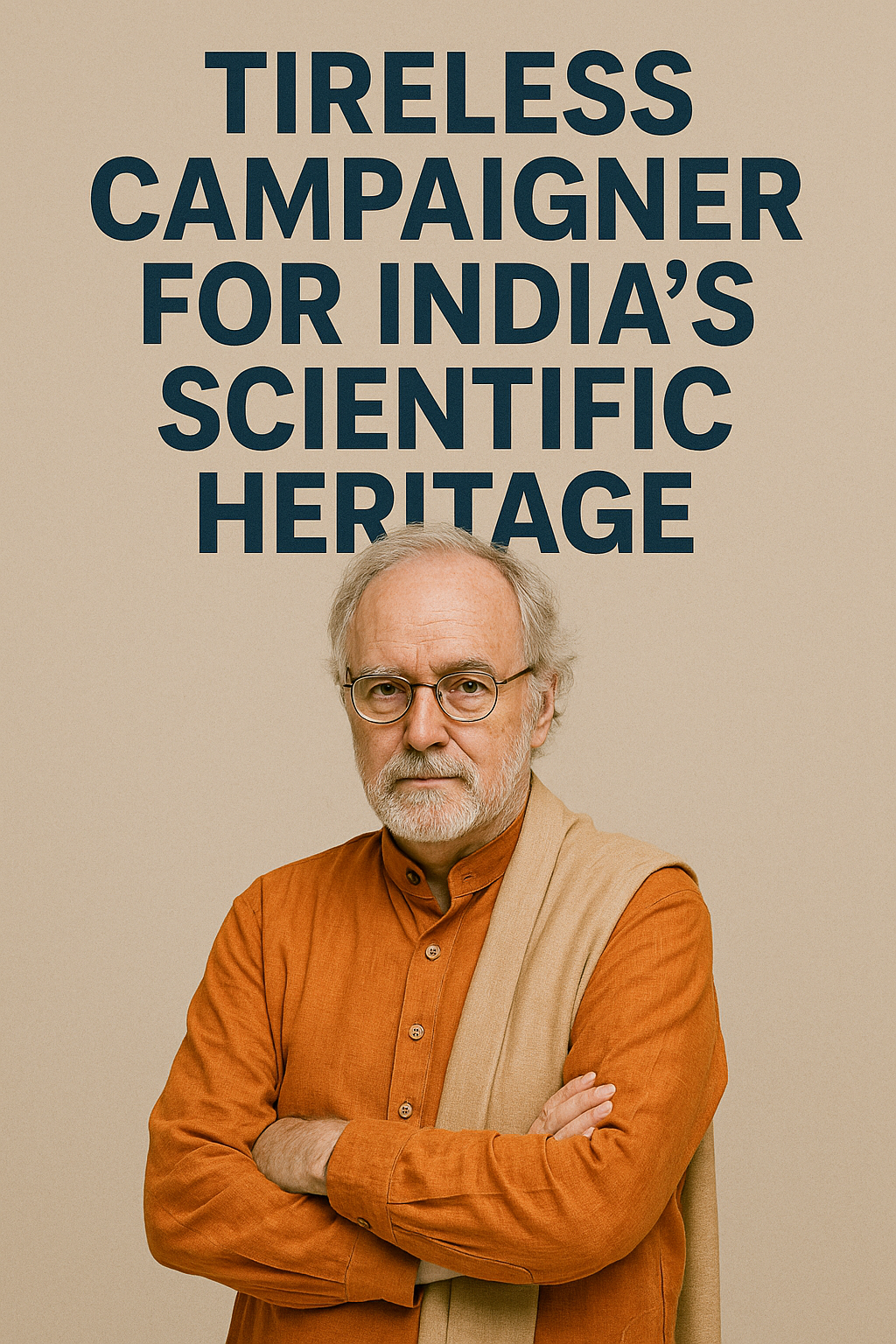

Dr. Laul Jadusingh
It would not be inaccurate to say that a crisis exists in contemporary Indian self-consciousness that is injurious to the collective self-esteem of India as a society at large and disempowering to the national will and self-confidence in multiple ways. This crisis is eminently amenable to an intellectual solution but requires a synergetic effort on a national and cultural scale that involves a re-evaluation of attitudes negligent of, ignorant of, and even deprecatory of the traditional knowledge systems of India, specifically those that pre-date the Muslim and British occupation and rule.
It is a great wonder that so much of our millennial intellectual heritage survives to the present, and this itself is proof of the vitality, relevance, and applicability of traditional knowledge originating in India and preserved there or abroad. However, the mere existence of this body of knowledge, and the practical methods and methodologies to perpetuate it, is insufficient in an atmosphere where traditional knowledge—broad in scope and comprehensive of all human concerns—is neglected and under-appreciated by large sectors of the Indian intelligentsia. This neglect is reflected at a policy level, especially in education, where Western paradigms, disciplines, and methods predominate, reducing much of our traditional knowledge to second-hand status.
The remediation of this requires vigorous efforts to be undertaken by practically all levels of Indian society, but especially in government policy to reform and re-vision the educational system. This reform must incorporate the traditional sciences, arts, and literature in a rigorous way, with emphasis on their contemporary applicability and relevance. In practically all fields—from psychology to medicine, from economics and politics to arts and literature, philosophy, and religion—abundant intellectual capital exists within Indian knowledge systems to encompass all human concerns. These systems have embedded within them practical methodologies that are being earnestly studied and exploited by non-Indians for enlightenment and profit, yet largely neglected by Indians.
It is patent that an attitudinal problem is largely responsible for this neglect. But this is not merely an issue of cultural pride or national self-consciousness; it is the potential loss of knowledge that is capable of uplifting Indian society through intellectual enlightenment, political sophistication, and practical solutions that can yield benefits on broad fronts within India and internationally.
Not unimportant is the potential economic benefit that may derive from the preservation, propagation, and research and development of products that should be valued as the common intellectual property of Indian society. Indians should beware lest their intellectual heritage primarily serves to enlighten and profit others. Some may object that it is illegitimate to assert intellectual property rights to knowledge that is of such universal scope and application, or that the survivability of traditional knowledge systems can best be facilitated by the rigorous academic disciplines developed in the West.
However, if the Indian intelligentsia cedes this trust to others, the irreparable loss will be for our culture, national self-esteem, and profit. Non-Indians have already marginalized Indians in the academic fields dealing with Indic studies in practically every area. Indians who object to whatever bias, distortions, and misrepresentations they perceive in the factual content, exegesis, evaluation, or methodology of Western academics are ignored or vilified, and whatever their learning or expertise might be in their traditional knowledge systems, their competence is questioned.
The ongoing and accelerating co-option of the discipline of hatha-yoga, and the certification of teachers by mostly non-Indians in the U.S.A. in particular, should be of concern to Indians who value their religious and cultural heritage. This phenomenon entails not merely intellectual loss but economic loss, as Indians seem willing to passively yield the teaching and practice of this discipline to others while doggedly pursuing Western disciplines, many of which are rapidly incorporating elements of yoga, meditation, and Indian philosophy. Ayurveda is another field where Indians are yielding both teaching and profit to others.
Beyond a campaign to preserve, propagate, and economically exploit for the national and cultural self-interest the traditional knowledge on its own terms, another more concerted intellectual effort is required in Indian academia and formulated in government policy. This effort entails the study of traditional knowledge systems with an emphasis on contemporary relevance, further research, and development.
The Philosophical Sophistication of Indic Thought: Yoga and Phenomenology
In the philosophical and ideological sphere, traditional Indian philosophy, for instance, having thoroughly debated the questions of evolutionism/creationism in terms remarkably parallel to the contemporary debate, can contribute much to the vexed and acrimonious dialogue between advocates of Darwinian evolutionary theory, the scientific orthodoxy, and a resurgent Christian fundamentalism insistent on the literal account of the creation myth of Genesis or the pseudo-scientific theory of Intelligent Design. These efforts are meant to reconcile the two views.
It is instructive that traditional Indian philosophies can offer well-developed theistic creationist accounts of the origin and destiny of the cosmos, as well as non-theistic accounts broadly evolutionist in character. The special virtue of the Indian systems in general is the formulation of evolutionist views which do not marginalize the role of consciousness, but rather advocate the primacy of consciousness while recognizing the circumscription of mind in embodiment.
The ancient and seminal Sankhya system is arguably a perfect model in this regard: pure abstract consciousness, self-illuminating and self-perceptive, is reflected in primordial nature composed of the equilibrium of the three basic properties of clarity-balance (sattva), motility (rajas), and inertia (tamas). Disturbing the equilibrium occasions the combination and permutations of atoms of the basic elements to produce conditions favorable for the evolution of organic and non-organic entities, including higher life forms of human and animal life. The pure consciousness is not essentially involved in matter, but its reflection therein is sufficient to produce a semblance of consciousness with the development of a highly organized hierarchy of mental and supramental faculties.
Another virtue of this view is that the three basic properties aforementioned are neither categorically material nor mental, thus avoiding the dichotomy of mind and matter fundamental to Western worldviews, scientific or otherwise. In the Sankhya system, intelligence (buddhi), mind (manas), and individuality (ahamkara) are integral aspects of nature, not epi-phenomenal. Evolution proceeds as long as the pure consciousness (purusha) is ignorant of its independence from nature (prakriti), but ceases for the individual purusha when recognition of its true nature as distinct from the mind-nature nexus takes place.
The Sankhya view affords some remarkable parallels to current scientific and empirical views, cosmological and evolutionary. It has its own version of the singularity principle in the involvement of purusha with prakriti, though this singularity is ontological rather than chronological. The pseudo-involvement of purusha with prakriti may also be construed as a version of the so-called anthropic principle, the contemporary cosmologist’s non-theistic substitute for a creator god. In common with all main Indian systems, Sankhya is stereological in orientation, i.e., it envisions the “summum bonum” as kaivalya, freedom from all limitations incurred by involvement with the body-mind, hence nature. Its ontology, epistemology, and psychology are broadly scientific or proto-scientific in analytical, empirical, and naturalistic orientation.
Broader Scope of Indic Philosophy
Though there are many intriguing parallels between Indic and Western systems of thought, it would be inaccurate and presumptuous to assert any complete isomorphism. While there are abstract and conceptual similarities, mainly in ontological and epistemological theory, there are significant divergences in goals, methodology, and pedagogy. Even systems such as the phenomenology of Husserl, which purport to have developed a comprehensive epistemology and ontology adequate to ground all knowledge and experience and rigorous enough to meet the empirical demands of experimental science, are lacking in an adequate praxis whereby their declared goal—achieving absolutely presuppositionless knowledge prior to conceptualization and verbalization—can be realized.
The decidedly intellectualistic orientation of contemporary Western philosophy, including phenomenology, precludes their investigative methodology from conducting penetrative analyses of sufficient depth to reveal the ground of essential being. This is the stated goal of Husserl’s phenomenology, namely, to reveal the ground of being in an unsynthetic act of consciousness called the primordial dator intuition. This is reminiscent of Dharmakirti’s definition of direct cognition (pratyaksha) as “kalpanaapodha-abhrantam-abhilapa-samsarga-ayogya-pratitih”, exclusive of conceptualization and incapable of coalescing with verbalization—the main difference being that Dharmakirti’s emphasis is more epistemological, while Husserl’s is more ontological.
The crucial difference between Western systems such as phenomenology and the Indic systems grounded in yoga is not that the former is mainly theoretical and philosophical, and the latter more mystical and pragmatic, as often asserted. The Indic systems have, in addition to adequate ontology and epistemology, a yoga practice by which the goal of omniscience and liberation—their main stereological goals—are realized. Rigorous logic and epistemology (pramana) are integral aspects of the Indic systems, but their aim is to transcend the intellect after exhaustive analyses, thereby realizing the very unsynthetic consciousness to which the phenomenologist aspires.
Many presuppositions hobble Western systems, rendering them incapable of transcending certain conceptual and methodological dilemmas, including: Judeo-Christian theological dogmas that insist on the incapacity of man to achieve omniscience and divinity; the dualism of matter and mind; and the Kantian denial that human knowledge can ever directly know the noumenon, the realm of essences, which is in principle unknowable and only indirectly intuitable.
The yogi’s presuppositions and goals are the inverse of these. For the yogi, true and objective knowledge can only be achieved in the transcendence of the subject-object dichotomy. The enlightened one can definitely realize omniscience and divinity, and all yogic practice is informed by this confidence. The phenomenologist program of phenomenological reduction—in three stages: epoch, eidetic reduction, and transcendental reduction—suspends the natural attitude and naive conventions of belief and perception to reveal the ground of being in a primordial dator intuition. This is roughly equivalent to the yoga’s three final stages (angas) of dharana, dhyana, and samadhi, wherein the object of meditation is revealed in its true objectivity, and the subject-seer manifests its naked awareness.
Whereas in yoga epistemology, the conclusion entailed by the coincidence, equivalence, and non-duality of subject and object is acceptable within its presuppositions, the phenomenologist followers of Husserl were reluctant to admit it as it verged on mysticism. In the yogic theory, by contrast, the only acceptable conclusion is that true objectivity is non-dual.
A Unified Theory of Knowledge Comports Well With Insights of Indic Thought
The trend in scientific epistemology is to arrive at a unified theory of knowledge. In practically all contemporary fields, this goal is either explicitly articulated or implicitly adumbrated. The prevailing scientific paradigm, informed by the Cartesian mind-body, observer-observed duality, is now universally acknowledged as inadequate and obsolete, incapable of accounting for the subtle material quantum realm as well as the varieties of consciousness.
Though challenged by discoveries in quantum theory and paradigm shifts such as the Heisenberg uncertainty principle, the Cartesian paradigm continues to be the fundamental operative assumption of scientific epistemology and positivist empiricism. Millennia in advance of these developments, Indian thought not only propounded a wide variety of atomic theories but also questioned the very validity of an indivisible atomic unit, favoring instead theories of probability and indeterminism, as in the Jaina tenet of syad-vada and anekatva-vada, and the Buddhist concepts of radical flux, insubstantiality, emptiness, and relativity (sunyata), multi-linear, reciprocal, and contingent causation (pratitya-samutpada).
The dialectical logic of Nagarjuna and his Madhyamaka successors, which exposed the dilemmas inherent in all theoretical constructs and thereby demonstrated the a priori relativity of all concepts and theories, was complemented by a critical theory of cognition formulated in the theory of three perceptual natures (tri-svabhava): the constructed (parikalpita), contingent-reciprocal (paratantra), and veridical (parinishpanna) of the Yogachara school of Vasubandhu and Asanga, providing a framework for a comprehensive epistemology.
A pivotal development with profound implications for ontology, epistemology, and pedagogy is the positing of two levels of truth: relative-conventional (samvritti) and ultimate (paramartha), an originally Buddhist concept adopted with varying degrees of explicitness by all stereologically oriented systems of India. As a pedagogical device (upaya), it facilitated targeted graduated discourse (anupurvika katha) directed to different mentalities, intellectual abilities, and aptitudes. As a principle of structural ontology, it provided the framework for the coincidence of ontological monism and epistemological relativism.
The traditional arts and literature, with its aesthetic theory of nine tastes/moods (navarasa/bhava), is another area in which traditional Indian knowledge systems arguably provide inspiration for a unifying aesthetic paradigm of universal applicability.
It is incumbent on Indian intellectuals to more stridently advocate the relevance, contemporaneity, and applicability of the holistic principles and ethos which preponderantly inform Indic thought in areas not exclusively religious or mystical, on an international scale. This is not merely possible but highly feasible, given the emerging global holistic paradigm, already influenced by Indic thought. In this way, Indic thought may reclaim the prominence it deserves, and the intellectual life of the world may be immeasurably enriched. The implication of these Indic concepts and their time-tested methodologies for an emerging holistic worldview should not be underestimated.
The coincidence of ideological, political, and economic factors favors a more proactive attitude; the historical and psychological moments have coalesced. There is an element of Manifest Destiny in this advocacy, but this is not foreign to our outlook or incompatible with our values. The recognition that our millennial culture and civilization has much to contribute to humanity is attested by the missionary initiatives of Ashoka and Vivekananda.
The contemporary nuance in this new advocacy must emphasize not merely the religious and mystical aspects of Indic thought, but also its rational and conceptual elements. Competent and articulate exponents should make the case that there is an essentially scientific approach in traditional knowledge systems encompassing philosophy and religion, arts and sciences. We should not be timid in asserting that our shastras employ broadly scientific methodologies.
Ideologically, however, Hindutva must not be narrowly construed: all our Dharmic traditions must be represented and integrated in order to thematically present the insights and intellectual achievements of Indian civilization effectively in a contemporary context.
In our pride of accomplishment, a bit of chauvinism may be unavoidable, but if we take to heart the excellent advice of the great Madhyamaka philosopher Chandrakirti, we are likely to maintain a balanced attitude:
“The intelligent person should accept whatever he sees as well explained from whatever source, by thinking of it as his own. Such truth does not abide exclusively with anyone, since it is equally objective for all, and since it is free from attachment and aversion, as sunlight, for instance, works impersonally for everyone with sight.” (Chatushataka 12, ad.k.300)
If this universalism and essentially scientific perspective informs our outlook, we are unlikely to falter.