
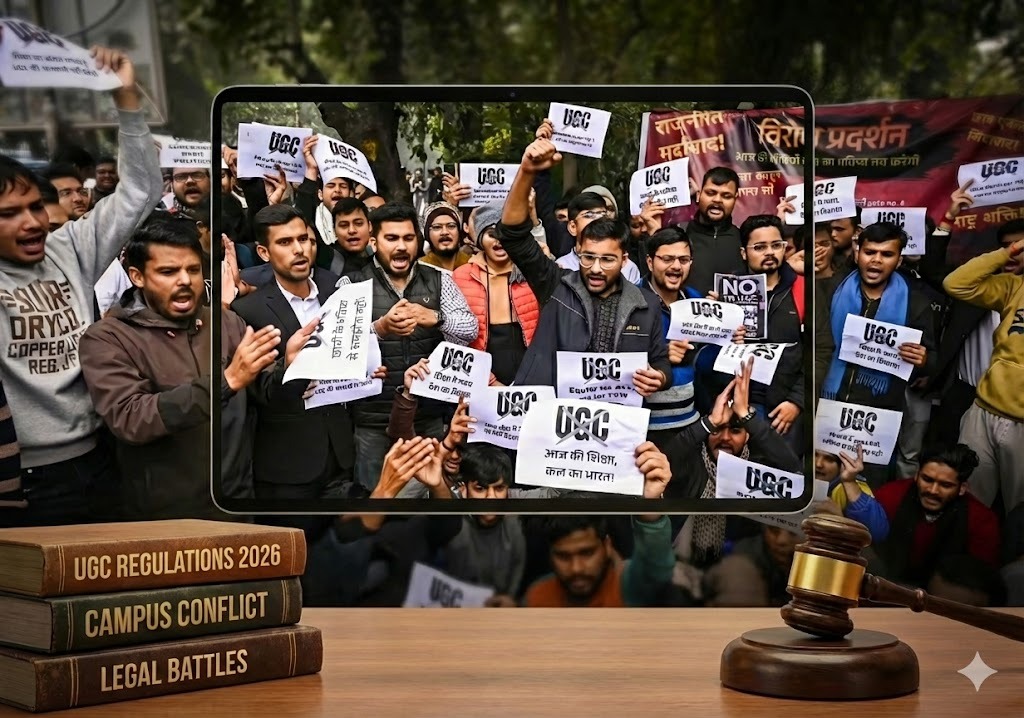
On 13 January 2026, the University Grants Commission (UGC) notified the UGC (Promotion of Equity in Higher Education Institutions) Regulations, 2026, replacing the earlier 2012 anti-discrimination guidelines. The new regulations mandated the establishment of Equal Opportunity Centres, Equity Committees, and structured grievance redress mechanisms in universities, with an explicit focus on preventing caste-based discrimination against Scheduled Castes (SCs), Scheduled Tribes (STs), and Other Backward Classes (OBCs).
Almost immediately, the notification triggered widespread controversy. By mid-January 2026, student groups and civil society organisations criticised the regulations for institutionalizing a selective definition of caste discrimination, arguing that the exclusion of unreserved categories violated principles of equality before law. Attention centred on Regulation 3(c), which opponents claimed was vague and susceptible to misuse. Regulation 3(c) defines caste-based discrimination expansively to include direct, indirect, structural, and implicit acts against SC, ST, and OBC students within higher education institutions, without clearly specifying evidentiary standards or procedural safeguards, thereby raising concerns about vagueness and potential misuse.
Between 20 and 25 January, demonstrations were reported at the UGC headquarters in New Delhi and across major university campuses, including Delhi University. Competing narratives emerged: while critics framed the regulations as an instance of administrative overreach, supporters defended them as essential tools to address entrenched caste hierarchies in higher education. Ironically, while the strongest critics of the UGC guidelines were right wing social media influencers, the supporters turned out to be from the BJP’s arch enemies – the Congress, the Samajwadi Party and other secular, pro-Ambedkarite groups.
Judicial intervention followed. On 29 January 2026, the Supreme Court of India stayed the implementation of the 2026 regulations, observing that the provisions appeared prima facie ambiguous and required closer constitutional scrutiny. The Court directed that the 2012 guidelines remain operative until further orders.
The stay intensified campus mobilisation. In early February 2026, students at Banaras Hindu University organised sit-ins demanding the reinstatement of the regulations, while organisations such as the Bhim Army and the Azad Samaj Party announced protests in cities including Lucknow and Bhopal. Supporters characterised the judicial stay as a setback to social justice, whereas opponents welcomed it as a corrective pause.
The Swarajya Magazine report, published on 27 January 2026, offers a critical appraisal of the UGC (Promotion of Equity in Higher Education Institutions) Regulations, 2026 and the role of the Ministry of Education in steering this contentious policy process. According to the report, the Ministry of Education and the UGC exhibited a major lapse of judgment in drafting and notifying the rules on 13 January 2026, failing to anticipate or address the legal and political backlash that ensued. The report characterises this episode as the most significant controversy confronting the education ministry since 2014, emphasizing the policy’s polarising impact and the perception that it lacks safeguards against misuse and protections for all categories of students.
The controversy surrounding the UGC (Promotion of Equity in Higher Education Institutions) Regulations, 2026, notified on 13 January 2026, reveals a fundamental policy and conceptual imbalance in the current approach to caste-based discrimination in Indian higher education. While the stated objective of the regulations is to address historical and structural discrimination, the framework restricts its protective ambit explicitly to Scheduled Castes (SCs), Scheduled Tribes (STs), and Other Backward Classes (OBCs), thereby excluding students from the general category from comparable grievance mechanisms.
By expanding the definition of discrimination to include implicit bias and structural disadvantage, while simultaneously failing to provide clear procedural safeguards, the regulations risk undermining principles of due process, institutional neutrality, and equality before law. The absence of protections against frivolous or malicious complaints has intensified concerns among students and faculty alike.
Official crime statistics compiled by the National Crime Records Bureau (NCRB) do not disaggregate crimes by caste for general category groups or specific castes such as Brahmins, which comprise a small minority (about 4% of the population). General category individuals are included in aggregate crime data but are not identified as a distinct victim group in NCRB releases, making specific atrocity statistics for Brahmins unavailable in official records.
By contrast, crimes and atrocities recorded against Scheduled Castes (SCs) are systematically published. The NCRB’s Crime in India 2023 report documented 57,789 cases of crimes against SCs in 2023, a modest increase from 57,582 in 2022, with Uttar Pradesh (15,130), Rajasthan (8,449) and Madhya Pradesh (8,232) reporting the highest counts; the crime rate was approximately 28.7 per 100,000 SC population. These cases include offences such as simple hurt, intimidation, rape, and offences under the SC/ST (Prevention of Atrocities) Act. Conviction and charge sheeting rates remain uneven across states, with many cases pending trial. Estimates from civil society analysis indicate that reported atrocities against SCs rose by around 19% over the last five years as measured against earlier datasets.
In the absence of equivalent official data on crimes against Brahmins or general category students, debates about discrimination must account for this asymmetry in official reporting and the lack of disaggregated data on non-SC/ST groups.
The UGC controversy reflects a deeper ideological drift within the BJP’s education policy, rooted in an uncritical attempt to co-opt Ambedkar and Ambedkarite discourse without engaging its philosophical limits. In pursuing an abstracted version of social justice under the slogan sabkā sāth, sabkā vikās, the party has substituted political symbolism for doctrinal clarity. This has produced policies leading to the alienization of the general category (GC) students who have historically formed the BJP’s most stable voter base. The result is a self-inflicted crisis: ideological dilution, administrative incoherence, and a growing perception of betrayal among core supporters. The same identity crisis and policy confusion is also seen in many of the BJP’s policies like the new NCERT textbooks where too they have tried to coopt left leaning scholars in the preparation of the new textbooks.
The experience of the RSS Thinkers’ Forum in earlier decades demonstrates the value of structured, internal deliberation within the broader Hindutva intellectual ecosystem. By convening economists, sociologists, constitutional scholars, educationists, and grassroots pracharaks, the forum historically enabled the RSS–BJP family to test policy ideas against civilisational principles, social realities, and long-term political consequences. This consultative mechanism helped prevent abrupt doctrinal shifts and ensured that governance choices retained ideological coherence.
The present disquiet surrounding higher-education policy underscores the costs of abandoning such deliberative traditions. Reviving a Thinkers’ Forum which would be plural, rigorous, and insulated from short-term optics would allow the BJP to recalibrate its approach to Hindutva, social justice, and other critical issues without alienating core constituencies. More importantly, it would help rebuild the party’s ideological moat by restoring confidence that policy emerges from dialogue within the Hindutva fold rather than reactive accommodation or symbolic politics.