“History is what everybody has agreed upon”
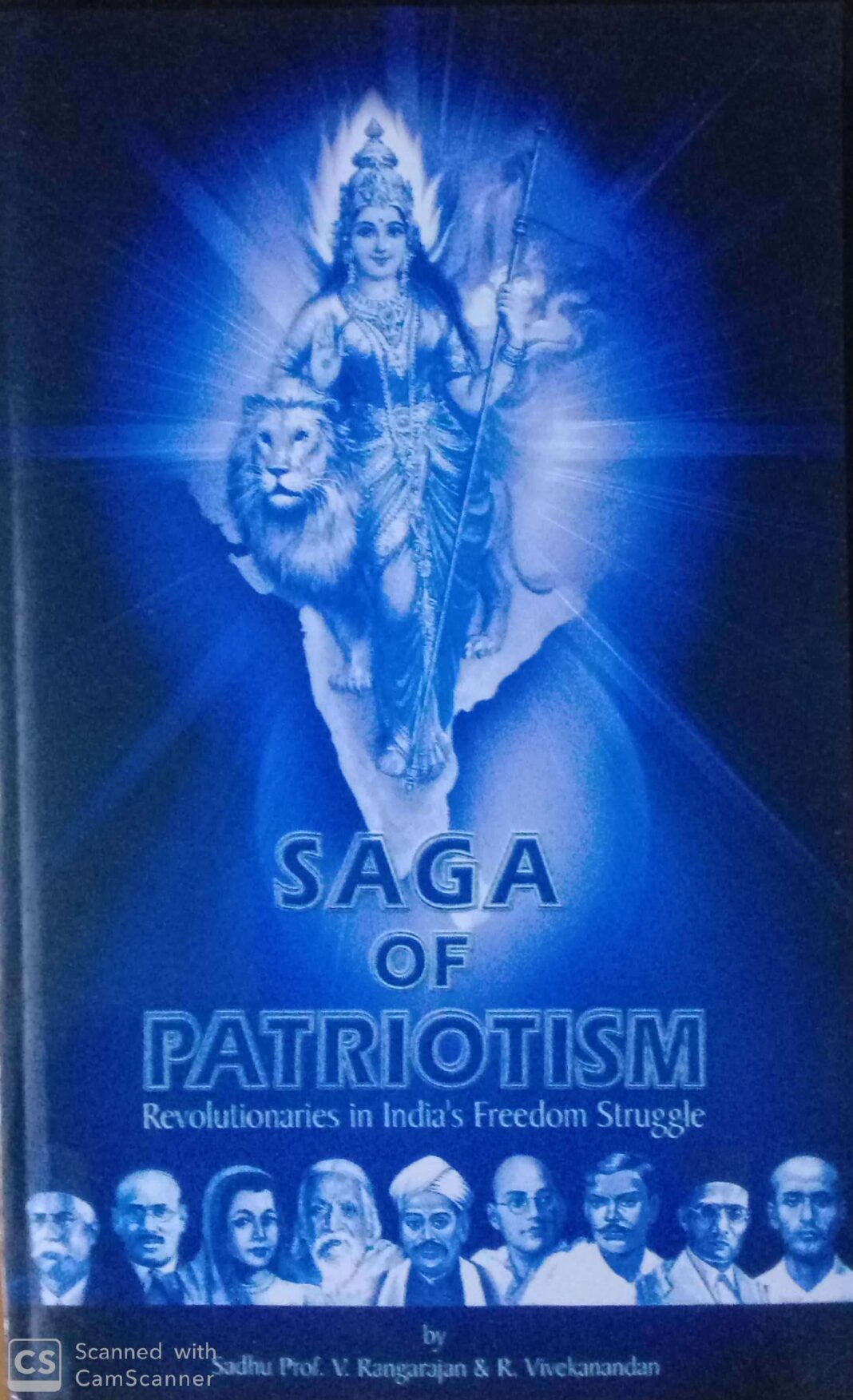
This book by Sadhu Prof. V. Rangarajan and Shri R. Vivekanandan is a fitting answer to the pseudo-liberal, left-leaning historians who often exaggerate the role of the communists in India’s freedom struggle.
It gives us glimpses of the life of great patriots, whose names have probably not figured in any of our history textbooks. It brings to light the immense contributions made by seemingly lesser-known revolutionaries like VOC Pillai, Madan Lal Dhingra, Bismil, Udham Singh, etc.
The account on each patriot is like a string of Rudraksha beads, so precious in content. And yet sometimes the string seems to be missing—some of the essays lack continuity and coherence. It is, of course, accepted that the authors never probably wanted to write full life accounts and just wanted to highlight the impact of their sacrifices.
This book will no doubt inspire the younger generation and sensitize them to lesser-known historical realities which official textbooks do not reveal, such as the failure of the Non-Cooperation Movement and the grand efforts of the Indian National Army.
Hopefully, this will serve as a springboard for them to question the lies and distortions fed to them from school. A more elaborate account of the lives of these patriots would be a fitting sequel to this book. The authors could also make efforts to introduce this kind of book into the curriculum of our schools.
Jai Hind!
Prashant R. Nair,
Amrita Vishwa Vidyapeetham, Coimbatore
E-mail: r_prashant@amrita.edu
Authors: Sadhu Prof. V. Rangarajan & R. Vivekanandan
Publisher: Sister Nivedita Academy, “Shri Bharati Mandir”,
Srinivasanagar, Kithaganur Road, Krishnarajapuram, BANGALORE – 560 036
Tel / Fax: 91 – 80 – 25610935
Email: sadhurangarajan@vsnl.com, sadhu@md4.vsnl.net.in
Journey of Jeevatma
This is a simple, concise, and lucid exposition of the foundations of Indian spirituality, with particular reference to the Bhagavad Gita and the four paths: Action (Karma Yoga), Devotion (Bhakti Yoga), Knowledge (Jnana Yoga), Meditation & Realisation (Raja Yoga).
Part 1 of the book on ‘Consciousness’ is a logical inquiry into the nature of the cosmos and different states of consciousness. Part 2 traces the journey of the individual soul to perfection through the various paths mentioned above. The author boldly draws his own conclusions based on his original analysis, sometimes even deviating from traditional knowledge and conclusions about metaphysical problems. For instance, he makes a subtle distinction between liberation (mukti) and salvation (moksha).
The introduction to the book begins with a moving autobiographical note about the author. His innate philosophical bent of mind gave him necessary strength to stoically withstand the sudden death of his only son due to heart failure and the demise of his daughter three years later due to fire burns on Deepavali day. His meeting with Swami Sivananda Saraswati, founder of Divine Life Society at Hrishikesh, marked a turning point in his life. His vairagya was strengthened after the mantra deeksha offered by Swami Sivananda. He resigned from the managing committee of the Ramakrishna Mission Vidyapeeth in 1992 and took to intense spiritual sadhana between 1997-2000, consisting of 500 days of silence and 40 days of solitude. This book is the crystallized form of his thoughts and insights gained during this period of introspection.
The book is very timely, considering the resurgence of the obsolete debate on the foundational similarities of science and spirituality in the Hindu context, following Meera Nanda’s pseudo-intellectual campaign in The Hindu (“Calling India’s Freethinkers,” May 22, 2004). ‘Freethinkers’ like her should take a little time off, like the sincere author of this book, and engage in sadhana and introspection to understand the depths of Hindu philosophical systems, instead of merely raising the bogey of Hindutva.
This book can also serve as an introductory course for all students of Indian philosophical thought. An interesting foreword by Prof. P. V. Arunachalam Society adds color to the book.
Eshwar, Business Publications Inc., 229/A, Second Floor, Krantiveer Rajguru Marg, Girgaon, Mumbai – 400 004
Tel: 380 8817, 3808819; Fax: 387 2625
Email: bpipl@vsnl.com
ISBN: 81-7693-137-3
Price: Rs. 95/-
Evam – Forum on Indian Representations
Evam is a cultural journal published by the Samvad India Foundation, Delhi, with support from the U.S.-based Infinity Foundation, and Prof. Makarand Paranjape of Jawaharlal Nehru University as its editor. Its content is of a high order and as such it deserves the support of all those who wish for India’s intellectual life to come up again.
The 3rd volume of Evam (over 300 pages, with black-and-white as well as color illustrations) has recently come out. The journal is published biannually in a very convenient and slick book format.
The 3rd volume includes many stimulating essays such as “The Inner Revolution and the Global Renaissance: Re-integration of Buddhism and Vedism (Hinduism) in Indic Religious Studies” by Prof. Robert A. F. Thurman; “Loss, Recovery and Renewal of Texts in Indian Traditions” by Prof. Kapil Kapoor; “‘Religion’ and ‘Religious Freedom’: Towards an Indic Understanding” by Prof. Arvind Sharma; “The U-Turn Theory: An Introduction” by Rajiv Malhotra, among others.
Michel Danino
International Forum for India’s Heritage
micheld@sify.com
Samvad India Foundation
N-16/B Saket, New Delhi – 110017
Email: evam@samvadindia.com
www.samvadindia.com
ISSN 0972-6160
The Wages of Impunity — Power, Justice and Human Rights
The author is a human rights lawyer, known to have identified himself with many Leftist, militant, and revolutionary struggles. While in real life, he tried to use legal instruments to defend the leftist militia, in this book, he argues vociferously in favour of human rights and advocates a strict no-compromise stand on the issue! Thus, every page of the book exposes his double standards.
The author projects the state as an oppressive, terrorist instrument. He claims that the Terrorist and Disruptive Activities (Prevention) Act, now called POTA (Prevention of Terrorism Act), is more repressive than the infamous Rowlatt Act. He wants issues giving rise to political turbulence (read PWG and Naxalism) to be addressed, instead of crushed by “law-and-order methods”.
Launching a tirade against “anti-secular” parties, he advocates that these parties should not be allowed even to participate in the politics of the country after the Supreme Court judgment in S.R. Bommai’s case (AIR 1994 SC 1918), declaring secularism as a basic feature of the Constitution. While arguing for tolerance vis-a-vis militant outfits in politics, the author himself tends to be intolerant towards political parties! Going by his logic, fundamentalist parties like the Muslim League (which has sent an MP to the Parliament for the first time in India in the recently concluded elections) should be debarred also.
He speaks as a political activist when he portrays the democratically elected Government of Gujarat as “Narendra Modi’s Hindutva laboratory”. He should be tried for contempt of Court as he attacks even the Supreme Court and blames it for the rise of “theocratic politics” through its decision of “equating Hinduism to Hindutva and giving legitimacy to the bigotry of Bal Thackeray.” One can only pray that the wages of the author’s impunity will not be as inhuman as his book.
Author: K.G. Kannabiran
Publisher: Orient Longman Pvt. Ltd.
Note: Publishers who wish to announce their book or get them reviewed in THR should send a copy to the Mumbai office.