
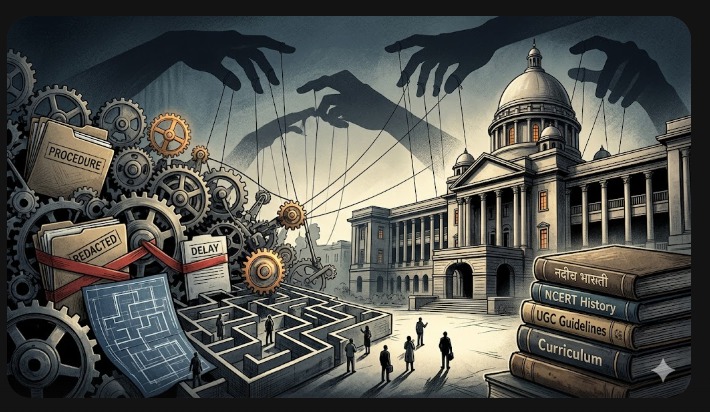
A lot has been discussed about two major controversies which erupted in India’s educational space – the UGC caste guidelines and the NCERT-judiciary chapter. However, not much attention has been focused on the invisible hand of the urban naxals who continue to influence critical policy changes, twelve years after the inflection point of 2014. While we celebrate the new India which conducts surgical strikes across the border, the sobering reality at home cannot be ignored: while the government has changed, the system has largely continued to be influenced by the left-liberal ideology.
In a report dated 27th January 2026 titled, “How Education Ministry Lost The Plot On UGC Equity Regulations,” Swarajya magazine reported that it was Indira Jaising’s intervention during a hearing in the Supreme Court of India on September 15, 2025, which led to a dramatic shift in the guidelines earlier proposed by the government, and the final regulations incorporated several of the proposals advocated by Jaising.
Similarly, when the Supreme Court ordered a withdrawal of the NCERT class 8 textbook containing a chapter on corruption in the judiciary, the Court thanked the media for bringing the chapter to their attention: “Sometimes there are some small channels, which indulge in all this. But look at the other aspect. It is the responsible media that brought the matter into the public domain. So, we are thankful to the friends in the media,” the CJI said.
The Telegraph quoted an NCERT official anonymously saying, “NCERT faculty members do not take any decision on content. The books are published in the NCERT’s name, but the content is decided by RSS ideologues.” And that “The NCERT’s in-house editorial team is not allowed to make any changes to the textbooks cleared by the experts and scrutinized by the RSS ideologues.”
There are two important details to note here. One, printed copies of the textbook seem to reach journalists in the media much before they are delivered to students, teachers, or schools for whom they are primarily intended. Second, resident NCERT officials are leaking sensitive and confidential information about the textbook development process to the media. It is an open secret that many of the resident faculties of the NCERT belong to the old left-liberal school of thought and pose a serious hurdle to the policy changes envisioned by the NEP2020.
Concerns have been raised that segments within the National Council of Educational Research and Training (NCERT), particularly among long-serving faculty and staff, have been slowing or diluting the implementation of reforms envisaged under the National Education Policy 2020. Critics argue that internal resistance, ranging from procedural delays and cautious reinterpretation of guidelines to preference for legacy frameworks in curriculum design, has limited the pace and depth of change.
The selection of the members of the text development teams and curricular area groups formed for the development of the new textbooks under NEP2020 also leaves much to be desired. There are no ideological background checks or screenings of the individuals who are recruited into these committees. While the RSS and its functionaries informally function as watchdogs, they themselves seem to be lacking the ideological clarity needed to separate the wheat from the chaff.
The HRD Ministry and Education have time and again proved to be the Achilles heel for the BJP. We have not learnt any lesson from the shrill saffronization campaign which derailed the Vajpayee government’s education policy earlier.
Two major controversies have put the BJP government at the centre in a spot, threatening to erode its core support base amongst the GCs and the right-wing sympathizers who voted the BJP to power three times in a row. Twelve years later, we still seem to be clueless about how to reform the system. Sab ka saath should not be stretched to such an extent that it prevents us from recognizing friend from foe.
Take the case of the author Alok Prasanna Kumar who wrote the controversial chapter on the judiciary. A simple Google search would have revealed that he is a regular contributor to Scroll.in and is known to be ideologically left-leaning. One wonders why such a person was allowed to write a sensitive chapter on the judiciary and how this chapter escaped the otherwise rigorous review process which the textbooks are meant to undergo.
The way the NCERT top brass conveniently made a scapegoat of Michel Danino, the chairperson of the social sciences text development team, reflects poorly on the NCERT leadership, as rightly pointed out by Dr. J S Rajput, a former director of the NCERT during the Vajpayee era. Michel Danino gave three years of his precious time and effort to the development of the new social science textbooks, in return for no significant monetary or other gains.
The NCERT also made a terrible blunder by needlessly dragging the name of Suparna Diwakar into the controversy. She was not a co-author of the controversial chapter, as claimed, but only a consultant for the backend office which was given the responsibility of coordinating the textbook development process. By throwing these individuals under the bus, the NCERT and the HRD Ministry have set a terrible example and effectively demoralized right-wing intellectuals and academicians who will think twice before taking such risks in the future. Here lies the difference between how the Congress and the BJP have nurtured (or failed) their respective ecosystems.
If the Congress returns to power, it will not take them twelve years to dismantle the changes brought in by NEP2020 or the new NCERT textbooks. During the Indian National Congress-led UPA years, the National Advisory Council functioned as a bridge between political leadership and civil society in shaping policy. Chaired by Sonia Gandhi, the NAC brought together activists, academics, and policy experts who played a key role in drafting and refining major rights-based legislations. Through this mechanism, the party was able to guide the ideological direction of policymaking outside the formal structures of government. Critics argued that it enabled an extra-constitutional concentration of influence over policy formulation, effectively allowing the party leadership to retain a close, indirect hold over key decisions.
However, the core problem here is universal to all democracies: how to prevent permanent bureaucratic-ideological blocs from capturing institutions. No democracy has fully solved this problem, but there are ways to manage it and keep them in check.
In the US, senior bureaucratic posts are often filled by political appointees who change with each administration, while Congressional committees conduct aggressive oversight of agencies and independent watchdogs (Inspectors General) audit and investigate. This prevents total ideological continuity at the top, allowing elected governments to actually steer policy. In Singapore, the model of governance is often described as a high-accountability, performance-driven state. Bureaucrats are well-compensated, subject to rigorous evaluation, and periodically rotated to prevent the formation of entrenched networks. At the same time, strong top-down political control ensures that the administrative machinery remains aligned with the priorities of elected leadership. Corruption and factionalism are dealt with firmly and swiftly, creating a system with very low tolerance for cliques or institutional capture.
Here are some processes which can prevent a repeat of the UGC-NCERT type of setbacks:
- Reduce the concentration of policymaking in a few bodies that can be captured by organized interest groups. Distribute decision-making across states and institutions.
- Mandate broader public consultations before finalizing guidelines, making it harder for any single ideological bloc to dominate the drafting process.
- Build in mandatory periodic reviews of guidelines so that no single era’s ideological priorities become permanently entrenched.
- Actively recruit academics and administrators from a wider range of ideological, regional, and cultural backgrounds — including those from non-metropolitan and non-Nehruvian intellectual traditions.
- Increase parliamentary oversight of bodies like the UGC and NCERT so that elected representatives have more visibility into their functioning.