A day after the Bengal election results, a Hindu monk living in a foreign land messaged me on WhatsApp. A Bengali family came to visit his ashram and told him that they were vacationing nearby and found this ashram to be the only Hindu temple in the vicinity. They said they wanted to offer a puja to celebrate the defeat of TMC in the elections. The sannyasi told me that he was pleasantly surprised that this family came all the way searching for the ashram for this purpose.
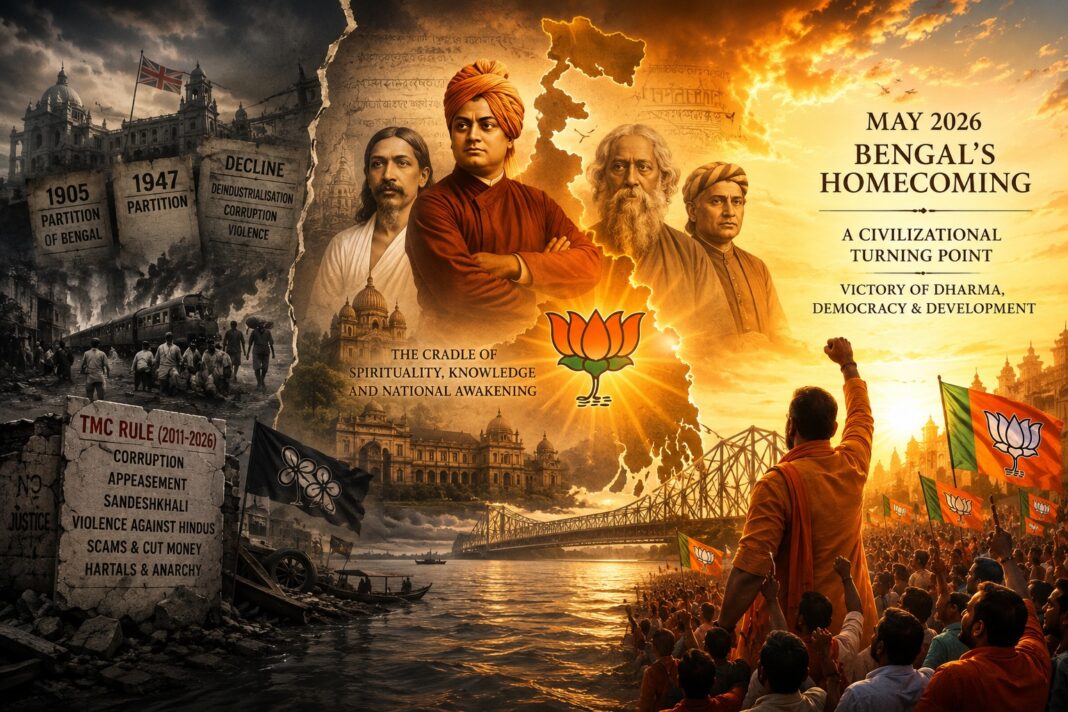
The iconic scenes of celebration across Bengal are a spontaneous expression of relief and hope. In the annals of Indian democratic history, few electoral outcomes carry the weight of civilizational consequence. The Bharatiya Janata Party’s historic victory in the West Bengal Assembly elections of May 2026, winning approximately 207 seats in a 294-member assembly to end fifteen years of Trinamool Congress rule, is one such moment. For students of Hindu civilizational history, this is not merely a political transition. It is Bengal’s long-delayed homecoming.
The Cradle That Was Forgotten
Bengal is not just a state. It is the womb of modern India’s spiritual and intellectual awakening. It was from this soil that Swami Vivekananda carried the torch of Vedanta to the world, that Sri Aurobindo translated the Upanishads into revolutionary politics, that Rabindranath Tagore gave humanity a literature rooted in the Gita, and that Bankim Chandra Chattopadhyay composed Vande Mataram, the battle cry of a civilisation reclaiming itself. Bengal, in the truest sense, was the intellectual and spiritual nerve centre of Bharatavarsha.
Yet what happened to this magnificent cradle of civilisation? The answer lies, first and foremost, in the colonial intervention that fractured it.
The British Wound: Partition, Partition, and Partition Again
The British understood precisely what Bengal meant to Hindu civilisation and they systematically set about dismembering it. The first blow came in 1905 when Lord Curzon partitioned Bengal along religious lines. Though the partition was reversed in 1911, it had already seeded the idea that a Muslim-majority east and a Hindu-majority west were incompatible.
Then came 1947 – the second, permanent partition. The Bengal that had been one cultural and civilisational entity was torn asunder. The great rivers, the poets, the temples, the syncretic folk traditions were divided by the Radcliffe line . Millions of Hindus fled east Bengal in waves, first at Partition, then after the 1950 riots, then again after the 1971 genocide, carrying with them nothing but trauma and the fading memory of ancestral lands. The Matua community, the Namasudra Hindus, the Bengali Hindus of Sylhet and Dhaka became refugees in their own nation.
The colonial project also deliberately deindustrialised Bengal. Calcutta, once the second city of the British Empire, was systematically starved of investment after independence was seen to be inevitable. The jute industry was gutted. The intellectual class, which had been educated to serve the Empire, was left politically fractured. The communists, who dominated Bengal from 1977 to 2011, inherited this broken economic and social structure and, for all their claims of redistribution, deepened Bengal’s industrial decline. Bengal, which had been on the cusp of being India’s industrial powerhouse, became a synonym for hartals, brain drain, and bureaucratic paralysis.
Fifteen Years of TMC: A Criminal-Jihadi Syndicate
When Mamata Banerjee swept to power in 2011 on a wave of genuine anti-incumbency against Left Front misrule, many hoped for renewal. What Bengal got instead was a different kind of destruction wrapped in the language of Maa Mati Manush but built on the foundations of appeasement, violence, and institutional collapse.
The record of the TMC rule speaks for itself in devastating terms. Communal flashpoints became routine under Mamata’s watch: the Baduria and Basirhat violence of 2017, the Ram Navami clashes in Asansol, the systematic desecration of Durga Puja idols in border districts, the Sandeshkhali scandal in which TMC-linked strongmen systematically terrorised and assaulted Hindu women while local administration looked the other way. Seventy percent of West Bengal’s population is Hindu, yet for fifteen years, they lived as second-class citizens in their own state.
The Sandeshkhali case was particularly revelatory. Victims described targeted gang rapes of Hindu women by TMC-affiliated strongmen, land-grabbing, and religious humiliation while police remained conspicuously absent. State welfare policies under Banerjee’s government were documented to have disproportionately directed resources toward minority communities.
The economic cost was equally staggering. Corruption permeated every level of governance. The Saradha chit-fund scam wiped out the savings of millions of ordinary Bengalis. The school recruitment scandal revealed how teaching jobs were sold to the highest bidder, corrupting the education system through which civilisational values are transmitted. The famous “cut money” system made basic government services transactional at every level.
Meanwhile, hundreds of BJP workers were murdered in political violence across the state. Post-poll violence in 2021 saw documented killings, rapes, and mass displacement of opposition supporters. Bengal under TMC became synonymous with corruption, bloodshed, and anarchy.
May 2026: The Civilizational Verdict
Against this backdrop, the BJP’s victory in May 2026 carries a meaning that transcends partisan politics. With a voter turnout of 92.93%, the highest in Bengal’s electoral history, the people of West Bengal delivered an unambiguous verdict. The consolidation of the Hindu vote, acknowledged even by TMC’s own leaders after the result, was not communalism. It was self-preservation. It was the natural response of a majority community that had been made to feel like a minority in its own homeland.
This is the first time in Bengal’s post-independence history that a right-of-centre, unapologetically Hindu political formation has won power in the state. The BJP becomes, as Wikipedia notes, “the first right-wing party to be elected in the state since assembly elections first began in 1937.” That is not a small achievement. That is a civilizational rupture with a century of Marxist and appeasement politics.
What This Means for the Future of Bengal and Hindu India
The significance of this victory reverberates far beyond West Bengal’s borders. Bengal was the last major stronghold of the Opposition in northern and eastern India, a psychological fortress that BJP’s critics had claimed was impregnable.
For the Matua community and the millions of Hindu refugees from East Bengal who have waited for decades for dignity and citizenship, a BJP government in Kolkata means the Citizenship Amendment Act can finally be implemented speedily. These are Hindus who fled genocide, who built new lives on the margins of Bengal society, and who were used as a vote bank by every government without ever being given the constitutional recognition they deserved.
For the broader Hindu civilisational project, Bengal’s return to the Hindu mainstream is invaluable. The state that gave Vivekananda, Aurobindo, and Subhash Chandra Bose, whose spiritual and nationalist traditions were the bedrock of India’s freedom movement had been, for too long, held hostage to a politics of fragmentation and appeasement. With a BJP government in place, the possibility of reviving Bengal’s civilisational legacy becomes real for the first time in generations.
The path ahead will not be easy. Bengal’s institutions have been deeply compromised. Political violence did not end on counting day as witnessed with the brutal murder of Suvendu’s young PA Chandranath Rath. The entrenched networks of local strongmen will resist displacement. But the mandate is clear and the direction is set. Bengal’s rivers once carried the hymns of the Bhakti saints. Her soil nurtured the sages who led the Sannyasi rebellion. Her sons and daughters dreamed, wrote, and died for a free and undivided Bharatavarsha.
Bengal is rising again. And in that stirring lies the promise of an India that truly knows itself. I am reminded of these soul-stirring words of Swami Vivekananda:
“The longest night seems to be passing away, the sorest trouble seems to be coming to an end at last, the seeming corpse appears to be awaking, and a voice is coming to us …. India, this motherland of ours, is awakening from her long, deep sleep. None can resist her anymore: never is she going to sleep anymore; no outward powers can hold her anymore; for the infinite giant is rising to her feet.”