
| To discuss ‘Hindutva in the present-day context’ is both simple and difficult at the same time. Simple because ample has already been and is still being said about Hindutva by its adversaries as also its advocates. Difficult because it is hard to sift the ocean of literature about Hindutva and interpret it in the present-day context. What adds to the intricacies of the task is the confusion surrounding the concept of Hindutva — thanks mainly to the intellectual liberty, almost bordering on irresponsibility, enjoyed by both adversaries and advocates alike. Too much political colouration of Hindutva and absolute apathy on the part of the academia and intelligentsia to understand its core message has made the task easier for its adversaries to paint it as a weird, unsustainable ideology. No wonder that almost two decades after the Ayodhya Movement, Hindutva hardly figures in whatever serious intellectual discourse is witnessed in India. On the one hand, adversaries of Hindutva indulge only in using it as an old stick to beat its advocates, while the latter do precious little to present it in the modern context and in the idiom which the intelligentsia worldwide understands. In the post-independence history of India, the nineties have their own importance. Early nineties saw the political consolidation of the forces behind the Hindutva movement, only to be taken to its logical end in the late nineties, manifested in the emergence of BJP-led governments in New Delhi. It was in this decade that Hindutva became a prominent, almost central theme of intellectual discourse in our country. Those who owed allegiance to Hindutva as a political ideology became a force to reckon with. Gradually, it became impossible to just ignore what was happening in the Hindutva camp. So much so that several political analysts of international standing attained fame for their very honest effort to understand what was happening in India. Nobel Laureate V. S. Naipaul believed that the movement was inevitable. Ayodhya Movement The Ram-Janmabhoomi movement was the perfect symbol of Cultural Nationalism and it communicated the message of Hindu Unity so very effectively that hundreds of Leftist scholars were at pains to explain how Hindus had come together through a movement which was described by them as ‘Brahmnical’. While sound logical arguments in favor of Ram-Janmabhoomi made it acceptable in educated urban and thinking circles, what was more important was the emotionality of the issue, which proved to be a unifier par excellence. It was an issue so deeply rooted in our shared ethos that it became hard for even the staunchest secularists to gloss over it. At least for a certain period, Ram-Janmabhoomi made the Hindus forget their caste identities and, in a way, forced them to think of their larger cultural identity — the Hindu identity. A number of secularist journalists who witnessed the events in Ayodhya on December 6, 1992, had to publicly accept the fact that the sea of humanity they witnessed had only one inseparable identity, and that was the Hindu identity. Regardless of the questions of legitimacy of the events on that fateful day, the one certainty was that in the entire length and breadth of our nation, the entire Hindu society experienced an intense feeling of unity and solidarity, so very unheard of about the Hindus earlier. This emotional unity, however short-lived it might have remained, was the greatest contribution of the Ram-Janmabhoomi movement. True, Vishwa Hindu Parishad (VHP) and other organizations had undertaken several programs aimed at consolidation of all those who are essentially Hindus right after the Meenakshipuram conversions. Still, the success of the Ram-Janmabhoomi movement was simply unparalleled. This single event had given rise to expectations that now, with solid popular support, Hindutva ideologues would strive to make inroads into the intellectual and academic arenas. Expectations soared further after the installation of BJP or BJP-led governments, both in some states and at the centre. It was thought that the ideology which proved instrumental in seeing BJP at the helm of affairs would also be duly recognized in academia and thinking circles. But, unfortunately, it just did not. Notwithstanding the propaganda of the Left-leaning academics about the so-called Saffronisation of education, Hindutva as an ideology continues to be untouchable in the corridors of academics. This untouchability emanates from various factors. Granted that largely this ‘untouchability’ is thanks to the lure of political correctness, it is also true that there are sections in the opinion-making classes who have genuine misunderstandings and, at times, serious complaints about this ideology. Not every objection deserves to be ignored, much less rubbished. Demystifying Hindutva While analyzing the challenge of demystifying Hindutva, it must be noted that the outer world has always seen the Hindutva movement through a particular prism only. Three dimensions of this prism consist of three important events in post-independence history of India: the murder of Mahatma Gandhi in 1948, the destruction of the disputed structure at Ayodhya in 1992, and the post-Godhra violence against the Muslim community in Gujarat in 2002. Majority of the opinion-makers consider these three events as stereotypes and base their understanding of the Hindutva movement on them. While it is true that there could be different angles of looking at these events, it is also true that regardless of whichever angle one desires to take, it is required to understand the backdrop on which these three independent events happened. All three events could be described as expressions of anger or pent-up emotions, and hence the state of collective minds responsible for these events needs to be dispassionately analyzed and a sound understanding developed before one chooses to either defend or denounce outrightly. Noted journalist Francois Gautier has brilliantly commented on this phenomenon of collective expression of anger. He says, “However reprehensible these acts of mass vengeance were, they have shown that Hindus keep quiet for a long time: they get riled at, they are made fun of, they are despised, their women raped, men killed, children burnt in trains and one day they blow up — and blow up badly. Riots don’t erupt in a few days: they are the fruit of decades, of generations even, of suppressed anger, of frustration, of a silent majority which sees itself more and more marginalized and taken for granted.” Due to this widespread belief that the persons responsible for these events were all avowed supporters of Hindutva, the entire movement received a bad name and a negative image, extremely hard to erase. People are aware that thousands of service projects undertaken for the underprivileged sections by hundreds of dedicated life workers believing in Hindutva have functioned consistently for several decades. Yet, such commendable work has not helped this movement earn acceptance because the so-called progressive and secular forces have consistently turned a Nelson eye towards the benign influence of Hindutva organizations and chosen to portray only the momentary aberrations committed by a section of erring Hindus. Destruction of Image Behind this double whammy against Hindutva is the unwillingness of its adversaries to really understand the strong sense of denial of Hindu aspirations, the feeling that historical wrongs against Hindus were not addressed by governments despite serious efforts of the Hindu community to focus attention on them and negotiate a solution. The result has been that adversaries of Hindutva relish painting the entire movement black. Their series of allegations against Hindutva consists of the following five points: Hindutva is sectarian and hence anti-Muslims and anti-Christians. Hindutva is communal, pro-upper caste, pro-Manu, and hence against the backward and weaker sections of society. Hindutva is anti-women, obscurantist, and against gender justice. Hindutva is against freedom of expression. Hindutva is anti-modernity. Most of the above allegations have been repeated umpteen times, creating thick clouds of misunderstanding around the entire Hindu movement. No ideological movement in the world may have ever faced such a grave image crisis. Considering the extremely wide gap between the reality about the movement and its largely established image, Herculean efforts from the defenders of Hindutva are a must. Spiritual Democracy Before we examine the basis of these allegations, it is necessary to inquire what exactly we mean by Hindutva. Hindutva consists of the term Hindu, which is largely understood as a way of worship, a religion, or a belief system. However, the term Hindutva per se does not refer to Hindu religion. Literally speaking, Hindutva means ‘Hinduness’. Just as the Sanskrit term Manushyatva means being a human, Hindutva can be explained as being a Hindu. Due to a huge multiplicity of worshipped deities and a vast diversity of the ways to worship them, no straightjacketing is possible in Hindu religion, and, as a consequence, in the Hindu worldview. It is in this complete denial of straightjacketing that lie the roots of spiritual democracy, which is the most distinguishing facet of Hindu religion. Unlike Christianity and Islam, Hinduism never presents itself as the only way to seek salvation. On the contrary, Hinduism considers that every path leads an individual to the same truth and to the same almighty, which wise/knowledgeable persons refer to in different ways. A firm belief in this concept, as communicated in Ekam Sat, Vipra Bahudavadanti (Truth is one, sages describe it differently), is the cornerstone of Hindu religious thought. This notion has, in effect, made all religions valid and reverential for all. It is due to this fundamental faith in the existence of multiple ways of seeking salvation that the concept of proselytisation and the resultant competition for converting people finds no place in Hindu religion. This is also true in other indigenous belief systems, be it Jainism or Buddhism. Let us not forget that this spiritual democracy, this fundamental spirit of accommodation, alone could make India a shining example of centuries of peaceful co-existence of different religions and belief systems. In other words, thanks to Hinduism, India could evolve a replicable model of sustainable pluralism. Acceptance of the fundamental equality of, and hence equal respect for, all religions and all the ways of worship is the basis of such sustained pluralism. It must be remembered that if one commits him/herself to the cardinal principles of sustainable pluralism, one cannot talk of the superiority of a way of worship and hence of the need to convert adherents of other faiths. Besides, once one indulges in the concept of superiority of a religion, no meaningful dialogue between faiths can happen. Today, when the entire world is facing a severe threat of terrorist tendencies, and the root cause of terrorism happens to be a particular religious belief system, can humanity survive without accepting spiritual democracy? The essence of the concept of spiritual democracy, I believe, has helped Hinduism survive. To put it simply, Hinduness does not lie in a set of rituals, systems of worship, or belief in any scriptures. It does not assert that there is only one path to attain salvation and openly concedes that belief, without any reservation. It is in this essential acceptance of, nay, welcome to other faiths and other gods, that the crux of Hinduness—i.e., Hindutva—remains. It is this very unique and supremely liberal characteristic of Hinduism that makes one a Hindu. It is on this background that one has to look at the proposition that to be an adherent of Hindutva, one need not necessarily be a Hindu. It is in the light of this core concept of Hindutva that one has to examine issues such as social justice and gender equality. No Place for Discrimination Once one accepts that every path ultimately leads to the same ultimate truth, the questions of caste and creed need to be settled once and for all. Hindutva has absolutely no place for discrimination on the basis of caste. Equality of human beings is the cardinal principle. In the Hindutva scheme of things, the superiority or inferiority of an individual cannot depend upon the family into which one is born. When Hindutva aspires to put an end to such discriminations lock, stock, and barrel, where comes the question of defending Chaturvarnya, untouchability, or caste conflict? The essential unity and equality of mankind perceived by Hindutva cannot accept any artificial divides promoted by politicians in the garb of academicians. Theories like Aryan invasion, conflict between indigenous and non-indigenous people, differences between aboriginals or Adivasis and others, branding certain social groups or communities as criminals by birth, or a conflict between the victor and the vanquished cannot find any place in the concept of Hindutva. It may be pointed out that adversaries of Hindutva always propagate that Hindutva is the other name of Brahmanatva. There cannot be any statement farther from the facts than this. Several references in Dalit literature are testimony that the upbringing of Dalit children happens in the same religious-cultural ethos as that of the so-called upper-caste children. The way Brahmans celebrate Diwali is in no way different from the way Mangs, Matangs, and other scheduled caste groups celebrate. The same is true of Adivasis. Several sociologists have established that Adivasis in India are not like aboriginals in Australia. Many erstwhile nomads or even martial communities took shelter in thick forests during times of turbulence, centuries before. Today, they are identified as Adivasis, the original inhabitants, as if all others are aggressors or outsiders. In this context, one must reconsider the terms used to refer to our own brethren. Again, to say that simply because some Adivasis eat beef or worship nature without idols, they go beyond the purview of Hindutva, is a misnomer. When Hindutva can accept even Lord Christ or Prophet Mohammad, where comes the question of not accepting nature worship? Above all, how can non-Hindus like church groups in India’s North-East sit in judgment and decide who are Hindus and who are not? Social Equality On this background, it is necessary to discuss the question of social equality in general and caste-based reservations in particular. It must be noted that the universally accepted and widely acclaimed concepts of affirmative action and positive discrimination for social justice are at the root of caste-based reservations. Supporters of Hindutva have realized long ago that larger and lasting Hindu unity will not be possible without the so-called upper castes cultivating a mindset to create space, at the cost of their own opportunity, for the underprivileged classes. It would not be wrong to suggest that the privileged and comparatively less fortunate sections of society also have to ensure that the weaker sections not only get reservations but are also duly empowered to take advantage of them. Those committed to Hindu unity cannot be unmindful that if emotional integrity is not achieved, Hindu unity will remain a chimera. For emotional integrity to sustain, one has to promote the spirit of mutual understanding, accommodation, and a sense of fundamental social responsibility. Hindus must remain fully aware of the designs of anti-Hindu-unity forces aimed at dividing society and breaking cultural-emotional bonds and inter-community harmony. Having said that, the whole gamut of issues concerning reservations needs a re-look. Thinking outside the box regarding ways to make caste-based quotas more effective and result-oriented is the need of the hour. For this to happen, the issue of caste-based quota must be de-politicized. Politicians must choose between securing vote banks and protecting national interest. High decibels while clamoring for quota cannot be the only yardstick for being progressive. Quotas cannot be de-linked from the wider issue of social and community identity. Narrow and communal identities need to be accommodated and amalgamated with the wider national and social identity. Ironically, this can happen only through respect and recognition for smaller identities, which can never be crushed but only accommodated. ‘Recognize first and then try to remold’ could be the only effective way of dealing with these issues. Creating an atmosphere where every part feels it can lead a meaningful life only while remaining inseparable from the whole is a severe challenge before the Hindutva movement. For this, disadvantaged sections of society need to be assured equal respect, equal opportunity, and equal protection. Mahatma Gandhi’s principle of Antyodaya (placing the last man first in a welfare state) as the mainstay of policies for social justice and social harmony alone can halt the process of social divide. Sustainable Pluralism The vexed issue of conversions has a close connection with social justice and equality. Firstly, demands for quota for new converts from formerly scheduled castes and tribes have rendered the argument that conversions bring social equality and respect completely hollow. More importantly, when Hindutva itself means broad-mindedness, how can one accommodate an argument that a particular faith alone is valid or has a monopoly on salvation? Granted that in a spiritual democracy, one is free to worship the gods of their choice. However, this cannot be stretched to accommodate a “sole distributorship of salvation” claimed by certain belief systems. Any argument in favor of conversion that construes acceptance of other faiths as inferior and invalid is totally against the grain of spiritual democracy. In any truly secular democratic polity, conversions should find no place at all. At several occasions in the past, those who swear by secularism have developed cold feet. The 45th Amendment of 1978 introduced in the Indian Parliament the definition of “secular” as “equal respect to all religions.” However, the Rajya Sabha, with a Congress majority, rejected this definition, mainly because some fundamentalist elements in non-Hindu belief systems opposed it. Yet another case of stubborn opposition to this equality of faiths is the year 2000 International Conference of all Belief Systems organized by the UN to mark the beginning of a new millennium, when the Vatican chose to stay away, saying they could not sit with other faiths and declare acceptance of equality of religions. Artificial or contrived conversions are an affront to human rights, and if fraudulent conversion is allowed unabatedly, it will deliver a body blow to sustainable pluralism in the long run. Gender Justice The foundation of Hindu ideology lies in scriptures like sarvepi sukhina santu, sarve santu niramayah (Happiness and health should reach all). Naturally, the idea of Hinduness encompasses the welfare of all humankind. If this is true, how can Hindutva ever be discriminating on the basis of gender? The Hindutva worldview presupposes both men and women as equal and complementary. Excessive insistence on mere equality may not ensure the desired creative co-existence, while stressing only complementarity may elude recognition and respect for the individuality of women. Element of justice must form the basis of any ideological concept in this regard. As advocated by renowned scientist Dr. R.D. Mashelkar, evolving a family system where women occupy centrality is the need of changing societies. Modern families where women receive equal opportunities, respect, protection, and facilities alone can survive. For this, men need to become more family-oriented. This mindset change can happen only through greater awareness among male family members about gender sensitization and gender equality. In the context of women-related issues, women can no longer be treated as slaves, nor should they be portrayed merely as deities. What women need is humane treatment. Practices such as Sati or any other traditions connoting inequality of the sexes are outdated and condemnable. Such obsolete practices have no place in Hindutva. Liberalism Unlike what is being portrayed, Hindutva forces have always stood for freedom of expression and, for most of the times, disapproved any attempts to suppress creativity. Instances like the brouhaha over the infamous Danish cartoons or Da Vinci Code are so very rare in the context of Hinduism that many progressive artists take liberty to play with Hindu sensibilities. The Hindutva movement will have to handle such issues with dexterity. The kind of maturity shown by Hindutva forces during the controversy over Dr. Ambedkar’s Riddles in Ramayan, in the early eighties, was illustrious since it ensured that the cause of larger Hindu unity was not harmed. It has to be underscored that concepts of democracy and liberalism form the core of Hindutva. As desired by Sant Dnyaneshwar, “Jo je wanchhchil to te laho,” meaning everybody should get whatever he or she aspires for, is the bottom line of Hindutva. Hindutva believes in autonomy in all respects. From food habits to fashions and from family systems to festivities, everything that is not against human justice and human rights should be generally acceptable. Any kind of straightjacketing is an anathema to Hindutva. Hindutva recognizes the importance of reforms, and also recognizes the fact that reforms cannot be transplanted from without. Only those who identify themselves with the traditions can effectively change them. For those who believe that practices like celebrating Valentine’s Day are Western and hence need to be abhorred, the best way could be to draw a longer line and popularize the indigenous version of this festival of love. Indulging in violence while decrying revelers just cannot be the answer. The observation that Hindutva represents anti-modern views has no base at all. Obscurantist elements are in every society, and even the way some of the Hindus preach and practice, they may sound extremely fanatic. But since Hindu religion is not book-based, really speaking, there is no scope for any fundamentalism. “Nitya Nutan – Chira Puratan” (Innovation and Modernity going hand in hand with Ancient and Historical) is the mainstay of Hindu thinking. The kind of resilience that Hindus have shown while accepting whatever is modern is a testimony of their being receptive to whatever is modern and in tune with the times. For Hindutva to be embraced by the entire humanity as a way of life, Hindus should be exporting their own cultural traditions, symbols, and even social institutions. One pre-condition of this is that Hindus first of all should come out of self-denial while understanding themselves. To that end, it has to start with the long-overdue re-stating of Hindutva. An absolute lack of clarity and sheer absence of articulation, coupled with incoherence and inertia, has made Hindutva forces appear like a bankrupt millionaire. Hindutva has become a favorite whipping boy of the so-called progressives. Many consider that without assailing Hindutva, one can never be considered legitimate in the worlds of academia, scholarship, and, to an extent, even media. Let it be remembered that thinking circles in India, let alone recognizing, are not even tolerating Hindutva forces. None of the Hindutva leaders have ever defended practices as irrelevant and anti-humanity as either untouchability or child marriages. From Swami Vivekananda to Balasaheb Deoras or L. K. Advani, those who have taken pride in their Hinduness (Hindutva) have, in no uncertain terms, denounced all such practices, describing them as perversions. But then, hardly ever efforts have been made to tell the world what are the ingredients of this new age or modern, or say contemporary “Hindutva,” and present it once again in the form of a theory or a thought. It was on this background that the Left-leaning thinkers had a field day, successfully hitting Hindutva with the same old sticks, wantonly indulging in self-flagellation, and in the process demoralizing the cadre. That this further helped them consolidate their position and continue with their “Thought Hegemony.” The most dreadful and anti-democratic consequence of this was the cult of ideological untouchability indulged in by several members of the intelligentsia. Clearing every kind of confusion about Hindutva, in no uncertain terms, once and for all, is the only way. Let us walk this way together… About the author: Mr. Vinay Prabhakar Sahasrabuddhe is the Director General of Rambhau Mhalgi Prabodhini, India’s only training and research institute for voluntary social workers and elected representatives. He comes from Khandesh, or the north Maharashtra region. Born in a middle-class family, Mr. Sahasrabuddhe has done his post-graduation in English literature. Since his student days, he has been active in the social sector. During the infamous Emergency of 1975, he participated in a Satyagraha and faced imprisonment for one and a half months. As a student activist, he was closely associated with Akhil Bharatiya Vidyarthi Parishad (ABVP) and also worked as a full-timer of this organisation for over four years. Since 1987, he is with Rambhau Mhalgi Prabodhini. From 1987 to 2004, he was a Member of the Senate of the University of Mumbai. He was also elected as a member of the Management Council of the University, where he worked for five years. For three years, he was on the Board of Governors of ‘Yashada,’ a government institute for the training of officials. Today, he is on the Governing Council of the Ahmedabad-based Sardar Patel Institute of Public Administration. During 2001–2004, he was the Chairman of the Western Region Committee of the Council for Advancement of People’s Action and Rural Technology (CAPART), a Government of India agency. Mr. Sahasrabuddhe is also a freelance journalist and has been contributing columns to various journals regularly. To his credit, he has four edited books and one book written by him. One of his books has bagged the Government of Maharashtra award. Mr. Sahasrabuddhe was selected as an Ambassadorial Scholar by Rotary International in 1998 and was working as a visiting researcher at the University of Illinois in the USA during 1998–99. For the purposes of research, paper presentations, training, and seminars, he has visited the US, UK, Germany, France, Austria, Turkey, Afghanistan, Israel, and China. | |
| Vinay Sahasrabuddhe | |
Hindutva in the Present-day Context
A Thematic View of Indian Civilization
| Michel Danino: On Indian History In the last few years, Indian history has been much in the news. Not, however, in an effort to make better sense of India’s past, of her behaviour as a civilization, of the specificities of Indian culture, nor also to integrate new findings into an ever-growing perspective, but mostly for polemical, political, or sensational reasons that only end up creating more confusion and driving us farther away from the central issue—how to deal with Indian history? Ideology barges in and a finer perception of India tiptoes out. In the end, we Indians are the victims, more particularly the students. As long as the teaching of history is manipulated and remote-controlled, it will stifle creativity and students will continue to look at the discipline as a chore pushed down their throats—a “sleeping pill,” as some of them once told me. Mathematics might be another, but then, you need it to get a good job—what do you need history for? That, in fact, is the whole question. Unless the syllabus, the textbook, and the teacher can together convince the student that history opens a window onto Indian culture and heritage and an understanding of ourselves—in short, a meaningful perspective of India—the answer to the question will merely be to get a few marks at the exam. If there is nothing more to it, we might as well scrap the whole discipline, as a few state governments have indeed suggested recently. India’s history is not about dates and kings and bloodsheds. It is about bringing out the life and culture of the Indian people, also the bend of the nation, the way India reacted (and continues to react) to crises and obstacles, adapted to new conditions, the way it has absorbed and given, changed but also remained the same. In a word, what makes India ‘India’? Two Views of India If we pursue this research, we will soon find that we have to deal with two diametrically opposite perspectives of India. One of them was aptly summarized by the great historian R. C. Majumdar: So far as the available evidence goes, there cannot be the slightest doubt that Indian civilization manifests itself in a way and a form very different from that with which we are familiar in the rest of the world. We have to consequently approach the history of India in a different spirit, and adopt a different scale of values in order to appraise her culture and civilization. The wars and conquests, the rise and fall of empires and nations, and the development of political ideas and institutions should not be regarded as the principal object of our study, and must be relegated to a position of secondary importance. On the other hand, more stress should be laid upon philosophy, religion, art, and letters, the development of social and moral ideas, and the general progress of those humanitarian ideals and institutions which form the distinctive feature of the spiritual life of India and her greatest contribution to the civilization of the world.[1] Rabindranath Tagore, whose view of India and Indian history is rarely highlighted, wrote a seminal essay entitled The History of Bharatavarsha. In it, he struck a chord parallel to Majumdar’s: The history of India that we read and memorize for our examinations is really a nightmarish account of India. Some people arrive from somewhere and the pandemonium is let loose. And then it is a free-for-all: assault and counter-assault, blows and bloodletting. … If Bharatavarsha is viewed with these passing frames of dreamlike scenes, smeared in red, overlaid on it, the real Bharatavarsha cannot be glimpsed. These histories do not answer the question, where were the people of India? Our real ties are with the Bharatavarsha that lies outside our textbooks. If the history of this tie for a substantially long period gets lost, our soul loses its anchorage. After all, we are no weeds or parasitical plants in India. Over many hundreds of years, it is our roots, hundreds and thousands of them, that have occupied the very heart of Bharatavarsha. But, unfortunately, we are obliged to learn a brand of history that makes our children forget this very fact. It appears as if we are nobody in India…[2] Such a conception was also that of Swami Vivekananda,[3] of Sri Aurobindo, who presented us with a comprehensive formulation of Indian civilization in his Foundations of Indian Culture,[4] of Sister Nivedita,[5] John Woodroffe,[6] Ananda Coomaraswamy,[7] K. M. Munshi,[8] and a host of other profound thinkers and scholars. On the other hand, we have what I venture to call the “colonial-Marxist” perspective. The hyphenation is justified, as we find that in India’s case, Marxist historiography accepts in practice the broad framework of the erstwhile colonial historians, even as it throws new insights, some of which (in the economic and social fields in particular) are often valuable. Among the main features of this perspective, we should certainly mention: 1. A purely materialistic, social and economic definition of man. Since no spiritual dimension is acknowledged, India’s religious and spiritual currents, movements, and evolution are interpreted purely from a materialistic standpoint. 2. Indian spirituality and religion (labelled “animism,” “idolatry”…) are therefore of no value, as are India’s great spiritual figures. To a Marxist historian, Swami Vivekananda’s or Sri Aurobindo’s or Tagore’s understanding of Indian history and civilization is of no relevance. 3. India’s cultural continuity and identity are basically denied. Artificial breaks are introduced in time (for instance the imaginary Aryan Invasion of India) or in society (the Brahmins vs. the rest of India). We do hear of India’s “DIVERSITY” but not of what constitutes its “UNITY.” India’s cultural cement, for instance the reach of epic and Puranic lore to the remotest corner of India, is not thought to be a worthwhile object of study. 4. A gross overemphasis on the caste system: Most social phenomena are interpreted in terms of caste. Yet the relative stability and economic prosperity provided by the caste system to Indian society is overlooked. Also, the substantial role of Islam and British rule in hardening the caste system is glossed over, while Hinduism is portrayed as the spread or sometimes the imposition of “Brahminism,” ignoring its organic interchange with local cultures. 5. India’s civilizational achievements and contributions to the world in terms of science, technology, philosophy, spirituality, religion, art, literature, scripts, etc., are consistently underemphasized. 6. Semitic religions and societies are gently dealt with, while the defects of Indian society are magnified and invariably put down to Hinduism. 7. India’s history is squeezed into a Eurocentric framework through an artificial and alien terminology: “barbarism,” “feudalism,” “class war”…. Failing to work out an Indian historiography of India, this perspective in effect promotes a de-Indianized view of Indian history, which can logically lead only to the atomization of India, since one is left to wonder what can hold together this bewildering medley. Themes in Indian Civilization In this paper, I propose to highlight a few key themes that naturally emerge from Indian history and archaeology. In themselves, they are by no means new, so I will not go over the “classical” evidence supporting them, which can be found in many studies.[9] I will only attempt to show how they receive fresh and sometimes crucial support from findings made in recent years. Which of the two above perspectives of India those new findings tend to endorse should be clear enough. 1. Antiquity and Continuity Antiquity and continuity are possibly the most striking characteristics of Indian civilization, and they have been amply confirmed by archaeological evidence. Among India’s most ancient settlements, Mehrgarh, an important site in Baluchistan, at the foot of the Bolan Pass, has been excavated in the last decades. Spread over 250 hectares, it has brought to light one of the earliest farming communities on the subcontinent, dating back to 7000 BC; by 6000 BC, it had “a veritable agricultural economy solidly established,”[10] in the words of French excavator Jean-François Jarrige. More importantly, Mehrgarh has revealed a continuous sequence of cultures spanning some 4,000 years and leading to the “mature” Indus-Sarasvati civilization and beyond. More such sites may yet come to light, giving us a better understanding of the growth of civilization on Indian soil. One possible candidate may emerge from the Gulf of Khambat, where in the last few years the National Institute of Ocean Technology[11] has been collecting artefacts from the sea bed, with pottery and wood pieces yielding dates between 3000 and 10,000 years old.[12] Moreover, sonar photography has revealed strangely geometric patterns along a paleo-river bed that resemble settlements. While the site does seem to hold potential, such patterns can also arise out of natural formations; we should therefore urge caution pending systematic excavations of the sea bed. Not far away, the submerged city of Dwaraka, discovered in the early 1980s, is yet to be explored systematically, even though it could hold a key to the thorny issue of the historicity of the Mahabharata. All that we can safely assert is that it dates back to 1500 BC at the least.[13] Going a little further back in time, sites of the Indus-Sarasvati civilization, the first on Indian soil (2600–1900 BC for its mature phase), have yielded many artefacts that evidence a cultural continuity with later Indian civilization, especially in the Gangetic region. For instance, ornaments (including craft techniques), games (from spinning tops to dice), traditions (red pigment at the parting of the hair), the use of conch shells for libations as well as trumpeting, the ritual use of water for purification (as seen at Mohenjo-daro’s Great Bath), religious symbols (the svastika, the trishul, the pipal, etc.), important modes of worship such as fire, mother-goddess, lingam, etc.[14] It is therefore hardly surprising to read such statements under the pens of archaeologists: John Marshall: “The [Harappan] religion is so characteristically Indian as hardly to be distinguished from still living Hinduism…. One thing that stands out both at Mohenjo-daro and Harappa is that the civilization hitherto revealed at these two places is not an incipient civilization, but one already age-old and stereotyped on Indian soil, with many millennia of human endeavour behind it…”[15] Jonathan M. Kenoyer: “Since the discovery of the Indus cities, scholars have made comparisons and contrasts between the Indus cities and later urban cultures of the subcontinent. Current studies of the transition between the two earthly urban civilizations claim that there was no significant break or hiatus.”[16] Jim Shaffer: “The previous concept of a ‘Dark Age’ in South Asian archaeology is no longer valid.”[17] Conclusions: The average history textbook greets its readers with a fragmented, confused and incoherent idea of India; they learn nothing of the unifying virtue of Indian culture, of its synthesizing (not “composite”) nature, its unparalleled continuity, least of all its spiritual foundations and its achievements. By contrast, other nations, with an often much more limited heritage than India’s, find nothing wrong in nurturing pride for it in their students. In 1918, Sri Aurobindo diagnosed the problem of Indian education thus: “The full soul rich with the inheritance of the past, the widening gains of the present, and the large potentiality of the future, can come only by a system of National Education. It cannot come by any extension or imitation of the system of the existing universities with its radically false principles, its vicious and mechanical methods, its dead-alive routine tradition and its narrow and sightless spirit”.[54] Together, the above themes offer a pedagogic alternative, in that they paint a living and inspiring, if incomplete, picture of Indian civilization. An innovative teaching of Indian history could organize its material around such “master ideas,”[55] as Sri Aurobindo called them, rather than follow a chronological line that churns out events pell-mell and without an atom of relevance to the life of today’s young Indian. This bookish approach must be done away with. Instead, an intelligent pedagogy could include, besides the above thematic approach, visits to archaeological or historical sites and museums, and even involve students in a local excavation or restoration; it could encourage the use of visual and multimedia material, good maps, etc. It should also encourage research projects based on the above or other themes, for instance the lives of a few great Indians – kings, but also scientists, saints, sages, poets, freedom fighters etc. – so as to show in what ways they have embodied the Indian genius. As a result, a student would acquire a far more concrete, often visual, contact with Indian culture and would grasp its evolution rather than a mass of scattered, unrelated and often outdated data. The gain would be enormous. No longer an isolated (and largely meaningless) individual in time and space, the student becomes part of the great stream of Indian civilization. Identity – the dreaded word of today’s scholarship – would also crystallize, but a self-confident, generous, creative identity in tune with the universe. Is it a sin to celebrate India’s symphony, while acknowledging a few false notes? The issue now facing India’s history is not some dubious “detoxification,” but nothing less than its decolonization and, in reality, its demoronization. Let us end this brief journey through Indian civilization with this profound observation of Sister Nivedita: “India, as she is, is a problem which can only be read by the light of Indian history. Only by a gradual and loving study of how she came to be, can we grow to understand what the country actually is, what the intention of her evolution, and what her sleeping potentiality may be”.[56] References & Notes: [1] The History and Culture of the Indian People (Bombay: Bharatiya Vidya Bhavan, 1951), vol. 1, p. 42. [2] Rabindranath Tagore, The History of Bharatavarsha, available online at www.ifih.org [3] Swami Vivekananda, Lectures from Colombo to Almora (Calcutta: Advaita Ashrama, 1992). [4] The Foundations of Indian Culture, vol. 14 in Sri Aurobindo Birth Centenary Library (Pondicherry: Sri Aurobindo Ashram, 1972) [5] Sister Nivedita, Footfalls in Indian History (Calcutta: Advaita Ashrama, 1990) [6] John Woodroffe, Is India Civilized? (Madras: Ganesh & Co., 1918) [7] Essays in National Idealism (1910, reprinted Munshiram Manoharlal, New Delhi, 1981); Art and Swadeshi (New Delhi: Munshiram Manoharlal, 1994) [8] K. M. Munshi, Akhand Hindustan (Bombay: New Book Co., 1942); also his introduction to The History and Culture of the Indian People [9] The Cultural Heritage of India (Calcutta: The Ramakrishna Mission Institute of Culture, 1958-2001, 6 vols.), The Wonder That Was India by A. L. Basham (Calcutta: Rupa & Co., 3rd ed, 1981), A Cultural History of India, ed. A. L. Basham (New Delhi: Oxford University Press, 1975-1983), India and World Civilization by D. P. Singhal (Michigan State University Press, 1969), L’Inde classique by Louis Renou and Jean Filliozat (2 vols., French) [10] Jean-François Jarrige, “De l’Euphrate à l’Indus,” Dossiers Histoire et Archéologie (Dijon, December 1987), p. 84 [11] Details and photographs: www.niot.res.in/m3/arch/index.htm [12] S. Kathiroli, S. Badrinarayanan, D. V. Rao, B. Sasisekaran and S. Ramesh, “Recent Marine Archaeological Finds in Khambat, Gujarat,” Journal of Indian Ocean Archaeology (New Delhi: Centre for Research and Training in History, Archaeology and Paleoenvironment), No. 1, 2004, pp. 141-149 [13] S. R. Rao, The Lost City of Dvaraka (New Delhi: Aditya Prakashan, 1999) [14] Jonathan Mark Kenoyer, Ancient Cities of the Indus Valley Civilization (Karachi & Islamabad: Oxford University Press & American Institute of Pakistan Studies, 1998); B. B. Lal, India 1947-1997: New Light on the Indus Civilization; The Sarasvati Flows On: The Continuity of Indian Culture (New Delhi: Aryan Books International, 1998 & 2002); Michel Danino, “The Harappan Heritage and the Aryan Problem,” Man and Environment, vol. XXVIII, No. 1, 2003, pp. 21-32 [15] John Marshall, Mohenjo-daro and the Indus Civilization (London, 1931, 3 vols.), Vol I, p. vi-viii [16] Jonathan Mark Kenoyer, op. cit., p. 180 [17] Jim G. Shaffer, “The Indus Valley, Baluchistan, and Helmand Traditions: Neolithic through Bronze Age,” in Chronologies in Old Worlds Archaeology, ed. Robert W. Ehrich (3rd ed., Chicago & London: University of Chicago Press), vol. I, p. 459 [18] Department of Ancient History, Culture and Archaeology, University of Allahabad: http://timesofindia.indiatimes.com/cms.dll/html/uncomp/articleshow?artid=23873 [19] Rakesh Tewari, “The origins of iron-working in India: new evidence from the Central Ganga Plain and the Eastern Vindhyas,” Antiquity, vol. 77, No. 298, December 2003, pp. 536-544 [20] Rakesh Tewari, “The Myth of Dense Forests and Human Occupation in the Ganga Plain,” Man and Environment, vol. XXIX, No. 2, 2004, p. 113 [21] Photograph in B. B. Lal, Sarasvati Flows On, op. cit. [22] Holger Wanzke, “Axis systems and orientation at Mohenjo-daro,” in Interim Reports, Reports on fieldwork carried out at Mohenjo-daro, vol. II, ed. M. Jansen & G. Urban (Aachen: Aachen University Mission, 1987); Asko Parpola, Deciphering the Indus Script (New Delhi: Cambridge University Press, 2nd ed., 2000), p. 201 [23] J. McKim Malville & Lalit M. Gujral, Ancient Cities, Sacred Skies: Cosmic Geometries and City Planning in Ancient India (New Delhi: IGNCA & Aryan Books International, 2000) [24] Baidyanath Saraswati, Lifestyle and Ecology and The Cultural Dimension of Ecology (New Delhi: IGNCA and D. K. Printworld, 1998); Bansi Lal Malla, Trees in Indian Art, Mythology and Folklore (New Delhi: Aryan Books International, 2000); Shakti M. Gupta, Plant Myths and Traditions in India (Munshiram Manoharlal, 2001); and series by C.P.R. Environmental Education Centre: The Ecological Traditions of Tamil Nadu (1997), Sacred Trees of Tamil Nadu (1998), Sacred Groves of Tamil Nadu (1998), Sacred Tanks of South India (2002), Temple Tanks of Chennai (2004); also Sanskriti Sangam: Proceedings of First International Conference & Gathering of Elders, Mumbai, 4-9 February 2003 [25] Selected studies on early Indian science: D. M. Bose, S. N. Sen & B. V. Subbarayappa, A Concise History of Science in India (New Delhi: Indian National Science Academy, 1989); Debiprasad Chattopadhyaya, History of Science and Technology in Ancient India (Calcutta: Firma KLM, 3 vols., 1986, 1991, 1996); History of Indian Science, Technology and Culture AD 1000-1800, vol. III, part 1 (New Delhi: Project of History of Indian Science, Philosophy and Culture & Oxford University Press, 1998); A. K. Bag, History of Technology in India (New Delhi: Indian National Science Academy, 1997); S. Balachandra Rao, Indian Mathematics and Astronomy – Some Landmarks (Bangalore: Jnana Deep Publications, 1998); N. Gopalakrishnan, Indian Scientific Heritage (Thiruvananthapuram: Indian Institute of Scientific Heritage, 2000); Dharampal, Indian Science and Technology in the Eighteenth Century (Hyderabad: Academy of Gandhian Studies, 1971); Indian Science Through the Ages, ed. M. Lakshmi Kumari, parts 1 & 2 (Madras: Vivekananda Kendra Patrika, 1983); George Gheverghese Joseph, The Crest of the Peacock (London: Penguin Books, 2000); S. Parameswaran, The Golden Age of Indian Mathematics (Kerala: Swadeshi Science Movement, 1998); T. S. Bhanu Murthy, A Modern Introduction on Ancient Indian Mathematics (New Delhi: Wiley Eastern Ltd., 1992); T. A. Sarasvati Amma, Geometry in Ancient and Medieval India (New Delhi: Motilal Banarsidass, 1999); T. R. N. Rao & Subhash Kak, eds., Computing Science in Ancient India (Louisiana: Center for Advanced Computer Studies, 1998); S. N. Sen & K. S. Shukla, eds., History of Astronomy in India (New Delhi: Indian National Science Academy); S. Balachandra Rao, Indian Astronomy – An Introduction (Hyderabad: Universities Press, 2000); Acharya Praffullachandra Ray, A History of Hindu Chemistry (Kolkata: Shaibya Prakashan Bibhag, centenary edition 2002); B. V. Subbarayappa, ed., Chemistry and Chemical Techniques in India, vol. IV, part 1 (New Delhi: Project of History of Indian Science, Philosophy and Culture, & Centre for Studies in Civilizations, 1999); School of Mathematics and Statistics, University of St. Andrews, Scotland, Internet resource: http://www-history.mcs.st-andrews.ac.uk/history/Indexes/Indians.html [26] K. V. Sarma, ed., Science Texts in Sanskrit in the Manuscripts Repositories of Kerala and Tamil Nadu (New Delhi: Rashtriya Sanskrit Sansthan, 2002), p. 16 [27] D. T. Emerson, The Work of Jagadis Chandra Bose: 100 Years of MM-Wave Research, www.tuc.nrao.edu/~demerson/bose/bose.html; also http://earlyradiohistory.us/1897tele.htm and www.qsl.net/vu2msy/JCBOSE.htm [28] Probir K. Bondyopadhyay, “Sir J. C. Bose’s Diode Detector Received Marconi’s First Transatlantic Wireless Signal of December 1901 (The ‘Italian Navy Coherer’ Scandal Revisited),” Proceedings of The IEEE, Vol. 86, No. 1, January 1998, pp. 259-285 [29] B. B. Lal, The Earliest Civilization of South Asia (New Delhi: Aryan Books International, 1997), p. 236 [30] Jonathan Mark Kenoyer, “Early City-States in South Asia: Comparing the Harappan Phase and Early Historic Period,” in The Archaeology of Early City-States: Cross-Cultural Approaches, eds. D. L. Nichols and T. H. Charlton (Washington, D.C.: Smithsonian Institution Press), pp. 51-70 [31] Steve Muhlberger, “Democracy in Ancient India,” www.unipissing.ca/department/history/histdem/ [32] The Foundations of Indian Culture, op. cit., p. 329 [33] Sri Aurobindo, On Himself, vol. 26 in Sri Aurobindo Birth Centenary Library (Pondicherry: Sri Aurobindo Ashram, 1972), p. 410 [34] Rabindranath Tagore, The History of Bharatavarsha, available online at www.ifih.org [35] Tagore, “Nationalism in India” (republished New Delhi: Macmillan, 1999), p. 69 [36] M. N. Srinivas, The Cohesive Role of Sanskritization and Other Essays (New Delhi: Oxford University Press, 1989) [37] The Vivekananda Kendra Institute of Culture, Guwahati [38] Mahabharata in the Tribal and Folk Traditions of India, ed. K. S. Singh (Shimla: Indian Institute of Advanced Study, 1993); Rama-Katha in Tribal and Folk Traditions of India, eds. K. S. Singh & Birendranath Datta (Calcutta: Seagull Books, 1993); Painted Words: an Anthology of Tribal Literature, ed. G. N. Devy (New Delhi: Penguin Books, 2002), chapter “Myth” [39] Sandhya Jain, Adi Deo Arya Devata: a Panoramic View of Tribal-Hindu Cultural Interface (Delhi: Rupa, 2004) [40] Jyotindra Jain, “Propitiation of Babo Ind: Survival of the Ancient Cult of India,” in Living Traditions: Studies in the Ethnoarchaeology of South Asia, ed. Bridget Allchin (New Delhi: Oxford & IBH, 1994), p. 13 ff [41] A. V. Balasubramanian, “Social Organisation of Knowledge in India: Folk and Classical Traditions,” paper presented at Indian Institute of Advanced Study, Shimla, 27-29 September, 2003 [42] C. Rajendran, “Folk Elements in Kerala’s Sanskrit Theatre,” in Living Traditions of Natyashastra, ed. C. Rajendran (Delhi: New Bharatiya Book Corporation, 2002), p. 117 ff [43] Los Angeles Times, June 12, 2002; John Noble Wilford, New York Times, July 9, 2002 [44] Man and Environment, vol. XXVII No. 1, 2002; Journal of Indian Ocean Archaeology, No. 1, 2004 [45] Peter Berresford Ellis, The Druids (London: Constable, 1995), p. 24 [46] Ian Pearce, website: http://www-history.mcs.st-andrews.ac.uk/history/Projects/Pearce/index.html [47] George Gheverghese Joseph, The Crest of the Peacock (London: Penguin Books, 2000) [48] K. Chandra Hari, “Genesis of Calculus” [49] Michel Danino, “India’s Impact on French Thought and Literature” (unpublished) [50] Swami Vivekananda, Complete Works (Vol. V, 5th Edition, 1947), p. 77; also Hinduism Today, May-June 2001, and Toby Grotz, www.hinduism.fsnet.co.uk [51] Subhash Kak, The Wishing Tree: The Presence and Promise of India (New Delhi: Munshiram Manoharlal, 2001), pp. 5-8 [52] C. P. Girija Vallabhan, “Indian Influence in the Development of Quantum Mechanics,” www.photonics.cusat.edu/article2.html [53] Fritjof Capra, Uncommon Wisdom, pp. 42-43, quoted at www.vedanta-newyork.org/articles/gita_13_15.htm [54] Sri Aurobindo, “National Education,” New India, April 8, 1918; Sri Aurobindo Birth Centenary Library, 1972, 27.505 [55] Sri Aurobindo, The Foundations of Indian Culture, Sri Aurobindo Birth Centenary Library, 1972, vols. 14 & 26 [56] Sister Nivedita, Footfalls in Indian History (Calcutta: Advaita Ashrama, 1990), p. 6 About the Author: Michel Danino is a long-time student of Indian civilization and has also translated and edited books related to Sri Aurobindo and Mother. He is also the convener of the International Forum for India’s Heritage. Email: micheld@sify.com |
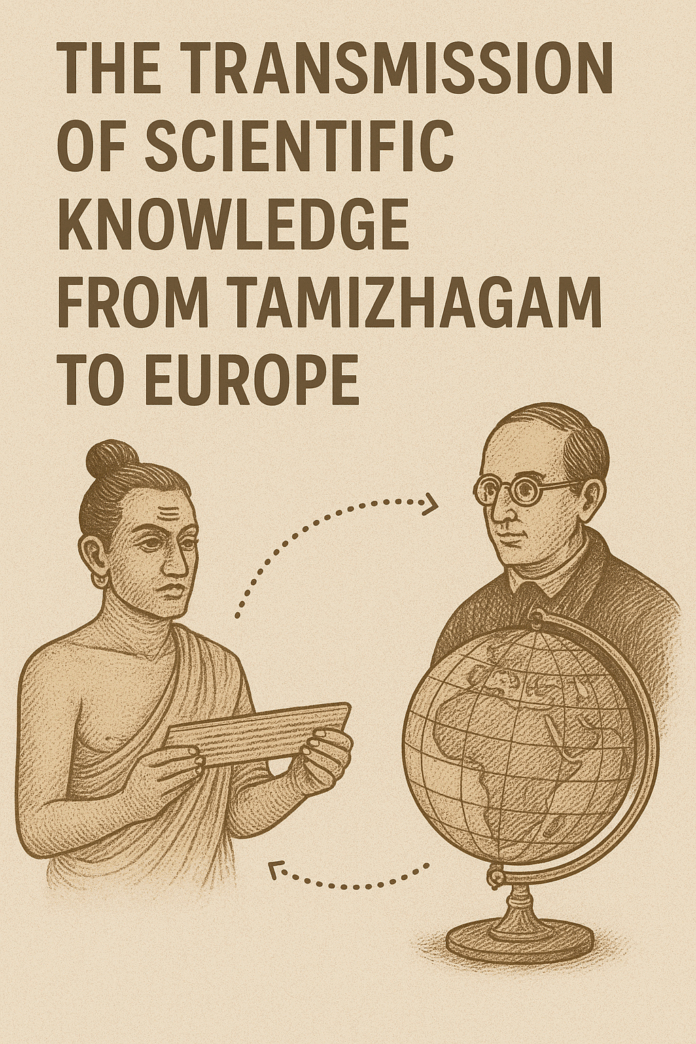
The Transmission of Scientific Knowledge from Tamizhagam to Europe
K. V. Ramakrishna Rao
Introduction:
About the transmission of mathematical and astronomical Science from South India, particularly from Kerala, studies have been already conducted and published by C. K. Raju, George Ghevergheese Joseph, Denis F. Almeida, and the Aryabhata Group of University of Exeter1. Though, Prof. D. S. V. Subba Reddy2 has pointed out the European interest and their books on Indian medicine, he stopped short with appreciating interest shown by them. However, about the transmission of scientific knowledge and/or manuscripts from Tamizhagam, it appears no study has been so far. The study of Jesuit writings reveal interesting details that such transmission had taken place during 1600 to 1850 period and even beyond. The study of events at Tranquebar, Pondicherry and Madurai provides wealth of such information.
Many times, the masquerade of the Jesuits has to be removed to find out their scientific pursuits (piercing the corporate veil to understand a company). The author has already presented and published some papers about Saltpetre3, the scientific pursuits of Robert de Nobili4 and Le de Gentil5, the interest of European Scientists in India6, etc. That even the British adopted such methods under the guise of scientific survey is interesting to study their motive7. The cross-reference of Tamil Siddha books correlates corroborate and gives ample evidence for such transmission taking place. The Tamil Siddha works – a compilation popularly known as “Periya Gnanak Kovai” and as well as individual works have been consulted8 for this purpose.
South India up to 18th Century:
From 10th century onwards (with due respect to the Pallavas), South India excelled in scientific and technological activities. Indian shipping, astronomy, chemical, textiles and food processing, architecture and other fields attained status. They in turn encouraged other industries and businesses. The Indian traders and businessmen had been common in many countries. The Cholas were reigning supreme during 10th to 14th centuries. During Vijayanagara period (14th to 16th centuries), everything was at peak followed by the Nayaks. The visiting Europeans (including Jesuits)9 were stunned at multi-storied buildings, gardens, dams and water reservoirs, the shipping activities, metal technology and above all, the time bound activities of the people. They could not understand the time reckoning methods of Indians, as the Europeans were struggling with corresponding activities involving calendar, longitude problem, compass and time reckoning. Here come the Jesuits and missionaries, their colleagues and contemporaries.
Europe during the material period:
During the same period, the European countries were faced with all problems, frequent wars, famines, diseases and above all religious fanaticism interfering with every walk of life. The imports from India and East Indies were as follows:
| Year | Percentage |
| 1588 | 14% |
| 1621 | 48% |
| 1669 | 70% |
The so-called revolutions took place changing the face of Europe -The American Revolution (1776-1783), the French Revolution (1789-1791), and the Industrial Revolution (1750-1850). Within hundred years, surprisingly, Europe began to discovering and inventing everything all of sudden, when they were plaguing with diseases, reeling under religious persecution and suffering from economic conditions. Definitely, the European companies and the Jesuits gained much from India. As the ships had to sail around India from west to eastern parts, the coastal areas became strategic and hence, the European companies were fighting with each others for domination. The oppressed and suppressed scientists got wisdom through Indian books. The Protestant England and Germany, thus opposed Catholic Portuguese and French. In any case, they were united in India as far as opposing heathen Hindus in all aspects.
The Prelude to the Scientific Quest of Europeans in India:
Portuguese Physician Garcia d’Orta (1501-1568), Finnish Botanist L’Ecluse, Christovas da Casta, Dutch scholar Henrick Adrian Van Reede (1637-1691), Johann Ernest Grundler (1677-1720), Charles Clusius, Linchoten (16th century), Poludanus (explaining the writing of Linchoten) and others had studied Siddha medicine and sent voluminous palm-leaf books to Europe. Rheede when landed in Kerala was surprised to witness a great botanical garden there. In India, such gardens have been part of temples (Nanda Vanam) and Hospitals (Muligaip Pannai). Interestingly, in his case, the modus operandi found is that he got written statements from the Indian doctors to that effect that as per the directions of him, they provided the medical data, information, books, samples and formulations. Three statements are reproduced below10:
“On the tenth of the black fortnight of Chaitra month and Rakshasa year of Salivahana saka 1597, on a camp at Cochin, we Rangabhatta, Vinayak Pandit and Appu Bhatta (Eye Physician) write the following testimony of truth so that no one should treat this as false.
On a message from Adrikin Fondre, Commander of Cochin, we collected herbs, flowers, fruits which are used for medicine from this Malabar Desha through a person who was paid for it and who was specialized in discriminating medicinal plants.
This material was collected in the various seasons when they are grown. Then on, all the herbs, fruits, flowers etc., were painted. Later on we testified and tallied this material with the descriptions in the Materia Medica which we had brought along with us.
We then described these herbs, their effects etc., of which we had experimental knowledge. For the last two years both in mornings and evenings we are doing this. Whatever is written over here should not be treated as false hence we are attesting our signatures below”.
Ranga Bhatta
Vinayak Pandit
Apu Dev
Written and signed in Marathi
“By the order of Commander Hendrik Van Rheede, I, a Malabar Physician of the Ezhava caste, born in Kollad house at Kadakkarapally in Karapuram village came to the Cochin Fort and dictated as already agreed, the details of the trees, shrubs, creepers and grasses in Kerala providing with diagrams, and the medicinal treatment with them, from the practical experiences as well as the erudition from our precious old books, to Manuel Carner, the official translator of the Company, so as to record them in books, after clearing the doubts, in such manner that no learned men of this field in Kerala could find fault with it and for this it is written in Cochin Fort on 20th April, 1675”.
Kollattuvaidyan
Written and signed in Kolaluthu script of Malayalam
“By the order of the Commamner Henrika Van Rheede, I Manuel Carner, born, married and put up in Cochin, working as the official translator of the Company at Cochin Fort, wrote down in books in Malayalam and Portuguese languages separately, the details, virtues and uses of (medicinal) trees, shrubs, creepers and grasses in Kerala and their flowers, fruits, seeds, roots and essences etc, being dictated by a Malabar Physician, Kolladan, belonging to Ezhava caste, born in Karapuram village, according to my previous agreement.
Thus the work is completed after clearing all doubts and mistakes and for this agreement my signature in this writings in Cochin Fort on the day, the 19th April, 1675″.
Manuel Carner
Written and signed in Grantha Lipi of Malayalam
Thus, the statements (which are amply self-explanatory in all aspects) have been direct evidence as to how the European doctors acquired Hindu medicine directly, rather extracted. The same modus operandi must have been followed by all other doctors, engineers, chemists, etc., of all categories either Jesuits or Protestants. At least, their letter correspondence exposes such transaction taken place, shown in the context below.
1. Tranquebar – The Fortified Scientific Research Centre for Europeans:
The account of foreigners on Tranquebar differs in many aspects, as they evidently want to suppress many facts. Even the recently brought out books have been reflecting same trend11. They only delve on the religious, theological and church planting and growth activities giving statistical details,12 keeping silence on the scientific pursuits undertaken by the Jesuits or the visit of scientists, doctors, botanists, surgeons, chemists, engineers, astronomers etc, to India, and in particular to Tranquebar, Pondicherry and Madurai. There the Europeans worked together in getting all data and information of Indian arts and sciences. The medical doctors and surgeons reportedly mentioned as “taking special interest in botany”, worked under or with “famous Botanist Linnaeus” and so on. The activities of these “Botanist-Doctors” and “Jesuit-Botanists” are interesting for study, as they also formed a society “The United Brothers”. They are discussed as follows leaving the details of much-popular-missionary activities:
• Parthalomius Ziegenbalg (1683-1719): Ziegenbalg was the first Danish to start collect such data and information on Indian arts and sciences, which includes original palm-leaf books and his writings. List of herbs, aromatic plants, etc., including Plant Lexicon had been favorite collection. In one of his writings, he describes 32 types of musical instruments sitting in Tranquebar learning Tamil. When he went to Europe in 1715, he took many of his collections to the envy of the company directors. After marrying, he went to England, met King George I and appraised his activities. However, the Directors of the mission accused him of marrying, spending too much money and staying in place for long. After his death, many palm-leaf books were taken to Halle-foundation13. They include the following:
i. Books on astronomy and astrology – One book numbered TAM 79, 123 reportedly containing nine planets, twelve zodiacs and twenty seven star families.
ii. A book of Anatomy (not listed in the on-line catalogue of Danish Halle Mission).
iii. Many books on Siddha medicines, classification of herbs / plants, samples etc. (not listed).
iv. Though, Sivavakkiyar had been famous in his theological writings, none of his works listed.
v. Many books – Atticcudi, Kondrai Vendan, Nidhi nul, etc., of Avvaiyar.
vi. Books authored by Pillaip Perumal Iyengar, Pattinattup Pillaiyar, Guru Namaccivayar, Ulaganatha Pandithar, Honganer (may be Konganar), Ganapathy Pandithar.
vii. Of course, there are polemic works between Catholics and Protestants like Veda Vilakkam, and many tracts issued by one group against the other.
He must have procured these works through his Hindu contacts there like Vairaventa Guru, Pancaccara Guru, Mapillai Guru, Sena Sastri, Minakshi Sastri, Citampara Sastri and Mokampara Sastri. Other close associates were 70 years old Tamil teacher (name not mentioned), Alappan / Azhagappan (the Company Dubash), Ganpathy Upadhyata (1670-1710), his father – a Pandit (name not mentioned), Arumugam / Aaron etc. Thus, the Danish had created a gang of contacts for the purpose.
• Heinrich Plutschau (c.1678-1747): He went to Denmark along with Zeigenbalg in 1710, but did not return. He took all of his collections at that time. That his explicit religious interests had even gone to the extent of threatening Johan Sigismund Hassius (1664-1729), the Governor of Tranquebar. Danish Governor proves the crucial role played. That he was not returned from Denmark in 1716 along with Ziegenbalg is intriguing. When Hassius jailed Ziegenbalg, he was running the show at Tranquebar. Perhaps, he accompanied Ziegenbalg as a watchdog.
• John Fryer (c.1650-1733): As a skilful and experienced artist, he came to India and Iran to conduct research on Indian medicine and as well as a sort of scientific espionage from 1673 to 1681. Directed by the EIC, he collected Indian medicinal plants, herbs, seeds etc., and returned to England in 1682. He obtained a MD in 1683 from Cambridge and was elected to the Royal Society in 1697 and remained there till 1707. In his correspondence, he records that a Dr. NG (from India) sent an account of the manufacture of ghee (clarified butter) to the Royal Society (Elgod 1951: 397).
• Samuel Brown: Directed by the EIC, he collected Indian medicinal plants, herbs, seeds etc., to England. He was having correspondence with James Petiver. The work, “An account of some Indian plants etc. with their names, descriptions and virtues“; communicated in a letter from Mr. James Petiver…to Mr. Samuel Brown, surgeon at Fort St. George, Philosophical Transactions of the Royal Society, London, 1698 proves the fact.
• James Petiver (1663-1718): Though, he was a London apothecary (a historical name for a medical practitioner who formulates and dispenses materia medica to physicians, surgeons and patients), it is surprising that he should work in collecting botanical samples, specimens, seeds and much other material from correspondents in the American and British colonies from India. He was a Fellow of the Royal Society as well as London’s informal Temple Coffee House Botany Club, famous for his study of botany and entomology. Petiver received many samples plants from the India-sojourned physicians, doctors and missionaries, and his collection formed for the Royal Society14.
• Samuel Benjamin Cnoll (1705-1767): A medical doctor educated in Halle and employed in Royal Danish Mission, Tranquebar from about 1732 until his death in 1767. He supervised the hospital from the 1740s, and in 1753, published an article on the Indian preparation of Borax in the Danish Journal15 Acta Medica Hafniensis. He served for 35 years contacting many Siddha doctors, collecting their works, gathering samples and creating a Botanical garden there, which was used by his successors for further research.
• “The United Brothers” (1768-1848): It was formed mainly to study Indian Siddha medicine system, collect samples and formulations. The members include Heyne, Klien, Rottler, Fleming, Anderson, Berry, John, Roxburgh, Buchanan (later Buchnan-Hamilton), William Jones etc. The members collected such items and sent them to Botanists of established reputation in Europe16. Many plants of Indian origins came thus be described by Retz, Roth, Schrader, Wildenow, Vahl and Smith. The French at Pondicherry also did not lag behind. Sonnerset and other Botanists from Pondicherry sent large collections of plants to Paris, and these were followed by the collections of Leschenhault and they were studied by Lamarck and Poiret. In 1788, the Tranquebar Society was formed just like the British Asiatic Society in Calcutta. It had members of naturalists, orientalists, linguists and historians from the Danish colonies and the mother country, including missionaries.
• Johan Gerhard Koenig (1728-1785): He succeeded Cnoll. Ralph records that modern Botany first gained a foothold in India through him, at Tranquebar. Though he was a missionary surgeon, he studied botany under famous Swedish botanist Carl Linnaeus (1707-78). T. L. S. Folly served under him in Copenhagen. As Koenig had other interests, he started working for the Nawab of Arcot also. He started his “medical voyage” to “discover” different disease-curing plants and herbs with the help of Indian doctors covering the areas from “the mountains north to Madras and to Ceylon” and published his findings in a Danish Scientific Journal17. In 1778, he was transferred to EIC undertaking several scientific journeys and working with notable scientists like William Roxburgh till his death in 1785. Thus, he worked for 17 years.
• Christoph Samuel John (1747-1813): He was a missionary succeeding Koenig in 1771 and continued his work with inspiration. As had been instructed by Koenig suitably about his activities, he immediately, started his work of collection of samples, preservation, packing and forwarding to William Roxburgh. Interestingly, he provides economical uses of Indian derivatives and extracts of Bassia Butyracea (Polyandria Monogynia), Bassia longifolia (Illeepei oil) etc., as been recorded by Roxburgh18. He took special interest in Indian fish. Employing Indian professional painters, he collected many figures, samples in jars and books, to Prof. Marcus Eliezer Bloch at Berlin19. Based on the data and information received from India, he published 12 volumes on the natural history of fish. He also helped another Prof. Jogann Reicnhold Forster at Halle20, who was interested in snakes, snake bites and antidotes prescribed by Brahmins. Based on the questionnaire sent by Forster, John sent back in 1792 with full details and samples. While he was discussing with Brahmins, he came to know about “Palakarai prediction” and accompanied cakras with mathematical tables used for such prediction. So he started collecting different types of cowries/shells with figures and books. Working for 42 yeas, he died in 1813 in Tranquebar.
• Johan Peter Rottler (1749-1836): He was another missionary to arrive at Tranquebar colony in 1776. His interest in botany had been so vigorous that he made “botanical excursion” around the “Tranquebar countryside and as far away as Ceylon” to collect Indian Medicinal books, formulations, drugs and medicines. He published descriptions of new species in European journals, verified the names of plants collected by two other members of the mission – Johann Klien and Benjamin Heyne. He served in Tranquebar till 1803 and then moved to Madras working for Madras Mission and died in 1836. Thus, he worked for 60 years in Tamizhagam, collected more than 2000 plants and sent them to Europe21. All the three – John, Klein and Rottler got Doctorates for their field work.
• Gottfried Klein (1766-1818): Interestingly, he was born in Tranquebar itself. However, he went to Europe for studies and returned to Tranquebar as a doctor in 1791. He got the medical title in 1795 by submitting a dissertation concerning ‘The Treatment of Venereal Disease by Indian Doctors‘. Thus, between 1791 and 1795, he must have done research on the subject matter. As his date of leaving India is not found in the records (by the author), he must have observed such cases, where Indian doctors cured the affected. He would have met Indian doctors, discussed and tried to get information from them. As the Indian doctors did not reveal the details, he must have started preparing medicines with herbs. Thus, staying at Tranquebar, he wandered covering many places and collecting many samples of plants, herbs and seeds to find out their medicinal value. That his samples reached Royal Asiatic Society immediately and Dr. William Roxburgh could write an article in Asiatic Researches22 proves the way in which they worked meticulously. Thus, he was born, worked and died in Tranquebar.
• Benjamin Heyne (1770-1819): After arriving Tranquebar in 1792, he worked with the Moravian brothers in charge of the pepper and cinnamon plantations in 1793 and then in Samalcottah23. As he could not meet his both ends, John recommended his best friend William Roxburgh to employ Heyne in EIC. In 1794, he acted as EIC’s botanist in the absence of Roxburgh at Madras. In 1799, he was appointed as an Assistant surgeon in the Madras Medical Establishment. Hayne became the EIC’s Naturalist and Botanist in the Madras Presidency in 1802. He went to Europe in 1812 via Sumatra with his collection. Returning to Madras in 1815, he started his work as a member of the Linnean Society and Gesellschaft Naturforschener Freunde Berlin. He employed Indian collectors and draughtsmen.
• Nathaniel Wallich (1786-1854): He was the best known Danish scientist to come to India, but he worked in Calcutta with EIC. He became the Superintendent of the Oriental Museum of the Asiatic Society, and later that of EIC’s Botanical Garden both at Calcutta. He prepared a catalogue for Botanical specimens to the extent of 20,000 classifying them24.
• Theodor Ludvig Frederich Folly25 (c.1740-1803): He came to Tranquebar to study Siddha medicine and its intricacies. He was commenting on the works of William Roxburgh.
T. L. F. Folly’s Interaction with Indian Doctors:
Folly also appeared to have played double-game in interacting with Indian doctors. He considered Indian Malabar / Tamil doctors as:
- ¨ Highly Superstitious imbibed with religious doctrines.
- ¨ Quacks, fake-doctors or not at all doctors.
- ¨ Had little knowledge of Medicine
- ¨ Knew no surgery
If that was the case, it is not known as to why he was so eager to find out their precise textual sources for their metallic drugs, possibly in order to find a better treatment for venereal diseases (particularly syphilis). In spite of such an opinion, a recent researcher says that he was always in search of their medical books.
Folly’s Enquiry into Siddha and Siddha Medicines:
The discussion, he had with Indian doctors is based on his note dated May 12, 1799. The two doctors came to him were father and son. Two Malabar Doctors were there to translate. Thus, it is evident that the meeting was arranged as per the requirement of Folly’s research. The discussion reveals the following facts:
•§ The Malabar-doctors (Doctors of Tamizhagam) were using mercury extensively for their preparations and it was coming from Madurai, Ramanadhapuram and other places in the interior of the country.
•§ First, he enquired about the mercury preparations.
•§ They explained the preparation of such a medicine in the form of pills which could be used for treating all venereal diseases.
•§ When he asked about the symptoms while taking such preparation, they explained that there might be wound formation in the patients’ mouth, but still he should take pills for 7 days and then stop.
•§ To cure the mouth sore, they explained that the mouth would be washed with boiled milk and malva leaves (mallow, Tutti). A preparation of Sulphur dissolved in mother’s milk could be also used. Only Kanchi would be given for diet. Purging was done in between, if necessary. The time taken for cure ranged between 12 to 15 days.
•§ When asked, if the patient still had sores on the sexual organs or other places, what should be done, they replied that the case referred to must be of “great venereal disease”, and then the pills should be continued for 15 more days. Now, the pills would be ground with Radix China (Parangippattai) and given as per the prescription.
•§ When asked for what were the other diseases which could be cured with mercury preparations, they gave the details.
•§ When enquired about the source of procurement of mercury, they replied that earlier they bought from the Dutch in Nagapatnam, after their departure, they got from Madras. They revealed that the Whites increased the price. Mercury was also obtained from Cinnabar (Jatilingam).
•§ When asked how the mercury was burned / calcinated, they replied that they learned the method from their ancestors.
•§ When he tried to suggest as to whether they learned the art from the Whites, particularly, the priests (implying white-men posing and roaming as Hindu Sanyasis) from whom they purchased mercury, they replied that they knew only their Gurus living in the mountains southwest. There were “Nine Masters” from whom they got the medicinal sciences, pharmacopeias etc.,
•§ When he wanted to buy their medicine, they refused as they could give only on seeing the patients. Persisting, he got some. He listed them as follows:
•o Boils and sores.
•o Stomach ache.
•o Diarrhoea.
•o Sweet pits (diabetes)
•o Drippers (Gonorrhea).
•o White flow (Syphilis)
•o And other diseases.
Procurement of Medical books:
He then describes about the process of mercury sublimation from the book of Tamil doctor Agastya obtained from the elder Tamil doctor. Folly confessed that he obtained the book and the process by giving one pound of purified mercury. He also promised to give more mercury, if they could get two books written by the “Nine Gurus”. The Indian doctors promised that they would come next year (1780) and give.
Following this, the note given by the author is interesting and it is reproduced2: “In all probability the mercury was brought to the Indians by the Europeans, and the formers learned its preparations from the latter. It is well-known that the Portuguese, Spanish and French, for more than 200 years have sent out missionaries, especially Jesuits. The skills of Jesuits in all sciences are well-known, and they have been around the entire country. In all parts of Indostan, especially on this peninsula, there have been monasteries, churches and missionaries. For the time being, they are expelled from the country by the Indian Princes, and in 1780-81, Hyder Ali has had all their churches, schools etc., in this country demolished, and expelled all Catholics clergymen. There are still plenty of them, where the Europeans have power”.
Then he goes on telling that there were pharmaceutical factories of the Jesuits in Goa and a Jesuit college in Pondicherry and the old monks there sent “compounded medical remedies all over the country, and of these their Drogue Amere, Elexir Ameres, Theriac, Eau de Melig, Syrup Capilar are still held in very high esteem by the residents of this country”.
Thus, the following facts are evident –
•§ Indian Doctors (e.g, Bogar) were going to China or Chinese merchants (during Chola period) coming to India for dealing with mercury. Understanding the fact, through Matteo Ricci and others, the European Companies decided to deal in mercury through the planted Jesuits.
•§ Realizing the scarcity and demand for mercury, the Europeans tried to exploit the Indian doctors directly and indirectly. That they increased the price and tempted with mercury is recorded in the Jolly’s note.
•§ As the Dutch had gunpowder factory at Pulicat, manufactured explosives and exported to Europe getting huge profits, it is evident that the Portuguese and the French also manufactured and exported these medicines to Europe exploiting the prevailing situation there.
•§ Previously, there was free movement of the doctors, scholars, students, traders etc., but after the advent of Mohammedanism, the rivalry between the Christians and them resulted in their restricted movement through north-west of India. Even after 16th century, the blockade continued through piracy carried on by both.
•§ The European doctors were desperately getting the Indian science, technology, medicine and other books. Of course, the Jesuits helped them, which they mentioned as follows (Jesuit policy as mentioned by Goncalco Fernandez Trancosco27):
Theft: So they must have robbed, stolen, burgled and committed larceny to get books
Confiscation: This could be possible, where the Europeans had their factories or churches, where they took the books by force, elimination and threatening the scholars, doctors.
Purchase: As Hindus did not sell books, “purchase” may not arise. However, as the Europeans started corrupting some of them, say by giving “one pound mercury to get a book of Agastya”, some Indians might have started selling the books.
“The Jesuit policy of Theft, Confiscation and Purchase” of Indian Books is repeated in the context of Mackenzie as “Beg, buy or borrow” as follows28: “The most impressive orientalist explorations were collaborative, unofficial and voluntary. Among these, none matched the enormous privately funded venture by Colonel Colin Mackenzie. His teams of Maratha Brahmin scholars begged, bought or borrowed, and copied, from village heads, virtually every manuscript of value they could finally acquired. Collections so acquired, reflecting the civilization of South India, manuscripts in every language, became a lasting legacy – something still being explored”
•§ In spite of the scholarship, professionalism and medical acumen, that the Europeans could act as Christians only, as revealed through the prejudice and biased thinking of Folly is interesting.
•§ Again, as his “Remark” is very revealing, it is reproduced29: “I must confess that what I have written about the separation of mercury, etc., by the Malabar might seem wrong to the learned people. However, I must be excused for my lack of understanding the language, and especially for the discretion of the Malabar doctors who never tell the truth. If one asks them about the composition of some medicament, they believe they will loose their income if they tell the truth. Therefore, they usually leave out one or two of the ingredients. My remarks about the two traveling doctors from Ramanathapuram, namely what they said about the nine great masters in the south, might possibly be true, since there has been a university for astronomy in Madurai. Furthermore, in Bengal, a province belonging to the English, there is a city called Kasi, where an Indian university still remains. The English government gives the entire income of this province, which amounts to twenty thousand rupees a year, to this university. From this university all their astronomical observations are sent out over all India and their calculations of solar eclipses are said to very precise. Their knowledge of medicine is the best in India and they are especially experienced in diseases of the eye, and even if their medicine is strong it often has a good effect. In the area of surgery they are said to have limited knowledge, but I hope soon to be able to report more fully on this”.
Again, this note reveals the following interesting details:
•§ He had accepted his poor knowledge of understanding the Indian Doctors.
•§ That the European doctors continued to, “ask them about the composition of some medicament, they believe they will loose their income if the tell the truth. Therefore, they usually leave out one or two of the ingredients”, proves their motive.
•§ There is nothing wrong, if the Indian doctors had hidden their formulations from the European doctors, as the latter had not been sincere in their dealings.
•§ They had not been honest enough to record their sources in their writings, encyclopedias etc.
•§ Even after knowing also, the western / European writers continue to write that the Hindu scholars, doctors, professionals, metallurgists etc., were “heathens”, “gentiles”, “followers of diabolic religion”, “the practices of gentility” etc., show their imbibed fundamentalism and hatred towards Hindus / Indians.
•§ That “since there has been a University for Astronomy in Madurai”, proves –
- ¨ That there was an astronomy university in Madurai.
- ¨ Perhaps, it was about to be or subjected to destruction or destroyed recently, as while mentioning about Kasi university, it is mentioned in the immediate next sentence, “Furthermore, in Bengal, a province belonging to the English, there is a city called Kasi, where an Indian university still remains.”
- ¨ Roberto de Nobili might have occupied, taken over or converted into his Ashram. As he could roam as “Romapuri Brahmin”, producing the “lost Yajur Veda” and “preaching wisdom among the wise”, he could be capable of doing that also.
- ¨ His references to calculations of solar eclipses, eye-diseases, surgery of Indians prove that he knew them already.
•§ Above all the Europeans of all sorts were working together as far as the study of Indian arts and sciences is concerned.
Inter-Medical Dialogue for Syphilis-Cure:
The entire dialogue has thus been revolved around the cure for syphilis. Folly was asking full details about the cure-pills made of mercury preparations, the dosage, the method of administration in a phased manner, and the precautions to be taken in between as the mercuric preparations had been harmful. It is evident that he forced the Hindu doctors to give out all details, but they refused informing that without seeing the patient, they would not give medicine. As a doctor, he should have treated Hindu doctors at par respecting their professionalism. But, he had approached them with preconceived ideas that they were quacks and so on. No doctor would give away all his valuable medicinal preparations, just like that. Had his medical methodology been supreme, he could have proceeded with their science, instead of getting medicine and medical knowledge from India. In fact, his “Remark” exposes his attitude. If the European doctors were proud of their knowledge, Hindu doctors could have also felt proud of their tradition, heritage and ethical practices. It is not inter-religious dialogue of “their own style” to talk with somebody and record in their writings that he had conducted 100 dialogues with heathens criticizing their diabolic methods or 200 conferences to debate male-female nature of Godhood or 300 workshops to disparage the scriptures, creation of universe, birth of Gods and Goddesses etc. Therefore, the Ramanathapuram doctors had definitely taught a good lesson to the Danish Surgeon, which has been revealed in his “Remark”. That is why, perhaps, it is not appearing in the “official manuscript” but in the “original manuscript”.
The Mystery of Moravians in Tranquebar – the ‘Hidden Seed’:
About the “visit of Morvians” much fuss is made by the missionaries themselves. The hatred of the Danish missionaries there against them is utterly surprising and inexplicable. They landed in Tranquebar in 1760 making shivers among the Danish-Halle missionaries there. When the Danish enquired, they came to know that they were sent by the Denmark King as a “Kiraikkadaikku ethir kadai” (shop opposite to green-grocery), rival shop to sell Christianity. Though, they lasted till 1803, they could counter the Danish-Protestants theologically. Anyway, this is to be taken as their internal problem, as Samuel Hugh Moffett30 characteristically calls them “the Hidden Seed” and of course, G. Samuel Iyer31 names it as a “grocery shop”. Both groups were Christians, sent by their own King, but the enmity between them is inexplicable, as the Tranquebar Danish had been very happy, when they dwindled down.
But, actually, they were a group of doctors, surgeons, botanists, astronomers, watch makers etc., specifically engaged and sent to India to study the arts and science of India, just like Le Gentil sent by the French Government. During the transit of Venus in 1761, observations were made at Tranquebar, as Le Gentil, the French astronomer did in Pondicherry. Le Gentil learned astronomy from a Brahmin of Trivalore33.
The details given about the Moravians have been very sketchy and after putting together, the picture emerged gave interesting details. Besides such professionals mentioned, particularly, doctors, there must have been patients, evidently suffering from syphilis and they were brought there for treating, curing or conducting experiment. Interestingly, the period 1760-1803 fits into TLF Folly c.1740-1803! In fact, as per their chronology, the Moravians had been there already. Therefore, the syphilis research of Folly and Moravians is revealing. The opposition and hatred shown towards Moravians is also perhaps answered.
The Mysterious Death of Moravians:
The sudden death of most of the Moravians due to diseases is really intriguing and surprising. “They were often on the verge of starvation……………….They suffered from the diseases of the liver………………..They died on the verge of starvation…………They suffered fever………….they never succeeded in the native language” The above are quoted from J. E. Hutton34 by P. Maria Lazar35 either partially or suppressing the lines which could convey some other details. In any case, the details given about them earlier contradict this situation:
- ¨ As they “had enough funds”, their starvation is intriguing.
- ¨ As they had “solid medical training” that could even present a “positive image on the Southern Coromandel Coast”, how they suffered from “diseases of the liver…” is not known.
- ¨ “They died on the verge of starvation…” again is intriguing, as if the first had been due to penury, the second must have been due to health condition or they were not in a position to eat
- ¨ “They suffered fever…” The nature of fever is not explained.
- ¨ “They never succeeded in learning the native language” – how it is related to death is not known.
Thus, again these puzzles lead to further investigation.
Nicobar Island used for Deportation of Diseased? :
The mysterious deaths occurred evidently in Nancauwery is one of the Nicobar Island. Before the arrival of the Moravians i.e., 1760, the Danish Company had withdrawn from the Nicobar Islands and had suspended traffic to Nicobar since most of the people sent to the Nicobar had died away. Thus the brethren had to wait until the Danish East India Company opened up traffic to Nicobar”. In 1768, the Company decided to open the traffic. Then, the death of brothers was described as mentioned above. Finally, it is also mentioned that “more than 30 brethren succumbed to tropical diseases“. The Nicobar Island was already in the Syphilis map of the Europeans, as has been recorded by them. Therefore, the reference mentioned here may point to the fact that the infected / quarantined patients or the persons already dying or beyond curability or recovery might have sent there as some sort of “medical deportation”.
Andreas Betschler – Did he conduct parallel research on Syphilis in Tranquebar (1760-1803)? :
It is reported that the Moravian doctors came to Tranquebar with “solid medical training with the help of which they could build a positive image on the Southern Coromandel Coast”. It is to be noted that Dr. Andreas Betschler was very efficient and popular. He was frequently sought after by the sick Europeans, and others. The Danish Governor used to take treatment from him. Over the years, the Brother garden had become a medical centre for the public. The questions arise here are –
•§ The emphasis that the doctors came there with “solid medical training” is intriguing.
•§ That “with the help of which they could build a positive image on the Southern Coromandel Coast”, implies that the earlier Danish doctors created some image.
•§ That “Dr. Andreas Betschler was very efficient and popular” and “He was frequently sought after by the sick Europeans and others” definitely shows the demand. But what for such demand necessitated?
The prevailing conditions prove Syphilis was rampant among the Europeans, particularly among the Danish and they were desperately searching for cure. As the above mentioned Botanist-doctors were also engaged in the same research, it is evident that the “search for cure” or the “discovery of a new drug” would have created the rivalry among the brethren in “the Brother Garden” (1760-1803) and “The United Brothers” (1768-1848).
Doctors posing as “Botanists” in search of Cure for Syphilis:
The above discussion clearly proves that the doctors of different specialization (as claimed or mentioned) had come here only for the following purposes:
- ¨ To study the cure of Syphilis by Indian doctors.
- ¨ To obtain medicines – ointments (kalimbu) and formulations from them.
- ¨ To visit their schools, laboratories and places of preparations.
- ¨ To meet their Gurus.
- ¨ To analyze the ingredients of the medicines.
- ¨ As the Indian doctors had not co-operated, they proceeded in their own way to obtain the plants, herbs, seeds etc., and started preparations.
- ¨ To send the collection of botanical samples, to send Indian books showing the classification of trees, plants, herbs etc., to European scientists, probably, Linnaeus, so that he could have completed the botanical classification successfully.
Syphilis compels Europeans to learn from Malabar (Tamil) Doctors:
The Europeans were called “Parangi” by the Tamils as they were infected with a contagious disease known as “Mega noi”, “Granthi noi” and so on. In fact, Johann Philip Fabricius (1711-1791) gives meaning for “Parangi” as Syphilis in his famous Tamil to English dictionary. Incidentally, the Danish official reports show that syphilis was high, wherever the Danish colonies were there in Tranquebar, Andaman & Nicobar, Mauritius etc. Thus, the Danish had been desperate to find a cure immediately. As they were getting reports from Tranquebar that some of their people were cured by the Tamil doctors, they deployed their group to study and send the report immediately.
An Indian’s Account of Syphilis:
Interestingly, Prof. D. V. Subba Reddy (1899-1987) has done much research on the subject matter. He published his thesis, “Antiquity of Syphilis (Venereal Diseases) in India”, in the Indian Journal of Venereal Diseases (Vol.2, No.2, June 1936), which fetched him Charaka Memorial Prize in 1936. Writing on the subject in many articles of the same Journal between 1938 and 1940, he published his collection in the form of a book, “Phirangi Roga or Syphilis in India in 16th and 17th Centuries: Sketches of early European Syphilographers” with extracts from their writings in 1939. Incidentally, he records an episode connected with his book, which worth to be reproduced: “It was to be dedicated to Prof. Karl Sudhoff and have a foreword from the veteran British Historian of Medicine, Sir D’ Arcy Power. The outbreak of the Second World War in 1939, stoppage of correspondence with Germany and death of British Surgeon, upset my plans. Then, though Prof. J. F. Fulton of Yale agreed to write a foreword, the two copies of the book, sent by ship, on different occasions did not reach him. Finally, I had to be content with the publication of the collected articles in a book form, with my short preface…”
Of course, he has published the following articles on the subject matter as follows:
• i. XVI Century Dutch Physician on Indian Drugs, in Bulletin of the Department of History of Medicine, Vol. III, No.3, July, 1965, pp.173-182.
• ii. Dutch Writings of 16th century on Indian Drugs, in Bulletin of the Institute of History of Medicine, Vol. I, Nos.3 & 4, July & October, 1971, pp.135-140.
• iii. A Forgotten Chapter in the History of Syphilis in India in XVI Century in Bulletin of the Institute of History of Medicine, Vol. II, No.2, April, 1972, pp.94-97.
Here, it can be noted that the “two copies of the book sent on different occasions” did not reach Prof. Fulton. Perhaps, the westerners might not have wanted such book to be published and circulated, that too with the title “Phirangi Roga” or Syphilis in India in 16th and 17th Centuries, as it might lead to further research to expose their strategies followed by them.
•§ Carl Linnaeus36 (1707-78): Influenced by the work of da’Orta, Linnaeus took much interest in Indian medicine, particularly based on herbs, flowers, creepers, seeds, plants etc. Through the works of da’Orta, van Rheede and Limmaeus, Ayurvedic traditions exerted an important and lasting influence on the development of botanical science in Europe (Grove 1995: Ch.21). He did not come to India, but his colleagues mentioned above were regularly sending him – (i) Preserved samples of plants, herbs, seeds etc, (ii) List of the above (as found in the Indian palm-leaf books) (iii)Plant Lexicon (Palm-leaf books) with classification, and (iv) Writings and jottings of interviews with the local Doctors. Using this data and information, he classified the Plant Kingdom in 1753 stating that the “number of plants in the whole world is much less than is commonly believed” 37, calculating that it “hardly reaches 10,000”, as he could not identify many species mentioned in the Tamil books. As Latin was the scientific language of the European scientists, just like Sanskrit, he Latinized the names of the plants, and thus they started appearing “scientifically”. A century later, in 1847, Lindley credited the Plant Kingdom with a total of 100,000 species in nearly 9,000 genera38. The figures of Linnaeus derived from Indian sources and the Indian medical wisdom has thus become component of modern global knowledge.
The Herbaria, Botanical Gardens and Explorations:
The Europeans operated to collects Indian medicinal books, formulations etc., in three ways:
•§ The Herbaria: The place where herbs are collected, treated, pressed, dried and displayed. However, such archival collection is not required for Indian doctors, as they believe in live-plants and they already identified and preserve the species. Ramadeva had been expert in this field. He went to Arabia to find out how the plants lived even under extreme temperatures. Later, returning to Tamizhagam, he experimented with certain plants at his herbarium at Caturagiri.
•§ Botanical Garden: Where the plants are grown. It has to be mentioned that in Tamizhagam, every temple had herbarium with many species of plants. In daily rituals, their preparations were used symbolically and given to the devotees after Abhisekam (the prescribed washing of the Idol of the presiding deity in a temple). For each devotee, a prescribed plant was there for the purpose, which was given to him as “prasada” (offering), which later, he/she took or applied according the prescription. In the Indian system of cooking and meals, the plants, herbs, seeds etc., are part and parcel of menu and they periodically consumed. In traditionally maintained cooking, families still take preparations of – (i) Different types of Paruppu (grams), (ii) Various types of Kuzhambu (where vegetables leaves, roots, are used along with mixture of leaves and seeds), (iii) Diverse Rasams (extracts of herbs), and (iv) Chutneys (rammed mass of leaves, herbs, seeds). Similar types of preparations are used in medicine by the Indian doctors either Ayurveda or Siddha. In Siddha, besides or instead of plant preparations, the inorganic chemicals are mixed to get quick relief, healing and curing. That is why the Europeans took more interest in the latter and camped in Tamizhagam, under different banners to exploit, loot, and exhaust the wisdom of Indians by all means. John Gerard of London maintained a good Botanical garden
•§ Botanical Exploration: This is nothing but grabbing the so-called “folklore medicines of the Indians”, including their books. This incidentally involved threatening, kidnapping and even killing of Indian doctors. Sadasiva Brimendrar and Ramalinga Adigal were perhaps victims of such processes; later glorified and hagiographed differently39.
British Commander gets Smallpox and is cured by Mariamma:
The story has been very famous that a British commander comes across the Mariamman festival just like Francis Xavier (1506-1552). He notices the Indian mode of inoculating to appease “the vicious, vengeful demon of smallpox”. As he ridicules, he gets the disease. For cure, he goes to the temple as per the advice of a small girl and prays. He is cured and his unbeliever wife also gets convinced of the power of Goddess, when they are saved from the sudden collapse of their house. The simple fact is that the disease (Ammai) and the cure are considered as the Goddess (Mariamma). This apocryphal story has the hidden fact of the British attempt to learn the inoculation method from the Tamils. Francis Xavier was sent to India and he made contact with the powerful Brahmin priests and medicine men40.
From Cowpox to Smallpox – Indian method of Vaccination’s Journey to Europe:
It was Vasco-da-Gama who found out that “Mari” was invoked to cure smallpox, but he or his translators made it to read as that “when he arrived Calicut in 1498, the heathens were praying Mary Mary” This is converting “Mari to Mary”, just like Cowpox turning to Smallpox41. Edward Jenner42, S.J (1749-1823) named the disease he invented as “Cowpox”. Xavier could not go further, because of his other agenda in the Coromandel Coast. However, Dr. J. Z. Holwell43 completes the story and sends his most detailed account of the Indian rites of vaccination to the College of Physicians in London in 1767. In 1792, Jenner writes his book “An Inquiry into the Causes and Effects of the Variolae Vaccine, a disease discovered in some of the Western Counties of England”, sends his paper to the Royal Society in 1797 and gets honorary M.D degree from the University of Oxford in 1813. No acknowledgement to India!
An American Medical Association book gives the following details with a picture of “A Malabar woman invoking the goddess of smallpox and carrying fire on her head symbolic of the disease”. Thus, the religious rituals of dramatic representation of the power of the Hindu goddess of smallpox, is described as follows44: “The goddess stands with two uplifted crooked daggers, threatening to strike on the right and left. Before her is a band of the executors of her vengeance. Two of them wear grinning red masks, carry black shields, and brandish naked scimitars. White lines, like rays, issue from the bodies of the others, to indicate infection. On the left there is a group of men with spotted bodies, inflicted with the malady; bells are hung at their cinctures, and a few of them wave in their hands black feathers. They are preceded by musicians with drums, who are supplicating the pity of the furious deity. Behind the goddess, on the right, there advances a bevy of smiling young women, who are carrying gracefully on their heads baskets with thanksgiving offerings, in gratitude for their lives and their beauty having been spared. There is, besides, a little boy with a bell at his girdle, who seems to be conveying something from the right arm of the goddess. This action may probably be emblematic of inoculation. In a country where every thought, word and deed are mere repetitions of those of their progenitors, a composition like this bears the stamp of great antiquity.”
Dr. J .Z. Holwell45 sent a most detailed account of these religious rites to the College of Physicians in London in 1767: “Inoculation is performed in Indostan by a particular tribe of Bramins, who are delegated annually for this service from the different Colleges of Bindoobund, Eleabas, Benares, & c. over all the distant provinces: dividing themselves into small parties, of three or four each, they plan their traveling circuits in such wise as to arrive at the places of the operation consists only in abstaining for a month from fish, milk, and ghee (a kind of butter made generally of buffalo’s milk); the prohibition of fish respects only the native Portuguese and Mahomedans, who abound in every province of the empire.”(An Account of the Manner of Inoculating for the Smallpox in the East Indies, Dr. J. Z. Holwell, F.R.S)
‘A Pious Fraud’ – A Rebuttal gives more Evidences:
Dominik Wujastyk46 has tried to prove that the claim of Indian origin of vaccination started with an article appeared in ‘Madras Courier’ dated January 12, 1819 as a letter to editor under the name ‘Calvi Virombon’. He traces the origin to one Tamil work. He then tries to assert that this article was picked up by the European writers and started writing that vaccination was invented in India before Jenner. Then he points out the opposition of the introduction of vaccination in India by the Brahmins from the 19th century British documents. He tries to interpret that one Ellis and Dr. Anderson of Madras produced some literature pointing out that the vaccination was an old practice in India and therefore, it need not be opposed by the Hindus. However, he accepts that this literature is not available. As the vaccination was prepared from the udders of British cow, the Hindus refused to get vaccinated. So the British applied Brahmins to inoculate. He also points a letter reportedly written by one Mopearl Streenivasachary (December 29, 1804) to Dr. Anderson, Madras. He also accepts that all these documents (his relied upon documents) are not available. However, he was tactfully silent on the report sent by Dr. J .Z. Holwell to the College of Physicians in London in 1767. However, the Tamil works mentioned ‘Yougimuni Cintamani’ and ‘Karisal Munnuru’ attributed to Agastya and another work ‘Jayana Vasishtham’ tell different story. The missionaries opposed and vehemently criticized when the Indian practice of vaccination was introduced in England, as they were trying to introduce ‘heathenish practices’ in Christian countries on the ‘Christian patients’!
From Small-pox to Great-pox, the Syphilis:
There have been many facts hidden behind the discovery of or attempted European discovery of cure for the diseases of smallpox and syphilis. Europeans accept that Jenner ‘discovered’ accidentally. The great argument brought against vaccination is the danger of transmitting other disease, syphilis with the lymph. During the material period, the Europeans were after cure for smallpox and syphilis besides leprosy. The real affinity of cow-pox is not to the small-pox but to the great-pox. As the Europeans of all sorts, particularly the sailors, soldiers, workers, and others, were traveling different countries they indulged in sex without any morality. The reports of naval surgeons, military doctors etc., vouchsafe such conditions (e.g., Sir George Balinggall47 1780-1855). Thus, their desperate chase after the Siddhas is understandable.
As Vasco-da-Gama48 introduced Syphilis in India through Calicut, the Tamils had a contempt for the Europeans and started calling them “Parangi”, that is the persons with such disease, syphilis. Of course, the Europeans accuse Columbus. The other names used for Syphilis are – the Great Pox, Lues, Lues Venera, the Great Mimic, the Great Imitator, Morbus Gallius, the French Disease, Spanish pockes, the Neopolitan itch, Pok Royal and each name reveals the fact behind. The cure with mercury, mercurial preparations and their availability in India made them attack India. Dr. Julius Jolly49 confirms that – “The identification of ‘Syphilis’ with the disease phiranga, phirangaroga, phirangamaya, the Franc disease is certain which, however, is mentioned in the works of the 16th century, especially in Bhavaprakasa 4.50.2 along with boils and smallpox. There its name is explained by the fact that it frequently occurs in the land of Francs (phiranga samjnake dese) i.e. in Europe. It is a gland-disease (gandharoga or gandaroga) that is caused by physical contact with a phirangin (European), (and particularly-comm) by intimate intercourse with a phirangini (European woman), and belongs to the disease. The disease originating from the external cause….the European origin of phiranga cannot, therefore, be doubted.” Thus, in the case of Syphilis, comes the surgeon – T L S Folly. The Danish took special interest in acquiring Indian medicine for curing Syphilis, as they were not satisfied with “Rob Anti-Syphilitique”. It was reportedly invented by a chemist Sieur Pierre Boyveau-Laffecteur (c.1750-1812), who worked at French Naval hospitals for thirty years.
The Indian Tribals targeted for Herbal Formulations:
Actually, Hindus respected Vanavasis (the forest dwellers and herbal doctors), as they live in their natural setting without disturbing the ecological imbalances so that the species of flora and fauna are not disturbed. Thus, there is no question of disappearance and dwindling away of any species from the mother Earth. But, the westerners had different approach of grabbing, exploitation and immediate usage for money-making. Understanding that certain Tamil tribes were having herbal medicines for syphilis, snake bite etc., the Europeans targeted them. However, in India, they had totally misunderstood the Hindu-tribes unlike that of other continents (Note that, none of the tribes are demeaned or under-estimated, the attitude of the Europeans is pointed out). They expected that they would be wild or uncivilized and so on. But, the way of their life proved otherwise. After all, Rishis and Siddhas also lived in forests. Thus, their way of life had been natural and they were the real “naturalists”. In fact, Siddhas and Rishis were guiding and protecting the tribes, as they were supplying herbs and minerals for their preparations. When, the Europeans tried to disturb them, some of them turned against them of course, literally condemning their qualities etc. Thus, some of the Siddha literature has been against Christianity, basic tenets and so on. Sivavakkiyar poems many times refute their theology implicitly and explicitly.
Bogar50 Apocryphal Story reveals that the Jesuits learned from Siddhas:
Tobacco (Lobalia inflate) was introduced into Europe from India, particularly medicinal properties, derivatives and formulations were obtained from Indian doctors. This is clearly mentioned in the books of Siddha doctors like bogar. The work Bogar7000 characteristically mentions how ‘Pothimattukkarar’ gives Tobacco to Bogar and gets medical education from him learning other formulations. ‘Pothimattukkarar’ implies the persons dealing with or handling pack-bullocks. The expression is used in derogatory manner in Tamil. First Konars (the Cattle-keepers) come to him with respect and learn the ‘Ema vittai’ (the art of converting bae metal to gold with basmam, ash). Then comes the ‘Pothimattukkarar’ to Siddha. As he was attracted towards the smell of tobacco, they offered tobacco to him. They started ridiculing him and mockering by all means. They challenged them to raise the fallen Asoka tree, which the Siddha did. Then they challenged him to bring rains, which he did again. Then, the “Pothimattukkarar” gave “Pugayilai karpam” (a compound of Tobacco) to the Siddha. Then he started teaching the ‘Pothimattukkarar’ as per the directions of his Guru. He taught them including ‘Ema vittai’. When tobacco itself had gone to Europe from India, there is no necessity for a Siddha doctor to get tobacco and have a puff and later to get its preparation. And finally, they got the art of transmutation of metal from him.
•§ Charles Curtis51: He was a Naval-surgeon of British fleet and in Madras between 1782 and 1783. He came there landing at Ceylon, Nagapatnam and Caddalore observing the cases of wounds, ulcers, burns caused by gun powder, luxes and fever diseases, cholera and different types of sores. At the Naval Hospital in Madras, he conducted many clinical studies observing and treating patients. Though, he followed modern methods, he also studied Indian sources and wrote a book, ‘An Account of Diseases of India’.
•§ Roberto de Nobili: He collected astronomical works and tables of Tamilnadu and studied the calendar making method adopted by the South Indians. At one side he criticized the Vedanga Jyotisa52, whereas on the other side, he was collecting all such astronomical works and tables. In fact, he was also discussing about Galileo’s tables with Indian astronomers. Here, one Antoniod Rubino played a role. As Ricco collected astronomical works from Cochin, he did the same from Madurai. He also compiled a Tamil book explaining the methods applicable to Church in observance of feasts and fasts of saints. After his death on January 16, 1656, his important Indian collections were sent to Rome.
Kepler and India – Nobili’s dialogue with Indian Astronomers:
That Johannes Kepler (1571-1630) had so much of contempt against Indian astronomy is intriguing. He studied the Kaliyuga and reckoning of the Hindus, but accused that Hindus borrowed from the Christians and the Jews from the Chaldeans, who, it is claimed that Messiah would appear in the Lunar year of the world 4320! Here, the important questions arise are:
• i. How and why he should have studied Kaliyuga?
• ii. What was the attraction of Kaliyuga to European scientists?
• iii. How Kepler knew about Kaliyuga, the calculations and Indian astronomy?
• iv. Why should he accuse that Hindus borrowed it from the Christians and the Jews from the Chaldeans?
• v. What was the necessity of placing Chaldeans on the top?
• vi. Why the comparison was made among the Hindus, Jews, Chaldeans and Christians?
It is very difficult to answer, but the fact is that Kepler knew all. When Nobili started debating Kepler Laws with Indian astronomers, there is a reason to believe that Nobili too knew about Kepler’s acquisition of Indian astronomy to criticize. Nilakanta’s planetary model is exactly the Tychonic model (Tycho was a contemporary of Christopher Clavius), except that it involves eliptical orbits. Tycho Brahe’s student was Johannes Kepler, who obtained his elliptical orbits by computing his (Tycho’s) observations. In 1990, physicists and writers reported that Kepler fabricated his data to obtain the planetary motion53. If the data could be obtained scientifically by working based on observations or derived formulae, one need not cook up figures, because, the figures are mathematical, which could be verified by anybody to find out the facts contained. Therefore, scientist like Kepler could not have changed his figures, unless, he got hold of some other figures, which would have appealed to him the most. As he was having only the final figures and not the working to arrive at such figures, he would have arrived at some figures without giving the source or working. Therefore, such changed figures are perhaps now mentioned as ‘fabricated’. By all means, the source material was nothing but Indian, which was given to the scientists on a platter.
Nobili had access to Brahmin secrets:
The main motive behind Nobili to masquerade as a ‘Brahmin’ is to learn astronomy and collect books from India. Jesuits understood that most of the books from north India were destroyed and taken away by the Muslims and used by the Arabs for their ‘scientific pursuits’, they came to know that south Indian Brahmins were still in possession of valuable books. During the 16th – 17th centuries, the moors were demanding huge money in the form of gold and other valuables for Indian books exploiting the European scholars. Therefore, the Jesuits planned to collect books directly from India. As Indian works were also available in Tibet, China and South East Asian countries, they targeted these countries also. Rome taking clue from Ricci ordered Nobili to don ochre to collect astronomical secrets from Brahmins.
•§ Matteo Ricco (1552-1610): He was the first batch of Jesuits trained in the new mathematics curriculum (astrology, astronomy, astronomical table preparation, calendar making etc) introduced in the Collegio Romano by Christopher Clavius. The Italian missionary was sent to China, who came to Goa, India in 1577. From there, he proceeded to China. Again, after his work in China from 1583 to 1610, he came to Goa in 1611 and stayed there for four years. In his first visit, he lived in Goa and then in Cochin from September 13, 1578 to April 15, 1582 meeting Brahmins and moors to learn recording and measuring time and collect manuscripts54. He specifically made enquiries about Indian calendar and collected connected manuscripts and took them when he left India. There is a strong reason to confirm that he must have taken the Madhava works of ‘Infinite series’ and circulated among the European scientists.
•§ Christopher Clavius (1538-1612): He collected all contemporary mathematical, geometrical, astrological, astronomical, and allied works and introduced the new mathematics curriculum (astrology, astronomy, astronomical table preparation, calendar making etc) in the Collegio Romano. He was a ‘Jesuit friend’ of Johannes Kepler and chided by Tycho Brahe for writing so many letters and supplier of manuscripts to Galelio Galeli, while visiting to the Jesuit Roman College Collegio Romano.55 His discovery of ‘Gregorian Calendar’ has been kept in secrecy, as many contemporary scientists criticized his ‘mystical methods’ applied. Kepler commented, ‘After all, Easter is a feast, not a planet” (about his addition of 97 days to every 400 years to get correct date of Easter!). Joseph Scaliger rejected it dubbing him as a ‘German potbelly’.
Nobili’s Interest in Indian Cosmology:
Nobili was startled and thrilled to know that such concepts were there already in Tamil books/manuscripts. One manuscript “Olagathuva Sasthiram” (The Knowledge of Earth) gives the following details:
16 hair-breadths = 1 scratch
16 scratches = 1 finger breadth
16 finger-breadths = 1 foot
5 feet = 1 arm’s length
3000 arm’s length = 1 astronomical kadham (1 kadham = 8 miles = 12.8 kms)
Then the diameters of planets are given as follows in terms of kadhams: The greatest circumference of earth = 7920 k = 101376 kms.
Thus, it is very evident that Galeli and Kepler got the details from Antonio Rubino and Nobili, who sent the books to Goa and from there they reached Rome. Kepler proposed the elliptical orbit concept only in 1609.
•§ Pope Gregory XIII (1572-1585)56: He was the reformer of the Julian calendar (later known as the Gregorian calendar) Decreed in 1582 that a calendar with fasts and feasts be adopted by the Roman Catholics, heavily depended on the Indian astronomical tables. To reform the calendar, he constituted a commission, which included astronomers like Italian physicist Lilio57, who had been familiar with Indian calendar and time reckoning and headed by Christoph Clavius. It is evident that he must have procured Indian methods of construction of calendar. He was to complete another great work, closely allied to the reform of calendar – the publication of the Roman Martyrology. The Saints whose feasts had to be celebrated only in certain places were inserted in of the Roman Martyrology.
•§ Chronological Pursuits: The European scholars had been curious and inquisitive about the Indian sciences, as they used to learn through Arabs. As they came to know that the Arabs were only passing on Indian arts and sciences besides the goods, they decided to deal with India directly. As the sea-route was dominated by Moors/Muslims, the missionaries tried to reach land and after establishment of their base at Goa, the ancient power seat of Kadambas (who dominated the trade with middle-east for centuries) the Portuguese tried to command their men from there.
•§ The Transit of Venus and India58: India has been the suitable location to study the transit of Venus for many centuries. Interestingly astronomers and scholars have never missed to visit India on such occasions. John Playfair gives details of the visits of Jesuits to Tamizhagam, their collection of astronomical and mathematical tables from different places. The movement of Coeurdoux from Krishnabourum to Maddigubba to Dharmavaram and reporting to Paris unfolds two aspects-astronomical observation and investigation of textile technology and chemistry; and sending the connected data, information and books.
Indian Saltpetre and Scientific Geometry / Crystallography:
Nobili collected many works on Indian crystallography, otherwise known as ‘Madhyama kshara’. Some of the salts were mentioned as Dandi (Balio Spermun Montanum), Dravanti (Salvinia Cucullata), Chitraka (Plumbago Zeylanica), Langaliki (Gloriosa Superba) and so on. Ayurveda contains usage of salts, but prepared and mixed judiciously to get desired cures. Indian saltpetre made the Europeans sensational in many aspects – the connected pyrotechnics was unknown to them; the crystallogragy was hidden knowledge; the alchemy was divine secret; and above all the explosive nature God-sent warfare. The samples of salt crystals of different colors, sizes and shapes and the connected works brought by the Jesuits induced the scholars, mathematicians, chemists, physicists, scientists and others in different angles. There were potassium nitrate and other alkaline salts, but all were not inflammatory or explosive, as they were used to heal disease, make soap, glass, fertilizers and textiles. Immediately, they understood as to how the textiles were processed, dyes manufactured, designs printed, metals extracted and purified, medicinal preparations made and so on. The calculation of numbers from the infinitesimal to infinity; distances and time accordingly, but always associating with man and nature had been illuminating, interesting and thought provoking. Indians kept the processing of such salts secret restricted to certain groups, what the Portuguese jealously called ‘castas’, which have become “castes’ now creating havoc. But technology held by them for generations was disappearing. As “Siddhas” or “Siddha like sadhus” were reportedly having such knowledge, the Jesuits and Mohammedans also targeted them. The other side of Saltpetre was that Europeans mainly used it for making gunpowder and used in battles. Saltpetre trade was started by the Dutch first in the Coromandel Coast. The Dutch and Portuguese were purchasing saltpetre from the east coast in huge quantities during 17th century. To compete, the British also entered.
Vediyuppu – Sodium Nitrate – Gunpowder:
The Siddha literature had been abundant with references to explosives using different types of naturally available salts. In India, the dynamites/explosives were used extensively for quarrying purposes, as they required large quantities of stones for building purposes. The rock-cut temples, monolithic monuments, lengthy pillars and slabs prove the tactful breakage of stones from rocky mountain along its cleavages. Another usage was for pyro-technique mixtures. Explosives were manufactured simply with saltpetre or potassium known as ‘Vediyuppu’, literally meaning ‘the salt that explodes’. However, they kept it as guarded secret, as the general belief of Indians has been such techniques should not fall into the hands of weak or perverted minds leading to disastrous consequences. But, the Europeans and Mohammedan rulers started knowing about it through Jesuits and tried to exploit for explosives. Tipu Sultan employed some experts to manufacture explosives to be used in battle. In 1646, the British started refining and processing saltpetre in their Malpore factory at Gujarat and packing such refined/ processed saltpetre in raw hides to prevent the loss in storage. In 1652, at Balasore and Hoogly factories, they found the processing was very expensive, as 200 out of 600 copper pans were damaged. However, as the Dutch could get Indian expertise, they could process easily and pack the processed powder in wooden barrels and then transferred to jars, known as Martaban jars purchased from Burma, so that the gunpowder could be kept for years. Tipu Sultan extracted the technique from the Siddhas by force. The Ashram of Sadasiv Bramendra was destroyed by the army. Actually, the Siddhas did not want such technology should fall in the hands of tyrants who could try to destroy the humanity and the world. That is why they kept it as secret.
•2. Madurai – European Centre for Production of Indian Mathematical and Astronomical Books and Transfer to European Scholars and Scientists:
The selection of Madurai by the Jesuits is significant and that is analyzed as follows by taking into consideration different European connections. Interestingly Augustus De Morgan59 (1806-1871), was born (blind in one eye) in 1806 in Madurai, where his father was associated with the East India Company. His DeMorgan’s laws, which were named after him stated:
“The negation of an ‘and’ statement is logically equivalent to the ‘or’ statement in which each component is negated.”
“The negation of an ‘or’ statement is logically equivalent to the ‘and’ statement in which each component is negated.”
De Morgan’s laws were an important element in the field of symbolic logic. It made things easier for other mathematicians to study symbolic logic and made them more receptive towards this abstract and radical study. De Morgan’s laws also played an important role in the study of sets theory that sprang up after his death.
The University of Astronomy at Madurai:
None cared to probe into why the Jesuit missionaries come to Madurai all along the way begging permission from the Naik Kings to start their activities. The European writers have been too clever to suppress the fact that they wanted to come there to get all details what they required, as the European scientists were struggling with numbers, hypotheses and theories. The model of ‘Christopher Clavious’ is followed faithfully60. The Jesuits learned Tamil along with Indian school children writing alphabets on the sand to at least read and understand so that they could locate and identify the palm-books, they wanted. Their grudge, antipathy and hatred against ‘Brahmins’ had been due to the fact that they never wanted to teach them, as they equated them with ‘mlechas’ i.e. they might use the acquired knowledge against the humanity.
According to Roberto de Nobili, Madurai was the excellent university where 10,000 Brahmins were learning different arts and sciences into groups of 200-300 under professionals. It was a residential university of which the King had taken care of finance. Understanding this he came here as a ‘Romapuri Brahmin’. Fr. Buccerio’s account61 proves that he acted as a Brahmin in all aspects just to fool the Hindus.
Take the case of inoculation, they did not want to learn it properly, but steal the knowledge in piece-meal, applied on experimental basis and killing people. Jenner inoculated his son, John Phipps son of his gardener, but both died. Of course the fate of two daughters of the Prince of Wales is not known who were inoculated by the Jesuits learning ‘the Indian religious rite’. The medical formulations have been useful and harmful to human-beings depending upon the nature of body. The Siddha and Ayurvedic medicines cannot be applied as such in the same manner prepared or manufactured in one country to another country. The Indian doctors have recorded such truths in their books, but the western doctors, pharmacists and pharmaceutical manufacturers did not care and experimented with animals and human-beings for clinical results and killed lakhs of people without their knowledge.
•§ Antonio Rubino (1590-1608), ‘The Astronomically Interested Missionary’: Antonio Rubino was a Piedmontse missionary, but ‘with astronomical interest’ as reported by western writers. He was entrusted with the main job to collect all astronomical, mathematical and scientific manuscripts with instruments and gadgets used by the Brahmins62. He was associated with Galeli Galileo (1564-1642), who was very much interested in getting Indian works after knowing details through his friends. As he tried to know astronomical secrets, he developed friendship with Brahmins. He was astonished at the interest taken by Brahmins ‘in the movement and aspects of stars and planets, particularly of those twenty-seven which rule men’s lives’. Vincent Cronin characteristically notes that, ‘”he had tried to find out how they predicted ‘the hour and even the minute of solar and lunar eclipses’, but with no success, for Brahmins guarded these secrets closely” adding that “Nobili, however, had access to Brahmin secrets”. He was informing Nobili about the inquiries and workings of Galileo. His “Account of the History and Religion of Vijayanagara (1608)” is interesting63.
•§ Jean Venant Bouchet (1655-1732): Siam became the nerve centre of the Jesuits, the moment the Hindu astronomical tables created a great debate among the European scientists. Simon de La Loubere (1642-1729) brought an extract of a Siamese manuscript containing tables and rules for calculating the places of sun and moon (Mem de l’Acad. Des Science, tom.8, p.281 & c). Inspired by this, the European scientists started their research in the tables. He was expelled from Siam for his activities. Bouchet in spite of his hobnobbing with John Britto and Panaraswamis, could cover coromandel coast by foot recording astronomical observation, making maps and sending them to France (from 1689 onwards). Here, the collusion of French missionaries with other European missionaries is revealed. Thus, it is evident that the ‘Pandaraswamis’ were their informers, helpers and collaborators for the Jesuits in getting the Indian palm-leaf-books. R. K. Kochar64 describes it as: “Obviously there was some sort of coordination between the Jesuit data collectors on the one hand and the French commercial and political interests, on the other hand”. The Jesuits sent many manuscript charts, and other materials to France continuously. D’ Anville prepared a map with the help of these materials (as the paper is restricted to Tamizhagam, the activities of north-India is not mentioned e.g. James Runnel (1742-1830), Anthony Monserrate (1536-1600), Claude Stanislaus Boudier (1686-1757), Joseph Tieffenthaler (1710-1785), Francis Xavier Wendel (c.1730-1803) etc, who have collected many Indian maps, charts, tables, samples and books on different sciences). As the Indian maps, geographical diagrams, pictures, charts were continuously taken away by the missionaries; maps drawn by Indians are not available and they are accused of their ignorance of ‘cartography’ in spite of their ship-building, navigation and oceanic adventures undertaken to different countries!
•§ Fr. Richard: He was a companion of Bouchet interested in the collection of astronomical charts, tables and lists of stars. Just like the fight between Newton and Leibniz over the claim of ‘discovery of Calculus’, there was a fight between him and another Fr. Fontenay about the ‘discovery of new stars’. Finally, Fontenay was credited with the discovery of the first Binary Alpha Crucis in 1685 from the Cape of Good Hope to reach India; and Richaud that of southern bright star Alpha Centauri in 1689 from India itself!
•§ Abraham Hyacinthe Antiquetil de Perron (1731-1805): He is the French collector of Indian mathematical and astronomical books, besides the Persian and Sanskrit. Had been in India between 1755 and 1764, and linking many Jesuits of India, he is generally credited with the translation of the Zend-Acestha (1771) and the Upanishads in Latin (1804). When he was forced to leave India to France in 1764, he took 180 manuscripts (Indian books). When Fr. Pere Coeurdoux was sending astronomical tables and books from Tamizhagam to Fr. Souchet, Paris, his name is figured in the context of an alleged book attributed to Beschi. Thus, his interest in Parsi and Sanskrit appeared to have excelled in the study of Tamizhagam astronomical manuscripts. He helped the Jesuits in translating Indian books to French and Latin and acted as a conduit for the manuscripts taking out of India. For example, Joseph Tieffenthaler in 1773 entrusted him with his voluminous collection of his works in Latin to a Prof. Krat Zenstein through the agency of a Dutch doctor, whom he met in India and other material to him directly.
•§ Tycho Brahe (1546-1601): About his involvement in transmission of Nilakanta Somasutvan (1444-1550) works to Europe, studies have been already published. Here, his dealing with astronomical instruments is studied. In his preface to ‘Mechanica’ to the Noblest Emperor Rudolph the 2nd, he comes out with the following details65:
- ¨ God made men to discover astronomy etc., because it is ‘divine astronomy’ and make instruments following the Christian Prophets.
- ¨ Many other devices that were constructed for this purpose by the most ancient kings were once observed, such as in India, Syria, Arabia, Chaldea, Ethipia, Egypt.
- ¨ The Arabs used zodiac armillaries (armillary sphere), torquetum, and plane astrolabe.
- ¨ He laments about many other astronomical instruments that might be perished due to frequent changes of the world.
- ¨ He accepts that recently (in 16th-17th centuries), the instruments used were quadrant, radius, and astronomical rings.
- ¨ About the usage of astronomical instruments by Copernicus, he records that “partly from those instruments considered to have been used by him that which still remain”.
- ¨ Then, he explains how he tried to construct ‘astronomical instruments’ since childhood but failed.
- ¨ He notes that “Ptolemy is seen to complain loudly about the same kind of instruments, which were made of solid metal and once used to stand in the Colonnade at Alexandria”, but he was making with wood.
- ¨ He mentions about “a certain very large quadrant intended for altitudes only, which I once used at Ausburg, in my youth”. Then, he mentions about the instruments he purchased without mentioning the source.
- ¨ “a certain steel quadrant, which I brought up earlier” –
- ¨ About his instruments, he says, “…..my instruments, which are not yet drawn and which I am not ready to exhibit, where also is added some indication of those that I am still thinking of constructing to great advantage”.
- ¨ Finally, he mentions about a “very great globe made of brass, which comprehends 1000 fixed stars that were placed by me with the greatest care and precision many years ago now….”
Thus, though the Arabs are mentioned, India is mentioned initially and not afterwards. The Indian works Surya Siddhanta, Aryabhatiyam and other ‘Karanam’ works mention about the practical astronomical instruments like armillary sphere, gnomon, compass, etc., for observations. The Siddhantic tables were extensively used for the preparation of Alphonso tables. Therefore, the astronomical instruments mentioned, particularly made of solid metal, steel and brass must have come from India during the material period. As the Indian books and tables had gone there, based on them it is unbelievable that they could not have known the Indian instruments and obtained. After all, the Arabs had only borrowed from India and introduced in Europe and the Europeans name them with Arabic adjectives – al-gamest, algorism, al-gorithm, al-gebra, al-kali, al-chemy, al-cohol, al-embic and so on. But, such naming alone cannot make them the owners or inventers. Any way, at that time, perhaps, the westerners never thought of intellectual property rights and so on!
The double-standards adopted by the European writers and researchers:
The European interest in Indian medicine had been open secret. That EIC established botanical gardens, collected Indian samples, wanted to classify Indian flora according to Linnaeus, conduct scientific investigation, etc., and were well recorded. They made efforts to collect the knowledge of Indian medicine, material medica, medicines themselves from the Indian scholars and doctors. However, they pretended as if the Indian doctors were quacks and not diagnosing scientifically and so on. They even accused that Indian doctors were not aware of the circulation of blood, did not perform autopsies and had little knowledge of anatomy. This is just like Roberto de Nobili questioning a Hindu astronomer as to whether he knew Kepler’s laws! They also alleged that the knowledge possessed by them was degenerated and clouded with religious superstition. Unfortunately, they are definitely accusing Hindus just for their weakness of religious fundamentalism during the material period. The circulation of blood, autopsy etc., were heavily condemned by the Church and they wanted to find an excuse from the Hindu doctors, but as the Hindu system had already been well established and time-tested, such preliminaries were not required. In fact, the so called discovery of circulation of blood, transfusion of blood resulted in creation of more denominations detaching from Catholicism.
Medicinal Works – Sthala Puranas – Vrukshayurveda – Sidhha Works:
•§ Collin Mackanzie (1753-c.1820): He came to India in 1782, working in Madras, Coimbatore, Tindugul, Nellore, Gundur, Mysore, Calcutta and Java, he bought thousands of manuscripts/palm-leaf books, charts, maps, and antiques related to all subjects of India, mainly concentrating on ancient Indian arts and sciences. Before coming he was already collecting details of Indian mathematics and astronomy. Vedanayagam Sastry, who worked with him in copying, making or rewriting manuscripts, has obeyed in master to do so as is revealed in his own confessional sort of statement in the ‘Idangai Valangai Varalaru’ and ‘Viswapurana Vacanam’. Thus, it is evident that many manuscripts were manufactured as per the directions of Mackanzie, which are now printed and circulated as originals. Moreover, the entire original collection was sent to England and returned partly (one-third retained in England), which is only numbered and preserved in Oriental Manuscript Library, Madras. To quote Robert W. Wink here is pertinent: “The most impressive orientalist explorations were collaborative, unofficial and voluntary. Among these, none matched the enormous privately funded venture by Colonel Colin Mackanzie. His teams of Maratha Brahmin scholars begged, bought or borrowed and copied from village heads, virtually every manuscript of value they could finally acquire. Collections so acquired, reflecting the civilization of South India, manuscripts in every language, became a lasting legacy – something still being explored.” Thus, here also, Christians and as well as converted Christians have consciously worked in suppressing the antiquity of India by suppressing manuscripts and creating manuscripts as ‘original ones’, which are against the Hindu interests. Here, the Hindu response has been nil. Actually, they should have demanded all manuscripts/palm-leaf books from England knowing the fact.
Logarithm Tables evolved from the Tables of Tamizhagam/South India:
Suryadeva Yajva (c.1191-1270) was a great astronomer in the courts of Rajaraja (985-1014) and Rajendra (1012-1044) Cholas. He helped the Kings during their campaigns to Gangetic areas and South-East Asian Countries for the naval expeditions. He also informed them about the Naval Academy functioning at Kanthalursalai having links with Moors. Thus Rajarajan immediately took action and destroyed their base dangerous to South India seizing many ships of the Cheras. Later, they were inducted in his navy. Yajva only wrote a commentary for Aryabhatiyam, but compiled astronomical data and tables based on his observations during his journey along with the Kings. With the advent of Vijayanagara Empire, science and technology flourished well in South India. Most of the Northern-Hindu scholars moved to South India and many went to South-East Asian countries, because of the Mohammedan atrocities. The Kanthalursalai episode proves the link between the astronomers and mathematicians working in Tamizhagam (including Kerala areas in those days) astronomers. As Vijayanagar Empires promoted sciences, there was a spurt in the activities of astronomy. Most of the progeny of scholars of the Chola courts started moving to them. Warren incidentally prepared his work Kala Sankalita based on Tamizhagam astronomical tables. Robert Sewell also compiled an astronomical table. Having Sine, Cosine and other tables, he could develop, enlarge and compile a table easily.
•3. Pondicherry – the French Centre Feeding European Scholars and Scientists:
•§ Joseph Constanzo (Constantius) Beschi66 (1680-1742): He came to Tamizhagam (Tutucorin) in 1710 and started learning Tamil from Pundit Subradipa Kavirayar in Madurai. He collected many Sanskrit and Tamil religious books on ethics, philosophy, logics, astronomy, medicine etc, and employed Pundits to read and translate. He employed Siddhanta Pandaram to compose Gnana Vilakkam. Julien Vinson67, who has complete and exhaustive study of Beschi’s works up to 1899, points out that Tembavani “is a strange imitations of old classical Tamil works with which the author mixed up Italian reminiscences”. He has also questioned the authorship of two other works. In fact, such works are listed under ‘Varia and Doubtful’ and the works circulated in his names ‘Books wrongly attributed to Beschi’ by L. Besse68. His contemporary Tamil poet, Muthusami Pillai in his “Veda Vikarpattikaram” points out his manipulations and opposes his Christianization of Indian ideas. On the other side, his collection of Indian books on astronomy, mathematics and medicine had been as usual as that of any missionary. He got hold of many books attributed to different Siddhas, rewritten and presented as his own. The books like Nasa Kandam, Rathina Curukkam, Vaithiya Murai etc, prove the fact. The genealogical tree prepared and reportedly presented to Bangara Tirumalai Nayakkar of Madurai69 proves his acquiring of astronomical, mathematical and geographical books and tables.
The Jesuit Discussion on ‘Tirucabai Kanitham’ proves the passage of Indian astronomical works to Europe70:
A Tamil astronomical manuscript was found at St. Joseph’s College, under the title numbering 24 sheets or 48 pages. The date of 1801 was written at the end of within a circle, with these words: Inda nidi kanakkum tidi kanakkum 1801 tuvakki, varushandorum tavaramel, Ulaga mudiya mattum aryalam (This calculation of days, months start from 1801. With this one can calculate such days and months for every year till the end of the world). The Christians believed that the table was meant for the Dominical letters going from 1800 to 1900 for Christian purpose and others opined it was a Hindu calendar:
•§ L. Besse comments that, “If we are not mistaken, we are in presence of a perpetual calendar; such are to be found at the beginning of the Roman Breviaries, to find out the date of Easter and of the other festivals of the church”.
•§ Julien Vinson thinks that under this title, is designated the fourth Appendix in the Tamil-Latin dictionary. But, Besse opines that this is quite a distinct work.
•§ Rev. E. Hoole (1844) calls this work “a treatise on Astronomy, is in verse and prose”. It has never been printed, but copies may be found in our libraries.
The opinions divide, because there were different manuscripts attributed:
• i. “A memoir on the concordance of the Hindu Kalendar and the Gregorian Kalendar”. This was the fourth Appendix to the Tamil-Latin Dictionary, already mentioned. It was written in Latin. We surmise that the note added by M. Mousset, p. 186-192, to the Grammar of Common Tamil (1843), on the Hindu calendar and the conversion of Indian dates, is based upon this memoir.
• ii. This memoir was published in French by J. Vinson, in his Revue de Linguistique, (t. xx, 1887, p.97-113). It has therefore only sixteen pages, and cannot be identical with the Tirucabai Kanidam, which contains fifty.
•iii. It had been also published in French, p.383-402, in the following work: Lettres sur Contantinople de M.l’abbe Sevin, suivies de plusieurs lettres de Peyssonnel, continant des details curieux sur l’empire Ottoman. On y a joint la relation du Consulat d’Anquetil a Surate un memoire du savant Beschi, sur le calendrier de Pinterieur de l’inde, revue par Jerome Lalande. Paris, Obre, an x (1802) s-vo. De xvi, 452 p.
Fr. Pere Coeurdoux, S.J., writing Fr. P. Etienne Souciet, Paris says: “I hope to send Your Reverence a small memoir composed by an Italian Father who is among the Portuguese Fathers, on the method followed by Indian calculators to find the first day of each month, etc. After translating it, I sent to that Father, who understands French. As we are at a great distance from each other, and there is no regular postal service in this country, I foresee that I shall not be able to receive back and send it before the departure of the last ships.” (Khrishmabouram, 2 November, 1733).
From the same to the same: “I do not send, this small writing of which I spoke to you, and which treats of the way of finding out the beginning of the Indian solar months. As they are lunar in these parts, I neglected that trifle to which I may go back when the divine providence recall me to the Tamil country, where the months are solar”. (Madigoubba, 10th September 1734).
The same to the same: “You have heard of the death of Fr. de Bourzes…As regards the so called treatise of Fr. Constantius Beschi of which late Father has spoken to you, it is a very small writing on the manner of finding out the beginning of the year and of the Tamil months for the Tamil country, where the year is solar. Fr. Beshi who had put it in Latin, had send it to me, and I had begun to put in it French with some alterations. As I came then into the Telugu country, where the months are lunar, although the year is luni-solar (a fact, I believe, which is not known by any Indian calculator of these parts), I neglected to finish this little method, which I shall try to do, whenever any business compels me to visit Pondicherry and the Tamil country again”. (Dharmavaran, 13th September 1735).
In 1733, Fr. de Bourzes wrote to the same Father Souciet: “Finally they have found out the cause of the inequality of the months. I suppose our Pondicherry Fathers would have communicated it in France. I saw a small treatise about it composed by one of our Fathers of Madurey (Father Joseph Constantinus Beschi, an Italian). I had made a précis of it to communicate to Your Reverence, as I have it not with me at present, I can only tell you what has remained vaguely in my memory. “The Indians begin the month on the day when the Sun, according to their calculations, enters a new sign. The entrance into new sign happens but rarely at dawn, when they begin the day. Hence the rule that the civil month begins in the morning, upon the entering of Sun in the new sign. However, they add to the astronomical month following what remains of hours and minutes, since the entrance of the Sun till the above said morning. E.g. the sun according to their calculations must enter Aries on Sunday noon, the month chittrye civil (April), which corresponds to it, will begin only on Monday morning. But, the maker of almanach will all the same count the hours and minutes, which elapsed till Monday morning and allot them to chittirey, to know when it must end. So, April will be shorter in proportion as March will have finished earlier before the Monday morning. The sooner the Sun enters Aries, the sooner will it go out of it. That is the reason why one year March will be of 30 days and another year of 29 or 30”.
About this work, Fr. Beschi says: “I have at last finished the treatise of the Indian months and years; I say treatise, because my work is longer than I thought at first. But I had to explain the system of those mathematicians and give the reason for their calculations; or reasons which they do not themselves, I consulted several Brahmins; scarcely did I found who could tell me things even materially. When I asked for the reason of it, they answered: Sic voluere priores. I had much trouble for several months, who pout everything in the order in which you will find it.”- (Beschi quoted by Fr. de Bourzes in his letter to Fr. Souceiet). The doubt is there as to whether Fr. Beschi wrote it in Tamil or Latin, as the opinion divides – one group says that it was written in Tamil, another asserts it was in Latin. This was translated by Fr. Coerdoux into French. Again another suspicion is whether the text published by M. labbe Savin and later on by J. Vinson, was Fr. Couerdex’s translation. To the worst, M. Labbe Sevin says it was printed “after the original which has never been published.” In any case, the above discussion exposes the following facts:
•§ The French Connection: The French Jesuits helped Indian books reaching European scientists. As noted by Fr. Pere Coeurdoux, S.J. played a key role. Incidentally, George Byran Souza71 points out the fact in the context of transmission textile and textile technology to Europe. From Pondicherry, Beaulieux in 1737 and Coeurdoux in 1742 and 1747 wrote authoritative letters and reports on the fabrication of painted cottons in southern India. Here, he was reporting, moving from different places about the astronomical methods followed by Indian astronomers.
•§ The Multi-pronged Attack on India: The European Companies, the Jesuits and missionaries acted together collecting and supplying data and information to European writers, scientists, doctors and technocrats. In fact, they had carried out all sorts of political, scientific, industrial, commercial and social espionage.
•§ Nadi Sastra – The Art of Pulse, Pulse Diagnosis etc: The concept of pulse and pulse diagnosis has been Hindu and it spread to other countries through the ‘Travelling Doctors.’ Thousands of palm-leaf books on the subject were taken away by the Chinese, Greeks, Arabs and the Jesuits. Coming under the category of ‘Hidden knowledge’ category, Hindus guarded it under ‘Tantric literature’ and later, Tamil Siddhas started incorporated in their literature. It is based on ‘Tridosha tatva’ linking nerves, the six nerve-plexuses, body liquids, breadth and yoga. As it mainly depends on the science of breadth, Siddhas taught only under Gurukula system. The Jesuits aided and abetted by the European scientists virtually looted the Siddha literature. They have not left out Ceylon and South-East Asian countries also, as they formed part of India with continuing Hindu medical tradition and system. As mentioned above, the ‘Science of Pulse’ spread through Silk routes. Praxogoras of Leos was the first to adopt pulse diagnosis in the west.
Fake Siddhas/Sanyasis/Iyers/Pandarams/Sufis/Gnaniyar/Pirs/Yogis etc:
As far as Masqueraded Siddhas are concerned, they were there even during the Tirumular period and hence, Tirumular72 has condemned them like anything.
•§ He urged that it is the duty of the ruler to contain such imposters.
•§ Those who do not have and follow the Vedic principles, there is no meaning for them to masquerade with saffron dress and other paraphernalia.
•§ It is better to cut off their gudimi (the tout) and punul (sacred thread).
•§ The ruler has to investigate into such activities.
•§ He accused the destroyers of temples and breakers of idols in clear terms.
•§ A consecrated Linga should not be removed from its place for any reason.
•§ Not even a brick should fall from the compound of any temple.
•§ If anything happens like that, he warns that sufferings would increase, rains stop, the (good) rule disappear and so on.
Therefore, it is evident that the moment, Siddhas deviate from the traditional path / Tirumular tradition, and switched over to the practices of rasavada, the fake Siddhas started increasing. Fake Siddha works also increased accordingly. Moreover, the fake Siddhas started destroying the works of others. The genuine Siddhas also started destroying their own works fearing that their works should fall into the hands of quacks and imposters, so that the time tested methods are misused by them. They have recorded the tearing down the palm leave manuscripts of many works in their poems themselves. That is why the researchers now declare that the original works of Siddhas have already disappeared. The available Siddha works have been composed by some poets and circulated in their names and are forged.73 Purnalingam Pillai has gone to the extent of telling that Siddhas have done a great injustice to the Tamil literature because, though their works appear as poems, they contain very ordinary words and expressions just like prose, language, syntax, colloquial vocabulary etc.
Here, three fake / imposter groups have to be analyzed. For convenience and identification, they are mentioned as follows:
•\ Hindu Group: The Hindu Siddha group divided because of the intrusion and infiltration of the fake/masquerade Christian and Mohammedan groups. Both non-Hindu categories had done maximum harm by converting Hindus resulting in social division of ‘hate-groups’. Mackanzie is the direct evidence, who directed the convert Vedanayagam to write forged Valangai Puranam to poison the Hindu society. Thus, the Siddha group got divided and started accusing each other in the creation of polemic literature, which was/is exploited by the Christian and Muslims for their search now. However, the Hindu supporting Siddhas have been meticulous in maintaining their stand. Thus, this group is mentioned as ‘Sanyasi-Siddhas’ in the Hindu context for convenience.
•V Christian Group: First, as usual the Jesuits must have roamed here as Sanyasis to collect preliminary information, as otherwise, the Masquerade Nobili or the Romapuri Sanyasi could not have staged his drama so meticulously at Madurai amidst the so-called ‘Brahminical Fort’ of Hindudom/Heathendom with their diabolic religious practices proving their gentility, as has been faithfully recorded by them in their divine language of Latin, though, they were credited with learning ‘dead language Sanskrit’ and ‘sacred Tamil’ going on composing poems without the knowledge of Tamil poets of the material period. The Catholic-Protestant rivalry turned religious polemic literature, had been there as has been revealed through the action taken against Robert de Nobili, the ‘theological or literary’ fight between Ziegenbalg and Beschi etc. However, the Christians could suppress the literature and few come to the knowledge of Indian researchers. Thus, this group is mentioned as ‘Jesuit-Siddhas’ in the Christian context for convenience.
•Z Mohammedan Group: The word ‘Mohammed’ is used strictly in legal sense, till they wanted to be called as ‘Muslims’ by themselves quite recently. The Mohammedans divided about the study of Tamil, composing Tamil literature involving their God – Allah, Mohammed, Wives of Mohammed etc. But without projecting them, they could not learn Tamil from the Hindu teachers; compose poems learning the nuances from Hindu poets and circulate in their names. So orthodox Mohammedans started restricting them to what extent they could describe/praise Allah without amounting it to ‘Idoltary’, Prophet particularly, when they started composing ‘Nabi Pillait Tamizh’ (as they could not describe all the Paruvams just like Hindu poets describing Hindu God), Prophet and his wives etc. If this is the ‘Tamil literary problem’, the problem of ‘Mohammedan Siddhas’ in search of India medicine persisted at the other side. So the orthodoxy condemned them. Thus, this group is mentioned as ‘Sufi-Siddhas’ in the Mohammedan context for convenience. Similarly, the Muslim mystics have criticized and condemned the fake mystics/saints as poli gnaniyar. Particularly, Pir Mohammed Appa and Maccaregai Sittan used strong language to condemn them. They are Kafirs, as they misinterpret scriptures, they recite scriptures like dogs for money, eulogize falling at the feet of Pirs – thus, Pir Mohammed Appa condemns. Maccaregai Sittan condemns them as the masqueraded Saitans, who came as Shaikh, Syed, Fakir, Mastan, Kamil, Ganani, Yogi etc. With facade of Sufis, they misled the common people and exploit them with their spurious messages. Here, the words as Shaik, Syed, Fakir, Mastan, Kamil, etc specifically denote Muslims and Ganani, Yogi – Muslim and non-Muslims. Therefore, the following facts are evident:
• i. The so called fake Shaiks, Syeds, Fakirs, Mastans, Kamils, Gananis, Yogis etc would have been opposed as they had un-Islamic opinion and practiced connected methods with objectionable paraphernalia.
• ii. The Shaiks, Syeds, Fakirs, Mastans, Kamils, Gananis, Yogis etc would have gone to the extent of appearing as Hindu counterparts or the difference would have been disappeared and thus, the orthodox Sufis would have warned in their poems.
• iii. Non-Muslims might have been attracted towards Sufism and adapted and adopted such dress, practice etc. As the orthodox Muslims did not want their mixing with Muslims, they would have warned.
Why this type of fake Siddha-Sufi groups should have increased during the 18th – 20th century period is to be studied critically. It is evident that these groups indulged in non-spiritual activities. That is why Sivavakkiyar has categorically refuted the communalist Siddhas and Sufis:
“Is there your God and our God thus God existing separately,
Can God exist here and there as two Gods for two believers
Do not you know that the omnipresent God is one
Those who differentiate God would die with disease in their mouths”.
How these groups could be divided is discussed now:
•§ Fake Saints/imposters existing in their own Religion: As there was respect in the society, the fakes would have imitated through name, dress, behavior and other external factors, though they were not match with the genuine ones in intellectual and spiritual capacities.
•§ Fake Saints/imposters existed to cheat/undermine the Other Religion: As the other religionists wanted to know the theology, philosophy, liturgy etc, they tried to don the robes so that they could dupe ordinary people with their expertise. Particularly, for conversion activities, such methodology was adapted and adopted.
•§ Masquerade as the Religion of the Majority: To get the confidence of Gurus, head of mutts, Siddhas and others, one has to don the robes and mannerism of the religion of the majority and thus they followed the suit.
•§ Masquerade to Grab the Secrets of other Religion: Indian religion was supposed to possess many secrets like elixir, transmutation of metals, flying, levitation, transmigration, and so on. Therefore, the other religionists were very much interested in learning such tricks and other magic. Thus, they donned the robes of Siddhas. Most of them were interested in rasavada techniques and those who could not learn successfully, roamed to cheat the public.
•§ Masquerade for Political Purposes: Many worked as spies for the rulers sending information to them as they could freely move in different parts of the country and move with all people without restriction.
These tendencies were noted in both the categories of Siddhas and Sufis during the material period as has been recorded and reflected through the respective literature as pointed out above. As fake saints/imposters increased, their literature also increased. Therefore, they are studied critically.
Fake/Forged Siddha-Jesuit-Sufi Literature:
Except the compilation of Siddha literature available as ‘Siddhar padalgal’, ‘Periya Gnanakkovai’, among the works of name and style, Vaidhyam – 1000, Karukkidai Vaidhyam – 600, Bogar Vaidhyam – 1000, Karpam – 360, Gnanasaramsam – 100 etc, attributed to Tirumular, Agasthiyar etc, are mostly forged. However, the existence of genuine Siddha literature on medicine is not questioned or doubted and the discussion is restricted here only to the forged works. This fact can be easily understood with the internal evidences. For example in Pulippani Vaidhyam, it has been mentioned under the Chapter ‘Nalyugangalin varalaru’ (The History of Four Yugas) that Boganathar lived during Dwarapayuga (i.e. 5105 YBP = Years Before Present), Pulippani 205 years after the starting of Kaliyuga (i.e. 3102 – 205 = 2897 BCE = Before Common Era) or 4899 YBP74. Similarly, the details found in the works attributed to Agasthiyar contain contradictory and non-verifiable data about the Yugas. Moreover, such details are not supported by any historical evidences. Therefore, the writers/composers of such works have purposely used the half-baked details of Yugas, the names and incidences of Itihasas and Puranas in the most assertive and authoritative tone and tenor to appear as if the works are authentic just to exhilarate, excite and inspire the readers. To take another example of a poem attributed to Tiruvalluvar, which runs as follows75:
“Calling the God Allah, folding their arms, worship saying –
‘Illallah’ and bending their bodies, and heads touching the ground.
Tell the message of God with the Cross, the Sutas,
Conquer through Spiritual propaganda, the Christians”
The conveyed meaning is self explanatory, but, during the period of Tiruvalluvar, there was no Christianity or Islam on the earth. Therefore, to what extent the forger could go could be known and understood by these forged, counterfeit and spurious works. In fact, it is a big literary and historical fraud to circulate such poems in the name of Tiruvalluvar or Tirumular.
Among the Rasavada literature also, the forged literature has been plenty. There are works with names – ‘The Book of the King’, ‘The Book of Mildness’, ‘The Book of Weight’, ‘The Book of Mercury’, ‘The Book of the 70′, ‘The Book of the 1200′ and so on attributed to Jabir ibn Hayyan/Jabar, Jibir/Geber/Jiyaber. These books contain the details about the preparation of elixir, conversion of Iron/Copper into Silver/Gold and so on. Till 1678, these were included in the Medical encyclopedias, reference books etc, attributed to Jabir ibn Hayyan. The French chemist Marcellin Berthelot (1826-1907), E. J. Holmyard, and Paul Kraus conclusively proved that these works were only Latin Geberian forgeries76. They were written after about 900 CE by the Arab religious sect called ‘Islamia’; took the name of Jabir and wrote these works from the ‘unknown’ sources! The existing works belong to 13th – 14th centuries. But, the scholars surprisingly, do not mention as to who actually wrote these works, which are the original source works, why they were written, when copied or adapted and adopted from ‘the originals’ or ‘unknown sources’, why such sources were not acknowledged, why the names of the original writers not mentioned. It is evident that the western and Arab/Muslim writers perhaps did not know the Siddhas and their works and therefore they could not relate the connection between them with the works. Those who read the existing works of Siddhas and the researchers on Siddhas could easily find out the similarity between the names of Siddhas and these forged works. Not only the names, even the poems, the methods mentioned to compose medicinal preparations, herbs/minerals used etc are very similar. Therefore, taking the accounts of sojourn of Siddhas to the Middle-eastern countries, it can easily be concluded that these works belong to Siddhas only. Such happenings could have taken place in historical settings in historical perspective as follows:
•§ As Indian works of Medicine, Astronomy, Astrology, Mathematics, etc, were translated into Arabic during the Abbasid period even by bringing the Indian Pundits/scholars from India, some Arabs must have written these works from the works of Siddhas.
•§ Adapting and adopting from the works of Siddhas, they must have been attributed to an Arabic scholar. Jabir ibn Hayyan is considered as ‘the first Sufi alchemist’. Therefore, his name must have been used by them for respect and popularity.
•§ The Siddhas who lived in the middle-east and got converted into Islam, might have written such works.
•§ As the episodes of conversion of Ramadeva and Bogar into Islam is mentioned, whether they were written by them is subjected to further critical study.
The scholars have mentioned the following details to the effect that:
•§ They say that the words al-kaya denote Alkalis/salts, segimen vitri to Carbonate of Soda, tutia to Copper Sulphate, al kuhl to finely ground grey Antomony ore etc.
•§ ‘al-iksir’ is nothing but Kayakalpam. The western scholars like George Lockmann forcefully try to derive the word from the Greek ‘gerion’, xerio = desiccative and Arabic ‘imam’ = the leader, they could not give proper and associated concepts and meanings. But, in Indian connotation, it is well known that ‘Kayakalpam’ is used for rejuvenation of the body or keeping the body young without aging.
•§ Moreover, the procedure prescribed, course explained and methodology used do not suit or match with their tradition, culture, heritage and civilization and such factors point to India.
Therefore, it is evident that either they would not have known the Siddhas and their works or knowingly they did not mention them with bias. The noting of Ajmalkhan77 can be quoted here – “The knowledge of chemistry must have gone from India to western countries. Siddhas Bogar and Ramadeva alias Yacob spread their works wherever they went. They visited Arabia, Turkey, China and other countries and had spread the Siddha medicinal practices”. Thus, these details constitute the first Siddha-Sufi dialogue taken place in the field of medicine.
A Note on Historiography of Medicine:
Rajesh Kochar78 has pointed out how the so-called European doctors were reportedly pampered by the Moghul rulers for their publicized cure of members of ‘royal families’ and getting ‘firmans’ for trade concessions including exemption from customs etc. However, he asserts as the ‘firmans’ are not there, the ‘miraculous cures of the doctors’ were publicized only by the British historians Thomas Bowrey and John Beard followed by Orme and Stewart. It has already been pointed out that the important fimans issued for the right of Madras given by Hindu Rajas on Gold were missing during 18th century itself. The Dutch, Danish and Portuguese always manipulated documents cheating the Hindu Dubash, merchants and Rajas. The best example is the exploitation of Naiks by them, getting permission from one Naik and doing business (here it includes everything – trade in goods and services, slaves and lunatics, etc.) in the territory of another. They ignore the Indian contribution all together, just by kicking the ladder after reaching the top. Therefore, in the historiography of medicine due acknowledgement should be given to Hindu doctors.
How Transmission taken place?
From the above, it is evident that the following were involved in handling Hindu books on Science and technology:
•§ European scholars, scientists, astronomers, botanists, Jesuits and other missionaries (here many times the so-called professionals themselves were Jesuits or missionaries or vice versa):
| Garcia d’Orta (1501-1568) | Nathaniel Wallich | Nevil Meskelyne |
| L’Ecluse | T. L. F. Folly | Antonio Rubino |
| Christovas da Casta | Andreas Betschler | Jean Venant Bouchet |
| Henrick Adrian Van Reede (1637-1691) | Carl Linnaeus | Fr. Richard |
| Johann Ernest Grundler (1677-1720) | Charles Curtis | Abraham Hyacinthe |
| Charles Clusius, Linchoten | Gancalco Fernandez | Antiquetil de Perron |
| Francis Xavier | Roberto de Nobili | Tycho Brahe |
| Parthalomius Ziegenbalg | Antonio Vici | Collin Mackanzie |
| Heinrich Plutschau | Balthasar da Costa | John Napier |
| John Fryer | Immanuel Martins | Joseph Constanzo Beschi |
| Samuel Brown | John de Britto | Pere Coeurdoux |
| James Petiver | Matteo Ricci | Etienne Souciet |
| Samuel Benjamin Cnoll | Christopher Clavius | Fr. De Bourzes |
| Johan Gerhard Koenig | Galileo Galeli | Julian Vinson |
| Cristoph Samuel John | Johannes Kepler | L. Besse |
| John Peter Rottler | Pope Gregory XIII | Francis Whyte Ellis |
| Gottfried Klien | Simon de la Loubere | C. T. Edward Rhenius |
| Benjamin Hayne | Isaac Newton | G. U. Pope |
| Gottfried Wilhelm Leibniz | Robert Caldwell | |
| Nicolas Luis de la Caille | ||
| Leonard Euler | ||
| La Gentil |
•§ Hindu Scholars, Scribes, Dubash, Teachers, Doctors, engaged by the Europeans:
| Vairaventa Guru (Ziegan balg) | Siva Dharma (Nobili) | Ranga Bhatta(van Rheede) |
| Pancaccara Guru (Z) | Brahmin of Trivalore (la Gentil) | Vinayaka Bhatta (R) |
| Mapillai Guru (Z) | Supradipa Kavirayar (Beschi) | Apu Deva (R) |
| Sena Sastri (Z) | Siddhanta Pandaram (B) | Kolattuvaidhyan (R) |
| Minakshi Sastri (Z) | Arumuga Navalar | Manuel Carner (R) |
| Citampara Sastri (Z) | Muthusamy Pillai (Ellis) | Many un-named, unknown, Tamil scholars, Pundits, Doctors, Pandarams, Siddhas, etc. |
| Mokampara Sastri (Z) | Vedanayaga Sastry (Mackazie) | |
| 70 years old Tamil teacher(name not mentioned) (Z) | Kalangiraya Pillai (Kappal satram) | |
| Alappan / Azhagappan (Z) | ||
| Ganpathy Upadhyata (1670-1710)(Z) | ||
| his father-a Pandit(name not mentioned)(Z) | ||
| Arumugam / Aaron (Z) | ||
•§ Eliminating the persons who did not come to India, short-listed from sr.no.1 is as follows:
| Garcia d’Orta (1501-1568) | Johan Gerhard Koenig | Simon de la Loubere |
| L’Ecluse | Cristoph Samuel John | Nicolas Luis de la Caille |
| Christovas da Casta | John Peter Rottler | La Gentil |
| Henrick Adrian Van Reede(1637-1691) | Gottfried Klien | Antonio Rubino |
| Johann Ernest Grundler (1677-1720) | Benjamin Hayne | Jean Venant Bouchet |
| Charles Clusius, Linchoten | Nathaniel Wallich | Fr. Richard |
| Francis Xavier | T. L. F. Folly | Abraham HyacintheAntiquetil de Perron |
| Parthalomius Ziegenbalg | Andreas Betschler | Collin Mackanzie |
| Heinrich Plutschau | Charles Curtis | Joseph Constanzo Beschi |
| John Fryer | Gancalco Fernandez | Pere Coeurdoux |
| Samuel Brown | Roberto de Nobili | Francis Whyte Ellis |
| James Petiver | Antonio Vici | C. T. Edward Rhenius |
| Samuel Benjamin Cnoll | Balthasar da Costa | G. U. Pope |
| Immanuel Martins | Robert Caldwell | |
| John de Britto | ||
| Matteo Ricci |
•§ The persons who claimed that they could read / write / speak Tamil and Collectors:
| Barthalomeous Ziegenbalg | La Gentil | Francis Whyte Ellis |
| Gancalco Fernandez | Antonio Rubino | C. T. Edward Rhenius |
| Roberto de Nobili | Jean Venant Bouchet | G. U. Pope |
| Balthasar da Costa | Collin Mackanzie | Robert Caldwell |
| Immanuel Martins | Joseph Constanzo Beschi | |
| John de Britto |
Thus, the short listed persons are all members of Society of Jesus (Catholics) and missionaries (Protestants). The European companies had significantly helped them in many aspects – shipping them from Europe to Indian destinations safely and transporting them back or their collection from Indian destinations to European ones. Here, perhaps the European pirates had also worked together or had some sort covenant not to attack the ‘Christian priests’, that too with ‘heathen books’ and ‘goods of gentility’. Anyway the transmission had taken place and such process is depicted figuratively as follows:
| European countriesóVatican |
| Goa,CochinCeylonMadras |
| TranquebarCeylon (via)Batavia Cophenhagen |
| GoaLisbonVatican |
| PulicatMadrasCeylonHolland |
The transmission of Hindu palm-leaf books, charts, maps, tables, pictures, instruments, specimens, samples, medicines, formulations etc.
Conclusion:
Diseases are the culmination of mind due to bad or inhuman thinking processes. Such thinking vibrations affect all neurons and cells – the factories inside and thus disturbing the activities of secretion, production and replenishment of cells etc. The health-keeping neuron is greater than the cells. That is why Hindus want to safeguard neurons always, as they know that body would take care of itself. Here come the Samskaras with rituals and mantras. The bodily diseases only could be cured with medicines. That is why Hindus related them to ‘Tridosha’ and ‘Panchbhuta tatva’. Theologically, also, they believed such nature given elements should go back to nature, thus following the rituals of ‘Five Elements’ eve during death. But, the west always wanted and wants to pose differently. They not only grabbed the knowledge of Siddhas, but want to be ‘Siddhas’, by burying their bodies.
Western scientists while suppressing the fact of deriving much of their fundamental knowledge from India, accuse that Indians have no proof for their claimed excellence or antiquity of sciences. It has to be mentioned that Indians had already tested the microcosm and thus presented the tested facts in the macrocosm for the use of humanity, but the westerners, no doubt in the urge of finding truth took Indian sciences, tested in their laboratories, converted technical name in Latin, proposed new hypotheses and theories with Latin and Greek terminology. In every subject, they have gone into – breaking matter to find out atomic (John Dalton 1766-1844) and sub-atomic particles (J. J. Thompson 1856-1940), analyzing the molecules of gases (Gay-Lussac 1778-1850) and liquids (Robert Brownian 1773-1858), probing into germs (Louis Pasteur 1822-1895, J. J. Lister 1827-1912), bacteria, virus, germs; cells in plants, animals and human-beings, classification of them (Linneaus, G. J. Mendel 1822-1884), circulation of blood (William Harvey 1578-1657) and so on. Take any science, their discoveries or claimed inventions are only in 18th-19th centuries, after their ‘comfortable’ association with, derivation of and consummation with India. Getting goods and services from India – searching for India – getting goods manufactured and exported to their countries from India – taking science and technology with samples and books to Europe – getting revolutionalized suddenly – all clearly proves the fact.
Thus, it may be noted that much of the western science and technology has been developed and established only after 19th-20th centuries. That too, they required ‘revolution’ for such things to happen. They assert that the so-called Industrial revolution happened in the late 18th and beginning of 19th centuries. They were using only wooden instruments and machines till late 18th and early 19th centuries and then only they switched over to metal, as they could learn the working of metals only thereafter. But note that Indians were using machines, of course made of stone, wood and metal, but could export textiles, medicine and food items to Europe till 19th century. This was possible, only due to the naturalized adoption of sciences. But, the westerners want to exploit nature. Here only Hindus/Indians differed and still differ. Just because of westernized or industrialized ‘mass-production’, the Indian concept of ‘production-by-mass’ cannot be belittled.
In medicine, they could achieve processes which could diagnose, administer, operate and heal quickly. Indians too adopted such methods only in ultimate conditions and not as prescribed or routine way. They considered the human body as the best example where all biological, physical, chemical and other activities are going on in thousands of in-built-factories, laboratories, workshops and R & D divisions. If mind and body are kept in consonance with nature with purity, the in-built factories would care of everything. This is now studied under Bio-physics, Bio-Chemistry, Bio-Technology, Genetics, etc. The EIC ironically ordered to close down all Siddha and Ayurvedic works and factories stealing the technology. Passing one Act after the other (Medical Acts from the respective regions), it banned Indian doctors, midwives, compounders and all connected people. Finally, it gave a death blow to Indian medicine by introducing Poisonous Act. Definitely, it was a poisonous Act for Indian Medicine, particularly Siddha system dealing with medicinal preparations with salts, metals, metallic poisons and combination thereof. They activated European intellectuals to write against their practices creating a bad impression so that Indians themselves feel ashamed of their ‘Medicinal system’.
About the Author:
The author is an independent researcher.
E-mail: kopallerao@yahoo.co.uk
Notes and References:
•1. C. K. Raju, Cultural Foundations of Mathematics, Oxford University Press, New Delhi, Aryabhata Group, ‘Transmission of Calculus from Kerala to Europe’, a paper presented during the International Colloquium of Aryabhata held at Thiruvananthapuram.
•2. His articles could be seen in the ‘Bulletin of the Indian Institute of History of Medicine’, Hyderabad; the Indian Journal of Venereal Diseases etc.
•3. K. V. Ramakrishna Rao, Saltpetre, ‘The British and the Missionaries’, a paper presented at the 12th session of Tamilnadu History Congress held at Mayiladhurai from September 30th to October 2nd 2005.
•4. ‘The Scientific Pursuits of Roberto de Nobili (1577-1656) in the Tamilagam’, a paper presented at the 25th session of South Indian History Congress, held at Madurai from January 20-22, 2005.
•5. ‘When a French Astronomer Learnt Astronomy in Tamilnadu’, a paper presented during a seminar ‘Contribution of Tribals of Tamilnadu’ held at Madras from June 17th to 18th, 2006 at Meenakshi college (to appear in the proceedings).
•6. ‘European Scientists: Indian Chronology and Historiography’, XXth Session of South Indian History Congress held at Tiruvananthapuram from Feb 25-27, 2002.
‘The Interest of European Scientists in Indian Chronology and Historiography’, UGC Seminar on Situating Historical Writings in Post-Independence India (Abstracts volume), held at Bharathidasan University on March 23 & 23, 2002, Tiruchirappalli, pp.16-17.
‘The Interest of European Scientists in Indian Calendar and Chronology’, in ‘Indian Calendar and Chronology’ (Seminar papers) held at Central Mining Research Institute, Dhanbad on August 9 & 10, 2003, pp.1-20.
•7. ‘The Other Side of the Great Arc’ – The Great Trigonometrical Survey Conducted, a paper presented at the 24th session of SIHC held at Calicut from February 16-18, 2004.
•8. The works of Tamil Siddhar have been published by different publishers, but each work differs from others in many aspects: (i) No. of songs vary attributed to each Siddha, (ii) the no. of Siddhas themselves vary, (iii) There have been many spelling mistakes found in the verses. Many words in the songs compiled also differ, (iv) there have been many spurious works circulated with the names of “Agastiyar”, “Sivavakkiyar”, “Valluvar” and so on.
•9. Robert Sewell, a Forgotten Empire.
•10. V. V. S. Sastry, Hortus Indicus Malabaricus (Garden of Malabar of India), Bulletin of the Indian Institute of Medicine, Vol. V, No.3, July 1975, pp.143-149.
•11. George Oomen and Hans Raun Iversen (Edrs.), ‘It Began in Copenhagen’, ISPCK, New Delhi, 2005.
•12. E. Arno Lehmann, ‘It Began at Tranquebar’, CLS, Madras, 2006.
•13. http://www.francke-halle.de – An article ‘A Boon for Researchers’ in ‘The Hindu’ (Jan. 23, 2006) claims that digitized form of all palm-leaf books taken by Ziegenbalg is available for researchers, but only partial list is available. No digitized palm-leaf books are available for reading when accessed.
•14. James Petiver, ‘An Account of Some Indian Plants’, in Philosophical Transactions of Royal Society of London, Vol. XX, p.313, 1698.
•15. Samuel Benjamin Snoll, ‘Titera autographica Tranqvebaria Indorum orientalium Fridericopolim Norvegiae missae de borracis artificiali commpositione’, Acta Medica Hafniensis, 1753, pp.64-66.
•16. The formation of it is mentioned in ‘A Sketch of the History of Indian Botany’ in http:// www.wgbis.ces.iisc.ernet.in/biodiversity/documents/botanical.htm
•17. Johan Gergard Koenig, ‘Doctor Koenigs reise fra Trankebar til Zeylon’, in Videnskabernes Selskabs Skrifier, Copenhagen, 1779, Part. XII, pp. 383-402. http://www.nationalherbarium.nl/fmcollectors.htm; Ralph R. Stewart, ‘Missionaries and Clergymen as Botanists in India and Pakistan’, Taxon, Vol. 31, No. 1, February, 1982, pp. 57-64.
•18. W. Boxburgh, ‘A Botanical and Economic Account of Bassia Butyracea, or East India Butter Tree’, Asiatic Researches, Vol. 8, pp. 499-510, 1809.
•19. Dr. Vijay Bedekar, Indian Contribution to World Civilization, in his inaugural speech see: http:// www.orientalthane.com/speeches/speech2005.htm. Interestingly, a Mackanzie manuscript no. 59 (D.3082), “Pazhaverkadu Kaipidhu” (A Detailed Note on Pulicat) contains details of different types of fish / species, their characters, figures, the time of catch etc. But, nothing is mentioned about C. S. John’s collection.
•20. Ibid.
•21. K. M. Mathew ‘Notes on Botanical Trips (1799-1800) of J. P. Rottler on the Coromandel Coast (India) with a translation of his Original Text, Explanatory Notes and a Map’, in Botanical Journal of the Linnean Society, Vol. 113, 1993, pp. 351-388.
•22. W. Roxburgh, opt.cit.
•23. http://www.nationalherbarium.nl/fmcollectors/H/HeyneB.htm
•24. http://www.nationalherbarium.nl/fmcollectors/N/Wallich.htm
•25. Niklas Thode Jensen, ‘The Medical Skills of the Malabar Doctors in Tranquebar, India as recorded by T. L. F. Folly’, 1798, in http://www.pubmedcentral.nih.gov/articlerender.fcgi?artid=1251641
•26. Ibid. Mercury was in demand in Europe itself during the material period. Therefore, enticing with Hg is interesting and intriguing. The Europeans were using Mercuric preparations; indiscriminately killing many patients suffering from syphilis. Thus, they were desperate in getting the Indian medicine at any cost.
•27. Goncalco Fernandez, ‘On Indian Heathenism’, translated by Ines G. Zupanov, Portugal Indico, Brown University, 2003.
•28. Robert W. Wink (Ed.), Historiography, Vol. V of ‘Oxford History of the British Empire’, 1999, USA, p.197
•29. Niklas Thode Jenson, opt.cit. In foot note no.80, he records as follows: “This remark can be found only in Folly’s original manuscript (Royal library catalogue number: Add.761 e40) and not in the copy made at the Royal Academy of Surgeons in Copenhagen (Royal library catalogue number: Add 333a Fol.)”
•30. Samuel Hugh Moffett, ‘A History of Christianity in Asia’, Orbis Books, USA, Vol. II: 1500 to 1900, 2005, pp.242-243. See the chapter 11 under “Hidden Seed”: The Moravians in India (1760-1803).
•31. G. Samuel Iyer, ‘History of Tranquebar Mission AD 1706-1955′, Tranquebar Printing & Publishing House, Madras, 1955, p.36.
•32. European doctors were treating the syphilis patients very badly. The sores were burned with hot iron rods and so on. When they learned about Hindu treatment, they would have decided to bring the patients for treatment and also tried to get full technique of cure from the Hindu doctors at any cost.
•33. K. V. Ramakrishna Rao, ‘When a French Astronomer Learnt Astronomy in Tamilnadu’, opt.cit.
•34. J. E. Hutton, ‘The History of Moravian Missions’, London, 1812.
•35. P. Maria Lazar, ‘Moravians in Tranquebar (1760-1803)’, http://www.trankebar.net/article/moravian-uk.htm
•36. DW, The Transmission of Indian Medicine to Other Cultures, http://www.ucl.ac.uk/histmed/PDFS/Teaching/ BSc/C123-Lecture10b.pdf
•37. Carolus Linnaeus, Flora Zeylanica sistens plantas Indicas Zeylonae Insulae, quae olim 1670-1677, Amnsterdem
•38. William A. R. Thomson (ed.), ‘Healing Plants-A Modern Herbal’, MacMillan London Ltd, UK, 1978, p.10.
•39. The incidences leading to disappearance or Jivasamadhi of Sadasiv Brimendrar and Ramalinga Adigal have been mysterious and not yet solved. These remarks are made not to hurt the feelings of devotees of the Saints, but to point out the puzzling situation around the incidences taken place – A Mohammedan cutting off hand of Sadasiv Brimendrar and a Christian threatening Ramalinga Adigal with an iron rod, when he refused to teach Rasavada.
•40. Vaccination – Vatican’s Medical Inquisition Revealed at Last! at http://www.reformation.org/vaccine.html
•41. Vasco-da-Gama brought Syphilis in Calicut and tried to cure it by worshipping at a Hindu temple. But the Church historians have written in such a way that when he landed, there was already a Church, where Christians were praying to Mary. Thus, Syphilis exposes many tricks played by the Jesuits in Indian history.
•42. His biographers point out that he was working as a “doctor” without basic qualifications. He got elected to the “Royal Society” by submitting a paper on ‘The Nesting Habits of the Cuckoo’ and became Dr. Jenner in 1790, by buying a Medical Degree from the University of St. Andrew for the sum of 15 pounds. He tried his vaccination with children and boys, who were dead by TB. In 1797, his paper was rejected by the Society with a warning that, “He had better not promulgate such a wild idea if he valued his reputation”. However, he published his book in 1798 and got honorary MD degree from the Oxford in 1813. (These details are pointed out to show the way in which the westerners wrote on India, and not to discredit any scientist or scholar.)
•43. J. Z. Holwell, ‘An Account of the Manner of Inoculating for the Smallpox in the East Indies’, London, 1767. The paper is available (see: Dharmpal) ‘Indian Science and Technology in the Eighteenth Century: Some Contemporary European Accounts’, New Delhi, 1971, pp.143-163.
•44. American Medical Association, ‘History of Inoculation & Vaccination’, Lecture Memoranda, Burroughs Wellcome & Co, London & New York, 1913, p. 18.
•45. J. Z. Holwell, opt.cit.
•46. Domink Wujastayk, ‘A Pious Fraud: The Indian Claim for pre-Jennerian Smallpox Vaccination’, in Studies on Indian Medical History, Egbert Forsten, Groningen, 1987, The Netherlands (Dutch), pp.131-167.
•47. Collection of Sir George Ballinggall (1780-1855), in the Wellcome Institute for the History of Medicine (Western MS, 6905).
•48. The misinterpretation in converting “Mari” to “Mary” has already been mentioned. Ironically, his landing of 500th year was celebrated forgetting his introduction of syphilis in Calicut!
•49. Julius Jolly, ‘Indian Medicine’, Mushilal Manoharlal, New Delhi, 1977, p.3, pp.128-129. Bhavaprakasa was written by Bhavamisra, a famous physician of Banaras. Another work Cobacini prakasa on Cobacini (Sarasaparilla) as a remedy against syphilis and other diseases compiled under the auspices of Ranjit Singh.
•50. S. P. Ramachandran (Pub.), ‘Bogar 7000 (Seventh Canto)’, Tamarai Nulagam, Madras, 1991.
•51. D. V. Subba Reddy, ‘Charles Curtis on Diseases of India in the Fleet and Naval Hospital at Madras in 1782 and 1783′, BIIHM, Hyderabad, Vol. IV, No. 3 & 4, July & Oct. 1974, pp.193-207.
•52. ‘Documenta Indica’, Vol. III, p.307. Vincent Cronin also records his interest in Indian astronomy, discussion of Kepler Laws with Indian astronomers etc.
•53. Kepler’s fabrication – see the following: ‘Planet fakery exposed falsified data: Johannes Kepler’, The Times, London, January 25, 1990, 31a, including large excerpts from the article by – William J. Broad, ‘After 400 years, a challenge to Kepler; he fabricated his data, scholars say’, New York Times January 23, 1990, C1, 6. The key article is Willliam Donahue, ‘Kepler’s fabricated figures: Covering up the mess in the New Astronomy’, Journal for the History of Astronomy, 19 (1988), p.217-37.
•54. Henry Benard, ‘Matteo Ricci’s Scientific Contribution to China’, Hyperion Press, Westport, Conn, 1973, p.38
•55. http://www.faculty.fairfield.edu/imac/sj/scientists/clavius.htm
•56. M. Labbe, J. E. Darrae, ‘A General History of the Catholic Church’, USA, 1868, Vol. III, p.307.
•57. Ibid, pp. 234-235.
•58. John Playfair, ‘Some Remarks on Astronomy of Brahmins’, Edinburgh, 1789.
•59. K. V. Ramakrishna Rao, ‘Why computers should work only on 0 and 1′, in ‘Vedic Sciences’ (Proceedings of Vishwa Veda Vijnana Satram), 2005, p.364.
•60. The urge to acquire Indian sciences and as well as the Clavius-Maestlin controversy made the Jesuits desperate in stealing all the manuscripts to prove the authenticity i.e. the mathematical and astronomical basis. See, Chapter One, ‘Establishing Mathematical Authority: The Politics of Christoph Clavius’, pp.15-48. www.stanford.edu/~mgorman/thesis/chapter1.pdf; Roger Ariew, ‘Theory of Comets at Paris during the seventeenth century’, in Journal of the History of Ideas, Vol. 53, No. 3 (Jul. – Sep., 1992), pp. 355-372. Francis Johnson, ‘Marlowe’s Astronomy and Renaissance Skepticism’, ELH, Vol. 13, No. 4 (Dec., 1946), pp. 241-254.
•61. Fr. Buccerio’s account of Madurai Mission to the Jesuit General Aquaviva 3 October, 1610 (this is appended to ‘Atma Nirnayam’, a work attributed to Nobili).
•62. K. V. Ramakrishna Rao, opt.cit, The Interest of European Scientists… on Antonio Rubino.
•63. Antotio Rubino, ‘Account of the History and Religion of Vijayanagara (1608)’, Atchv fur Religionsgeschichte, Vol.3, 2001, pp.210-256.
•64. R. K. Kochar, ‘Secondary Tools of Empire: Jesuit Men of Science in India’, in Discoveries, Missionary Expansions and Asian Cultures, Concept Publishing Co., New Delhi, pp.175-183.
•65. For details see ‘Preface by Tycho Brahe to the noblest emperor Rudolph the 2nd‘, in http:// www.asu.cas.cz~had/tychpref.html
•66. L. Besse, ‘Father Beschi of the Society of Jesus, His Times & Writings’, St. Joseph Industrial School Press, 1916. This book gives the complex version of the controversial nature of Beschi based on letters of missionaries. About controversies like his arrest and release, polemics with Tranquebar Protestants writing many Tamil works engaging Tamil Pandarams and poets give mosaic picture.
•67. Julien Vinson, ‘Manuel de la Langue Tamoule’, p. xxv (quoted in the above boon on pages 181-182).
•68. L. Besse, opt.cit, pp. 232-240 and 245-246.
•69. V. M. Gnanapragasam, ‘Beschi and Inculturation’, in Jesuit presence in Indian History, edited by Anand Amaladas, Gujarat Sahitya Prakash, Anand, 1988, p.176.
•70. The discussion is made on the details given L. Besse in his book on the topic ‘Tirucabai Kanitham’ in appendices.
•71. George Byran Souza ‘The French Connection: Indian Cottons, their Early Modern Technology and Diffusion’
•72. Tirumantiram – 231, 240, 241, 242, 247, 515-519.
•73. P. V. Namasivaya Mudaliyar, ‘The Coronation Dictionary’, Chennai, 1911, p.938. K. V. Ramakrishna Rao, ‘A Critical Study of Siddhas and Sufis in Historical Perspective’ (in Tamil); in Ayvarangak Kovai (Proceedings of the First Islamic Tamil Literary Conference), Sri Lanka, 2002, pp. 360-382. ‘A Critical Study of Siddhas and Sufis in Historical Perspective’, All India Oriental Conference, 2002, p.256.
•74. S. P. Ramachandran (Pub), ‘Pulippani Vaidhyam’, Tamarai Nulagam, Chennai.
•75. S. Kalyanaraman, ‘Tiruvalluvar Carittira Maruttuva Araycikkathir (Siddhar Marabu)’, Chennai, 1972, pp.171-172.
•76. George Lockemann, ‘The Story of Chemistry’, Philosophical Library, U.S.A, 1959, pp.30-31.
•77. P. M. Ajmal khan and M. M. Vuwais, ‘Islamiya Tamil Ilakkiya Varalaru’, Vol. IV ‘Sufi Meignana Ilakkiyangal’, Madurai Kamaraj University, 1997.
•78. Rajesh Kochar, ‘The Truth behind the Legend: European doctors in pre-colonial India’, in http://www.ias.in/jbiosci/september1999/article2.htm
Editorial – Varshapratipada 5109
| Written by Dr. Nachiketa Tiwari | |
| Over past 60 years, experts on India have contested fiercely on the question: Why should India exist? For some the answer lies in advancing the cause of Indian civilization. For others, India is no different from so many other nations, it has no civilizational purpose, and that it exists merely to meet the utilitarian needs of her people. Many in this group go to the extent of arguing that dismantling of India is a historical imperative. Some consider India as a contested space with unsettled destiny. From the Editor… Over past 60 years, experts on India have contested fiercely on the question: Why should India exist? For some the answer lies in advancing the cause of Indian civilization. For others, India is no different from so many other nations, it has no civilizational purpose, and that it exists merely to meet the utilitarian needs of her people. Many in this group go to the extent of arguing that dismantling of India is a historical imperative. Some consider India as a contested space with unsettled destiny. This incoherence about India has amplified significantly in second half of 20th century. The fundamental reason for this increased dissonance about our national identity is that we have not understood the core essentials of our civilization. Half-baked theories have been advanced which portray every sacred and unifying element of India’s civilizational core in worst possible terms thereby generating self-doubt, which slowly gnaws away our civilizational roots, making us weak and effete. This challenge to our civilization is not merely academic. Four different ideologies have forged a tactical alliance to finish off Hindu civilzation so as to advance their own selfish interests. These are the Leftists, the Islamists, the Christian Imperialists, and the Western Capitalists. Their strategy is two-pronged – to project Hindutva as an ‘us versus them’ ideology thereby reducing its appeal in general ; and to project Hindutva as retrograde – anti-women, anti-Harijan, anti-weak, anti-minority, illiberal. An effective response to such attacks should have three key elements – understanding the core essentials of Hindutva in precise terms, communicating this understanding to people, and developing and implementing a road-map for translating this vision into reality. Hindutva is an abstract noun. Literally, it means Hindu-ness. Grammatically the term is a fusion of the word ‘Hindu’ and the Sanskrit word ‘tatva’, which loosely translates to ‘characteristic’. It is the glue that holds Hindu society together. Hindutva provides the foundation for the Hindu society. It is the social component of our identity and provides us with social capital. Hindutva is not a term of religion. It does not deal with after-life theories, worship practices, nature of reality, religious beliefs, the origin and fate of universe, the nature of atman, the reality or lack of samsara, and conceptions of Ishvara. These questions lie in the realm of spirituality and religion. In all likelihood, we were given the name ‘Hindu’ by foreigners coming from West of India. They referred to us by a single term because they understood that we, despite our spiritual diversity, have always subscribed to a common core set of unique values, thereby making us one people. Hindu society has endured for so long, because it is united by a set of common and sanaatan values known as samaanya dharma. For Hindus, Dharma is inviolable, and supercedes beliefs. Our avataars of Ishwar descend on Earth not to enhance the number of their devotees, but to ensure that those who follow Dharma are protected. In contrast, for followers of non-Hindu traditions, beliefs are inviolable and supercede Dharma. While the unity of Hindus is anchored in our common values and duties, the unity of other traditional societies is rooted in their commonly held beliefs. Thus, Hindutva is a reference for all those values and duties, which are shared by seemingly diverse but interconnected Indic spiritual traditions. An organic and sovereign entity run by Hindus, who are bonded by a common set of values, is called Hindu rashtra. All Hindus, regardless of our spiritual diversity, adhere to the same set of values which constitutes the samaanya dharma for Sikh, Bauddha, Jain traditions, and Manusmriti. Manusmriti Jainism Buddhism Sikhism Dhriti Forbearance Right view Ahimsa Kshama Modesty Right intention Brahmcharya Dam Transparency Right speech No intoxicants Asteya Purity Right action Awareness Shaucha Truth Right livelihood Indriya-nigraha Self-restraint Right effort Dhee Austerity Rt. awareness Vidya Detachment Rt. concentration Satya Brahmcharya Akrodha Then, what is the nature and purpose of a State run by Hindus? The answer to this question is very clearly provided in Vaidik texts. Here are the salient features of a Hindu rashtra. . The existential purpose of rashtra is promotion of human welfare. . Rashtra can fulfill its purpose only if it is strong. The Atharvaveda says; “The sages carried out austere penances for the welfare of mankind; and out of that (penance) was born rashtra endowed with strength and prowess. Let us worship this rashtra-devata”. The Hindutva movement has plateaued. This stagnation is attributable to two principal reasons – increasing incoherence within the pro-Hindutva community, and diminishing growth in the popularity of Hindutva as an ideology. Both of these factors feed on each other. The number of adherents to Hindutva is not growing because the movement is increasingly perceived as being asynchronous with societal needs. As long as there remains a perception that Hindutva touches upon only the macro-aspects of national life (security, culture, foreign policy, etc.) its grip on popular imagination will remain limited. Hindutva should also touch upon micro-issues, such as social justice, economic well-being and good-governance. Thus, addressing individual issues constitutes the first element of a repositioning approach. But then, the world also needs Hindutva as an anchor for development. Current developmental paradigms have their limitations, and humanity is looking for approaches that further human happiness in sustainable ways. Thus, positioning Hindutva as the provider of loka-hitam for the world in general constitutes the second element of a repositioning approach. This makes Hindutva acceptable the world over. However, global acceptability of Hindutva will only be in proportion to its acceptability within India. Currently, about a quarter of India’s population votes for Hindutva. Growing from practically a non-existent base in 1947 to this level is no mean achievement. But then, it should also be realized that these votaries of Hindutva on their own would be unable to effect long-term self-sustaining meaningful changes in India’s polity, since they do not assure Hindutva forces a numerical majority in our governance structures. A further spread of Hindutva in India requires that it be strongly positioned as an ideology, which promises justice (social and economic) to all and also ensures that our state is strong, confident and culturally enlightened. Only once this is achieved can we embark on offering Hindutva as a civilizational alternative to people of the world. Specifically, this implies: – Creating and supporting movements and organizations (NGOs) which genuinely promote human rights, social and economic justice, gender empowerment, environmental responsibility and peace; – Ensuring that these movements also attribute their activism to their Hindu-ness; – Vigorous and emotional grass roots activism to further causes of socio-economic justice; – Rreasoned, factual, and dispassionate articulation of the Hindutva “theory” whenever and wherever possible. Indian civilization is rooted in the idea of Hindutva and that Hindutva is popular only to the extent people feel that they have a stake in its promotion. Hence, social and economic justice, are thrust areas which Hindutva forces have to focus on in order to promote Hindutva and Hindu rashtra. Such an ideological positioning, which is consistent with our shastric edicts, will also enhance Hindutva’s support base in both quantitative and qualitative terms. Only once India emerges as the undisputed seat of Hindutva, can we credibly offer Hindutva as a viable alternative to current dominant social, political and economic paradigms, which continue to shape global institutions and societies in ways not necessarily conducive to loka-hitam. (The Editorial was authored by Dr. Nachiketa Tiwari) |
A Crisis of Confidence, Apathy, and Neglect Threatens the Survival
Dr. Laul Jadusingh
It would not be inaccurate to say that a crisis exists in contemporary Indian self-consciousness that is injurious to the collective self-esteem of India as a society at large and disempowering to the national will and self-confidence in multiple ways. This crisis is eminently amenable to an intellectual solution but requires a synergetic effort on a national and cultural scale that involves a re-evaluation of attitudes negligent of, ignorant of, and even deprecatory of the traditional knowledge systems of India, specifically those that pre-date the Muslim and British occupation and rule.
It is a great wonder that so much of our millennial intellectual heritage survives to the present, and this itself is proof of the vitality, relevance, and applicability of traditional knowledge originating in India and preserved there or abroad. However, the mere existence of this body of knowledge, and the practical methods and methodologies to perpetuate it, is insufficient in an atmosphere where traditional knowledge—broad in scope and comprehensive of all human concerns—is neglected and under-appreciated by large sectors of the Indian intelligentsia. This neglect is reflected at a policy level, especially in education, where Western paradigms, disciplines, and methods predominate, reducing much of our traditional knowledge to second-hand status.
The remediation of this requires vigorous efforts to be undertaken by practically all levels of Indian society, but especially in government policy to reform and re-vision the educational system. This reform must incorporate the traditional sciences, arts, and literature in a rigorous way, with emphasis on their contemporary applicability and relevance. In practically all fields—from psychology to medicine, from economics and politics to arts and literature, philosophy, and religion—abundant intellectual capital exists within Indian knowledge systems to encompass all human concerns. These systems have embedded within them practical methodologies that are being earnestly studied and exploited by non-Indians for enlightenment and profit, yet largely neglected by Indians.
It is patent that an attitudinal problem is largely responsible for this neglect. But this is not merely an issue of cultural pride or national self-consciousness; it is the potential loss of knowledge that is capable of uplifting Indian society through intellectual enlightenment, political sophistication, and practical solutions that can yield benefits on broad fronts within India and internationally.
Not unimportant is the potential economic benefit that may derive from the preservation, propagation, and research and development of products that should be valued as the common intellectual property of Indian society. Indians should beware lest their intellectual heritage primarily serves to enlighten and profit others. Some may object that it is illegitimate to assert intellectual property rights to knowledge that is of such universal scope and application, or that the survivability of traditional knowledge systems can best be facilitated by the rigorous academic disciplines developed in the West.
However, if the Indian intelligentsia cedes this trust to others, the irreparable loss will be for our culture, national self-esteem, and profit. Non-Indians have already marginalized Indians in the academic fields dealing with Indic studies in practically every area. Indians who object to whatever bias, distortions, and misrepresentations they perceive in the factual content, exegesis, evaluation, or methodology of Western academics are ignored or vilified, and whatever their learning or expertise might be in their traditional knowledge systems, their competence is questioned.
The ongoing and accelerating co-option of the discipline of hatha-yoga, and the certification of teachers by mostly non-Indians in the U.S.A. in particular, should be of concern to Indians who value their religious and cultural heritage. This phenomenon entails not merely intellectual loss but economic loss, as Indians seem willing to passively yield the teaching and practice of this discipline to others while doggedly pursuing Western disciplines, many of which are rapidly incorporating elements of yoga, meditation, and Indian philosophy. Ayurveda is another field where Indians are yielding both teaching and profit to others.
Beyond a campaign to preserve, propagate, and economically exploit for the national and cultural self-interest the traditional knowledge on its own terms, another more concerted intellectual effort is required in Indian academia and formulated in government policy. This effort entails the study of traditional knowledge systems with an emphasis on contemporary relevance, further research, and development.
The Philosophical Sophistication of Indic Thought: Yoga and Phenomenology
In the philosophical and ideological sphere, traditional Indian philosophy, for instance, having thoroughly debated the questions of evolutionism/creationism in terms remarkably parallel to the contemporary debate, can contribute much to the vexed and acrimonious dialogue between advocates of Darwinian evolutionary theory, the scientific orthodoxy, and a resurgent Christian fundamentalism insistent on the literal account of the creation myth of Genesis or the pseudo-scientific theory of Intelligent Design. These efforts are meant to reconcile the two views.
It is instructive that traditional Indian philosophies can offer well-developed theistic creationist accounts of the origin and destiny of the cosmos, as well as non-theistic accounts broadly evolutionist in character. The special virtue of the Indian systems in general is the formulation of evolutionist views which do not marginalize the role of consciousness, but rather advocate the primacy of consciousness while recognizing the circumscription of mind in embodiment.
The ancient and seminal Sankhya system is arguably a perfect model in this regard: pure abstract consciousness, self-illuminating and self-perceptive, is reflected in primordial nature composed of the equilibrium of the three basic properties of clarity-balance (sattva), motility (rajas), and inertia (tamas). Disturbing the equilibrium occasions the combination and permutations of atoms of the basic elements to produce conditions favorable for the evolution of organic and non-organic entities, including higher life forms of human and animal life. The pure consciousness is not essentially involved in matter, but its reflection therein is sufficient to produce a semblance of consciousness with the development of a highly organized hierarchy of mental and supramental faculties.
Another virtue of this view is that the three basic properties aforementioned are neither categorically material nor mental, thus avoiding the dichotomy of mind and matter fundamental to Western worldviews, scientific or otherwise. In the Sankhya system, intelligence (buddhi), mind (manas), and individuality (ahamkara) are integral aspects of nature, not epi-phenomenal. Evolution proceeds as long as the pure consciousness (purusha) is ignorant of its independence from nature (prakriti), but ceases for the individual purusha when recognition of its true nature as distinct from the mind-nature nexus takes place.
The Sankhya view affords some remarkable parallels to current scientific and empirical views, cosmological and evolutionary. It has its own version of the singularity principle in the involvement of purusha with prakriti, though this singularity is ontological rather than chronological. The pseudo-involvement of purusha with prakriti may also be construed as a version of the so-called anthropic principle, the contemporary cosmologist’s non-theistic substitute for a creator god. In common with all main Indian systems, Sankhya is stereological in orientation, i.e., it envisions the “summum bonum” as kaivalya, freedom from all limitations incurred by involvement with the body-mind, hence nature. Its ontology, epistemology, and psychology are broadly scientific or proto-scientific in analytical, empirical, and naturalistic orientation.
Broader Scope of Indic Philosophy
Though there are many intriguing parallels between Indic and Western systems of thought, it would be inaccurate and presumptuous to assert any complete isomorphism. While there are abstract and conceptual similarities, mainly in ontological and epistemological theory, there are significant divergences in goals, methodology, and pedagogy. Even systems such as the phenomenology of Husserl, which purport to have developed a comprehensive epistemology and ontology adequate to ground all knowledge and experience and rigorous enough to meet the empirical demands of experimental science, are lacking in an adequate praxis whereby their declared goal—achieving absolutely presuppositionless knowledge prior to conceptualization and verbalization—can be realized.
The decidedly intellectualistic orientation of contemporary Western philosophy, including phenomenology, precludes their investigative methodology from conducting penetrative analyses of sufficient depth to reveal the ground of essential being. This is the stated goal of Husserl’s phenomenology, namely, to reveal the ground of being in an unsynthetic act of consciousness called the primordial dator intuition. This is reminiscent of Dharmakirti’s definition of direct cognition (pratyaksha) as “kalpanaapodha-abhrantam-abhilapa-samsarga-ayogya-pratitih”, exclusive of conceptualization and incapable of coalescing with verbalization—the main difference being that Dharmakirti’s emphasis is more epistemological, while Husserl’s is more ontological.
The crucial difference between Western systems such as phenomenology and the Indic systems grounded in yoga is not that the former is mainly theoretical and philosophical, and the latter more mystical and pragmatic, as often asserted. The Indic systems have, in addition to adequate ontology and epistemology, a yoga practice by which the goal of omniscience and liberation—their main stereological goals—are realized. Rigorous logic and epistemology (pramana) are integral aspects of the Indic systems, but their aim is to transcend the intellect after exhaustive analyses, thereby realizing the very unsynthetic consciousness to which the phenomenologist aspires.
Many presuppositions hobble Western systems, rendering them incapable of transcending certain conceptual and methodological dilemmas, including: Judeo-Christian theological dogmas that insist on the incapacity of man to achieve omniscience and divinity; the dualism of matter and mind; and the Kantian denial that human knowledge can ever directly know the noumenon, the realm of essences, which is in principle unknowable and only indirectly intuitable.
The yogi’s presuppositions and goals are the inverse of these. For the yogi, true and objective knowledge can only be achieved in the transcendence of the subject-object dichotomy. The enlightened one can definitely realize omniscience and divinity, and all yogic practice is informed by this confidence. The phenomenologist program of phenomenological reduction—in three stages: epoch, eidetic reduction, and transcendental reduction—suspends the natural attitude and naive conventions of belief and perception to reveal the ground of being in a primordial dator intuition. This is roughly equivalent to the yoga’s three final stages (angas) of dharana, dhyana, and samadhi, wherein the object of meditation is revealed in its true objectivity, and the subject-seer manifests its naked awareness.
Whereas in yoga epistemology, the conclusion entailed by the coincidence, equivalence, and non-duality of subject and object is acceptable within its presuppositions, the phenomenologist followers of Husserl were reluctant to admit it as it verged on mysticism. In the yogic theory, by contrast, the only acceptable conclusion is that true objectivity is non-dual.
A Unified Theory of Knowledge Comports Well With Insights of Indic Thought
The trend in scientific epistemology is to arrive at a unified theory of knowledge. In practically all contemporary fields, this goal is either explicitly articulated or implicitly adumbrated. The prevailing scientific paradigm, informed by the Cartesian mind-body, observer-observed duality, is now universally acknowledged as inadequate and obsolete, incapable of accounting for the subtle material quantum realm as well as the varieties of consciousness.
Though challenged by discoveries in quantum theory and paradigm shifts such as the Heisenberg uncertainty principle, the Cartesian paradigm continues to be the fundamental operative assumption of scientific epistemology and positivist empiricism. Millennia in advance of these developments, Indian thought not only propounded a wide variety of atomic theories but also questioned the very validity of an indivisible atomic unit, favoring instead theories of probability and indeterminism, as in the Jaina tenet of syad-vada and anekatva-vada, and the Buddhist concepts of radical flux, insubstantiality, emptiness, and relativity (sunyata), multi-linear, reciprocal, and contingent causation (pratitya-samutpada).
The dialectical logic of Nagarjuna and his Madhyamaka successors, which exposed the dilemmas inherent in all theoretical constructs and thereby demonstrated the a priori relativity of all concepts and theories, was complemented by a critical theory of cognition formulated in the theory of three perceptual natures (tri-svabhava): the constructed (parikalpita), contingent-reciprocal (paratantra), and veridical (parinishpanna) of the Yogachara school of Vasubandhu and Asanga, providing a framework for a comprehensive epistemology.
A pivotal development with profound implications for ontology, epistemology, and pedagogy is the positing of two levels of truth: relative-conventional (samvritti) and ultimate (paramartha), an originally Buddhist concept adopted with varying degrees of explicitness by all stereologically oriented systems of India. As a pedagogical device (upaya), it facilitated targeted graduated discourse (anupurvika katha) directed to different mentalities, intellectual abilities, and aptitudes. As a principle of structural ontology, it provided the framework for the coincidence of ontological monism and epistemological relativism.
The traditional arts and literature, with its aesthetic theory of nine tastes/moods (navarasa/bhava), is another area in which traditional Indian knowledge systems arguably provide inspiration for a unifying aesthetic paradigm of universal applicability.
It is incumbent on Indian intellectuals to more stridently advocate the relevance, contemporaneity, and applicability of the holistic principles and ethos which preponderantly inform Indic thought in areas not exclusively religious or mystical, on an international scale. This is not merely possible but highly feasible, given the emerging global holistic paradigm, already influenced by Indic thought. In this way, Indic thought may reclaim the prominence it deserves, and the intellectual life of the world may be immeasurably enriched. The implication of these Indic concepts and their time-tested methodologies for an emerging holistic worldview should not be underestimated.
The coincidence of ideological, political, and economic factors favors a more proactive attitude; the historical and psychological moments have coalesced. There is an element of Manifest Destiny in this advocacy, but this is not foreign to our outlook or incompatible with our values. The recognition that our millennial culture and civilization has much to contribute to humanity is attested by the missionary initiatives of Ashoka and Vivekananda.
The contemporary nuance in this new advocacy must emphasize not merely the religious and mystical aspects of Indic thought, but also its rational and conceptual elements. Competent and articulate exponents should make the case that there is an essentially scientific approach in traditional knowledge systems encompassing philosophy and religion, arts and sciences. We should not be timid in asserting that our shastras employ broadly scientific methodologies.
Ideologically, however, Hindutva must not be narrowly construed: all our Dharmic traditions must be represented and integrated in order to thematically present the insights and intellectual achievements of Indian civilization effectively in a contemporary context.
In our pride of accomplishment, a bit of chauvinism may be unavoidable, but if we take to heart the excellent advice of the great Madhyamaka philosopher Chandrakirti, we are likely to maintain a balanced attitude:
“The intelligent person should accept whatever he sees as well explained from whatever source, by thinking of it as his own. Such truth does not abide exclusively with anyone, since it is equally objective for all, and since it is free from attachment and aversion, as sunlight, for instance, works impersonally for everyone with sight.” (Chatushataka 12, ad.k.300)
If this universalism and essentially scientific perspective informs our outlook, we are unlikely to falter.
Astrology Is Prominent and Primitive of All the Sciences
Dr.Bhawaan B.R.V Tatavarthy
[Ref: Call for Papers and Participation in a Seminar titled “Restoration of Traditional Knowledge Systems and Reforming the Educational System.”]
This is an attempt to focus on some of the fundamental ideas based on which scientific postulates are formulated, experimented, and proved or disproved. It has the intricacy of Mathematics, the fascination of Physics, and the effect of Psychiatry. We need to look out for all learned intellectuals to supplement their knowledge, to derive a new strategy for research, and to pass on our ANCIENT TRADITIONS to the coming generations.
Astrology is born with history. The existence of the entire earth is based on the Sun. Sun, heavenly Gods, and stars are all the causes of rains. To show gratitude, it is customary to perform Yagnas. Upon receipt of crops, performance of Yagnas gives the Havissam to these bodies. The Vedas advocate “Yagna Karmas.” The time for performing Yagnas is also determined in the Vedas. Astrology indicates the method of identifying auspicious times. In this way, Astrology became a Vedanga as a time-indicatory science. It took a prominent position among all the Vedangas, like that of human science.
Food is essential for all living beings. The production of food depends on rains. Seasons are causes for rain. Seasons depend on the Sun. So, the rains and seasonal changes like winter came into existence since that time. Astrology reflects the routine activities of human beings with a sense of time, referred to as “Prakruthi Dharma.”
In the Vedas, plenty of astrological aspects like Samvatsara kala (year), Chandra masa (lunar month), Surya masa (solar month), allocated days, months, seasons (ritu), ayans, years, yugas, planetary orbits with their details, and stars’ equinoxes were clarified.
The Vedas are the primitives of all world literature. Western scholars have expressed various opinions about their antiquity. Weber opined that the Vedas are “age-long.” Max Muller researched and dated the Vedas to 1200 BC. McDonald reexamined them as 1500 BC, Witney as 2000 BC, and Brenhauter as 200 BC. Geological researchers indicate that ancient Aryavartha had four boundaries. Before the evaporation of these four seas, the Rigveda came into existence. This shows that astrology exists for more than one lakh years, according to Siddhantha.
“Bharateeya Jyothisha” of Dr. Nemi Chandra Sastry gives the following division of time:
Period before to 10,000 BC — Andhakara (Dark) Kala
10,000BC to 500 BC — Udaya (Rising) Kala
500 BC to 500 AD — Adi (Ancient) Kala
501 AD to 1000 AD — Poorva Madhya Kala
1001 AD to 1600 AD — Uttara Madhya Kala
1601 AD up to now — Adhunik (Modern) Kala
The creation, the growth of living beings in it, movements, different shapes, natures, and energy for motion are factors to be known for the utility of mankind. The knowledge of science arises from deep thinking and the constant search for the cause behind human acts and thoughts.
After observing all these, primitive man concentrated on enjoying happiness by identifying DIK (direction), DESA (place), and KALA (time). Gradually, lifestyle changed—from food knowledge, medical knowledge, and moral science to reduce conflicts, to spiritual science to achieve happiness and a prosperous life. He moved out according to time to collect food, experiencing happiness, sorrows, and illness. To remove illness and maintain sound health, he invented the use of herbs as medicine and followed spiritual paths for greater enlightenment.
Since time immemorial, saints recognized the effects of planetary forces on human beings and included them in the Vedas, as they could visualize these planets and their effects through Yogadristi (Vision). The various aspects of time and its determination made astrology take a prominent place.
Veda means a science worth knowing. Vedas are not meant solely for astrological aspects; they were taught whenever there was an occasion. On examining the Vedas, it is understood that astrology was mingled with the routine schedules of mankind. In the Vedas, plenty of astrological aspects were explained along with various other Dharma Sastras.
We find in Vedic culture, areas of study, progress, and expression that are as relevant today for human advancement as they were thousands of years ago. India and its Vedic culture have contributed much to the world, such as music, astronomy, holistic medicine, and the mathematical system.
In Vedangas:
Sikha/Sikshna [Phonetics]: The ways of pronunciation of ‘Varnas’ and ‘Swaras’. It further deals with the pronunciation of Udatta, Anudatta, Swanita, Harswa, Deergha, and Pluta of Veda mantras. Thirty scripts are available on this subject at Yajnavalkya Siksha. Paninneeya Siksha is prominent.
Vyakarnam [Grammar]: This knowledge helps gain command over language and pronunciation. Panini is the famous book on Vyakarnam.
Chandas [Metre]: The beauty of a sentence or sloka in literature is achieved through proper usage of varna, laya, etc. Nirukta deals with various aspects of word meanings, Mantrartha Devatas, and the appropriate use of phonic sounds in context.
Astrology: Jyothi means light, and light rays naturally emanate from the Sun. Since time immemorial, the Sun, Moon, stars, and planets have been recognized as sources of light and other types of energy.
Kalpa: Shrouta Sutras, Griha Sutras, and Sulbha Sutras are collectively termed Kalpa. The Vedas are called Shruti. Daily life principles are in Shrouta Sutras. Family life, including wife and husband relations, is detailed in Griha Sutras. Performing Yagna, the size of the Yagna Kundali, and related procedures are in Sulbha Sutras.
As such, astrology initially started as a special science among Vedangas and took prominence in day-to-day human activities. Astrology is treated as the “Eye of Vedapurusha.”
Rigi Jyothisha, written by Lagada, is the initial book on astrology, dating to 500 BC [36 karkas are available]. At a later period, Yajusha Jyothisha, with 49 slokas, deals with Kala Parva knowledge. In Vedic Jyothisha, only Sun and Moon transits are explained; other planets are not included.
Atharva Jyothisha pertains to predictive astrology, comprising 162 stanzas in 14 chapters. It is a form of discussion by Pitamaha and Kasyapa and explains the division of time, furious stars (Roudra Nakshatras), mild stars (Soumya Nakshatras), Karma Yoga Nakshatras, and Karana Nakshatras.
According to ancient Indian history, people often died of simple ailments. The Rishis aimed to eradicate them, acquiring knowledge that was codified as Ayurveda.
Thus, astrology and Ayurveda are two limbs of Vedic sciences, like branches of the same tree. Many astrologers practiced Ayurveda, and many Ayurveda doctors were astrologers. Ayurveda is primarily based on the concept that the planets and their movements are intimately connected with the human body and mind. Astrology determines the basic physical constitution of human beings and indicates which planet affects which part of the body. Ayurveda provides cures using various herbs, roots, metals, and extracts. Therefore, understanding the relationships between planets and plants, as well as the effects of planets on human minds, is essential.
Astrology and Ayurveda share much in common and both are grounded in Vedic science and the planetary influence on living beings. Ayurveda views ailments as a natural process, with cures also derived from nature. Its three main aspects are:
- Aetiology – the science of the causes of disease
- Symptology – the study and interpretation of symptoms
- Medication – the ways and means of curing diseases
The system aims to understand the eternal truths of the human body, mind, and spirit, seeking permanent cures.
Sounds provoke various mental responses in humans, such as headache, irritation, or pleasure. Animal and bird sounds are not uniform in nature. The Swaras, taking form as Ragas, reveal that Ragas born due to positive aspects of planets can cure diseases caused by the negative effects of the same planets. The planetary varnas and the musical sangeeta varnas are comparable.
Planets Varnas Colors
Ravi [Sun] Ga Gold color
Moon Ma White with yellow tint
Mars Ri Red
Mercury Sa Green
Jupiter Da Yellow
Venus Ni Multi-color
Saturn Sa Black
The relation between colors and swaras, and colors and planets, has been thoroughly studied and is used for curing diseases. Among swaras, Hindola is associated with love, Deepaka raga with kindness, Megha raga with daringness, and Bhairava raga with peace. Scientists have experimentally derived and confirmed these utilities through experience. However, one cannot conduct laboratory experiments regarding the effects of planets.
In the evaluation of Indian astrology, Astro-Mathematics was developed. In 476 AD, Aryabhata and Bhaskar made significant contributions, which remain popular even today. Notably, the concept of zero is attributed to their findings.
In Aryabhateeya, there are four main chapters: Geetika Pada, Ganita Pada, Kalakriya Pada, and Gola Pada. Aryabhata also created technical symbols, where each alphabet represents a specific number.
A = 1
I = 100
U = 100 = 10,000
Ru = 100 = 10, 00,000
Iu = 100 = 100,000,000
E = 100 = 10,000,000,000
Ai = 100 = 1,000,000,000,000
O = 100 = 100,000,000,000,000
Au = 100 = 10,000,000,000,000,000
Ka = 1 Ta = 11 Pa = 21 Sha = 80
Kha = 2 Tha = 12 Pha = 22 Ksa = 90
Ga = 3 Da = 13 Ba = 23 Ha = 100
Gha = 4 Dha = 14 Bha = 24
Nya = 5 Na = 15 Ma = 25
Cha = 6 ta = 16 Ya = 30
Chha = 7 tha = 17 Ra = 40
Ja = 8 da = 18 La = 50
Jha = 9 dha = 19 Va = 60
Ni = 10 na = 20 Sa = 70
The total rotation of the Sun presented as Khu, Yu, Ghr, means Khu,Yu, Ghr if it deco defied that Sun’s rotation are 4,320,000 years.
In Ganita Pada : It consists of 33 stanzas. He explained the numbers, which are increased in 10.
Eka = 1
Dasa = 10
Sata = 100
Sahasra = 1000
Koti = 10,000,000
Arbuda = 100,000,000
Vrinde = 1,000,000,000
Remaining stanzas explained Square, Cube, Square Root, Cube Root, Vargas, Kshetra, Ghana phala, Kshetra phala of triangles, cone, circle, and its kshetraphala gola ghana phala etc., Circles, radius, circumferences were given.
Before introduction of Indian Astrology, Western Scientists thought that ‘Sine’ was first introduced by ‘Albarooni’ of Arab country. But after observing this “Aryabhateeyam’ westerns changed their mind and accepted that Indians have this theory in 4th and 5th centuries itself. The theory of ‘Pythagoras’ is explained in ‘Sulbha’ sutras. Many countries support this statement.
Kalakriya Pada: There are 25 stanzas, stating time measurement indicated for months, days, Nadi, Kshetra vibhaga is similar to kala vibhaga where divisions of ‘lipta, vilipta, tatparas’ all given this.
Gola pada: There are 50 stanzas, indicated the sun movements, starting point from Aries to Virgo moves to North and from Libra to Pisces towards South. He explained minimum distance of Sun to the remaining Planets [4th stanza]. The Earth and remaining half part in opposite direction to Sun [5th stanza] like this he explained various aspect including when the person travels on the boat, the trees and other objects on the land appear to the moving opposite direction due to rotation of Earth. Among the ancient astronomers, Aryabhatt was first to accept to Earth rotation theory [11th stanza]. North and South poles, Astro mathematics and calculations of Sun and Moon, Eclipses are indicated.
The greatness of Aryabhatta in the field of astronomy is spread in Arab Countries in 8th and 9th centuries, Almansoor, Almam made it popular. In 360 AD ‘Dayophantas’ and other Greek mathematics scholars had very little knowledge of Geometry compared to ‘Aryabhatta’ who is calculated many unknown results in the field of Geometry.
In the Indian astro-mathematical history ‘Aryabhatta II’ in 950 AD, he wrote ‘Mahasiddhanta’. It is a book on astrology. It contains 18 Chapters namely ‘Adhikaras’ 625 stanzas having the meter of ‘Arya’, specified the ancient astro-mathematics information very clearly and widely given. He also analyzed the calculation of ‘Chaturbhuja’
Other well noted Astro – Mathemations are ‘BHASKARA II and I. Bhaskara I wrote 2 books namely ‘Mahabhasaskareeya and Lagubhaskareeya’ which are available. Another book ‘Aryabatta tantra bhashya’ is not available. He belongs to 629 AD.
Bhaskara II wrote two books ‘Siddhanta Siromani and Karanakutoohala’. Siddhanta Siromani having 4 parts those are “Leelavathi’ [Patiganitha], ‘Beejaganita’, ‘Ganitadhyaya’ and ‘Goladhyaya’. ‘Measurements’ given in the chapters were followed by Indians and other countries also. Further he gave adding, deductions, multiplications, divisions, square, square root, cube, and cube root in details. In “Triprasna vasana’ he explained methods to sun rise, and day etc., Moon is situated below the ‘Pitrudevatas’. While giving the details about eclipses, he supported mythological view of ‘Rahu’ is the cause for this. In ‘Brihatsamhita Varahamihara also told the same with slight changes.
In ‘Yantradhyaya’ many details about ‘machines’ and calculation of the planetary planes. He told that the ‘mind’ [Buddhi] is the good machine of all, and ‘Gola’, ‘Nadeevalaya’, ‘Yashti’, ‘Shanku’, ‘Ghati’, ‘Chakra’, ‘Chapa’, ‘Turya’, and ‘Phalaka’ are nine machines and their details given.
Evolution of astrology in western countries: Astrological researchers are continuing in all places of the world wherever light is found. Firstly, their researches started by astro-materials in the sky. When they say one theory, it may turns to another theory in a new way.
‘Ptolemy’ [ancient yavana writer] is the first person among western famous astrologists. He wrote an astrology book ‘Tetro Biblos’ in four volumes. Alen Leo is famous for modern astrology.
Mespatomea: There are two rivers as the home for the ancient civilization namely ‘Tigris and Euphretis’. This country is combined with ‘Asseerians and Babiloneans’ in 607 BC They preserved their observations on mud-plates. Their Ephemeris is depending on the new-moon day.
Ezypt: Known for ancient civilization in 4000-3000 BC. It seems Greeks [yavanas] learnt geometry here. They prepared their Ephemeris depend on rise of Sirius star.
China: The Chinese people made astronomical studies from 4000 BC calculating the eclipse and in 2608 BC built a planetarium to correct the mistakes in Ephemeris. In China and Veda of India their researches made number studies constellations.
Greeks: The famous Greek scientists and their astronomy and astrological researchers are ‘Pteleez’ 640 BC, ‘Pythogrous’ 550 BC, ‘Eudaxus’ 400 BC, ‘Aristorcus’ 275 BC, ‘Eratosyneez’ 230 BC, ‘Apaloneas’, 200 BC, ‘Hiporcus’ 150 BC.
(i) Astronomy, (ii) Almanac, (iii) Astrology, (iv) Horary, (v) Omens; the five branches together become astrology. A mathematical calculation of planets and influences on human life is called astrology and their overall influence becomes ‘Samhita’. It got recognition as separate branches in the sciences of astrology. The methods mentioned in astrology for proper performance of various religious functions in the day-to-day life are ‘Samhita’. It is an encyclopedia. The study of earthquakes, exploration of earth, investigations in determining directions, atmosphere, orbit etc., were clearly enumerated.
It is essential to conduct research on various topics in Astrology / Samhita on the original rules contained in the old texts for the benefit of the society.
Meteorological Observations:
The investigations into the atmosphere are a special item under Samhita. The total amounts of rainfall during the year and instant rains and their knowledge have been already famous. The transitions of the Sun in various constellations have been treated as Kaartes of those particular constellations. The rainfall, its volume is made known through the available proverbs of villagers. It shows that the knowledge of samhitas already existed with the villagers. A careful study of these subjects combined with day-to-day practical knowledge gives fruitful results. By this we can be able to take precautionary measures which will be more advantageous to farmers.
Astro-meteorology is a science dealing with laws governing atmospheric conditions and rainfall, storms and cyclones, etc., which are most important for mankind. The hypothesis of the ancient astrologers is that star and planetary power are transmitted to earth without attenuation or with distance and mass. Scientists could not assimilate, understand and imagine such a hypothesis, since it is not amenable for verification through their laboratories. Gravitational waves because of magnetic disturbances are electrical disturbances, so that SUNSPOTS synchronized with sudden and violent electric currents in the earth, are synchronized with oscillations in the atmosphere. Since atmospheric pressures synchronizes with rain, wind storms and earthquakes; the ebbs and tides of gravitational waves of universe control the solar system and the solar system is controlled by sun. Sun absorbs star and planet power, transmits it to the moon and is reflected back to the earth. So, sun is the transmitter and moon is the reflector. The most important planet which induces a cyclone is the moon who gives finishing touch in timing the depressions, cyclones etc.
Usefulness of ALMANAC:
The kalayadyabdas [number of years passed on from commencement of kali yuga] are useful to count the long duration belonging to the apices. At present the historical events are counted with reference to ‘Huna saka’ [Christian era]. Prior to the introduction by the British people in our country, the time was counted with reference to ‘Salivahana saka’. ‘Hijari’ is a saka of Mohammedans.
The Almanac consists of ‘Tithi’ [lunar day], ‘Vara’ [week-day], ‘Nakshtra’ [star], ‘Yoga’ [combined effect of the Sun and Moon], and ‘Karana [half part of a lunar day].
Almanac can show the time of sunrise and sunset of the day, lunar month, ritu cycles, festivals, muhurtas for doing auspicious functions, intricate details of quantum of rainfall along with the stage of growth of agricultural yield with effects of transits of the sun, diseases, digits of gains and loses, rajayoga and avamanam [Kandaya phalas] in that particular year with reference to the birth star. Inauspicious muhurtams ‘Moudhya’ [Jupiter and Venus combustion with Sun] periods and ‘Subha Muhurtams to perform functions etc. Apart to this, the procedure of formation of ‘Nava Nayakas and analysis of their results and the effects of the planets influencing the conditions of the country, rain fall of the year and its suitable types of crops to be taken up in the agriculture operations can be thought over.
Birth is common to all living beings. Just like human beings animals also had handsome and beautiful body occurs. The prominent animals like, cow, dog, horse, elephant etc occupy unique importance in animal palmistry. The influence of the animals do good or bad reflects to the owner. More and more details about animal palmistry are in the works of Samhita to distinguish auspicious and inauspicious signs of the animals.
To conclude from the above truths and facts, Indian scholars proved a theory not only in Indian traditional ways but also in modern theory of mathematics through astrology defiantly, enable to know all day-to-day human life activity in related with planetary movements. Not only that, the Vedic science of astrology explains insight of knowledge of botany, zoology, metrology, psychology, medical [ayurveda] field. Hence, it is appropriate to say that astrology is a prominent and primitive science among all traditional sciences.
Email: bhawaanbrv@gmail.com
References:
- Fundamental of Astrology, SPT University, Hyderabad, India.
- Astrology History, SPT University, Hyderabad, India.
- Samhithas, SPT University, Hyderabad, India.
About the Author:
Dr. Bhawaan has been awarded an Honorary Doctorate of Philosophy in Astrology by the Interamerican University of Humanistic Studies (U.S.A.) and is a member of the Astrological Association (U.K.) and the International Vedic Federation (U.S.A.).
He is an Astrological consultant and specialist in Muhurtam, Medical Astrology (Research Project), Compatibility of Horoscopes, and Predictive Astrology.
He is also the President of the Hyderabad Chapter of the International Federation of Astrology & Spiritual Sciences and Secretary of the Hyderabad Science Association.
Introduction on the Art of Varma

Dr. N. Shunmogom
Varmam is a divine art. It cannot be measured by the existing scientific equipments or apparatus. Its true form is to attain enlightenment. Its external form is to prevent diseases and cure diseases. Its spurious form is martial art. At present, its spurious form is treated as true form. The world is scared by its martial art form. But if we bring out its true form, the world will bow to varmam.
The immortal art of varmam is developed over a period of time by persons who were kind to living beings. Varmam is energy. This energy is used for body enrichment, life longevity, and mind flourishing. Varma energy forms within the body when the collection of universal energy of Prana penetrates the unit of Akasam (Space). This energy is deposited in different parts of the body in different forms. It gives strength to the gross body, subtle body, and energy body. One who knows the location of these energy spots is known as Varma Gnani (wisdom of varmam). One who knows how to transform this varma energy into divine energy is known as Varma Yogi.
More than a hundred different titles of varma texts are available for this field. All the available texts are not in book form; instead, they are in manuscript form. At present, this art is in practice in India, specifically in Kanyakumari district in Tamilnadu. The art can be learned through gurukulam practice.
Through this art, everyone can learn to protect their body and life force from diseases. One can treat existing diseases. Thirumoolar Varma Research and Therapy Centre has obtained a lot of evidence to prove varmam can cure diseases. These evidences are accepted by allopathic and Indian indigenous registered medical practitioners. These evidences are of great surprise to the modern medical field. Currently, more than 1000 medical practitioners from various fields like Allopathic, Siddha, Ayurveda, etc., have learned varmam treatment methodology through our institute. Even non-medical persons are learning this art. [Thirumoolar Varma Research and Therapy Centre is a unit of Art Research Institute (ARI), which is a registered public charitable trust.]
Through varma energy, one can attain inner peace. One can attain spiritual bliss. This art contains wonderful techniques to bring out the divine power hidden within us. Kabilar’s Sangiyam, Buddha’s Buddhism, Hindu religion, and all other religions in the world have grown out of the basic philosophies of this varma art. Keen researchers in the religious fields will deduce the truth of varmam behind every religion.
The art of varmam forms the core thread of fields like the medical field, astrology, art of yoga, vasthu, tantric art, mantras, yantras, sexual art, art of sculpture, Bharatham, anga sastra (study of body structure and gesture), dhwani sastra (study of sound), food science, art of living techniques, music, aurotation, breathing techniques, martial art, techniques to bring animals under control, theory of rasam (how the body expresses what the mind thinks), techniques to enhance the body, art of asthra (spiritual energy flow), techniques to enhance mind power, and so on.
The evidences for this magnificent art are recorded in Tamil by Siddhars who lived in Tamilnadu. This art can be practiced with proper learning. We should bring out the real varmam art to human society. Only then will the world understand the great contribution made by India.
We should bring out the contribution made by Vedha Sathi as varmam to world spirituality, world religion, world health, human society, fine arts, food science, and so on.
If people with the same frequency can work together and develop varmam, the world’s attention will turn towards India. India’s economy will grow. India will become the world.
Flourish Vedha Sathi
About the Author:
The author is an Advisory Board Member of the Arts Research Institute at Coimbatore, India.
Alternative to Government Control of Hindu Mathas and Temples
Despite initial reluctance of the judiciary during the British colonial rule, temples and mathas came under more and more intrusive judicial intervention even in the colonial days. This was largely because of petty-minded quarrels among influential devotees (a classic example is the Vaishnavas’ long and bitter infighting in South India), greedy sevadars, hereditary beneficiaries of devotee offerings to the deity, and power-hungry ‘trustees’. Over time, blatant misuse by the ’matathipathi’ of the matha property and income, and systematic plunder of temple wealth and mismanagement, resulted in strong public opinion—including that of educated and religiously inclined elite—in favour of State intervention.
Starting with Tamilnadu in the 1920s, State governments began to bring these places of reverence under their increasing supervision over a period of about 80 years, on the ground that temples and mathas were places of public importance and interest and should not be allowed to be misused or be centers of in-fighting. But after Independence, the motive of legislation became government control (instead of regulation) of the financial and other assets of these places of religious importance to Hindus. Misinterpretation of the Constitution by the Judiciary, both in the States and the Center, aided this development. The avarice of elected legislators and ministers made temples virtually a government department, particularly in the Southern States. The moneys and patronage involved were simply irresistible.
Today, the Tamilnadu Endowment Act and Rules, the oldest, is the model for similar law in States such as Andhra Pradesh. In many States, big and ancient individual temples are controlled under specific individual laws. Examples are Varanasi Kashivishwanath temple, Bhadrinath, and Kedarnath, etc. The term ‘temple’ or ‘matha‘ does not occur in the Constitution. They are strangely treated as no more than “public religious and charitable institutions”—not as places of worship—in the Concurrent List of the Constitution.
The Sir C.P. Ramaswamy Iyer Commission, appointed in 1960 by the Government of India to look into temple and matha management in the country, produced a classic and comprehensive report in 1962. It recognized matters of gross mismanagement in places of Hindu reverence but emphasized that government should have only a regulatory role in improving matters, and such regulatory role should also apply to Muslim and Christian places of worship. It also:
(i) Wanted a model law to be drafted by the Central government;
(ii) Insisted that temple income and wealth must be spent only on temples and in strengthening knowledge of Hindu religion and philosophy among the Hindu populace, and in training of archakas and pujaris.
A Religious Trusts Bill introduced in the Parliament was, however, allowed to lapse. Pseudo-secularism had already begun to raise its ugly head. The States were left to do what they pleased with Hindu places of worship and teaching. Christian and Muslim places of worship were left out of the State legislations.
Why should places of worship and reverence be under devotee control?
The present regime of control of only Hindu places of reverence is blatantly discriminatory against the majority population. In Hindu tradition, temples were not merely places of periodic visit for worship of the deity. They were places of social, literary, and cultural expression of Hindu society. Places of Hindu worship and reverence were also places of sacred pilgrimage for people from far and wide in the country.
Thus, temples and mathas played a major role in establishing sacred connectivity and essentially a common understanding of life’s values and philosophy, among Hindus in various nooks and corners of this vast land of ours, irrespective of their language and local customs. Temples and mathas were thus verily living and vibrant symbols of Hindutva, the tattva (essence) of Hindu Dharma and philosophy.
Government management of temples has tended to make them establishments of sterile commercialism, centers of mere tourist attraction, and bureaucratic centers of pelf and patronage. Devotee management of places of spiritual reverence to Hindus will, besides restoring their sanctity, bring back the sense of self-esteem and pride in their tradition to the Hindu populace, long lost because of several centuries of colonization, brutality, and religious oppression. It will bring a sense of unity to Hindus, rejuvenate Hindu Dharma and society, and make them once again the envy of the world.
Thus strengthened in a wholesome manner, Hindus can play an effective role in fostering social harmony in the country.
What is required to regain devotee control and management
These places of Hindu worship and teaching have been managed by a well-entrenched and large bureaucracy under legislative control for a long time. A huge case law, generally adverse to Hindu sensitivities, has accumulated over the years thanks to much puerile litigation.
We will, therefore, need to establish the credibility of the new model of governance evolved, to the satisfaction of State organs including the Judiciary, as well as of the common temple-going Hindu masses who look for proper treatment, orderliness, and financial accountability. Reasonable traditional arrangements of remunerating sevadars and long-standing trusteeships would need to be accommodated.
The only way this can be done is for temples, small and medium ones to begin with, to be actually run efficiently by local Hindu temple committees. The manner in which the committees are put in place, the manner in which succession takes place from time to time, the transparency and accountability that the committees show in financial and personnel management, and the support they receive from stakeholders, are all crucial for the new model of governance to gain credibility and succeed.
The first step, therefore, is to form such committees and to run temples which are not under any State law and gain grassroots experience and responsibility.
The possible route to regain control
There appears to be good ground to challenge the constitutionality of government control of places of Hindu reverence. This aspect is dealt with briefly in the next section. But it seems virtually impossible, with the present constellation of political parties and forces, to get the State legislatures or the Parliament to enact any significant change either in the Endowment law or in the Constitution. All politicians, irrespective of the political party, are now benefiting from temple property, temple income, and the associated patronage system.
Large-scale Hindu public agitation could help, but sustaining it till success is achieved is very difficult, considering the fragmented nature of the Hindu political mass. By a process of elimination, we come to litigation. High-quality Constitutional battle appears a viable option. But steps to implement this option must go hand in hand with the implementation, State-wise, of the suggestions in paragraph 3 above.
Legal and Constitutional aspects
The Constitution says that the Indian Republic is ‘secular’. It is, therefore, a travesty to allow the State to interfere in the present manner in the control of places of Hindu religious sanctity. The travesty becomes worse when such interference is only in respect of one religion—the religion of the vast majority, Hinduism.
It is open to argument if the term ‘denomination’ in the Constitution has been defined and treated rightly and fairly by the Courts from the standpoint of Hinduism. There is ambiguity and perhaps contradictory opinion in several judgments on what is ‘secular’ and what is ‘religious’ in the affairs of a temple.
It is not certain if a temple can be categorized as merely a ‘religious and charitable institution’ (Entry 28, List III of the Constitution) and laws to control temples and mathas can be enacted, overriding the Fundamental Rights guaranteed under Article 25 of the Constitution to all citizens in regard to practice of religion. Another relevant aspect is whether protective rights under the Constitution of ‘minorities’, meant to prevent possible ‘majority’ oppression in our democracy, can be construed and interpreted as privileges not available to the ‘majority’.
It is also to be noted that in many cases affecting temples and mathas which went before higher courts in the country, it was the claims of hereditary trustees and other sevadars that were pressed and contested under the pretext of ‘religious freedom’ and adjudicated upon; the more basic issue of religious freedom of Hindu society at large in respect of places of sacred reverence to it does not seem to have been specifically and effectively argued or considered.
Elements of a Model of Good Governance of Temples and Mathas
Any system of good governance of places of worship, religious teaching, and reverence of Hindus should rest on the following basic principles:
- The mechanism of governance should rigorously obviate mismanagement and should be transparent and accountable but confine government to a regulatory role and not allow it to get into a control mode.
- There is some opinion in the country that the model to be canvassed should completely keep government out of temple legislation and leave everything to devotee hands. If statutory recognition is to be sought, it is not possible to keep government totally out of the picture because implementation of any statute has necessarily to have a nexus with government.
Given the impossibility of having a single religious authority, in the very nature of Hindu Dharma, the State cannot be just wished away. Without some supervisory authority on non-religious matters, from whatever distance it may be exercised, it is very unlikely that all stakeholders in temple management can be taken along to support a new system of governance that insists on accountability and transparency.
The SGPC Act applicable to Sikhs and the Wakf Act applicable to Muslim trusts are hardly suitable models. The former is basically a political instrument; the latter is a dead letter for all intents and purposes.
Elections on the Western model for governing entities of temples should not be immediately attempted. Elections are not likely to promote harmony and unitedness, nor will they result in good governance of temples, given the fractious nature of society and insufficient democratic maturity, which we witness in India even after 50 years of Constitutional democracy.
State Level Governance Structure
There should be a Statutory Dharmic Council in each State. Members should be venerated Acharyas of ancient Sampradayas and mathas in the State, and widely respected and eminent exponents of Hindu Dharma.
A Committee comprising the Chief Justice of the State High Court, the Chief Minister of the State, and the Leader of the Opposition (if any of them is not a temple-worshipping Hindu, the next senior most member in the institution who fulfils that criterion) shall invite suggestions, select, and nominate the members. In filling up the Council, the Committee may consult those who already stand nominated. Suitable criteria for membership could be evolved.
The Council should reflect all the ancient Sampradayas in the State and should have in its membership at least two lay Hindus, erudite in Hindu Dharma and knowledgeable in managing religious entities. The number of members may not exceed eleven. It may be reconstituted once in a few years on a rotational basis to ensure participation by all Sampradayas and continuity.
This Council shall be the ultimate authority to decide on all matters of spiritual and religious nature. The Council shall also have general powers of supervision in respect of all Dharmic aspects in the governance of all places of sacred reverence to Hindus in the State.
Statutory Hindu Religious Tribunal
There shall be a Statutory Hindu Religious Tribunal in each State, with three members. A retired Judge of the High Court or the Supreme Court shall preside over this Tribunal. A personage of great Hindu Dharmic scholarship and a retired civil servant highly regarded for integrity and administrative capability shall be the other members.
Membership of the Tribunal shall not be open to politically active persons. The Chief Justice of the State High Court shall nominate the Chairman of the Tribunal and, in consultation with him, select the other two members. This Tribunal shall be the final authority on all non-religious (temporal) matters, which come under dispute or question.
All matters connected with temple trustees, the welfare of sevadars, pujaris, and archakas, and associated personnel shall be finally decided by this Tribunal. Appeal against the Tribunal’s decision shall lie only in the Supreme Court, subject to its procedures. The Tribunal shall be reconstituted at five-year intervals on a rotational basis.
Temple Management Board
The only other State-level entity required is a Temple Management Board of five members. The State government should constitute it. The Statute should prohibit the nomination to the Board of serving government officials or persons active in politics, but mandate membership of women. Members shall be temple-worshipping Hindus, with a good record of public service.
The Board will have quasi-judicial authority in implementing the Statute, supervise (not control) the financial and administrative management of temples and mathas. It shall not have a large bureaucracy. Its main purpose is to educate, encourage, and guide temple management committees in transparent and accountable management of temples. Appeals against the Board’s decision shall lie with the Tribunal.
Temple Level Committees
Individual temples or groups of small temples of the same Sampradaya shall have individual temple management committees. They should have rotating membership once in a few years. The manner of nominating this committee is for further careful thought. The Statute shall provide specifically for membership of women and Hindus of all classes and ‘castes’ in these committees.
At the District or regional level, as may be required by the number of temples and mathas, there shall be Committees to supervise the temple-level committees. They will also operate as localized dispute-settling entities. Representation of individual temple management committees could be provided for in these Committees. Minimum qualifications shall be prescribed for the membership of temple and regional committees.
Use of Temple Income
Obligatory and desirable purposes shall be prescribed in the Statute for the use of temple income. Expenditure proposals for any purpose other than temple rituals and immediate temple needs shall be subject to scrutiny and prior approval of an independent and competent committee for each temple or group of small temples.
Illustratively, obligatory purposes are: proper performance of temple rituals; training of archakas, adhyapakas, and reciters of holy texts; loan liabilities; repair, renovation, and extension of temple premises; cleanliness and hygienic maintenance of pilgrim amenities.
Desirable purposes are: free food supplies to pilgrims; propagation of fundamentals of Hindu Dharma; commissioning and publication of religious literature; financing scholarly research in Hindu history and publications; promotion of temple architecture, sculpture, and fine arts; creation and maintenance of schools and colleges specializing in Hindu religion and philosophy; poor homes for destitute devotees, Hindu widows and aged people; and socio-economic welfare activities among needy communities.
Dharmic Fund and Auditing
A Dharmic Fund shall be constituted at the State and at the district or regional level. Each temple with sufficient income shall contribute a portion of its income to these Funds, as prescribed. These Dharmic Funds are to be utilized for rejuvenation, education, and welfare of poor and underprivileged communities of Hindu society in accordance with Rules under the Statute. These Funds shall be audited, and reports thereof published in the local language.
External and concurrent audit shall be prescribed, and annual accounts mandated to be published for each temple or group of small temples.
Such a model will reflect a fine balance of the Constitutional guarantees, concerns of accountability, authority to enforce the Statute, Case Law, sentiments of Hindu devotees at large, and also reasonable elements of religious tradition. It is very likely to be widely accepted. It will ensure in a constructive manner salutary principles of good governance of places of public worship and reverence of Hindus.
Implementation
As mentioned earlier, a suitable entry point for judicial recourse must be looked for. Simultaneously and without any more delay, temple management committees must be set up State by State and experience gathered in satisfactorily governing temples to which the Endowment Act does not apply.
Intensive legal research must be undertaken under the leadership of a dedicated Entity to be identified, on the massive Case Law, to enable a comprehensive judicial challenge on a solid footing against the Endowment Acts, as indicated in paragraphs 5 and 6 above. This judicial challenge will take some years to fructify and will require the services of some of the best Constitutional lawyers in the country. A substantial Fund is required to be set up for the entire exercise. The dedicated Entity mentioned above should be amenable to be held accountable for efficient use of finances made available and spent.
October 14, 2006
R. Venkatanarayanan
Methodological Rigor in Knowledge Building – Ayurveda and the Scientific Challenge
| Ram Manohar Is Ayurveda an old system of thought based on ancient Hindu and Persian beliefs? 1. Does it need to borrow the methods of science to resurrect itself as a respectable system of medicine in the modern world? Such and other analogous questions daunt one’s mind as one watches the resurgence of this age-old medical tradition of India in the global scenario under the umbrella term CAM – Complementary and Alternative Medicine. There is a need for alternatives to scientific medicine it seems, which is increasingly being complemented with other health care approaches2. The crisis in global health care that brings the older medical traditions back into the vanguard gives room for a subtle epistemological debate on knowledge systems. Have we reached a point from where we need to look beyond the ken of science – seek an alternative not just to medical systems, but science itself? Throughout the long span of its evolutionary history, religion, military onslaughts, politics and law have challenged Ayurveda. Once upon a time, Ayurvedic physicians became outcastes on religious grounds because they touched impure and diseased bodies. Centres of Ayurvedic learning and rich collections of medical manuscripts were destroyed by ruthless invaders. The British colonizers politically subjugated Ayurveda and withdrew state patronage. In modern times, international law does not recognize Ayurveda as a legitimate system of medicine outside India, save for a few exceptions. Withstanding and overcoming these challenges, Ayurveda has survived into the new millennium and is fast gaining acceptance in various forms amongst the general public at a global level. At the same time, it is facing an intellectual confrontation – an epistemological challenge that is more profound than all the challenges that have been thrown at it and which may have far reaching implications in terms of its future growth and development. The testimony of science is being demanded from Ayurveda to prove itself as a medical system worthy of recognition and adoption by the developed nations of the world. The scientific validation of Ayurveda has already been initiated with international bodies like the World Health Organization and National Institutes for Health announcing research agendas for CAM3. Only time can tell what the outcome of these projects will be and how they will influence the destiny of Ayurveda. At this critical juncture, an enquiry into the position of Ayurveda as a knowledge system assumes significance as it has never before. For the simple reason that such an exercise will enlighten us on the innate potential that Ayurveda possesses to withstand the emerging epistemological challenge from the scientific community. Belief, Knowledge and Science: Organized systems of thought that humanity has developed through the ages can be categorized as belief systems or knowledge systems. Science is a highly evolved and rigorous knowledge system that has gained such universal acceptance and popularity that it has become synonymous with knowledge itself. In this paper an attempt is being made to distinguish between a belief system and knowledge system as well as to characterize science as a specialized knowledge system. An attempt will be made to epistemologically position Ayurveda in the backdrop of this canvas. Belief System and Knowledge System: We can look at five characteristics based on which a belief system and a knowledge system can be distinguished from each other. They are: 1. Origin 2. Proof 3. Acceptance 4. Revisions 5. Methodology A belief system advocates supernatural origins of knowledge. The concept of divine revelation is central to this system of thinking. Most of the major religions of the world exemplify this approach. On the other hand, a knowledge system professes natural origins of knowledge and human agency as the key component in the process of knowledge acquisition. Rational systems of thought that were nurtured in ancient India, Greece and such other parts of the world and of course, science, illustrate this approach. In a belief system, the authority of a deified personality is the ultimate proof for the validity of knowledge. In very rigid belief systems, a single authority is worshipped as the ultimate source of knowledge. In a knowledge system, however, observation and experience become the criterion for valid knowledge. What cannot be verified experientially does not constitute knowledge. A cardinal feature of a belief system is the tendency to accept a teaching uncritically and without investigation. Everything is a matter of belief and nothing can be questioned. A knowledge system accepts a proposition only after a thorough investigation. Any new suggestion is subjected to critical enquiry before being accepted as knowledge. A belief system resists change and does not allow revision of previously accumulated knowledge. What has been said once is the final truth. A knowledge system is typically open to revisions and accumulates knowledge on the go. Old theories are modified, elaborated or abandoned and new theories are introduced. A belief system is not based on any well-defined or rigorous methodology to acquire and verify knowledge. It just transmits beliefs from one generation to the other. In contrast, a knowledge system thrives on rigorous methodology. Transmission of knowledge itself is a process of verification, where in, the teaching is subjected to rigorous analysis and internalized before acceptance. The characteristics that essentially differentiate a belief system from a knowledge system can be summarized succinctly in the form of a table. FEATURE BELIEF SYSTEM KNOWLEDGE SYSTEM: Origin Supernatural origins of knowledge Natural origins of knowledge Proof Authority is the proof Observation is the proof Acceptance Uncritical acceptance Acceptance after criticism Revisions Resistance to revisions Openness to revisions Methodology Lack of well defined methodology has well defined methodology. Ayurveda as a Knowledge System: In the background of this discussion, we can now attempt to explore and define the character of Ayurveda as an organized system of thought. Is Ayurveda a belief system or a knowledge system? What position does Ayurveda take on the origin of knowledge?Interestingly enough, a careful study of the classical texts of Ayurveda yields contradicting answers. For example, the mythological account of the origin of Ayurveda states that it was first remembered by Lord brahmā, thereafter transmitted to prajāpati who imparted the knowledge to the aśvini twins and from whom indra obtained it4. These are all mythological characters and hence at the first look, it appears as though Ayurveda is promoting itself as a belief system by tracing its origins to supernatural sources. Indra is the link between the mythological personalities and human beings and various sages, who were essentially human beings, acquired the knowledge of Ayurveda from indra. In stark contrast, another section of the text talks about direct perception (pratyakṣa), inference (anumāna) and verbal testimony (āptopadeśa) as the true sources of knowledge5. A particular passage even goes to the extent of subsuming the importance of verbal testimony and stating that direct perception and inference make up the tools with which the wise acquire knowledge. Some times correlative logic (yukti) is also considered as a valid tool of knowledge6. The celebrated Ayurvedic text, the caraka samhitā, states that the scope of knowledge is to distinguish between what is real and unreal and this is done by employing the tools of knowledge, which is fourfold – verbal testimony, direct perception, inference and correlative logic7. Unmistakably, Ayurveda projects itself as a knowledge system through such positioning. One cannot help, but be intrigued by the apparent dichotomy of the thought process discernible in the Ayurvedic tradition – a blend of the elements of both belief systems and knowledge systems. The same ambiguity is reflected in the context of proof of knowledge. There are passages in the classical texts that almost attribute absolute authority to the precepts of a particular individual or revered teacher of the past. The celebrated author vāgbhaṭa, who composed the aṣṭāṇga hṛdayam, for instance, struggles to prove that his exposition is only a repetition of what the authorities of the bygone days have expounded and that he has not deviated even by a syllable from what they have said8. In spite of being one of the most outspoken exponents of classical Ayurvedic learning, vāgbhaṭa in one context distinguishably characterizes Ayurveda as a belief system. He states that the knowledge of Ayurveda should be used like a mantra, without ever being subjected to critical examination, because it has come down from authoritative persons and produces practical results9. In several other situations, he throws all caution to the winds and criticizes authority without mincing words and advises the aspiring physician to rely on his own intelligence and understanding without blindly relying on the teachings alone10. In his characteristic and pithy remarks like “a statement does not become acceptable just because it comes from the mouth of a ṛṣi, rather it is accepted on the merit of the truth that it conveys”11 and “the fact that oil alleviates vāta, ghee pitta and honey kapha remains unchanged whether it is uttered by brahmā or his son”12, one cannot miss the sarcastic tone that scoffs at authority with unveiled contempt. To sum up, Ayurveda fluctuates across the domains of a belief system and knowledge system when it comes to deciding what constitutes the proof for knowledge. We can notice a much more volatile situation when we try to examine and understand the position that Ayurveda has taken with regard to acceptance of propositions as valid knowledge. The Ayurvedic texts get transformed into an arena for hot debates and discussions. Technical discussions and debates are very much encouraged in the tradition and the teachings are not so easily accepted without questioning13. This has given rise to different schools of thought in Ayurveda and variations in theories and explanations of its basic tenets. However, much of the energy seems to have been diverted in proving and consolidating already proposed theories and establishing the supremacy of the older ideas, which ultimately overrides the importance of the newer notions. In some instances, new ideas are accepted only if they confirm to and do not contradict the already established conceptions, failing which, they are rejected. One gets the impression that Ayurveda exhibits greater flexibility when it comes to critical examination of a proposition before acceptance but offers much resistance as far as revision of older theories are concerned. Radical revisions to the basic theories of Ayurveda are literally unknown in the long span of its historical evolution though the expositions have been refined and elaborated as well as new applications derived from them in the course of time. For example, the tridoṣa theory was well established at a very early period but the concept of five types of pitta and kapha was a later development14. Finally, when it comes to methods of knowledge acquisition, the Ayurvedic texts are quite eloquent in elaborating rigorous protocols and systems for validating knowledge. The texts distinguish between speculative thinking (tarka) and definite knowledge15. It is the existence of a sufficiently rigorous methodology for acquisition of knowledge that helps us to characterize Ayurveda as primarily a knowledge system. This discussion has revealed the dual character of Ayurveda, which appears to take on the features of both a belief system and knowledge system. How do we make sense of this paradox? In order to understand this peculiarity of Ayurveda, one has to delve into the complex structure of Ayurveda as an organized body of knowledge. The texts clearly state that the knowledge of Ayurveda has been organized to address three levels of intelligence – the dull, the mediocre and the bright16. For the dull student, the knowledge of Ayurveda has been packaged as a belief system and for the bright student it becomes a knowledge system opening up new frontiers of knowledge. For the mediocre, it takes on a dual nature and is partly a belief system and partly a knowledge system. The dull witted has been advised to just follow instructions and not to attempt to understand subtle implications of the teachings17. On the other hand, the bright person should go beyond what has been taught and discover new knowledge18. The ancient teachings have therefore been clothed in three layers of interpretation and one will have to delve into the deepest level to discover the not so obvious character of Ayurveda as a knowledge system. Ayurvedic knowledge has been organized on a three tier structure, which corresponds to the three levels of intelligence. This constitutes the realm of application (vyavahāra), which is based on operational concepts or theories (śāstra) and which in turn stems from a direct experience of a truth principle (tattva). The dull witted has to just follow instructions (dos and don’ts called as vidhis and niṣedhas) at the level of vyavahara to get expected results. The mediocre can attempt to understand the sastra or theory behind an application and thereby handle it more efficiently. The intelligent student, however, can have a direct experience of the truth behind a theory and improvise or modify the theory as well as invent novel applications. The ideal physician according to suśruta, is well grounded in the practical applications and delves into the tattva (truth content) behind the śāstra (theory) and becomes an innovator or inventor himself19. Belief based on direct perception of results (pratyakṣaphaladarśana) is sufficient for one who operates at the level of applications. This has to be supplemented with inference at the level of theoretical discussions. At the level of direct perception of the truth principles, altered states of consciousness have to be invoked and the world of sensory experiences transcended to obtain direct knowledge. The allusion to the origin of the knowledge of Ayurveda from the mythological personalities is an indication that the real substance of the body of Ayurvedic knowledge has emerged from higher states of consciousness. indra, meaning knowledge is sahasrākṣa20 (one who has a thousand eyes), with an ability of perception that has been increased thousand fold by rigorous discipline (śatakratu21 – performance of a 100 yāgas to purify and refine the cognitive apparatus). Knowledge from the level of tattva is purely a matter of verbal testimony for the dull witted and a matter of direct perception for more advanced seekers. The level of vyavahāra is always changing as new applications have to be constantly discovered in response to varying spatio-temporal situations. The level of śāstra is relatively stable but subject to modifications, revisions and elaborations reflecting change in human understanding of the truth principles. The level of tattva is stable and purely experiential reflecting the innate and unchanging nature of the fundamental truth principles and laws that govern the universe. In the light of the above discussion, we can conclude that Ayurveda is essentially a knowledge system with an inbuilt flexibility to present itself as a belief system for aspirants with lower levels of intelligence. Knowledge Systems and Science: Let us now try to position science in relation to knowledge systems. Science no doubt is a knowledge system and the very term ‘knowledge system’ includes science. It is however, important to realize that science is a specialized knowledge system, which differentiates itself on the basis of some rigorously defined basic premises from other knowledge systems. What are the characteristic features of science?Science is essentially empirical. Confronted with the limitations of the sense organs, science attempts to expand the scope of sensory perception through sophisticated instrumentation. Valid knowledge originates from observation and though intuition is recognized as a way to know, it has to be substantiated by actual observations of multiple observers. Thus science is not only empirical but also objective. Constant observation being the method of science, it has a characteristic tendency for self-correction. In the light of new evidence old theories are revised or rejected quite often and replaced by new ones. Science therefore advances in the quantity and quality of the knowledge it accumulates in the passage of time. Science is concerned with theorizing. Science is empirical like intuition and its higher expression of mysticism. Common sense is also a kind of empirical knowledge but differs from science in that it confines itself to merely a working knowledge of the Universe. Common sense accepts an idea as knowledge if it works. But science is concerned about the theory of how something works. Another important characteristic of science is the process of experiment wherein a hypothetical assumption is verified by planned observations under controlled conditions.Last but not the least, the unique characteristic of science is the criterion of falsification. It is easy to look for confirmations or verification to support the veracity of a theory. But the real test of a theory that would accord it a scientific status is the possibility of attempting to refute it or falsify it. A theory is accepted not just because it can be verified but only if one fails to falsify it22. We can thus arrive at the understanding that science is a specialized kind of knowledge system with unique characteristics. Ayurveda and Science: At the very outset, it has to be emphasized that there are both points of divergence and convergence between Ayurveda as a knowledge system and science. Both Ayurveda and science are empirical but science, as mentioned, does not formally accept intuition and common sense as valid sources of knowledge. Ayurveda includes all these and also objective methods as sources of valid knowledge. Thus, one of the essential differences between Ayurveda and science lies in what constitutes the sources of valid knowledge.The next difference is in the operational realm. Being empirical, both Ayurveda and science rely on sensory observations. But when confronted with the limitations of the sensory apparatuses, Ayurveda attempts to transcend the sensory realm through mystical approaches to knowledge (alaukika pratyakṣa) whereas science extends the scope of sensory perception by extending it with technology. On account of differences in the source of knowledge as well as the level of reality on which they operate, there is a certain degree of incommensurability between Ayurveda and science. This incommensurability stems from paradigmatic differences and becomes more pronounced when science attempts to understand Ayurveda. This is because science adopts an exclusive approach while Ayurveda is inclusive.Problems of incommensurability can be better tackled if Ayurveda attempts to accommodate the methods of science in a proactive way. When science approaches Ayurveda, there is the danger of reductionism trimming the scope of Ayurveda within the framework of science. On the other hand, if Ayurveda approaches science, there is a better chance of preserving the totality of Ayurveda as a knowledge system. The rest of this paper is a discussion to explore whether Ayurveda has the potential to meet the scientific challenge in terms of methodological rigor in knowledge building. For this we need to see if there are at least a few major points of convergence between Ayurveda and science.The very word Veda is an elaboration of the process of knowledge acquisition. This word means existence, conceptualization, analysis and realization23. These are four stages in the knowledge cycle, which starts with observation of existent phenomena and its conceptualization. Such conceptualized knowledge is transmitted as a teaching and subject to analysis and internalized experientially. Knowledge seeking is an attempt to differentiate between what is real and what is unreal. This is clearly an empirical exercise and all knowledge is experiential. But all expressions of empiricism cannot become knowledge or in other words, knowledge is experiential but all experience is not knowledge. Validated experience alone becomes knowledge and therefore knowledge acquisition is all about validating experience24.The tools used to validate experience are called as pramāṇas and the number and type of pramāṇas vary from system to system. Ayurveda recognizes at least three such tools or pramāṇas – verbal testimony, direct perception and inference and also correlative logic in certain contexts as already pointed out earlier. The knowledge gained through verbal testimony is basically conceptual (jñāna). When it is verified through direct perception and inference, it becomes experiential (vijñāna). Therefore, the real tools of validating knowledge are direct perception and inference. This exercise is technically known as parīkṣā meaning investigation25. Thus, we can conclude that Ayurveda accepts empirical knowledge only after validation and meets science eye to eye in this regard.The need for objectivity is also emphasized in the Ayurvedic tradition. Knowledge has to be theorized, objectified and validated by multiple observers before it is accepted as a doctrine or siddhānta26. anumāna, one of the tools to validate experience, is not merely inference but inference based on perception. anumāna proposes a rigorous methodology to establish causal relationship between events in a systematic way. When an association between two events is observed repeatedly for a number of times, a correlation is suspected. This is called sāhacarya or vyāpti27. Establishing this correlation is tantamount to discovering a law and helps us to control the event. In scientific parlance, this is the study of two variables; one is independent and the other dependent.However, mere association cannot help us to formulate a law of correlation between two variables. Certain other criteria will also have to be fulfilled. They are:(a) Law of exclusivity (avyabhicāritva) – the dependent variable should not be influenced by another independent variable than the one being studied, it should be exclusively associated with the independent variable under study.(b) Law of invariable concomitance (avinābhāvasambandha) – the two variables should always be seen together or in other words, the dependent variable should be influenced by the independent variable on all occasions of observation.(c) Law of inherence (ayutasiddhatva) – The two variables should always co exist and should not be observed independent of each other28. In this approach we can discern the rudiments of the experimental method to validate hypothetical assumptions.In the biomedical context, the clinical trial design seeks to study a trial drug against a control and a placebo. For the trial drug to be acceptable, its action should be comparable to that of the control and not comparable to that of the placebo. This is very similar to what is meant by pakṣa, sapakṣa and vipakṣa in the process of validation through anumāna29. sapakṣa is equivalent to the trial drug; it is a context in which a particular effect is doubted to exist. pakṣa is the control; which is a context in which the effect being studied is proved to exist. And vipakṣa can be compared to the placebo; i.e., a context in which the effect being studied is established to be non-existent. Such a suggestion does not seem to be improbable altogether and it does look like the importance of validation of clinical outcomes was recognized in ancient days. The caraka samhitā states clearly that a clinical outcome that has not been validated by proper reasoning can only be dismissed as accidental success30.It is beyond the scope of this paper to engage in further discussions on the parallels between Ayurveda and science. The objective of this discussion has been to demonstrate the fact that though not a science in the strict sense of the word, Ayurveda has the right ingredients ingrained in its epistemology to confront the scientific challenge that has been thrown at it in recent times. The future of Ayurveda as a knowledge system and a medical system in its own right will very much depend on how successfully it understands and accommodates science and at the same time operates from within the larger framework of its epistemological foundations. REFERENCES What is Ayurvedic Medicine? Backgrounder – NCCAM, October 2005, NIH US DHHS, p. 22. Expanding Horizons of Health Care – Five Year Strategic Plan 2001–2005, NCCAM, September 2000, NIH Publication No. 01-5001, p. 73. Expanding Horizons of Health Care – Five Year Strategic Plan 2005–2009, NCCAM, December 2004, NIH Publication No. d 251. WHO, Strategy on Traditional Medicine 2002–2005, Geneva, 2002. A.H. Su. St. 1.35. C.S. Vi. St. 4.36. C.S. Vi. St. 4.67. C.S. Su. St. 11.178. A.S. Su. St. 1.209. A.H. Ut. St. 40.81 A.S. Su. St. 7.26 A.H. Ut. St. 40.88 A.H. Ut. St. 40.81 C.S. Vi. St. 8.15 The fivefold divisions of pitta and kapha are not seen mentioned in Caraka Saṃhitā but only in later texts. C.S. Sa. St. 7.14 C.S. Su. St. 30.18 C.S. Vi. St. 8.3 C.S. Su. St. 4.20 S.S. Su. St. 34.19 C.S. Su. St. 1.23 – Indra is referred to by the synonym Catakratu here. C.S. Su. St. 1.18 – Indra is referred to by the synonym Catakratu here. Karl Popper, Conjectures and Refutations, London: Routledge and Keagan Paul, 1963, pp. 33–39. The word Veda is derived from the root vid, which has four meanings – sattā, jñāna, vicāra, and prāpti. (Tarkasangraha, pp. 152–153) C.S. Su. St. 11.26 C.S. Vi. St. 8.37 Tarkasangraha, p. 160 Tarkasangraha, pp. 160–171 Tarkasangraha, pp. 165–166 C.S. Si. St. 2.28 ABBREVIATIONS CS – Caraka Saṃhitā SS – Suśruta Saṃhitā AH – Aṣṭāṅga Hr̥dayaṃ AS – Aṣṭāṅga Saṃgraha Su.S. – Sūtrasthānaṃ Sa.S. – Cārīrasthānaṃ Si.S. – Siddhisthānaṃ Vi.S. – Vimānasthānaṃ Ci.S. – Cikitsāsthānaṃ Ut.S. – Uttara sthānaṃ BIBLIOGRAPHY Yadavji Trikamji Acharya (ed.), Caraka Saṃhitā, Chaukhambha Surabharati, Varanasi, 2002. Yadavji Trikamji Acharya (ed.), Suśruta Saṃhitā, Chaukhambha Surabharati, Varanasi, 1994. Hari Sadasiva Sastri Paradakara (ed.), Aṣṭāṅga Hr̥dayam, Chaukhambha Surabharati, Varanasi, 1994. Ananth Damodar Athvale (ed.), Aṣṭāṅga Saṃgraha, Mahesh Anand Athvale, Poona, 1980. Acharya Kedaranatha Tripati, Tarka Saṃgraha: Nyāyabodhinī Sanskrit and Hindi vyākhyāna, Varanasi: Kashi Hindu Viswavidyalaya, 1985, 2nd edn. About the Author: P. Ram Manohar is the Director of Research at Arya Vaidya Pharmacy in Coimbatore.d Keagan Paul, 1963, pp. 33-3923. The word veda is derived from the root vid, which has four meanings – sattA, jJAna, vicAra and prApti. sattAyAm vidyate vetti jJAne vinte vicAraNe, vindate vindati prAptau rUpabhedA videh amI24. Tarkasangraha, pp. 152, 15325. C.S. Su. St. 11.2626. C.S. Vi. St. 8.3727. Tarkasangraha, p. 16028. Tarkasangraha p. 160 – 17129. Tarkasangraha, pp. 165,16630. C.S. Si. St. 2.28 ABBREVIATIONSCS – caraka saMhitA; SS – suCruta saMhitA; AH – aSTAGga hRdayaM; AS – aSTAGga saMgraha; Su.S. – sUtrasthAnaM; Sa.S. – CArIrasthAnaM; Si.S. – siddhisthAnaM; Vi.S. – vimAnasthAnaM, Ci.S. – cikitsAsthAnaM, Ut.S. – uttara sthAnaM. BIBLIOGRAPHY1. Yadavji Trikamji Acharya ed., caraka samhitA, Chaukhambha Surabharati, Varanasi, 20022. Yadavji Trikamji Acharya ed., suCruta samhitA, Chaukhambha Surabharati, Varanasi, 19943. Hari Sadasiva Sastri Paradakara, ed., aSTAGga hRdayam, Chaukhambha Surabharati, Varanasi, 19944. Ananth Damodar Athvale, ed., aSTAGga saGgraha, Mahesh Anand Athvale, Poona, 19805. Acharya Kedaranatha Tripati, tarka saMgraha: nyAyabodhinI Sanskrit and Hindi vyAkhyAna, Varanasi: Kashi Hindu Viswavidyalaya, 1985, 2nd edn About the author: The author is the Director of Research at Arya Vaidya Pharmacy in Coimbatore. |
Fundamentals of Hindutva and the Concept of Hindusthan
| Hindustan, conceptually is a nation of Hindus and those others in the nation who accept with pride that their ancestors are Hindus. The identity of an “Indian” follows as an easy corollary as one who is a Hindu or one who proudly acknowledges that his ancestors are of Hindu faith. Even today most nations abroad refer to India as Hindustan [e.g., Yindu guo in Chinese, Hind in Arabic]. Only in our country we go by the English garbled variation India of Hindustan. Parsis, Jews, Syrian Christians come in a special category of Hindustan’s religious minority, as those who were welcomed by Hindus since they came to Hindustan seeking refuge from persecution in their own lands abroad, and who willingly accepted to abide by, and adopt cultural customs of Hindus. All these minorities however had inter-married with Hindus over the last millennium and a half, and hence have a claim to the nation’s Hindu civilization by ancestry. From the Hindustan identity flows the fundamentals of Hindu-ness or Hindutva as the cultural parameters of the Hindustan society. Why the need to discuss? Why is it important after sixty years, since the British imperialists were driven out, that we need to discuss today the concept of our identity and the fundamentals of Hindutva? This need arises because of the misfortune of the almost uninterrupted rule of Jawaharlal Nehru[17 years] and Indira Gandhi[16 years], and their cheap imitators in office since 1947.The concept of Hindutva and the ancient Hindu foundation of the nation were demeaned during their tenure, and those who dared to advocate it were ostracized by the government. The nation was not allowed by these imposters to find its feet after a thousand years of debasement of, and brutality against Hindu religion, by a vulgarization of Hindustan’s true and glorious history in textbooks that were prescribed by the Congress governments. That debasement continues today under the present government. Over the last two millenniums, Hindu religion had been subjected to threats several times from other religious groups, but these threats had been met, the challenges faced and overcome sometime actively as by the Vijayanagaram and Mahratta kingdoms or passively as in the Freedom Struggle. Well before the birth of Christianity and Islam, Hindu religion had been once intellectually dethroned by Hinayana Buddhism. But Adi Sankaracharya rethroned Hinduism through his famous shastrathas[religious debate] and caused a renaissance in Buddhism itself, which then came to be known as Mahayana Buddhism, conceptually in complete harmony with, if not indistinguishable from, Hindu theology. In South India, the azhwars and nayanmars also through shastrathas repositioned Hinduism after absorbing Jainism and Buddhism. Since then the Hindu dharmacharyas have always been looked up to, when Hindu society faced a threat or crisis, for guidance to meet the challenge to the Hindu religion. Today, we again need the revered acharyas to show us the way. Hence the formation of the ‘Hindu Dharma Acharya Sabha’ under the guidance of Swami Dayananda Sarasvati of Arsha Vidyalaya and the Tirupati Declaration of July 2006 are of vital importance for the future renaissance of the nation. Hindu ethos provided for sanctuary and home to those of other faiths fleeing from their countries due to religious persecution. As I stated earlier, Parsis, Jews and Syrian Christians are among those religious groups who had sought refuge in India, and survived because the Hindus looked after them. These three religious communities have had and have today a disproportionate share in power and wealth in Indian society, but Hindus have no resentment about it. These minorities had come to India in search of peace and found safe haven in the midst of Hindu society. Parsis migrated elsewhere in the world too, but disappeared as a community in those countries. Jews have openly acknowledged that India as the only country where they were not persecuted. Syrian Christians too are today completely integrated into India. Even early Arab Muslim travelers who came peacefully to settle in Kerala were taken into Hindu families, and hence called Mapillai[meaning son-inlaw– Moplah in English]. That is a fundamental of Hindutva, the ethos of compassion and co-option that is unparalleled in world history. However, militant Islam and later crusading Christianity came to India, and aggressively challenged Hinduism. They seized power in sequence and established their own state in India. But despite state patronage to the ensuing onslaught, plunder and victimisation, those of Hindu faith could not be decimated, and Hinduism remained the theology of the vast Indian majority. This was passive resistance of Hindus, much before Mahatma Gandhi came of the scene. Defiant Hindus suffered persecution and economic deprivation during Islamic and Christian reigns, such as through differential taxation[e.g., jezia and zamindari land revenue appropriation] and plain brutality, but Hindus by and large refused to capitulate and convert. Even after almost a thousand years of such targeting by Muslims and Christian rulers, undivided India in 1947 was more than 75 percent Hindu. This was partly because of the victorious Vijayanagaram, the Sikh reign, and Mahratta kingdoms, and later the Freedom Movement, each inspired by sanyasis such Sringeri Shankaracharya, Swami Ramdas, Guru Nanak, Swami Vivekanada and Sri Aurobindo, who by their preaching about the Hindu identity and Hindutva ensured that the flame of Hindu defiance never dimmed. It was also due to individual defiance of Hindus such as of Rana Pratap, Rani Jhansi, Rani Bennur, Kattaboman and Netaji Subhas Bose. These icons are admired not because they led us to victory [in fact they were defeated or killed], or had found out a safe compromise[they did not], but because of their courage of conviction in the face of huge odds not to submit to tyranny. That courageous defiance is also is part of Hindutva. But those who capitulated like Raja Man Singh or Jai Chand or Pudukottai Raja in order to live in pomp and grandeur are despised today by the people. Hindutva means: resist by passive non-violent resistance if possible, otherwise by vigorous aggressive action if necessary. Hindutva means never to submit, never to compromise with evil. In 1947, temporal power was defacto restored to the Hindu majority. But the Indian state formally adopted secularism, which concept however was never properly defined or debated. For example, it left vague what modern Indian’s connection was with the nation’s Hindu past and legacy. In the name of secularism, it was taboo for a public servant even to break a coconut or light a oil lamp to inaugurate an official function on the ground that religious symbols must not invade public life.Such orthodoxy was promoted by Jawarharlal Nehru and his Leftist advisers. But the government took over supervision of temples, legislated on Hindu personal laws, appropriated temple revenues and regulated religious festivals, but kept aloof from the Muslim and Christian religious affairs. The secularism principle was foisted on the Hindu masses without making him understand why they had to abide by such legislation but not the Muslims and Christians. It made a mockery of Article 14 of the Constitution on equality before law. As a result, the renaissance that had begun in the late nineteenth century to redefine the Hindu identity [in contemporary terms and on norms valid in a pluralistic society] was aborted by the confusion thus created in Hindu minds by Nehruism. Electoral politics further confounded the issues arising out of secularism, and hence the Indian society became gradually and increasingly fragmented in outlook and of confused perspective. Hindu society became divided by caste that became increasingly mutually antagonistic. Attempts were made through falsification in history texts adopted for curriculum in the education system to disconnect and disinherit the contemporary Indian from the past glory of Hindu India. The intrinsic Hindu unity has been sought to be undone by legitimizing such bogus concepts as Aryan-Dravidian racial divide theory, or that India as a concept never existed till the British imperialists invented it, or that Indians have always been ruled by invaders from abroad. There is no such word as Aryan in Sanskrit literature [closest is ‘arya’ meaning honourable person, and not community] or Dravidian [Adi Sankara had in his shasthrath with Mandana Mishra at Varanasi, called himself as a ‘Dravida shishu’ that is a child of where three oceans meet, i.e. south India]. The racial divide theory was a deliberate distortion by British imperialists, and propagated by their witting and unwitting mental Indian slave academicians on the hapless students in educational institutions. Incidentally, the Aryan-Dravidian myth has now been exploded by modern research on DNA of Indians conducted by Professor C. Panse of Newton, Mass. USA and other scholars. In light of such new research, the British Broadcasting Corporation [BBC] in it’s October 6, 2005 service completely debunked the Aryan—Dravidian race theory in stating that: “The theory was not just wrong, it included unacceptably racist ideas” [www.bbc.co.uk, religion & ethics homepage, Thursday, 6/10/05]. Modern India is portrayed by foreign interests through this curriculum, as a discontinuity in history and as a new entity much as are today’s Greece, Egypt or Iraq. That curriculum is largely intact today. On the contrary efforts are afoot to bolster the disparagement of our past in the new dispensation today. A rudderless India, disconnected from her past has, as a consequence, become a fertile field for religious poachers and neo-imperialists from abroad who paint India as a mosaic of immigrants much like a crowd on a platform in a railway junction. That is, it is clandestinely propagated that India has belonged to those who forcibly occupied it. This is the theme around which the Islamic fundamentalists and fraud Christian crusaders are again at work, much as they were a thousand years ago, but of course in new dispensations, sophistication, and media forms. Thus the concept of Hindustan, and India’s Hindu foundation implicit in Hindutva, are dangerously under challenge by these forces. Tragically most Hindus today are not even cognizant of it. Hindu patriots thus must meet this challenge by propagating the concept of Hindustan and spreading the knowledge among Hindus of the fundamentals of Hindutva. The challenge today confronting Hindus is however much more difficult to meet than was earlier in history because the forces at work to erode and undermine the Hindu foundation of the nation, unlike before, are unseen, clandestine, pernicious, deceptive but most of all sophisticated and media-savvy. Tragically therefore, a much more educated and larger numbers of Hindus have been unwittingly co-opted in this sinister conspiracy directed by foreigners who have no love for India and who also see, much as Lord Macaulay saw in the nineteenth century, that the hoary Hindu foundation of India is a stumbling block for the furtherance of their nefarious perfidious game for castrating Hindustan. Adherence to Hinduism is also being sought to be diluted in the name of modernity and this dilution is made a norm of secularism. Religion, it is advocated, is personal. To be a good Hindu today is conceptually being reduced to just praying, piety, visiting temples, and celebrating religious festivals. The need for a collective Hindu mindset, an essential fundamental of Hindutva, is being ridiculed as chauvinist and retrograde, even fundamentalist. The concept of a corporate Hindu unity and identity however is that of a collective mindset that identifies us with a motherland from the Himalayas to the Indian Ocean and it’s glorious past, and the concomitant resolve to defend that vision. However pious a Hindu becomes, however prosperous Hindu temples become from doting devotees’ offerings, when the nation is in danger it is this collective mindset of the people that matters, and not the piety of the individual in that collective. The sacking of Somnath Temple by Ghazni should serve as a reminder of the validity of this dictum. Hindu society today lacking a cohesive corporate identity, is thus in the process of becoming fragmented, and hence increasingly in disarray. This fission process is on simultaneously with the reality of millions of Hindus who go to temples regularly or walk to Sabarimalai or participate in Kumbh Mela. When I speak of Hindu unity, I am not taking of piety of Hindus as a community. I am instead referring to the Hindu consciousness, which encompasses the willingness and determination to collectively defend the faith from the erosion that is being induced by the disconnection with our glorious past. What Swami Vivekananda, Bankim Chatterjee, Sri Aurobindo, and Subramania Bharati had achieved by raising Hindu consciousness, has now in the name of Nehruvian secularism been distorted and dissipated over the last six decades. Even the writings of Dr. Ambedkar, and his oration in the Constituent Assembly for a strong united country have been vulgarized by the Nehruites. In his scholarly paper presented in a 1916 Columbia University seminar [and published in Indian Antiquary, vol. XLI, May 1917 p.81-95] Dr. Ambedkar stated: “ It is the unity of culture that is the basis of homogeneity. Taking this for granted, I venture to say that there is no country that can rival the Indian Peninsula with respect to the unity of its culture. It has not only a geographic unity, but it has over and above all a deeper and much more fundamental unity – the indubitable cultural unity that covers the land from end to end”. Ambedkar wrote several such brilliant books, but alas, Nehru and his cohorts so thoroughly frustrated him and isolated him that in the end, bitterness drove him to Buddhism. Thus, if this degeneration and disconnect are not rectified and repaired by a resolve to unite Hindustanis [Hindus and those others who proudly identify with India’s Hindu past], the Hindu civilization may go into a tail spin and ultimately fade away like other civilizations have for much the same reason. Today the sacrilege of Hindu concepts and hoary institutions, is being carried out not with the crude brutality of a Ghazni or Ghori, but with the sophistication of the constitutional instruments of law. The desecration of Hindu icons, for example the Kanchi Kamakoti Mutt, is being made to look legal, thereby completely confusing the Hindu people, and thus making them unable to recognize the danger, or to realize that Hindus have to unite to defend against the threats to their legacy. We Hindus are under siege today, and we do not know it! That is, what is truly alarming is that Hindu society could be dissembled today without much protest since we have been lulled or lost the capacity to think collectively as Hindus. To resist this siege we first need Hindu unity based on the fundamentals of Hindutva. Let us remember that numbers [of those claiming to be adherents to Hinduism] do not matter in today’s information society. It is the durability and clarity of the Hindu mindset of those who unite that matters in the forging of an instrument to fight this creeping danger. We Hindus cannot fight against looming and creeping danger, unless we first identify what we have to fight. We cannot effectively respond unless we understand the nature and complexity of the challenge. What makes the task of defending Hinduism much more difficult today is that the oppressors are not obvious marauding entities as were Ghazni, Ghori, or Clive. The means of communication and the supply of funds in the hands of our enemies for camouflaging their evil purposes are multiples of that available in the past. My contention here today is that Hindus are facing a four dimensional siege and this siege is pernicious, clandestine, deceptive and sophisticated. It requires an enlightened Hindu unity to combat the threats and get the siege lifted. We have to begin by first understanding the content and scope of the four-dimensional siege before we Hindus can unite to battle it. 1. The clandestine defamation of Hindu symbols and institutions Making Hindus to lose their self-esteem by disparaging their tradition, which also had been the strategy of British imperialists for the conquest of India, as Lord Macauley made clear on February 2, 1835 in the British Parliament. “I do not think we would ever conquer this country unless we break the very backbone of this nation, which [backbone] is her spiritual and cultural heritage. And therefore, I propose that we replace her old and ancient education system, her culture, for if the Indians think that all that is foreign and English is good and greater than their own, they will lose their self-esteem, their native self-culture and they will become what we want them, a truly dominated nation”. That basic strategy of those who want to see a weak and pliant India remains. Only the tactics have changed. Now the target is the Hindu institutions and Hindu icons, and the route is not the creation of a comprador class to subdue the nation, but fostering a psychological milieu to denigrate the heritage and to debunk Hindutva, thereby causing a loss of self esteem and a pride in the nation’s past. 2. Demographic restructuring of Indian society People of India who declare in the Census that they are adherents of religions born on Indian soil, that is Hindus, Sikhs, Buddhists, and Jains constituted 84.21 percent of the total Indian population in 2001. In 1941, the proportion adjusted for Partition was 84.44 percent. This figure hides the fact that Hindus resident in undivided Pakistan have migrated to post- Partition India, which is why the share of Hindus and co-religionists have barely reduced since 1941. In the area now called Bangladesh, Hindus were 30 percent in 1941. In 2001 they are less than 8 percent. In Pakistan of today, Hindus were 20 percent in 1941, and less than 2 percent in 2001. Such religious cleansing has not been noticed by anybody. If the figures are adjusted for this migration, then in the five decades 1951-2001, Hindus have lost more 3 percent points in share of Indian population, while Muslims have increased their share by about 3 percent. What is even more significant is that Hindus have lost 12 percent points since 1881, and the loss in share has begun to accelerate since 1971 partly due to illegal migration from Bangladesh. The continued rise in the share of Muslims and Christians in the total population is a threat to the Hindu foundation of the nation. We have to find ways and means to meet this threat. Kerala is a state where the Hindu population declined from 69 percent in 1901 to 56 percent in 2001. Muslims are now 25 percent and Christians 19 percent. But Hindus’ share in agricultural activities has fallen to 24 percent; while for Christians the share has risen to 40 percent. For Muslims it is 33 percent. In commerce and industry too the same proportions obtain, while in foreign employment, Hindus’ share is just 19 percent, Muslims 49.5 percent and Christians 31.5 percent. In the land fertile districts of Western UP, from Rampur to Saharanpur, Muslims, due to a much higher population growth rate, are now 40 percent of the population. Six of the 14 districts of Assam in the northeast are already Muslim majority, and by 2031, all fourteen will be Muslim majority if present trends of differential population growth rate and illegal migration from Bangladesh continue. In northeast India, minus Assam, 45.5 percent of the population is already Christian. Every one of the seven sisters states has a galloping Christian population. Arunachal, which had zero Christian population in 1971, now has over 7 percent. These two communities today fiercely safeguard their control of institutions spawned on public money besides receiving funds from abroad. Take for example the educational institutions. ‘Jamia Millia Islamia University’ has been reorganized as a central university with liberal government grants. But 88 percent of the faculty is Muslim. American College, Madurai’s faculty is 66 percent Christian. Its junior faculty is 95 percent Christian. Union Christian College at Aluva, Kerala has 83 percent Christian faculty. There are no exceptions. All institutions run by Muslims and Christians have grossly disproportionate share of their religionists. Differential application of family planning, non-uniform civil code, illegal migration, and induced religious conversion have together created a serious looming crisis for the Hindu character of the nation. We see what Muslim majority will mean to Hindus when we look at the situation in Kashmir. Even if Muslims are in a majority at the municipality level, they begin to oppress the Hindu minority. We can witness this in Thondi in Ramanathapuram and Rasathipuram in Vellore districts, in Mau and Meerut in U.P., and in the Northeast. We can learn from witnessing how Muslim majority treats minorities or even women of Muslim faith when we look around the world and study Islamic nations. Muslims believe the world is divided as Dar-ul-Islam, where Muslims are in a majority and are rulers, and Dar-ul-Harb, in which Muslims are in a minority and are entitled by the Koran and Shariat, by hook or crook, to transform these countries to Muslim ruled and/or Muslim majority. At present, India is viewed as Darul Harab, and unless the Hindu majority compels or persuades the Muslim minority to enter into a contract to live in peace, whence India becomes Dar-ul-Ahad, the Muslim population will always play host to fanatics bent upon creating upheaval in India. That is why I am emphasizing that Muslims in India must declare that their origin and ancestors are Hindus, and that Hindustan is their matrubhoomi and karmabhoomi. Christians too have their view of the world as divided between heathens who have to be ‘saved’ by conversion and followers of Jesus Christ. Now, with the publication of Dan Brown’s ‘Da Vinci Code’ and revelations about Opus Dei organization, Hindus have to go on high alert about Christian missionaries from abroad. Moreover, patriots concerned with the safeguarding of the Hindu foundation of the nation have to take note that religious entrepreneurs have put conversion to Christian faith on a war footing. In Dallas, Texas, USA, the Global Pastors Network [GPN] held a conference and resolved that over the next fifteen years, the organization will support financially worldwide the construction of five million churches and conversion of one billion persons to Christianity. From India alone, according to the Evangelist Pat Robertson, the target is 100 million persons. Hence, Hindus are not only under siege, but face a terrible pincer of Islamic fast population growth and illegal migration, in conjunction with Christian money-induced conversion activities. Therefore, Hindus will have to hang together or ultimately be hanged separately. This is no inflamed psychosis. Not long ago, despite being the overwhelming majority, Hindus had to pay discriminatory taxes to the Muslim and Christian emperors who were ruling India. Lack of unity was the reason, and not poverty. In fact, when the onslaught and enslavement took place, India was the richest country in the world. Within 150 years thereafter we were reduced to the poorest in the world. Now, if the demographic restructuring described herein goes on unchecked, then the danger becomes several fold than before. The Rise of Terrorism Directed at Hindus If one were to study the terrorism in Kashmir, Manipur, and elsewhere, it is apparent that only Hindus are the target. The driving away of the Hindu population from the Kashmir valley by targeted terrorism of Islamic jihadis is the single biggest human rights atrocity since Nazi Germany pogroms against the Jews. Yet it has hardly received notice in international fora. Why? Hindu population in Bangladesh has declined from 30 percent to less than 8 percent of the total population by deliberate targeted ethnic cleansing by Islamic fanatics aided and abetted by their government [see Hindus in Bangladesh, Pakistan and India’s State of Jammu & Kashmir: A Survey of Human Rights, June 17, 2005; hinduamericanfoundation.org], and yet there is no outcry. Why? This is because of the lack of Hindu mindset to retaliate against atrocities against Hindus. When in 1949, anti-Hindu riots took place in East Pakistan, Sardar Patel had declared that if the government there could not control it, then India was quite capable of putting it down for them. Soon after, the riots stopped. Terrorist attacks against India and Hindus in particular are growing because we seem today incapable of retaliating in a manner that deters future attacks. According to the well-known National Counterterrorism Center, a US government body, in its report titled A Chronology of International Terrorism for 2004, states that: “India suffered more significant acts of terrorism than any other country in 2004,” a damning comment. India is suffering, on average, about 25 incidents of terrorism a month. India’s Home Ministry in its 2004-05 Annual report to Parliament acknowledges that 29 of the 35 states and union territories are affected by terrorism. Moreover, all India’s neighbours have become hotbeds for anti-Hindu terrorists training. Because of a lack of Hindu unity and a mindset for deterrent retaliation, terrorists have become encouraged. In 1989, the Indian government released five dreaded terrorists to get back the kidnapped daughter, Rubaiyya, of the then Home Minister. Kashmir terrorists got a huge boost by this capitulation. When the Indian Airlines plane with 339 passengers was hijacked to Kandahar, Afghanistan, the government again capitulated and released three of the most dangerous terrorists. Today, these three freed terrorists direct the three most murderous terrorist organizations in Kashmir. And yet there is chorus today to give clemency to the terrorist Mohammed Afzal who masterminded the attack on Parliament on December 13, 2001. Then there is the case of the LTTE, which murdered Rajiv Gandhi. We have made no effort to apprehend the leader of the LTTE who had ordered the assassination. On the contrary, those MPs [of PMK, MDMK, and DMK] who publicly praise that terrorist and hold the assassination as justified have become Union Ministers in a coalition led by the widow of Rajiv Gandhi! During the NDA rule on Ms. Sonia Gandhi’s plea, one of the LTTE conspirators ordered to be hanged by the Supreme Court, viz., Nalini, was given clemency! Terrorism cannot be fought by appeasement. But that precisely is what the government is doing today. Tragically, innocent Hindus have invariably been the victims of this capitulation. To combat terrorism, there has to be a determination never to negotiate a settlement with terrorists. Citizens of a country have to be educated that there will be hazards when faced with acts of terrorism, but that the goal of the government will always have to be to hunt down the terrorists and fix them. Only under such a zero-tolerance policy towards terrorism will the ultimate good emerge. For example, in the Indian Airlines hijack case, in order not to risk 339 passengers’ lives, the government released Mohammed Azhar from jail. But Azhar went to Pakistan after his release and formed Jaish-e-Mohammed, which has since then killed nearly a thousand innocent Hindus and is still continuing to do so. How has the nation gained by the Kandahar capitulation then? Hence, the Hindu political leadership must treat the fight against terrorism as a dharmayudh, as a fight to the finish, and a religious duty not to negotiate, compromise, or capitulate to terrorists. The government must safeguard the nation by adopting a policy of “hot pursuit” of terrorists by chasing them to their sanctuaries no matter in which country they are located. The Erosion of Moral Authority of Governance The well-known organization Transparency International has graded about 140 countries according to the corruption levels from least to most. India appears near the bottom of the list as among the most corrupt. Recently, The Mitrokhin Archives II has been published wherein KGB documents have been relied on to conclude that shamefully, “India was on sale for KGB bribes.” If India is one of the most corrupt countries today and purchasable, it is because the core Hindu values of simplicity, sacrifice, and abstinence have been systematically downgraded over the years. Wealth obtained by any means has become the criteria for social status. There was a time in India when persons of learning and simplicity enjoyed the moral authority in society to make even kings bow before them. Not long ago, Mahatma Gandhi and later Jayaprakash Narayan, without holding office, were exercising the same moral authority over political leaders. In a very short period, that Hindutva value has evaporated. India is fast becoming “a banana republic” in which everything, a person or policy, is available to anyone for a price. The proposal, now implemented in some states, to have reservation in government employment for Muslims and “Dalit” Christians is one such sell-out. Reservation quotas are strictly for those whom the Hindu society, due to degeneration, had suppressed or had isolated from the mainstream. But those who were ruling classes in our nation, such as Muslims and Christians, and that too for a total of 1000 years, cannot claim this facility. But some political parties, in reckless disregard for equity and history, have sold out for bloc votes the national interest by advocating for such a reservation proposal. In such a situation, the nation’s independence and sovereignty slides into danger of being subverted and rendered impotent. This has happened before in our history, not when the nation was poor but was the richest country in the world. India then was ahead in science, mathematics, art, and architecture. And yet because the moral fibre weakened, all was lost. We had to struggle hard to recover our freedom. But by the time we did, we had lost all our wealth and dropped to the bottom of the list of countries in poverty. In this time of creeping darkness in our society, there are still venerated souls who draw crowds of people who come on their own expense to hear such evolved souls and follow them. These are our Dharmacharyas, many of whom are members of the newly formed Hindu Dharma Acharya Sabha. With the RSS and VHP, this Sabha must, just as Rshi Vishwamitra picked his archers and hunters to put an end to asuras and rakshasas, pick a political instrument to cleanse the body politic of the nation. This, however, cannot be done without Hindu unity in our democracy, and hence formulating a code of ethics and moral principles is essential for creating a meaningful and purposeful Hindu unity. This code and principles together constitute the fundamentals of Hindutva. The nation looks to this spiritual force today, for guidance in this hour of need. Therefore, my call today is first and foremost for the unity of Hindus, a unity based on a mindset that is nurtured and fostered on the fundamentals of Hindutva. This also requires an action plan to fight and lift the siege [see my Hindus Under Siege—The Way Out, Haranand Publishers 2006, for a detailed elaboration]. Only then Hindus can meet the challenge of Christian missionaries and Islamic fundamentalists. I can do no better here than quote Swami Dayananda Sarasvati: “Faced with militant missionaries, Hinduism has to show that its plurality and all-encompassing acceptance are not signs of disparateness or disunity. For that, a collective voice is needed.” Non-Hindus can join this Hindustani unity, but first they must agree to adhere to the minimum requirement of recognizing and accepting that their cultural legacy is Hindu, and revere their Hindu origins, that they are as equal before law as any other but no more, and that they will make sacrifices to defend their Hindu legacy just as any good Hindu would his own. In turn, the Hindu will defend such non-Hindus as they have protected the Parsis and Jews, and take them all as part of the Hindustani parivar. India can be only for those who swear that Hindustan is their matrubhoomi and karmabhoomi. Since the task to defeat the nefarious forces ranged today against Hindu society is not going to be easy, we cannot therefore trust those amongst us whose commitment to the motherland is ambivalent or ad hoc, or those who feel no kinship to the Hindu past of the nation. We have partitioned a quarter of Hindustan to enable a homeland for those Muslims who could not live with Hindus in a democratic framework of equality and fraternity. Hence only those are true children of Bharatmata today who accept that India is their matrubhoomi and karmabhoomi. I have tried summarizing the above-stated concept of Hindustan and the fundamentals of Hindutva in the following axioms of Hindu renaissance: A Hindu, and those others who are proud of their Hindu past and origins, must know the correct history of India. That history records that Hindus have always been, and are one; that caste is not birth-based and nor immutable. India is a continuum, Sanatana. That ancient Hindus and their descendants have always lived in this area from the Himalayas to the Indian Ocean, an area called ‘Akhand Hindustan’, and did not come from outside; and there is no truth in the Aryan-Dravidian race theory. Instead, Hindus went abroad to spread learning and spiritual knowledge. Hindus believe that all religions equally lead to God, but not that all religions are equal in the richness of their theological content. Respecting all religions, Hindus expect from others that respect is two-way. If Hindus are to defend the right of others to adhere to one’s own religion, then other religionists have to stand up for Hindus too. Thus, by this criterion, secular attitude as defined till date is a one-way obligation for Hindus, and hence Hindus must reject such a concept because of its implied appeasement. At the same time, enlightened Hindus must defend and protect vigorously those non-Hindus who identify with the concept of Hindustan. That is, a nation of Hindus and those who accept that their ancestors are Hindus. A vibrant Bharatvarsh, of course, cannot be home to bigotry and obscurantism since that has never been Hindu tradition or history. But Muslims and Christians shall be part of the Hindustan parivar or family if they accept this truth and revere it. Hindus must prefer to lose everything they possess rather than submit to tyranny or to terrorism. Today those in India who submit to terrorists and hijackers must be vehemently despised as anti-Hindus. They cannot be good Hindus merely because they are pious or go regularly to the temple or good Hindustanis just because they are citizens of India. Hindus must have a mindset to retaliate when attacked. The retaliation must be massive enough to deter future attacks. If terrorists come from training camps in Pakistan, Bangladesh, or Sri Lanka, Hindus must seek to carpet-bomb those training camps, no matter the consequences. Today’s so-called self-proclaimed “good” Hindus have failed to avenge or retaliate for the attack on Parliament, Akshardham Mandir, Ayodhya, and even a former Prime Minister’s [Rajiv Gandhi’s] assassination. On the other hand, those who defend these assassins and praise the terrorist organization behind them are permitted to be central government Ministers today. All Hindus, to qualify as true Hindus, must make effort to learn Sanskrit and the Devanagari script in addition to the mother tongue, and pledge that one day in the future, Sanskrit will be India’s link language since all the main Indian languages have large percentage of their vocabulary common with Sanskrit already. These five axioms, if followed, will constitute the virat Hindu unity, a bonding that Hindus need to be in a position to confront the challenge that Hindu civilization is facing from Islamic terrorists and fraud Christian missionaries from abroad, who are also aided and abetted by confused Hindus within the country. Without such a virat Hindu unity and the implied mindset, we will be unable to nullify and root out the subversion and erosion that undermine today the Hindu foundation of India. This foundation is what makes India distinctive in the world, and hence we must safeguard this legacy with all the might and moral fibre that we can muster. In this, we can get great moral support from Hindus resident abroad because of their sheer commitment to the motherland. Free from economic constraints, aching for an identity, and well educated, I have seen them organize effectively to challenge the attempts to slander Hindu religious symbols and icons. Overseas Hindustanis have contributed during our Freedom Struggle, the Emergency, and in enabling our acharyas to spread the message of the Hindu religion abroad. This has been done without demeaning other religions. I urge and implore the Acharya Sabha, that since in a democracy the battle is in fighting elections, therefore to resolve to foster a Hindu consciousness that leads to a cohesive, vigorous Hindu unity and mindset, so that the Hindustani voter will cast his ballot only for those candidates in an election who will be loyal to a Hindu Agenda drawn up by the Dharmacharyas. The Tirupati Declaration of July 2006 adopted by the acharyas must be electorally translated. Dr. Subramanian Swamy About the author: | |