Home Blog

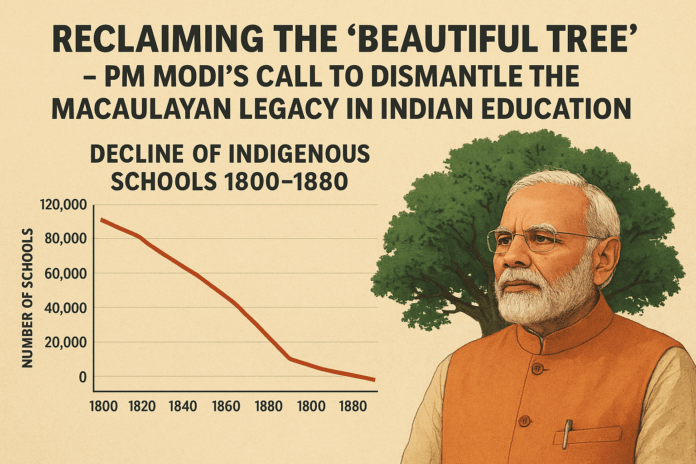
Reclaiming the “Beautiful Tree” – PM Modi’s Call to Dismantle the Macaulayan Legacy in Indian Education

0

Prime Minister Narendra Modi’s recent address at the sixth Ramnath Goenka Lecture has reignited a longstanding discourse on the colonial transformation of Indian education. Calling upon the nation to “free ourselves from the mindset of slavery that Macaulay imposed on India” by 2035, the bicentennial of Thomas Babington Macaulay’s infamous Minute on Education, the Prime Minister has placed the decolonisation of knowledge systems at the centre of India’s developmental vision. ​

Macaulay’s Minute: Colonial Intent and Its Instruments

On February 2, 1835, Thomas Babington Macaulay, as a member of the Governor-General’s Council, presented his Minute on Education, a document that fundamentally altered the trajectory of Indian learning. Macaulay’s contempt for indigenous knowledge was categorical and unapologetic. He declared: “I have no knowledge of either Sanscrit or Arabic. But I have done what I could to form a correct estimate of their value… I have never found one among them who could deny that a single shelf of a good European library was worth the whole native literature of India and Arabia.”

This sweeping dismissal extended to historical scholarship, with Macaulay asserting that “all the historical information which has been collected from all the books written in the Sanscrit language is less valuable than what may be found in the most paltry abridgments used at preparatory schools in England.” Such pronouncements, delivered without proficiency in either Sanskrit or Arabic, reflected not scholarly assessment but colonial hubris designed to delegitimise millennia of Indian intellectual tradition.​

The Minute‘s most consequential articulation, however, concerned its stated objective: “We must at present do our best to form a class who may be interpreters between us and the millions whom we govern,—a class of persons Indian in blood and colour, but English in tastes, in opinions, in morals and in intellect.” This explicit agenda to create a culturally alienated intermediary class between colonial administrators and the Indian masses remains the foundational critique of what is now termed the “Macaulayan mindset.” ​

Gandhi’s Lament and Dharampal’s Documentation

The devastation wrought by this policy was powerfully articulated by M K Gandhi during his 1931 address at the Royal Institute of International Affairs: “I say without fear of my figures being challenged successfully, that today India is more illiterate than it was fifty or a hundred years ago… the British administrators, when they came to India, instead of taking hold of things as they were, began to root them out. They scratched the soil and began to look at the root, and left the root like that, and the beautiful tree perished.” ​

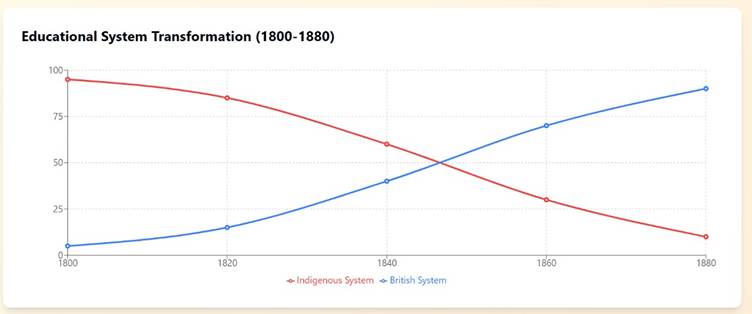
This metaphor of the “beautiful tree” was later substantiated through rigorous archival research by Dharampal, whose seminal work The Beautiful Tree: Indigenous Indian Education in the Eighteenth Century marshalled extensive statistical evidence from British colonial surveys themselves. The data revealed a remarkably inclusive and widespread educational ecosystem that contradicts persistent narratives of pre-colonial illiteracy and caste-based exclusion. ​

William Adam’s survey of Bengal and Bihar (1835–1838) documented approximately 100,000 village schools, nearly one school per 450 people. Crucially, Brahmins and Kayasthas nowhere formed more than 40 percent of the student population, while in two Bihar districts, they constituted merely 15 to 16 percent. The survey further noted that 674 scholars from the lowest sixteen castes attended native schools, compared to only 86 in missionary institutions. ​

The Madras Presidency survey (1822–1826) conducted under Governor Thomas Munro, who himself observed that “every village had a school”—produced equally striking figures. Students from Shudra communities constituted approximately 65 percent of enrolments, while Brahmins, Kshatriyas, and Vaishyas comprised only 24 percent. In Bellary district, Shudra students numbered 63 percent against 33 percent from upper castes; in Malabar, the ratio stood at 54 percent Shudra to 20 percent upper caste. ​

Contemporary Significance

PM Modi’s invocation of this history serves to contextualise the National Education Policy’s emphasis on instruction in local languages, not as linguistic chauvinism, but as recognition that nations such as Japan, China, and South Korea “adopted many western practices but never compromised on their native languages.” The Prime Minister clarified that the government is “not opposed to the English language but firmly supported Indian languages.” ​

The call to liberate Indian consciousness from colonial psychological conditioning by 2035 represents an invitation to critically re-examine educational foundations established nearly two centuries ago. As Dharampal concluded, understanding “what existed and of the processes which created the irrelevance India is burdened with today, in time, could help generate what best suits India’s requirements and the ethos of her people.”

Fig: A graphic visualization of the decline of the indigenous schools between 1800-1880, following the policy shift advocated in Macaulay’s minute. Based on the data found in Dharampal’s pioneering work, “The Beautiful Tree” (graphic generated using Claude AI).

Relevance of Traditional Knowledge Systems in the Information Age

0

Hardeepak Bassi

Yoga : There is no doubt that yoga philosophy has been an oral tradition passed on for thousands of years in India. Its relevance today is more significant as majority of people are living a sedentary lifestyle. There are thousands of yoga teachers in the western hemisphere. Due to its health benefits more and more people are seeing it as a powerful ally to the medical care system; yet, closed mindedness or prejudice of church authorities who have labeled yoga as a mystical religion,  prevent many from its miraculous health benefits. It remains a minor part of mainstream physio-therapy program recommended by very few medical doctors. Being a yoga teacher, I have seen amazing benefits of yoga first hand in my students with illnesses such as : anxiety attacks, OCD, infertility, prostate, diabetes, insomnia, migraine headaches, eating disorders, anger management, substance abuse etc. etc. 

Astrology : Whether we look at Jyotish ( Vedic ) or  Western, Chinese and Mayan astrology, all these are rooted in  pre-historic cultures. Origin of these knowledge systems is controversial. Due to ignorance and improper regulation by governments and education boards, we have a situation around the world where most people see astrology as a superstition of bygone era ! Add to that  past persecution of its practitioners by so called religions of love and peace during middle ages, astrological education remained vastly occult or hidden. 

Unless we  give this sacred art and science its proper place in society, we may not see whole lot of spiritual progress in our young people. To practice astrology is to respect creation in its all shape and form; this is foundation of a healthy lifestyle  I am a professional astrologer and served as executive member of  Astrology Toronto Inc. ( ATI ) in Toronto, Canada from 1992 – 1994. ATI is a non-profit organization that promotes public awareness of astrology through its Monday night lecture series.

Both yoga and astrology are self-empowerment and self-realization tools helping human soul to defeat easily five proverbial enemies : lust, anger, greed, attachment and arrogance. I feel that most institutions are threatened by the extreme nature of benefits drawn from these without involving capitalist ideology. Hospitals are going to see very few chronic illnesses and merely reduced to emergency care. Religious priests would no longer get away with lies when majority is enlightened and empowered. We may do away with bureaucracy and run our planet more efficiently by being more peaceful and honest with each other – a natural side-effect of yoga and astrology practice. Many health and service related industries may simply disappear ! Know that such society could only exist if it is truly founded on Sanatana Dharma. “Paropakaram hitam sareeram”  may not be a priority  of those in power right now; however, we shall prevail as our roots are much deeper and stronger.

Caste Discrimination in “Egalitarian” Churches

0

MADURAI (TAMIL NADU): It is an accepted thing that many Dalits seek refuge in Christianity because of oppression by non-Dalit Hindus. But there seems to be no escape for the neo-converts as discrimination continues in churches too. Dalit Christians have separate pews and burial grounds and are served Holy Communion wine from a separate chalice. The most visible form of untouchability is the double tumbler system in which a separate drinking glass is kept for Dalits in teashops. A similar system followed by the church till the late 20th century, particularly in Thanjavur district, was the double chalice system. A separate chalice was kept for serving Holy Communion wine to Dalit Christians.

The practice is now waning following agitations within the church by some ‘enlightened priests and sisters’. Following the ban on double chalice system, some churches have now resorted to serving communion wine with a spoon. “Shocking as the revelation may seem, this is the truth,” asserts Rev Dr Dhyanchand Carr, the rebel priest, who is the principal of the Tamil Nadu Theological Seminary, Arasarady, in Madurai. Carr said Dalit Christians still suffered ostracisation, segregation and oppression in the church. Neo-converts have to sit in separate pews during mass and have separate burial grounds. Some churches have also ‘generously’ built crucifixes, (miniature churches) in the vicinity of the main church for Dalits to make their appeals to the Creator. A majority of the Christians from Tamil Nadu and Kerala were converted from upper-caste communities in the early centuries of AD, and to this day, their descendants hold lower-caste brothers at bay. A majority of the clergy too belong to upper castes and so the Dalits are treated with scorn.

Carr relates an incident, which happened at the church in Tiruppuvanam, near Madurai, in the early 80s. About 200 Hindu Dalits embraced Christianity. On one occasion, a Dalit member ‘dared’ to handle the offertory bag. The pastor, who noticed it from the altar, shouted at the man mentioning his caste and demanded to know how dare he touch the offertory. Unable to bear this insult, the Dalit flock walked out and reconverted to Hinduism. It took almost five years to bring them back into the Christian fold, says Carr. Though the situation has changed over the years, the relics of casteism still remain deep -rooted in the church. Converted Dalits find no place in the decision-making bodies. Carr, who never covers himself with cassocks or vestments, says Dalit students find it difficult to enter educational institutions and hostels run by the church.

Those who raise their voice against such discrimination have been stigmatised as ‘Dalit pastors’. Dalit Christians are denied the rights and concessions extended by the Government to Dalits who haven’t converted to Christianity. The church too does not compensate them for this loss, says Carr. The neo-converts find it hard to shed their Hindu identity and continue to dress as before and observe the same customs.

The case of Dalits who convert to Islam is different. They shed their dhotis and begin wearing lungi and often sport a beard. Mercifully, the situation is changing for the better with more progressive young non-Dalit men entering priesthood in the church. But it will take a long time before the Dalit Christians begin to feel that they are being treated as members of the same fraternity, the rebel priest feels.

(Courtesy: The New Indian Express)

Building Brand ‘Hindu’

0
There is one “side-effect” of the feel-good factor which neither the “India Shining” nor the “India Cheated” peddlers seem to have noticed. The increasing confidence with which many Hindus are owning up their dharmic identity has certainly something to do with the economic growth within the community. The “Hindu Rate of Growth” has finally come home to roost!
This is precisely why many a wiseman has commented that we must be not too harsh in judging the BJP led NDA government in spite of its backtracking on almost all Hindu issues. ‘India Shining’ alone, it is said, is a sufficient reason to give them another chance. The nationwide Loksabha elections in April-May will test the truth of this view.
Indeed, none of us would like to identify with a religion that appears to shackle its adherents in poverty. That is precisely why economically weak Hindus have been highly vulnerable to poaching by dough-wielding missionaries. In addition, connect all the imaginary social evils under the sun to Hinduism and you have the perfect recipe long used by anti-Hindus to annul the Hindu identity.
The average Hindu is thus left with no choice but to adopt a new non-Hindu public identity that brings acceptance and prestige. Plenty of such alternatives have been provided to us in exchange – you can become a rational atheist, humanist, modernist, socialist, secularist in India or a South-Asian-Indian-American hyphenated hybrid in the USA.
Fear of the Other
In recent years, the Hindu identity has also been increasingly defined in comparison with the aggressive and cohesive identity of Muslims and Christians. While this has served the intended purpose of consolidating the in-house differences within the Hindu community, it has also led to an unnecessary fear that this modern Hindu identity is an aggressive socio-political handle to do away with the ‘other’. This false image has gained strength thanks to the ballyhoo in the national propaganda machine (the so-called the English Press) against the Sangh Parivar and Hindutva. Hence, the popular perception that Hindus who openly call themselves Hindus are “fundamentalists” of one Parivarian hue or the other.
Both these negative stereotypes deserve to be challenged. Our Hindu identity is primarily based on the positive value-system that forms the driving force of Sanatana Dharma. Thus, a Hindu is one who inherits this value-system by virtue of being born a Hindu or one who adopts it consciously.
The assertive social identity described above is a secondary aspect of this primary and positive Hindu identity. Yet, the secondary aspect is important and fulfils the concurrent need of answering the challenge posed by the exclusive and monotheistic worldviews of the Semitic faiths.
Subaltern Identities within Hinduism
Time was not far off when even Hindu religious leaders and ashrams who were supposed to provide us with the necessary leadership and initiative in creating a positive communal image, instead, withdrew from the mainstream Hindu identity – Ramakrishnaism, Aurobindonism and Arya Samajism are distressing examples of identity denial and failure of Hindu leadership.
Happily, the trend is being reversed today by revered preceptors who have more substance and courage and a time will come when these subaltern Hindus will be forced to join the mainstream by the growing strength and confidence of the community.
The Business Model of Religion
It appears that our religious identity has more to do with economics than the India Shining admen can ever imagine. In a multicultural world marred by religious and cultural conflicts, it is important to understand that organised religions behave much like business corporates in promoting their brands or selling their products.
We must study this business model carefully, for our task today is very much businesslike! Each one of us is consciously or unconsciously contributing to the formation of a new brand – 21st century Hinduism. We must play our roles well so that the 21st century Hindu stops being ashamed of his identity. “Garv se kaho hum Hindu hain” should not remain merely an emotional slogan; it should come from the depth of one’s soul, from wisdom born out of a deeper understanding and practice of Sanatana Dharma.
The Future of Hinduism
This issue is dedicated to young Hindus, especially American Hindus, many of whom have begun to rediscover their Hindu identity. They face an uphill task for being Hindu in a modern world is not child’s play. On the one hand is peer pressure (“It’s not ‘cool’ to be a Hindu”) and on the other hand is the apathy and sometimes even hostility of parents who are often more ignorant themselves and seek to impose their secular worldview on their children.
Some parents, in addition, have a mortal fear that their children will renounce the world and become ascetics if they took too much interest in religious matters (images of naga sadhus from the Kumbh Mela coverage in the media probably haunt their mind!).
It is the duty of every Hindu parent and teacher to facilitate such self-enquiry, instead of discouraging and injuring these blooming lotuses. This rediscovery is literally a rebirth and involves deep mental churning and soul-searching. May our young Hindu friends be reborn like the twice-born dvijas of yore. May their tribe increase!
– Editor
Identity Blues

The Great Banyan and the Small Worm

0

This is a story of hoary antiquity. But, the lesson it teaches us, especially the people of the Hindu society, is valid even today.

Long long ago, in the ancient city called Sanatanapura, there was a huge Banyan tree, of gigantic proportions. Nobody in that little town knew how old it was. The general belief, however, was that it had been planted by an ancient sap, may be Vasistha, may be Visvamitra or even the four-faced Brahma himself!

This mighty tree was so strong that even if a hundred elephants tugged at it simultaneously, it would not budge an inch. It was standing still, for ages, giving cool shade and protective shelter, to hundreds of living beings. It has usually been seen in this small world of ours – that is what it is when compared to the galaxy in which it exists – that greatness in one, often makes the small ones smaller still. Out of petty jealousy they react trying to besmirch the great ones. Though the great ones face every situation created by them in a way that befits their greatness – sometimes becoming martyrs even – the small ones do great harm to the society through their sinister manoeuvres.

This is what happened to that great Banyan tree one day. A small little worm, a poisonous one at that, and no bigger than a mustard seed, bored a hole in that tree and laid a few eggs. These eggs hatched into worms. These worms again bored more holes and laid more eggs. This ‘chain-action-reaction’ of eggs, worms and bores, went on ceaselessly for months on end.

All the while, the tree appeared to be mighty from outside; but, inside, it was gradually becoming empty, being sapped of its sap. And then, one day, as soon as a crow sat upon it, it just collapsed, unable to bear its weight. The mighty Banyan tree which did not budge even an inch by the tug of a hundred elephants, bent and broke under the burden of a tiny bird!

This story has a great lesson for us, the Hindus of India. True it is that our society has been like that mighty Banyan tree. Invasions and attacks from outside by thousands of barbarians and marauders often shook it and bent it but could never break it.

However, there is every possibility of its now becoming an easy prey to internal worms, poisonous and dangerous bacteria, against which eternal vigilance is urgently needed.

What are they?

Ours religion has withstood the test of time. It has produced innumerable saints and godmen. However, our Hindu society has not been able to rise to the level that is expected of it. We have no faith in ourselves, in our religion and culture. Then, what to speak of righteous pride?

This is the first ‘worm.’

What are its offshoots? Some of ‘our own’ people who style themselves as secularists and rationalists raise a hue and cry against our religion, write articles using intemperate language, deride our deities and even dare to caricature them on the screen, big or small. (Will they dare to do it against other religions, especially of the Semitic kind?)

And we? We hear them, read the articles, see the cinemas paying money and then keep stoically quiet or just remark that it is better to ignore the prattling of these people who do not know the greatness of our religion!

Have you ever seen the followers of certain religions of non-Indian origin taking things lying down when their religions are criticised? Should we not, at least, learn the spirit of virile faith in one’s religion, society and culture from them?

The second ‘worm’ is the tendency to change our religion, as easily as we change our shirt, and get converted to other religions, especially of the aggressively proselytising type. The main reason seems to be the attractions offered by them – ‘woman and gold,’ to put it in the language of Sri Ramakrishna – in the form of material benefits or pressurising tactics, often too subtle to be noticed. It is a well-known fact that these proselytising missionaries are too scared to approach certain other groups, whose swords will come out, no sooner than they are touched.

It will not be out of place here to quote Swami Vivekananda from his lecture delivered at Detroit in America: “One thing 1 would tell you, and I do not mean any unkind criticism. You train and educate and clothe and pay men to do what? To come over to my country to curse and abuse all my forefathers, my religion, and everything. They walk near a temple and say, ‘You idolaters, you will go to hell.’ But they dare not do that to the Mohammedans of India; the sword would be out.”[1]

Is it not inspiring to remember here, the great Sikh Guru, Tegh Bahadur, (A. D. 1621-1675) who refused to get converted to Islam, but declared that he would rather give up his life than his religion?

The tendency to quarrel in the name of our caste is the next, the third, ‘worm’. All of us are super-Vedantins, freely meting out the advice that all are equal from the standpoint of the atman or as embodied humans. (However, in practice we are a little more equal than others!)

While feeding a hungry soul or helping one who is in trouble or favouring one who is in need of it, caste-consciousness gets the upper hand! Objections to this behaviour are easily warded off with the universal declaration that the former is philosophy whereas the latter is the usual custom which cannot easily be brushed aside.

No doubt that great persons from Buddha (560-486 B. C.) and Basavesvara (12th century) right up to Mahatma Gandhi (A. D. 1869-1948) struggled their whole life to reform the Hindu society into a casteless mould. Can we too not add our efforts to theirs, at least to lessen, if not eliminate, the caste-based animosities?

It is easy to add more ‘worms’ to this list. But, it is not going to help us much. Let us wake up at least now, diagnose our internal illnesses first and the worms responsible for them. Then, take effective steps to destroy them.

If and when we stop quarrelling in the name of castes, cults and groups, if and when we remember the great Guru Teg Bahadur’s inspiring last words, if and when we develop tremendous faith and pride in our religion, culture and ourselves, a righteous pride that brooks not even the least humiliation to these, then and then alone, our Hindu society that has been like a vast and extremely strong Banyan tree, will regain its past strength, glory and beauty which no power on earth can dare even to try to uproot.

– Swami Harshananda

A Poet, a Revolutionary, and a Vedacharya

0

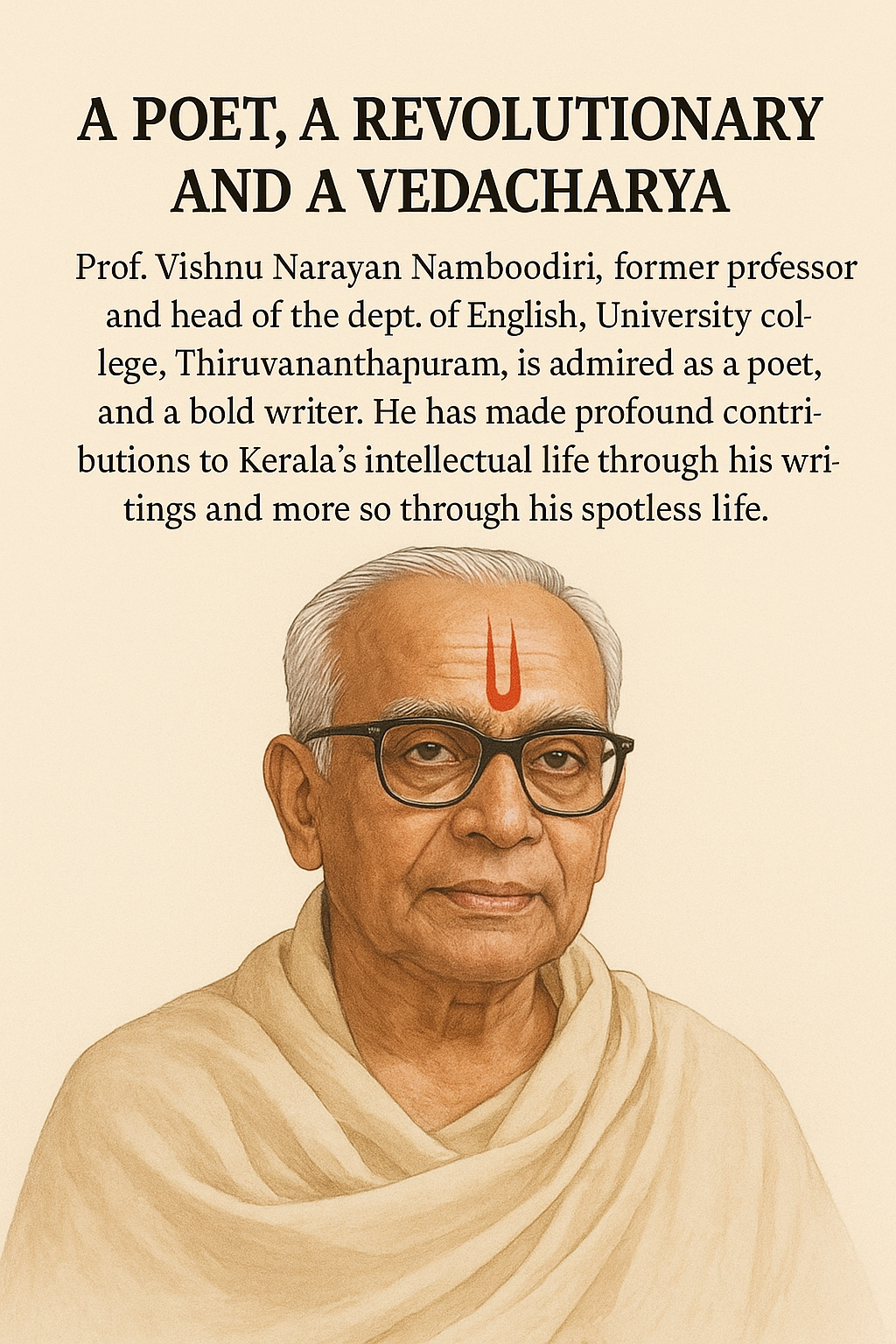
Prof. Vishnu Narayan Namboodiri, former professor and head of the dept. of English, University College, Thiruvananthapuram, is admired as a poet, and a bold writer. He has made profound contributions to Kerala’s intellectual life through his writings and more so through his spotless life. He was born and brought up in Kerala in the traditional atmosphere of Vedic learning which helped him fulfil his duties later as the high priest of the Tiruvalla temple. However, tradition did not narrow his horizons nor did his modern education in Physics & English literature uproot him from his roots. This, in fact, helped him build new bridges between science & spirituality, modernity & tradition. He shared some valuable insights with us. His loving interaction with local Dalit families is an example all Hindus must emulate. For further interaction, he can be reached at vnnamboodiri@yahoo.co.in

Q: What was it that invoked the poet within you? I have heard Malayalis say that Namboodiris cannot be good poets as a rule? What made you such a pleasant exception?
A: I am surprised at the remark. Because, the history of Malayalam testifies that so many of our great poets are Namboodiris. In fact the rule reads the other way: Poetry is part of the legacy of Namboodiris. I remember how as a boy during my Brahmacharya, the poetic sensibility I imbibed with the family Vedic education had often tempted me to babble in verse.

Q: Tell us something about your early life as a student of Vedic learning. The popular image is one of rigorous study coupled with extreme austerity. Some claim that many Brahmins in Kerala rebelled against this orthodoxy and rigorous lifestyle to join the communist ranks. Is this true?
A: Yes. My grandfather, like the illustrious V. T. Bhattathiripad, was one such rebel in early life; though later he grew to a great Vedic scholar harmonising tradition with modernity. It was not merely the rigorous course that repelled young Namboodiris in those days. The system of teaching then laid more emphasis on rituals and chanting, without letting the student breath in the warmth and vigour of Vedic learning. Then there were social evils to fight against – like caste and untouchability and landlordism. But let us not forget that the Gurukula system had its own matchless merits too. For example, it aimed at developing the latent skills and potentials of the young, rather than stuffing them with packed up knowledge. It trained them in moral habits as well as in spiritual inquiry. It was integral, never compartmentalised, as is the present western education system. We learned by heart thousands of slokas and retained them in memory for ready reference – Amarakosha, the dictionary, sutras (aphorisms) of grammar, pretty long narrative poems (kavyas) etc., without ever looking into a book. We practised the kalpaganitha, an arithmetic device to fix any number as a word by converting integers and zero into letters. As it were, the student used his brains verily as a computer and a library! Even today I can compose poems as I travel by bus or train, thanks to my early training. I do not require paper or pen for that.

Q: Did your traditional upbringing create obstacles to your growth or clash with modern life?
A: Never, never! It did help my organic inner growth much as a fence protects the growth of a garden.

Q: Temples have become the subject of a heated debate in the Hindu community today. The gross misuse of temple funds under government control is being challenged by many Hindu dharmacharyas. As a former priest of the Tiruvalla temple, what insights can you share with us on the functioning of temples. What solutions would you propose in resolving this conflict?
A: There were no temples in the Vedic past or later, even in the time of Ramayana or Mahabharata. The ashrams were the centres of spiritual pursuit as well as of effective social control. It was in the wake of Buddhism that temple worship came into vogue. Later, temples became centres of economic life, regulated by the priest who in his turn was representing royal power. In my view the problem today is not who manages the funds – the Government or Swamis. The problem is, how is the fund spent away? Temple funds must be exclusively used for educational, cultural, and spiritual purposes. Strict limits have to be placed so that no single paisa is spent on commerce in the form of revenue, tourism, and official paraphernalia. Better, I would suggest that temples may dispossess themselves of their exchequers, keeping just a bare minimum for the daily pooja functions. Money, you know, is evil; and it lies at the root of most other evils.

Q: Do you really advise dispossession of temples at this time? If temples have to once again become centres of Hindu cultural and spiritual life, they will need to channel their resources properly instead of entirely giving them up. Awakened Hindus today are also looking up to temples to fill this gap. Moreover, temples, especially ancient ones, will need sufficient revenue even to maintain themselves.
A: As to dispossessing the temples, it is my dream, the dream of a humble poet, of which I am not at all ashamed – rather proud of it! The feasibility of it is an entirely different matter. My ideal society is the Vedic society in which caste system was unknown; women were not discriminated; land was not monopolised; and aparigraha, non-possession, was the individual as well as the social discipline. I consider this the precise ideal for India to pursue. Failing which, I believe, she is bound to fall materially and spiritually… I admit that the work of approximating the national activities to that Vedic ideal is the grand task of the sociologist and the enlightened politician.

Q: Is it true that that there were no temples in Vedic times or during the Ramayana and the Mahabharata? Archaeological evidence coming to light seems to be pointing to the contrary…?
A: The only form of worship known to the Vedic people was offering into the fire; and the essence of it was tapas, spiritual exploration through meditation. The tank found in the Harappan site might very well be a tank for holy ablutions, mantra snaana, an essential part of the yaagas (vedic sacrificial rituals). True, there are references to centres of pilgrimage in the Itihasas (epics). They are found even in later works like the poems of Kalidasa. But those teertha sthaanas (holy places) are not just the temples that we see in those sites today. They were places of tapas (austerity) under Rishis; or confluences of sacred rivers like Ganga and Yamuna; or sacred mounts like Kailasa.

Q: As a Vedic scholar and practitioner, can you throw any new light on the Aryan Invasion debate? Have you come across any verses in the Vedas which refer to a non-Indian homeland or retain memories of any foreign lands?
A: The Aryan invasion is an exploded myth. The content of it is even less than nonsense. The Vedas in “a thousand blended notes” sing in praise of the holy land between the Himalayan ranges (Parvataa Himavantah) and the friendly ocean (Samudro Bandhuh), where the seven sacred rivers (Sapta Sindhuh) flow. If anybody can show me a single passage otherwise, I will kiss his feet in humility.

Q: Hinduism is in urgent need today of a consolidated social upliftment programme to care for the weaker sections of the Hindu community. What insights did you gain through your interaction with them?
A: Open up the sanctum of every Hindu temple for the spiritually aspirant Dalit priest of pure spirit and clean habits. After all, brahminhood is based on quality, not on birth. The day this is achieved, caste barriers will crumple down; and India will have her glorious rebirth.

Q: Regarding the idea of Brahminhood as a quality, can you provide a specific quote from the Veda / Mahabharata which sanctions this approach? Detractors argue that some teachers like Shankaracharya argued in favour of brahminhood by birth and hence Hinduism is bound to be caste-ridden…
A: The following Rigvedic passage tells that a person is born just a human being; and that he has to attain Brahminhood by spiritual competence. Manur Bhava Janayaa Daivyam Janam. Sankara says in plain language that the training for Brahminhood is Apeta Brahmakshatraadi Bhedam i.e., to be imparted without discrimination like Brahmana, Kshatriya etc. (Introduction to Brahmasutra Bhashyam).

Q: Some Dalits complain that Hindus today have begun to express concern for the weaker sections only out of fear and anger against poaching by Christian missionaries? Is Hinduism then lacking in a genuine tradition of caring? Why did it take us so long a time to wake up and help each other?
A: Let us not waste time and vitality digging up dead roots. Better late than never. And it is never too late to begin something so good. Remember, the basic tenet of Hinduism is: See that nobody is in sorrow! (Maa Kaschid Duhkhabhaag Bhaved).

Q: The mainstream media often uses the expression “silent majority” to differentiate the ordinary Hindu from the “Sangh Parivar.” Do you think such a silent majority exists? Aren’t a majority of Hindus today becoming conscious of their political and social rights? Is this a sign of radicalisation of the Hindu community as some fear?
A: The temper of the Hindu mind is such that fascism can never step into it. Therefore, if the majority of Hindus are charged with supreme national spirit, it is a welcome sign. In my view, what promotes this is not aggressiveness, but cool and determined activity. Hinduism succeeds and survives by the power of wisdom and the bravery of the soul. My only moment of disagreement with the Sangh Parivar comes when they justify violence as the last recourse.

Q: What direction do you think Hindu revival should take?
A: Evolution of a common civil code for India; abolition of all kinds of special privileges; introduction of Sanskrit at the fundamental level of education; ban on liquor, proselytisation, and the tourism craze. In development, a shift of paradigm from the consumerist Western to the eco-spiritual Eastern (from parigraha to aparigraha); and, of course, prayer / meditation and pilgrimage instead of the present orgy of festivals… so runs my dream.

– Prof. Vishnu Narayan Namboodiri

Re-defining and Positioning “Hindutva” for the Global Age

0
Human Thought Evolution  
The human race starting as nomadic tribal groups of people in prehistoric times has arrived in the Global Age today meanwhile undergoing many transformations beginning with survival instincts thru development of ideas, ideologies, isms and religions guiding their behaviors as individuals, families and societies.  These changes were aimed at the enhancement of their living conditions, fulfillment of individuals and development of purposeful missions for human life here on this planet and hereafter for Eternal Happiness. In the past three hundred years the development of science and technology has contributed significantly in advancing the understanding of the Natural Laws, the Physical laws, material sciences, health sciences and engineering. The Greek and Roman philosophies, the power of Church in Europe, the European Renaissance, the development of Rational Thinking and science, the birth of the ideologies of nationalism, socialism and communism and the emergence of the American Nation based on the ideals of liberty, democracy, and capitalism all have evolved in the past many millennia. 
Western and Eastern Paradigms 
For at least the past few centuries the Western Paradigm of life is dominating the world. The contributions of ideas, ideologies, and the current economic and political systems are all Eurocentric or are rooted in western philosophies. An entirely different paradigm of life developed in India thousands of years ago, long before the developments of the Greek and Roman thought, described as Sanatan Dharma or Vedic Knowledge and later named as Hindu Dharma pervading all spheres of human life from material sciences to moral laws. In the history of the development of human thought and culture this fact needs to be acknowledged by the scholars of the world. The ancient wisdom of the seers and sages of Bharat and their contributions to the development of an eastern or Integral World View has to be brought out in modern parlance using modern means of communications. The ancient wisdom described as Darshan by the Hindu seers is the intuitional knowledge thru their contacts with the Cosmic Intelligence. The Darshans are revealed in deep meditation and are neither philosophies rooted in the power of Rational Thinking as in the west nor the earlier knowledge rooted in the survival instincts. 
Epistemology of words 
Ideas are stray thoughts. Ideologies are crystallized thoughts. Isms are fossilized thoughts. Darshans are intuitional thoughts. Dharma is knowledge rooted in Cosmic Intelligence. Religions are traditions, beliefs and practices to relate individual self to personal or impersonal, with form (Sakar) or formless (Nirakar), Ishwar or God. Organized religions are mass movements aimed at directing or controlling human behavior based on non verifiable claims or as articles of faith in the scriptures. Darshans are not ideologies. Napoleon labeled a group of philosophers opposing his imperial ambitions as “ideologists.” The term later became integral part of Marxist proletarian movement. The monopoly of the Marxists over the use of the term ideology ended with other thoughts like Nazism or Fascism described as ideologies. Now ideology is established as a vehicle of idealists who subscribe to the ideals of radically transforming the societies to break the status quo of the realities of the human life (1). 
Emergence of the concept of Hindutva                       
In the nineteenth and twentieth century Indian leaders gave a clarion call to the people of India to drive out the British Colonial Rule from India and establish an Independent Nation. The masses were inspired by slogans like Vande Mataram, Glory to Mother India. The spirit of national consciousness was awakened with spiritual fervor by leaders like Swami Vivekananda, Shree Aurbindo and others (2, 3, 4.). The term Hindutva was coined by Swatantraveer Savarkar to describe the national identity rooted in the core values of Hindu Dharma. Later the term was adopted by organizations like Hindu Mahasabha, Rashtriya Swayamsevak Sangh (RSS) and others to energize the masses with much diversity of religious beliefs, languages, customs, dresses and above all the evils of high and low castes based on birth and developing a feeling of Oneness based on Hindutva (5) 
Experimenting with Ideologies in Independent India 
The leaders of the Indian Independence movement imposed their own perceptions on millions of Indian masses in the hope of transforming India and bring her to the center stage of the world affairs. The Indian politicians of the Congress party and other leftist parties experimented with the ideologies of socialism, democratic socialism and secularism. The first step necessary after independence was to define the national identity in tune with the national spirit of India. However the partition of India at the time of independence developed a psychological complex in the Congress leaders to win the hearts of the Muslim minority by defining secularism as a political philosophy with a special twist of appeasement in favor of the religious minorities. In the post Independence era under the leadership of Pandit Nehru the nation was guided by the principles of secularism and planned economic development on the lines of the Socialist model of the USSR. An alternative model for the economic and political development in Bharat, based on the principles of Integral Humanism was proposed by leaders like Pandit Deen dayal Upadhyaya. A new political party named Bharitya Jan Sangh , under the leadership of Dr. Shyamaprasad Mukerjeee was launched in1951. This party challenged the distorted practice of secularism to appease the religious minorities by Congress- the party in power.
Relevant Observations from Indian Constitution 
At this stage it is important to make two important observations about the Indian Constitution. First, the article one of the Indian Constitution defines the name of the country as,” India that is Bharat.”(6) The question is why the framers of the Indian Constitution and the Parliament that adopted the Constitution did not keep the ancient name of the country as Bharat or Bharat Varsha or Bharat Khand or Hindustan?  Was the name India adopted to cut out the thousands of years of Indian history and heritage?  Was it aimed at erasing the inspiring history of ancient India from the minds of the future generations of India? Second, the original Indian Constitution did not refer to secularism as a guiding principle. The words secular and socialist were introduced as the forty second amendment of the constitution during the period of Indian Emergency imposed by the then Prime Minister Mrs. Indira Gandhi in 1975-77. 
Origin and Interpretations of Secularism 
Just as the words ideology, fundamentalism, Fascism, Nazism etc were introduced in some specific context and later applied to other events over a period of time so also the word secular was introduced at some time in history and later applied with some altered meaning to it. The root of the word secular is in Latin word ‘saeculum’ meaning a ‘period’ also meaning ‘world’. According to the Holy Bible God created the world in six days and He rested on the seventh day. He, ‘The Father’ is in Heaven and hence the world is devoid of God and hence secular. This is in contrast to the Hindu view of creation as described in the Upanishads “Ishwar is pervading the entire creation and the creation is Holy.” Later in Europe the power of the State and the power of the Church came in conflict. The State declared its independence from the Church and became secular. Secularism is a system of social ethics based upon a doctrine that ethical standards and conduct should be determined exclusively with reference to the present life and social well being without reference to religion (7).  It was meant to describe the non- interference of religion in the matters of State but never meant to make the rulers irreligious or anti-religious. Even the Head of the state in the United States of America takes an oath of his office by keeping his hand on the Bible. Also the US Congress opens with a prayer by the Chaplain. Even the constitution of the USA is presented in the name of God and the US currency has the imprint, “In God We Trust.” But in India, secularism is equated with anti religious and particularly anti Hindu practice to appease the religious minorities. The advocates of secularism in India appear to be mostly agnostics or atheists and are the products of the colonial rule. Many secularists are privately practicing religion but are afraid to admit in public to maintain their image. Since Independence the leaders like Pandit Nehru and others have made untiring efforts to imprint on the minds of the Indian Intelligentsia that Hindu identity is a mark of communalism, narrow mindedness, backwardness  and the national identity with Hindu Cultural Nationalism is anti-secular, lacking progressive attitude and detrimental to the secular image of India. India, a country of over one billion people, having 85% Hindu population is left confused about the national identity. Among the seventy percent people living in rural areas of India, who have very little or no knowledge of English, calling them Indians has failed to provide any sense of belonging to a great nation. 
Dharma at the root of National Identity 
The vast majority of the people of Bharat know that their roots are in the soil of Bharat, their Motherland. This majority is inspired by Dharma and keeps trying to live according to the tenets of Sanatan Dharma while following diverse modes of worship and beliefs.Swami Vivekananda and Maharshi Aurobindo had given the linkage of spiritual vision to rebuild Bharat rooted in Sanatan Dharma. All the prominent leaders of India including Mahatma Gandhi, Pandit Nehru, Lokmanya Tilak, Chakrborty Rajaji were inspired by Swami Vivekananda’s call for the worship of Bharat Mata. Thus the concept of nationality is rooted in spirituality and Dharma. In the Ramayana, Bhagwan Shree Ram expresses his love for Motherland saying, “Api svarnamayi Lanka na me rochte Lakshman  Janani Janmabhoomishcha  swargadapi gariyasi.” “O, Lakshman, I do not like Lanka even though filled with gold My Motherland is the most adorable even compared to Heaven.” The call of “Vande Mataram ” “Glory to the Mother.” inspired thousands of young men and women in India to lay down their lives for the Freedom of India. Mahatma Gandhi was deeply religious and aspired for Ram Rajya meaning Dharma Based Bharat and not Secular Bharat.  On the other hand the perception is that the primary allegiance of the people of the minorities is to their religion and then comes the allegiance to Bharat. The minorities therefore hesitate from becoming the main stream society of Bharat. The special status of religious minority allows them favored treatment over the majority of the people due to the twisted meaning of secularism by the secular and leftist parties in India. This status appears at the root of the lack of urge among these people to become integrated in the national consciousness. 
Hindu, Hindu Dharma and Hindutva: Hindu in Persian Literature 
Who is a Hindu? How and when did the Hindu identity come into existence? The word Hindu has no mention in the ancient scriptures, the Vedas. Instead the value system of the people of Bharat was known as Sanatan Dharma. In the book entitled Bhartiya Sanskriti the origin of the word ‘Hindu’ is explained based on the word ‘Sindhu’. The ancestors of the present Parsees who were residents of Iran knew the Aryas of Bharat by the name of Hindus. The Iranians themselves were the people of Bharat. Perhaps this is the reason they may have called the Bhartis as the Aryans living beyond Hindu River or Hindu Aryas, the S in Sanskrit pronounced as H in Persian language (8). Thus the Vedic name Sapta Sindhu is mentioned as Hapta Hindu in Avestha. Following this lead the Greeks, almost all Europe and late Americans began to call us Hindus or Indians.   To quote from the book “Discovery of India” Mr. Nehru writes, “The word Hindu does not occur at all in the ancient literature but it is clear that the word is very old one, as it occurs in the Avestha and in old Persian. It was used then and for a thousand years or more lately by the people of Western and Central Asia for India or rather for the people living on the other side of Indus or Sindhu river. The word is clearly derived from Sindhu, the old as well as the present Indian name for the Indus. From the word Sindhu was derived the word Hindu and Hindustan, as well as Indus and India. The land described as Sapta Sindhu covered the lands from the Caspian Sea in the west to the Hindu Kush and beyond in the east, Pamirs in the north to Punjab, Sindh and Kashmir in south. This description of Bharat in Avestha agrees with the one given by Alberuni (9). 
Hindu in Chinese Literature 
Bharat used to be known as T’ien Chu by the ancient Chinese. Yuan Chwang writes T’ien Chu (India) is derived from Shen-tu and Sien or Hien-tou, now pronounced as Yin-tu means Moon, the prominent among the stars, referring to India as the shining star among the other nations. According to Chwang Tien-Chu Shen-tu and Sien-tu are dialectical varieties of Yin-tu that is also written as In-tu referring to Sanskrit word Indu (moon) so the word Hindu appeared to be derived from ‘Sindu’ or ‘Indu’ or both (10). Even if both the names Hindusthan and India have the same origin in Sindhu river, India is a name given much later by Europeans. Hindusthan or Mother Bharat relates to the entire Vedic period and the history of glorious Bharat, the history of great personalities like Prithviraj, Guru Gobind Singh, Chhatrapati Shivaji. Nehru’s preference for the name India is rooted in his psyche nourished in England and his utter disregard for religion and his belief in economic development as a strong binding force of nationhood. 
Hindu Dharma: 
The Vedas are the books of the Hindus, the primary source of Sanatan (Eternal and Universal) Dharma. Dharma is the Cosmic Law, the Natural Law, the moral and ethical law that sustains the cosmic order (3). Dharma covers the relationships of individuals, societies, nature and Ishwar. Thus Sanatan Dharma is all inclusive, revealed through human consciousness. No historic person or a Prophet can claim to be the Founder of Sanatan Dharma. One who practices Dharma is blessed with Self-Discovery of the potential divinity of the Self. Dharma therefore does not divide the humanity among believers and non-believers and does not condemn the non-believers as Pagans (non-believers in Bible) or Kafirs( infidels or non-Muslims) It does not send anyone to Eternal Hell based on his/her beliefs. Dharma therefore goes beyond the religious traditions, mode of worship or religious beliefs of the people. Hindu Dharma is Sanatan Dharma. It is known as Hindu Dharma because the knowledge of the Cosmic Laws was revealed by Rishis who were Hindus. Just as we know the law of gravity as Newton’s Law of Gravity to honor Newton for revealing it to the world.During the past 1300 years Hindus were under constant struggle to protect themselves and their heritage from the onslaughts of invaders. The invaders demolished the educational institutions and the systems providing the knowledge of Dharma. During this struggle the Hindus sustained their great heritage very informally and could not keep up with the enhancement of knowledge. The people kept hanging to some rituals and prayers in their homes. The powerful influence of Dharma was reduced to a minimum resulting in deterioration in the society. It is well known that Dharma protects those who protect Dharma. Hindu society lost its edge and suffered from all sorts of evils dividing themselves in high and low castes based on birth, the social injustice quoting scriptures and poverty caused by the exorbitant loot of the wealth by the invaders and the colonial rulers. The practice of Dharma was reduced to mere maintenance of rituals. 
Hindutva: Philosophical Foundation 
During the independence struggle in the nineteenth and early twentieth centuries, the leaders had to restate the Vedic Truths using a different terminology to reenergize the society. The leaders appealed to all the masses to understand the underlying cultural unity in spite of apparent diversities. They gave a call to the mass consciousness in the name of the organic nation Mother Bharat. They coined the word Hindutva to appeal to the people to live as one organic nation with the diversities of languages, castes, sects, classes, regions and forge a common front to drive away the British Rulers from India. Hindutva is thus the expression of the group character of the people who believe in Dharma. Hindutva is the total expression of the philosophy, the traditions, the culture and the heritage of the Hindus. It is the essence of the national consciousness of India. Hindus have made significant contributions to the development of material sciences, health sciences, mathematics, astronomy, state governance, legal system, military besides music, art, architecture, mysticism and philosophy. All these contributions are the beautiful petals of the flower called Hinduism (11, 12). Hindutva is neither a political ideology nor a religious belief system. The Hindutva philosophy is based on the integral view of life searching for human happiness irrespective of their personal religious beliefs. Hindutva is therefore the spiritual thread of Bharat that is India. In Sanskrit language the word Vyaktitva means individuality meaning the sum total of the personality of an individual including physical, intellectual, emotional, moral and spiritual domains of life. Hindutva is similarly the expression of the total national life of Bharat. It is therefore the only binding force to keep the entire country as an integrated nation with her all inclusive, pluralistic, spiritual and temporal living tradition. The judgment of the Supreme Court of India (1994) on the election appeal No 2836/1989 is an important landmark supporting the views on Hindutva expressed here (13). 
Hindutva vis a vis minority religious groups 
It is an uphill task for the Hindutva movement leaders to foster this understanding among the people of Islamic and Christian faith to this view of Hindutva and to make them accept their forefathers and their achievements without giving up their religions. The minorities would have the same civil and political rights as the majority of the population. They are welcome to the Hindu (Indian) polity. The acceptance of the common national identity, irrespective of religious preferences, is the only genuine approach to keep Bharat a real secular country in the long run. Thousands of years of Hindu history welcoming and accommodating many different people like the Jews, the Parsees, the Syrian Christians and innumerable paths of worship among the Hindus is the proof for the claims made by Hindu leaders. Even the democratic set up in India is attributable to the Hindu psyche in India. But the greater hurdle to the change of the psyche of minority religious people is the political agenda of the secularist and the leftist politicians of India. These pseudo-secularists would like to continue pampering the minorities, bestow upon them special privileges and continue inducing in them the fear of persecution from the majority Hindus. Besides the Indian secular intelligentsia have to be convinced about the game of the secular politicians. The English news media is the powerful weapon in the arsenal of the secularist politicians and is being deployed against the Hindutva leaders. On the other hand the Hindutva leaders have no support of media savvy journalists or ownership of media to counter the anti Hindutva propaganda of presenting secularism as the antidote of Hindutva. The headlines news, the editorials, the Op-Ed articles, the letters to the editors published in news papers all point to the planned onslaught on Hindus, Hindutva, Hindu leaders and organizations inspired by Hindutva. The Hindutva leaders need a reorientation and refocusing on the communications techniques to deliver the message without emotional outbursts and too many generalized observations and resolutions about national and international issues. 
Onslaught on Hindus 
The onslaught on Hindu interests and the indifference of secular politicians have generated among the Hindus the feelings of helplessness and frustrations. The anti-Hindu acts of the secular Government of India and the State Governments are undermining the interests of the Hindus. The take over of Hindu temples management and temple properties by the government, the selling off of the temple land, the disbursement of the temple donations to support non- Hindu causes (16), the proposal of reservations in education based on religious minority status and the move to identify military personnel of religious minorities are the acts of giving wall to the Hindus
Hindutva and Bhartiya Janta Party (BJP) 
The current Bhartiya Janata Party (BJP), former Jan Sangh, came into existence after the defeat of Mrs. Indira Gandhi’s Congress following the imposition of political emergencyin India from 1975-1977. The BJP embraced the term Hindutva in party’s political agenda. The party has emerged as an alternative national party to the Congress party. According to the BJP, the Hindutva agenda is not aimed at establishing a theocracy of Hindus in India and the party membership is open to all without any religious bias. However the Secularists and the Leftist parties in India dragged BJP and their supporters in the debate of Secularism versus Hindutva. The Hindutva agenda of the BJP included the amendment of the article 370 of the Indian Constitution dealing with Kashmir’s special status, the common civil code for all the citizens of India, the ban on cow slaughter and the reconstruction of Shree Ram Janma Bhoomi Temple at Ayodhya (14). The temple issue was originally the agenda of Vishwa Hindu Parishad and it was later adopted by the BJP at the National meeting held at Nagpur in 1989. The election results in 1998 returned 181 members of the parliament from the BJP, a significant increase from 88 seats in 1992. The demolition of the Babri structure at Ayodhya in December 1992 and the close alignment of BJP with VHP and RSS during the last decade of the last century created an alarm in the secular politicians. The speeches and statements of the Hindutva leaders were critically analyzed by media. As a result the term “Hindutva” gained a negative connotation and its supporters perceived as Fundamentalist or Communalist or Fascist Hindus. The English news media played a major role in this negative propaganda sponsored and supported by anti-Hindu forces. The rise of the BJP as a ruling party in the coalition of thirteen political parties in the government of the NDA made the secularists and the leftists to be more aggressive to damage the image of Hindutva forces in the country. The BJP, to become the ruling partner had no choice but to agree to the agenda of the NDA, giving up the party’s Hindutva agenda. This strategy of the BJP backfired as the leaders could not deliver any results to satisfy their constituents and supporters from the VHP or the RSS. The BJP government did deliver some good results like positioning India as the nuclear power of the world and generating enthusiasm among certain sections of the Indian polity due to economic development programs. The BJP leaders decided to hold early elections (2004) in the hope of easily winning by riding on the wave of India Shining. According to the reports received during the pre-election period the party ignored their own supporters at the grass root levels and also the important leaders of the Hindutva Movements.  The leaders of BJP tried to move away from the Hindutva base in the hope of finding more support of the minority groups to come out much stronger in the election results. But the BJP failed to get the required number of seats to form the government in the national elections of the year 2004. Following the defeat of the NDA, the differences of vision, mission and working relations among the BJP, RSS and VHP leaders were strained and their statements provided the spices necessary for the media to demoralize the grass roots and also the supporters of the Hindutva agenda. Even the most ardent supporters of the Hindutva movement were shocked in utter disbelief observing the lack of organizational discipline and observing in their leaders’ utter disregard for the highest ideals of serving the country even at the cost of their lives. 
Hindutva and Global Scenario 
One additional challenge to the Hindutva leaders is the game of the international Islamic and Christian movements actively engaged in weakening India’s position in the global affairs. In the changing global scene the civilization conflicts rooted in religions have taken over the game earlier confined to the cold war tensions among the Communist and the Capitalist countries and their allies (15).
Global Hindu 
The word Hindu, originally meant to describe people within a certain geographical territory, namely Bharat, has assumed a new dimension. Today over 20 million Hindus of Indian origin and over 10 million others of non-Indian origin who follow or believe in Dharma based traditions live all over the world. These people along with one billion people in Bharat need a common identity. They can accept the name Hindu or Dharmi to develop a global net-work. The people of other Dharmic traditions having their roots in the soil of Bharat and living globally include Buddha, Jain, Sikh and ancient traditions. These people share many common spiritual values and may prefer to align with Hindus or Dharmis. India is the Holy land for Hindus living all over the world. All Hindus aspire to go to pilgrimage to the Holy Himalayas, taking a dip in the Holy River Ganga, have darshan of the Holy shrines and their Gurus besides visiting their relatives and friends. Hindus wish their children and grand children remain connected with the spiritual heritage of the country of their origin. Hindu Diasporas has a deep seated religious urge to be able to visit India, the country of Hindu culture and civilization. They are the stakeholders in the future India remaining the religious and spiritual center for Hindus in particular and for humanity at large in general. 
Global Realignment 
The world is undergoing a realignment process after the collapse of the Soviet Union. Earlier the alignments were among the countries that shared common ideologies subscribing to democracy, capitalism, western values of life and identified communism as their common threat. In the post Soviet era, many expected the United States of America to become the supreme leader of the world. According to Prof. Samuel Huntington (14) the world instead is moving toward multi-polarity with new fault lines developing along the common civilizations. The eight major civilizations along the religious lines are: 1 Islamic, 2.Christian, 3.Budhhist, 4.Hindu, 5.Orthodox Christian, 6.Japanese Shinto, 7.African, and 8.Sinic.Confucianism. Islam and Christianity are both proselytizing religions. According to their theology, it is the duty of the followers of Islam and Christianity to convert the people of other religions to save them from their sin. The history of both these religions has recorded Jihad and Crusades, killing millions of Kafirs and Pagans or converting them and destroying many cultures around the world. The Christian Missionary activities, as far back as 1960, in the tribal and backward areas of India are aimed at mass religious conversions using fraudulent means. The national integrity of Bharat is threatened seriously in North Eastern states of India. 
Global Terrorism 
The growing menace of terrorism perpetrated as an assertion of Islam has resulted in making sanctuaries of terrorists in and around India. Hindus have bled for centuries and survived many onslaughts from the followers of Islam invading from the north –west frontiers of India. Modern day politicians have shown no effective strategy to combat the acts of terrorism except empty slogans and weak resolutions. Following any act of terrorism, the typical reactions are the declaration of the politicians promising to deal firmly with terrorists, the statements of moderate Islamic leaders stating Islam as a peace loving religion and the fringe groups of Islam expressing their support to the acts of terrorism. In India over 40,000 Hindus have been victims of terrorist acts in Kashmir. The terrorists- attacks starting from the Mumbai blast in 1993, killing in Akshardham temple, Gujarat, Shree Raghunath temple, Shree Ram Janma  Bhoomi temple, Ayodhya, The Indian Parliament, New Delhi (2001), attack on the temple in Varanasi, serial bombings in markets of New Delhi on the eve of Hindu New Year day (Deepavali), a murder of a professor of mathematics, IIT Bangalore, RSS headquarters, Nagpur (2006), the 7/11/2006 Mumbai suburban trains blast killing nearly two hundred and injuring over seven hundred people are all aimed at Hindus and Hindu Civilization and are reported to carry fingerprints of the involvement of Pakistan based terrorist groups. The latest report of the terrorist attack on Shree Krishna Temple, Imphal, during Janmastami celebration on August 16, 2006 leave no doubt that for the terrorists India is a prime target. 
Role of Global Hindus and Dharma Gurus 
It is time for the Hindus settled outside of Bharat and the Dharma Gurus traveling around the world, to open a dialogue with other religious traditions and form a strategic alliance with the people who are opposed to terrorism. A global voice condemning terrorism and an international support countering terrorism require immediate implementation. This global initiative should compel the Indian Government to protect the Hindus and the Hindu culture from being destroyed by the Jihadis. 
Violations of Hindu Human Rights: 
Over and above the acts of terrorism causing massacre of innocent Hindus and others, the Human Rights violations sponsored or supported by States have resulted in elimination of Hindu minorities in Pakistan, Bangladesh and Kashmir. The Indian Government due to the special brand of secularism practiced in India has miserably failed in addressing the issue directly or indirectly. Even the Human Rights agencies have done very little to raise the voice against the states committing Human Rights violations of the Hindus in these countries. Any voices raised by organizations concerned for the Hindus have been maligned as communal or fundamentalist and ignored completely. Let us look at some examples of these violations over the last many years. The Kashmiri Pandits, over 600,000 of them, now living as refugees near New Delhi, in their own country are the victims of Pakistan sponsored acts of terrorism.  The genocide of Bangladeshi Hindus and other religious minorities in Bangladesh who are reduced from 41% in 1941 to 10 % in 2003 in a population of 140 million people is an act of ethnic cleansing sponsored by Islamic theocracy. Recently Nepal, the only Hindu State in the world was forced to give up the Hindu national Identity by the Marxists working closely with other anti-Hindu forces in Nepalese territory. Hindu American Foundation (HAF) has published a very objective report covering the genocide, ethnic cleansing, terrorism and discriminating laws that Hindus face everyday in many countries. In Pakistan only 1% population of Hindus, mainly in Sindh, is remaining of the 24% Hindu population at the time of the formation of Pakistan in 1947. According to HAF report, there was a spate of Hindu temples destruction in 2005, kidnapping and conversion of Hindu girls. The report also includes the story of discrimination against Hindus in Fiji and Afghanistan. The other countries that are under constant threat of annihilation, religious conversions or discrimination include Indonesia, Malaysia, Guyana, Suriname and Trinidad. 
Need a New Vision and a New Strategy in Indian Politics: 
India is among the top four or five countries in the world, namely China, India, the United States of America and Brazil with population over 250 million. The demographic changes place India among the young countries of the world with a population of one billion of which over 75% population is below the age of 35 years. India is among a few nations with independent, disciplined and most powerful military forces and nuclear power. India provides the most needed technological, scientific and educated professionals to the world. But above all India gives a great hope for the humanity with her ancient wisdom of living in harmony with all. India has spread the message of peace and non- violence to the world by remaining an example that has not invaded other countries or cultures to capture power, wealth or promote her way of life causing destruction of other civilizations of the world. All these facts make one believe that it is time for India to provide the much needed leadership to the world for making the twenty first century a period of spiritual advancement for the entire humanity. It is time for the beginning of a new political era in India. In the recent past the first phase of transformation of India was the Independence Movement in the first half of the twentieth century led by Mahatma Gandhi and others. The second phase in the second half of the twentieth century was the stabilization of Independent India as the largest democracy of the world and inspiring the whole generation to transform the society inspired by the Hindutva Movements. In the coming decade India needs a new political party of young leaders with integrity, dynamism and a new vision “Bharat, the Hope for Global Peace.” It is time to focus on Dharma based politics in India. All the people who have faith in moral and ethical values of life (Dharma)and who are willing to clean the Indian political system and the governments at all levels need to come on one platform and develop an alliance with a common agenda for positioning Bharat among the leaders of the world. How should Hindus address the most fundamental issues of the national identity, the core values of the Indian nation, the ideological orientation of the people to inspire them to strive together for the well being of all the citizens and to position India among the top five nations of the world, are some of the immediate major challenges for the leaders of India. The current political debate on Secularism versus Hindutva is founded on wrong assumptions. Both secularism and Hindutva refer to the orientation of the psyche of the Indian society. The primary goal of secularism is to ensure that those in power do not impose their religious beliefs on the rest of the citizens. It is to ensure that followers of a certain religion are not given a preferential treatment in opportunities of careers, jobs or any civil rights. One major realization of Hindu Dharma that the entire creation is one family ensures the ultimate limit of secularism anyone can envision. This realization has been in practice in Hindu families where family members have the freedom of worship according to individual inclination and also among the various sects of the society. India is one nation and not an assembly of religions and communities. For the vast majority of the citizens of India, the name of the country is Bharat or Hindusthan. The national identity of the people is Bhartiya or Hindu and their core values are rooted in Dharma, the moral and ethical values for all human beings. The religious traditions and modes of worship may be rooted in different sources and need not be equated with Dharma. The current practice of secularism is dividing the country among those whose religious beliefs are not having their roots in India, primarily Islam and Christianity, and the rest whose religious practices are rooted in India. It is important to note that the ancestral roots of the majority of the people classified as minorities and the vast majority of the citizens of India are common. It would be a significant achievement of the minorities if they begin to appreciate that their ancestors practiced the same Dharma and belonged to the same cultural heritage as the vast majority today. Furthermore if they realize that their adoption of different religious practices is not a reason for them to give of their pride in their ancestors, it would pave the way for their acceptance of the main stream national consciousness. The vast majorities of the people in India are not allowed to claim them to be minorities even while they have different religious beliefs and practices. They are grouped together as the followers of Hindu religion even when the word Hindu refers to the identity of the civilization and not a religion. This is an anomaly. The commonality among the Hindus and the minorities is in their being the people of the same ancestral heritage and the same civilization. How can a group of people of the same ancestral heritage be divided as minorities in a country like India where diversities of religious practices and traditions are always respected? The acceptance of Dharma as the Rule of Law and the assurance of the Fundamental Rights under the Indian Constitution should be enough to protect and to advance the well being of all the citizens of India. . Dharma is at the root of Indian nation and not religious practices. This realization is essential to generate a new political debate in India about Dharma versus Secularism and not Hindutva versus Secularism. The constitution of India protects the fundamental rights of all the citizens. The democratic form of the government ensures the adult franchise. Shri R. K. Sidhwa, a prominent Parsee member of the Constituent Assembly (1943) said that the ultimate phase of the political life of all Indians should be one nation, no communities.” But this ideal can not be realized till the politics of secularism gets support in the election manifestos of the political parties of India. To ensure the national integration of India, Dharma (moral and ethical values) based politics giving assurance of fundamental rights to all the citizens as per the Indian Constitution is the first step toward building India that can be among the leader nations of the world. 
Scheduled classes and Scheduled tribes 
The second most important step toward national integration is to take a closer look at the current state of the schedule classes and schedule tribes in India. The policy of reservations or special benefits enacted in Article 16 of the Indian Constitution is an acknowledgement of the horrible injustice done to the Dalits and other backward people in the past. In framing the policy, Dr. B. R. Ambedkar wanted to ensure that those people, who were deprived, discriminated or forgotten, were given special opportunities of education, employment and social status and eventually became integrated in the main stream of the Hindu society. Even after 59 years of Indian Independence, very little progress has been achieved in improving the lot of these people. The primary cause has been at the level of implementation of the policy. The secondary cause is rooted in the indefinite time for continuation of the reservation policy itself, encouraging the politicians in playing the vote-bank politics. The worse situation today is the exploitation of the people classified under scheduled tribes, scheduled classes or backward classes, for the political gains by those who are interested in sustaining this evil in the society to keep Hindus divided horizontally for capturing votes by giving false hopes and promises. It appears that the solution to this serious problem is not in adding special articles or more detailed descriptions of the rights or more number of reservations for these people in the Indian Constitution. It is a problem deeply rooted in the psyche of the people, a social problem, and it requires a social solution. Today there is a wave of spiritual awakening in India due to the efforts of many spiritual leaders of India.  All these spiritual leaders, the Dharma Gurus have to make a clarion call to the conscience of the Hindu society through their devotees to accept all the human beings as children of God without discrimination. The emphasis needed is to phase out gradually all the lists of the scheduled tribes, the scheduled castes and backward Classes giving every citizen the same status. Special training and education programs and employment opportunities to those who have suffered due to social injustice in the past must be made available to ensure social justice. This will ensure the development of high self esteem among all the people of India. Unless all the privileged class Hindus accept this as a challenge to do away with the social injustice, India cannot regain her glory among the nations of the world. The Hindutva Movements have definitely done a lot in this area of social development. Let the Dharma Gurus take up the unfinished work and lead the Hindu society to the real path of hope and harmony. 
Dharma and not Secularism an antidote for Corruption 
The single most epidemic that is eating away the confidence of people in the moral and ethical values of life is the epidemic of corruption. The corruption is rampant and the ideology of secularism has not given any positive results to free the society from this epidemic. The principles of Dharma carry a greater weight in the psyche of the Indian people. If Dharma based politics is advocated, it may inspire all the citizens, including the elected representatives, the bureaucrats and the public servants, and we may see the magical result in controlling the epidemic of corruption to a large extent. Let there be public debates for and against the topics,” Is secularism or Dharma an antidote to corruption?” “Are secularists Dharmic or Adharmic?” A new tilt in political discourse is needed in redefining the real issues of the Indian Polity. 
Economic Development 
Besides the identity crisis and the rampant corruption, the other cause of frustration among common people in India is the uneven economic progress. India has definitely made major strides in the economic development in the last decade but the benefits of the overall growth of the Indian economy have yet to reach the bottom half of the Indian population. The challenge before the leaders of India is to develop an economic model keeping the well being of the human beings in the center while being conscious of the interdependence of the human society on the global environment. Can India provide an alternative model of economic development to the world based on Dharma resulting in sustainable development without causing unrestrained exploitation of the natural resources? 
Hindutva for Social Transformation  
A vast country like India run by a democratic process unquestionably needs an inspiring ideology ensuring national integrity, powerful well tuned political parties as vehicles and political leadership with vision, integrity and dynamism. Bharat, Hindusthan or for the comfort of some, India, is the name of the country with thousands of years of history and cultural heritage. The people of Bharat have been known as Bhartiyas during this long history or as Hindus for at least over two thousand years and as Indians for a couple of centuries. The core values of these people are rooted in Dharma. Hindutva represents nothing but the core values of Dharma. This word though often misused and misquoted by Indian political parties, is the only word describing the real core of the Indian values, giving due recognition to ancestors, providing emotional bond to the majority of grass-roots and inspiring millions of people to dedicate their lives for the cause of India. Hindutva is the solution for Hope and Harmony in this global age.  However the magical message of Hindutva is muffled due to a lot of background noise of anti-Hindu global forces. The effectiveness of the message of Hindutva has been weakened by the thoughts and deeds of some misguided people holding the banner of Hindutva. To coin a new term to replace Hindutva, to make it popular and inspiring enough to build a new movement around it are formidable tasks and the tide of time is against it. To refocus the agenda of Hindutva based movements and to articulate effectively to media and to regain the vibrant power of Hindutva is well within the reach of many leaders of the movement. Hidutva movements have to nourish the Hindu cultural ethos at the grass-roots level. 
Contributions of Hindutva Movements 
Here is the score card of the most effective social transformation conducted by the Hindutva Movements in India and even globally. While accepting Hindutva for the social transformation, it is not a political ideology and hence a new debate is needed  to challenge the twisted form of secularism promoted as a political ideology in India. The Hindutva movements in India and around the world conduct thousands of constructive social service programs. These programs are conducted by thousands of volunteers donating their time, money and energy and even their lives in some unsafe regions of Bharat. These volunteers come from many organizations like the RSS, VHP, Seva Bharti, Bharat Vikas Parishad, Rashtra Sevika Samiti, Vidya Bharti, Deen Dayal Research Institute and others. Ekal Vidyalay Foundation, Friends of tribal Society and vanvasi Kalyan Ashram focus their efforts in serving seventy million vanvasis living in over 100,000 villages and helmets in the most difficult hills and forests of India where there are no access roads for vehicles. These organizations run over 17,000 schools covering 20 states. The VHP serve over one million people with the help of 4,000 full time volunteers and 5900 projects. These projects include orphanages, leagal help centers, working women hostels, priests training, Goshalas, Gomutra medicine production centers etc. Seva Bharati and other organizations conduct over 25,000 social service projects all over India (17). The volunteers of these organizations are in the forefront whenever and wherever a natural disaster strikes the people. The services of these volunteers were available at the time of Gujarat earthquake or Sunami or Katrina or disasters caused by terrorism as in New York 9/11. The social service projects and programs conducted by the Hindutva movements deserve special recognition by the global human society. These projects not only provide the needs of the less fortunate people but teach them how to live with self respect and national pride in their hearts to become the integral part of Bharat. These self less services rendered by the volunteers of Hindutva movements are rooted in their sense of sacrifice for the Motherland without any aspirations for personal glory or recognition. This great human endeavor is not given due publicity by the media that is engaged in maligning all the Hindutva movements as fundamentalist and communal. Whatever it be, the Hindutva Movements should continue focusing on their primary goals of awakening and serving the masses of India. 
Dharma for Indian Polity
The new direction needs a new national political movement with a new vision, a new mission and a new leadership. The new vision is to build Bharat as an integral nation rooted in Dharma, the core values life for the universal well being of humanity. The new mission is to position Bharat as a Global leader of Hope and Harmony by the year 2020.The new leadership of   Bharat must be with a profile of integrity of character, vision and dynamism. The new party must challenge the secularists and the leftists to a new debate of Secularism versus Dharma. The current game of the secularists to keep India divided vertically among Hindus and Muslims and horizontally among High caste Hindus and Dalits, Scheduled tribes etc toward fulfillment of their narrow political objectives must be completely rejected by throwing a new challenge to them. Dharma based politics is the only hope for an Integrated Bharat to become the center of the Global hope and harmony. The immediate goals of the new party should include: a corruption free administration, economic development programs aimed to provide opportunities of earning income through education and training and health care for the lower 50% of the Indian population, implementation of human intelligence and modern technology to eliminate the fear of terrorism within the country, to  protect the country from the onslaught of aggressive foreign powers interested in destabilizing India and to make the nation’s borders safe from the neighboring countries and with a global reach programs to promote harmony among civilizations. The academicians, social workers, and other experts should be encouraged to organize Think Tanks to recommend well studied policies regarding the innumerable topics of importance in the governance of the country. The new movement must focus on young leaders. Today India with one billion people has 75% of the people below the age of 35 years age. The current Indian Parliament of over 500 members has not more than a dozen young members. The choice of the young leaders is not meant to disregard the wisdom and experience of the old leaders. But the future of the country should be in the domain of individuals with an average age of 50. The services of the Elder Statesmen should be made available through the Advisory Councils of Experts. The new movement should be organized with the help of leaders who are willing to bring new energy in the democratic institutions of India. The BJP has lost its credibility due to the past performance to combat the games of the secularists and the leftist parties. As of today, BJP has reduced itself to the status of a B-team of the Congress party. The Hindutva Movements should stay focused on their agenda of Hindu Cultural Renaissance, without getting organizationally involved in the day to day politics of any parties. The State level political parties, with their local agenda, will remain a significant force to reckon with. The new party will have to incorporate the State interests and to integrate them with the national agenda. The formation of a new party is a formidable challenge but not an impossible one for those who have fire in their bellies to make India the global leader of Hope and harmony.                                                             
REFERENCES 
1. Integral Humanism, K. R. Rao, p.30-48, 1995
2. K. M. Panikkar in World Thinkers on Ramkrishna Vivekananda, edited by Swami Lokeshwrananda p.57. 
3. Karmayogin, Vol.1, 14. 
4. India’s Rebirth, Sri Aurobindo 
5. Bunch of Thoughts, M.S. Golwalkar, p 117, 1996. 
6. The Constitution of India. 
7. Webster’s Third New International Dictionary. 
8. Avestha- Vendidad (P 1-18) 
9. English translation of Alberuni, Vol. I pp. 197-98,258, 260 
10. Beginnings of Life, Culture and history, S. D. Kulkarni p.487, 1988. 
11. Indian Sciences Through The Ages Vol. 12, Part I and II, Vivekananda Kendra Patrika 1983.    
12. Science and Scientists in India, (Vedic to Modern) Nem Kumar Jain, 2001 
13. Supreme Court Judgment on Hindutva compiled by M. Rama Jois, 1996 
14. Bhartiya Janata Party Election Manifesto, 1996. 
15. The Clash of Civilizations & the Remaking of World Order, Samuel Huntington, 1996 
16. Statement Hindu Dharma Acharya Sabha, Chennai, Nov. 29, 30 & Dec 1, 2003. 
17.Seva Disha 2004, Publisher: Rashtra Seva Bharti
Dr. Mahesh Mehta About the author:

The Voice of Indian Students on School Education

0
Michel Danino: We have long heard that India’s school system, a legacy of the colonial era, needs to be radically overhauled if it is to meet the needs of a modern and largely young nation. Yet students themselves have rarely been asked for their own impressions, much less consulted on ways to improve the quality of education.
To help fill this lacuna, the International Forum for India’s Heritage (IFIH) conducted an NCERT-sponsored Survey on Educationfor Standards 9-12; over 11,000 students were asked to answer 72 questions. The survey was conducted in English (66%) and seven Indian languages; students (40% of them girls) were drawn from 278 schools spread over 21 States; 85% of the students were from private schools, 81% from urban schools.           
The questionnaire’s first part dealt with Indian culture and values, the second part with the students’ experience of other aspects of the educational system; while some questions were of the yes/no type, most required the students to spell out their thoughts and suggestions, which provided a substantial qualitative feedback.
Findings on culture in education           
The Survey first questioned students on aspects of Indian heritage: arts, science, festivals, traditional sports and games, literature, inspiring historical or mythical characters, yoga and spirituality. The results were striking: 91% of all students felt that they would benefit from learning elements of Indian culture. Among the aspects of Indian culture that students would like to learn, art comes first, followed by asanas and pranayama, physical games such as kabaddi, and meditation.
Coming to values, only 38% of the students felt that they were acquiring some values at school, an alarmingly low proportion; 7% specifically stated they were acquiring no values at all, 11% gave intermediate replies, and 44% did not reply at all.
As regards the values which students said they would most like to practise in their own lives, honesty came first followed by truthfulness, brotherhood and friendship, duty and dharma, reverence for / inspiration from one’s parents, self-perfection, courage and simplicity each, and finally non-violence.
When asked which values they felt they had acquired from stimulating stories from theRamayana, Mahabharata, Panchatantra, etc., the categories and proportions were very similar, which reflects on the inspirational potential of such texts and stories when used as educational tools.           
In a study correlating 11 different questions and defining a five-grade scale, 83% of students showed a substantial degree of interest in Indian culture or in learning about it at school, denoting an eagerness for cultural education – undoubtedly one major finding of this Survey.           
Analyzing the variables, we found that Indian-language students value Indian culture (including yoga and meditation) markedly more than their English-medium counterparts. While Tamil-medium students are the most dissatisfied as regards the attention paid to Indian culture in their curriculum, students of Gujarati and Bengali mediums are those most interested in Indian culture; barring Hindi, English-medium students score the lowest. Overall, students of rural Govt. schools showed far more interest in Indian culture, followed by their counterparts from private urban schools. Students of Govt. urban schools seemed the least interested.
Findings on the quality of the educational system           
The Survey highlighted aspects of the students’ experiences at school.
Mother tongue vs. English47% of the students feel that the mother-tongue medium is the best to facilitate understanding (against 24% who favour English). This feeling is especially strong in Govt. schools (63%), and among students studying in Bengali, Kannada, Tamil and Gujarati. Even among English-medium students, 40% favour the mother-tongue medium.
Competition: Even though 64% of the students find competition beneficial, 43% feel that the examination system is stressful (the figure is probably much larger in reality).
Textbooks: 62% find the load of textbooks they are made to carry to school unnecessary and excessive.
Role of parents: While the majority seem satisfied with the role of their parents in their education, 35% report being under pressure to get marks.
Physical training: 70% of the students find physical training a pleasant change, but 31% of them find it insufficient. Most schools have some physical activity once a week, but many have it once a month or even less.
Eco-awareness: About half of the students report participating in the planting of saplings or cleanup programmes, but only 26% have been taken on visits to Nature spots. 67% desire a green area in or around their school.
An elaborate study of a “satisfaction” pattern, correlating 15 different questions and drawing a five-grade scale, concluded that only 42% of all students could be said to be satisfied with the quality of school education (out of which 8% were “very satisfied”). Another 28% are average, 23% are dissatisfied and 8% very dissatisfied. Moreover, students of Govt. schools, especially in urban areas, are more dissatisfied than those of private schools. Overall, Bengali-medium students rank as the least satisfied, followed by English-medium and Tamil-medium students.
MediumEnglish-medium students find the examination system much more stressful than do Indian-language medium students; we showed that one contributory factor for the stress is the difficulty of following studies in English.
Remarks on Expression           
Our studies of patterns highlighted a few important points:
•The proportion of blank answers to challenging questions was generally high (21% over all questions, rising to 36% over the more challenging questions), suggesting a lack of habit of original thinking or expression. We feel that this is because the school system relies largely on mechanical methods of teaching and learning, and discourages students from articulating their own thoughts.
•Analyzing the more challenging questions, we found that students of Govt. rural schools are the most capable of expressing their thoughts. Private urban school students come a distant second.
•In terms of medium, the same study shows that students in Tamil and Gujarati are well ahead of others, including English-medium students, in the ability to articulate their thoughts.
Conclusions           
Our Survey has highlighted the failure of the average school curriculum to meet the cultural needs of students, regardless of the school type or medium of instruction. This confirms long-standing observations by educationists that schooling in India imparts no meaningful cultural values to the students. In particular, English-medium students come out as the least interested in Indian culture; whatever the cause, this points to a systemic failure.
Value-based education has long been viewed as supremely desirable, yet the average Indian school appears as far from this goal as ever. To meet the students’ aspirations, it would be essential to:
•Reduce the pressure of examinations and competition, and lighten the syllabus to make space for such disciplines.
•Integrate Indian culture into the curriculum innovatively, and encourage schools to conduct extra-curricular activities of a cultural nature.
•Work out ways to reward students who excel in cultural disciplines.
The above can only be done if deeper reforms are envisaged. Students themselves have provided valuable suggestions for change:
•Reduction of the syllabus to make room for quality.
•A less mechanical pedagogy: Many students complained strongly about teaching methods that brought no stimulation to thinking. They also asked for teachers to have human qualities such as patience, understanding, and cheerfulness.
•A practical-oriented pedagogy: There was a consistent demand for more practical, less bookish or theoretical learning, including audiovisual material, computers, sports and physical activities, visits to places, industries, and nature spots.
•Examinations: 24% of students suggested either doing away with exams altogether, replacing them with daily evaluation, or making them more flexible in terms of subjects and timing. Exams should test the child’s real talent and understanding, not merely the capacity to memorize textbooks.          
Despite some limitations, this Survey has highlighted areas where school education has failed in its mission to equip a student to face life. It also shows that the still prevalent notion that education can be designed without the active participation of the students is a relic of the past. In any effort to make those twelve years of schooling a more fulfilling period in a child’s life, students should not be seen as passive recipients. The students’ voice is a genuine one and deserves to be heard. They should be accepted as active participants in their own education.
Michel Danino
Convener, International Forum for India’s Heritage (www.ifih.org)
80 Swarnambika Layout, Ramnagar, Coimbatore – 641 009, Tamil Nadu, India
Email: micheld@sify.com, ifih@vsnl.netnet
About the Author:
Michel Danino is a long-time student of Indian civilization and has translated and edited books related to Sri Aurobindo and Mother. He is also the convener of the International Forum for India’s Heritage.

Hinduism in America: Setting Our Own Terms

0

If you have read Aditi Bannerjee’s recent article, “The Hyphenated Hindu”, in Outlook magazine, you’ve likely concluded that Hinduism faces great peril in America. Perhaps, this is so. But for me, growing up Hindu in America, even in small, pious, Christian, Midwestern, Bible-belt America, was a privilege, not a curse. Thanks to the efforts of my parents and other Hindus in the community, we formed a Hindu school and took various trips to Gurukulams. Thanks to the open-minded curiosity of our neighbors and friends, we, unthreatened, could deepen their understanding of Hinduism, as well as our own, whenever they had any questions. Thanks to the new environment, we could choose which aspects of our great religion — and our great country — to hybridize. People trusted us to explain our religion, because they recognized that it was our lived experience. I realize that mine might be a rare, lucky story, a product of parental interest and benign social neglect. Regardless, my experience in the heart of America taught me to value both my religion and my society for the openness with which they allowed me to explore one another.

When I arrived in college, however, my environment changed. In essence, it now resembled the environment Aditi described in her article. Before, it was sufficient for me to explain that all the usual negative buzzwords in Hinduism — caste, chauvinism, and ritualism — were not part of Hinduism as it was practiced by 90% of those I knew. Now, I had to justify this observation by distancing myself from those buffoons — whom I had never met or seen — who still practiced regressive Hinduism. Before, it was sufficient for me to explain that Hinduism was a religion of tolerance; now, I had to swallow my irritation as others used a few horrible exceptions to tar Hinduism’s record. Worst, I could not simply explain key concepts of my religion to others using whatever words were handy; suddenly, labels had become all-important. Was I an Advaitist or Dvaitist? A Vaishnavite or Shaivite? A Congress “secularist” or a BJP “fundamentalist”? Because my parents had maintained neutrality (for our town’s Hindus, at least) between these often-pointless labels, they had unconsciously taught me to see the good in each. Such nuance found no home between these simple homogenizations, which took on a life of their own. Soon, I found myself divided against myself, and against my colleagues; where once my diversity was my strength, a simple act of naming had transformed it into my weakness.

The problem of labeling has a long history in India. The Vedic rishis taught us to avoid it with their characterization of God as neti, neti (not this, nor that). It was later thrust upon us in the form of a clumsy word — Hindu — which was little more than a geographic signifier. Later, it divided our various sects into different “religions” as it was manipulated to mean caste and ritualism. Later still, labeling helped to divide India between the “backward” and the “forward” and continues to create new fissures. And the problem’s scope is endless. When Westerners define religion, they often mean non-rational faith; by this label, Hinduism only occasionally qualifies. Religious scholars now try to find ways of “including” Hinduism as one of the “religions” worth study. It’s hard not to see the slur, as if the oldest contiguously surviving and flourishing spiritual/cultural system in history “needs” their classifications to prove worthy of study. A well-meaning student of religion once informed me “there is no such thing as Hinduism, only ‘Hinduisms’.” I was so conflicted that I couldn’t even protest. The warning of the rishis never seemed more apt: labelling, whether inspired by self-exorcism or scholarly creativity, has wreaked havoc.

Labels also underlie the difference between Aditi’s experience and my own. A benign environment allowed me to pick and discard my labels at will; a hostile environment forced her and other Hindus to adopt those of others. In the hostile environment, one cannot be a “devout Hindu” and yet a “believer in secularism”, despite the fundamentally pluralistic nature of Hinduism. One cannot simply hate bigotry; one must also hate the “Sangh Parivar”, and find faults even in its most humanistic goals. This self-imposed exile by moderates only leaves the Sangh in the hands of even more extreme individuals, ironically perpetuating the cycle of alienation.

And the labels are not just divisive; frequently, they are untrue. What is “true” Hinduism: what Hindus practice or what we hear of our practice from scholars of dubious integrity? How is it “secular” to engineer governmental take-over of temples? With a combination of labelling and deceit, the detractors of Hinduism have set the terms of discourse and kept alive the policy of divide-and-rule. They have so twisted the meaning of words that a former geographic signifier — Hindu — now means nothing more than caste, ritualism, and whatever else negative can be attached to it. There can be no positive new formulations as long as others control our fundamental name and its attendant implications. One need only examine the record of the Ramakrishna Mission, Sri Aurobindo Society, the Arya Samaj and Sikhism, all of which were born in the wide arena of Hinduism, and all of which eventually denied their Hindu-ness. None wants to be associated with this pariah word. In such an environment, even innocuous labels like “Hindu-American” will only serve to further deracinate the very body of Hinduism proper we are trying to save.

New labels will avail us nothing; it is the very act of labelling, especially when it is steeped in deceit, that we must challenge. For this problem of labeling to be ameliorated, we must do many things. First and foremost, we must challenge the labels. What do people mean by “Hindutva?” Do they fix a value for Hindu traditions? What do they mean by “Hindu revivalists?” Do they mean we fight to modernize our religion and make it relevant? Each question will force the labelers to explain themselves and expose the deceits implicit in many of their “guilt-by-association” strategies. Second, we must pick new labels that accurately characterize us as individuals. Most of us are pluralists; most of us are tolerant. Many are humanists. We must focus on our individual non-classifiability, as well as that of any movements we might support. The bottom line is that we should set our own agenda, not agree to pre-arranged categories that bear little resemblance to reality.

In the real world, we cannot simply do away with them, so we should ensure that we do our work by setting them ourselves. We need to challenge, overturn, and redefine them when they divide deceitfully. We must control, at the very least, the way our own positions and ideas are discussed. Otherwise, even adding new labels will be a futile exercise. Without a more aggressive approach, “Hindu-Americans”, like so many reformers before them, will soon grow ashamed of the “Hindu” their names were designed to protect.

28th January, web edition.
The article is available online at:
http://www.outlookindia.com/full.asp?fodname=20040128&fname=aditi&sid=1

Author:
Raman Khanna, hailing from Ohio and a former student of religious studies at Northwestern University in Evanston, is presently pursuing his medical studies in Chicago, Illinois (USA).

Raman Khanna

Hindutva in the Present-day Context

0
To discuss ‘Hindutva in the present-day context’ is both simple and difficult at the same time. Simple because ample has already been and is still being said about Hindutva by its adversaries as also its advocates. Difficult because it is hard to sift the ocean of literature about Hindutva and interpret it in the present-day context.
What adds to the intricacies of the task is the confusion surrounding the concept of Hindutva — thanks mainly to the intellectual liberty, almost bordering on irresponsibility, enjoyed by both adversaries and advocates alike. Too much political colouration of Hindutva and absolute apathy on the part of the academia and intelligentsia to understand its core message has made the task easier for its adversaries to paint it as a weird, unsustainable ideology. No wonder that almost two decades after the Ayodhya Movement, Hindutva hardly figures in whatever serious intellectual discourse is witnessed in India. On the one hand, adversaries of Hindutva indulge only in using it as an old stick to beat its advocates, while the latter do precious little to present it in the modern context and in the idiom which the intelligentsia worldwide understands.
In the post-independence history of India, the nineties have their own importance. Early nineties saw the political consolidation of the forces behind the Hindutva movement, only to be taken to its logical end in the late nineties, manifested in the emergence of BJP-led governments in New Delhi. It was in this decade that Hindutva became a prominent, almost central theme of intellectual discourse in our country. Those who owed allegiance to Hindutva as a political ideology became a force to reckon with. Gradually, it became impossible to just ignore what was happening in the Hindutva camp. So much so that several political analysts of international standing attained fame for their very honest effort to understand what was happening in India. Nobel Laureate V. S. Naipaul believed that the movement was inevitable.
Ayodhya Movement
The Ram-Janmabhoomi movement was the perfect symbol of Cultural Nationalism and it communicated the message of Hindu Unity so very effectively that hundreds of Leftist scholars were at pains to explain how Hindus had come together through a movement which was described by them as ‘Brahmnical’. While sound logical arguments in favor of Ram-Janmabhoomi made it acceptable in educated urban and thinking circles, what was more important was the emotionality of the issue, which proved to be a unifier par excellence.
It was an issue so deeply rooted in our shared ethos that it became hard for even the staunchest secularists to gloss over it. At least for a certain period, Ram-Janmabhoomi made the Hindus forget their caste identities and, in a way, forced them to think of their larger cultural identity — the Hindu identity. A number of secularist journalists who witnessed the events in Ayodhya on December 6, 1992, had to publicly accept the fact that the sea of humanity they witnessed had only one inseparable identity, and that was the Hindu identity. Regardless of the questions of legitimacy of the events on that fateful day, the one certainty was that in the entire length and breadth of our nation, the entire Hindu society experienced an intense feeling of unity and solidarity, so very unheard of about the Hindus earlier.
This emotional unity, however short-lived it might have remained, was the greatest contribution of the Ram-Janmabhoomi movement. True, Vishwa Hindu Parishad (VHP) and other organizations had undertaken several programs aimed at consolidation of all those who are essentially Hindus right after the Meenakshipuram conversions. Still, the success of the Ram-Janmabhoomi movement was simply unparalleled. This single event had given rise to expectations that now, with solid popular support, Hindutva ideologues would strive to make inroads into the intellectual and academic arenas. Expectations soared further after the installation of BJP or BJP-led governments, both in some states and at the centre. It was thought that the ideology which proved instrumental in seeing BJP at the helm of affairs would also be duly recognized in academia and thinking circles. But, unfortunately, it just did not.
Notwithstanding the propaganda of the Left-leaning academics about the so-called Saffronisation of education, Hindutva as an ideology continues to be untouchable in the corridors of academics. This untouchability emanates from various factors. Granted that largely this ‘untouchability’ is thanks to the lure of political correctness, it is also true that there are sections in the opinion-making classes who have genuine misunderstandings and, at times, serious complaints about this ideology. Not every objection deserves to be ignored, much less rubbished.
Demystifying Hindutva
While analyzing the challenge of demystifying Hindutva, it must be noted that the outer world has always seen the Hindutva movement through a particular prism only. Three dimensions of this prism consist of three important events in post-independence history of India: the murder of Mahatma Gandhi in 1948, the destruction of the disputed structure at Ayodhya in 1992, and the post-Godhra violence against the Muslim community in Gujarat in 2002. Majority of the opinion-makers consider these three events as stereotypes and base their understanding of the Hindutva movement on them.
While it is true that there could be different angles of looking at these events, it is also true that regardless of whichever angle one desires to take, it is required to understand the backdrop on which these three independent events happened. All three events could be described as expressions of anger or pent-up emotions, and hence the state of collective minds responsible for these events needs to be dispassionately analyzed and a sound understanding developed before one chooses to either defend or denounce outrightly.
Noted journalist Francois Gautier has brilliantly commented on this phenomenon of collective expression of anger. He says, “However reprehensible these acts of mass vengeance were, they have shown that Hindus keep quiet for a long time: they get riled at, they are made fun of, they are despised, their women raped, men killed, children burnt in trains and one day they blow up — and blow up badly. Riots don’t erupt in a few days: they are the fruit of decades, of generations even, of suppressed anger, of frustration, of a silent majority which sees itself more and more marginalized and taken for granted.”
Due to this widespread belief that the persons responsible for these events were all avowed supporters of Hindutva, the entire movement received a bad name and a negative image, extremely hard to erase. People are aware that thousands of service projects undertaken for the underprivileged sections by hundreds of dedicated life workers believing in Hindutva have functioned consistently for several decades. Yet, such commendable work has not helped this movement earn acceptance because the so-called progressive and secular forces have consistently turned a Nelson eye towards the benign influence of Hindutva organizations and chosen to portray only the momentary aberrations committed by a section of erring Hindus.
Destruction of Image
Behind this double whammy against Hindutva is the unwillingness of its adversaries to really understand the strong sense of denial of Hindu aspirations, the feeling that historical wrongs against Hindus were not addressed by governments despite serious efforts of the Hindu community to focus attention on them and negotiate a solution. The result has been that adversaries of Hindutva relish painting the entire movement black.
Their series of allegations against Hindutva consists of the following five points:
Hindutva is sectarian and hence anti-Muslims and anti-Christians.
Hindutva is communal, pro-upper caste, pro-Manu, and hence against the backward and weaker sections of society.
Hindutva is anti-women, obscurantist, and against gender justice.
Hindutva is against freedom of expression.
Hindutva is anti-modernity.
Most of the above allegations have been repeated umpteen times, creating thick clouds of misunderstanding around the entire Hindu movement. No ideological movement in the world may have ever faced such a grave image crisis. Considering the extremely wide gap between the reality about the movement and its largely established image, Herculean efforts from the defenders of Hindutva are a must.
Spiritual Democracy
Before we examine the basis of these allegations, it is necessary to inquire what exactly we mean by Hindutva. Hindutva consists of the term Hindu, which is largely understood as a way of worship, a religion, or a belief system. However, the term Hindutva per se does not refer to Hindu religion. Literally speaking, Hindutva means ‘Hinduness’. Just as the Sanskrit term Manushyatva means being a human, Hindutva can be explained as being a Hindu.
Due to a huge multiplicity of worshipped deities and a vast diversity of the ways to worship them, no straightjacketing is possible in Hindu religion, and, as a consequence, in the Hindu worldview. It is in this complete denial of straightjacketing that lie the roots of spiritual democracy, which is the most distinguishing facet of Hindu religion. Unlike Christianity and Islam, Hinduism never presents itself as the only way to seek salvation. On the contrary, Hinduism considers that every path leads an individual to the same truth and to the same almighty, which wise/knowledgeable persons refer to in different ways.
A firm belief in this concept, as communicated in Ekam Sat, Vipra Bahudavadanti (Truth is one, sages describe it differently), is the cornerstone of Hindu religious thought. This notion has, in effect, made all religions valid and reverential for all. It is due to this fundamental faith in the existence of multiple ways of seeking salvation that the concept of proselytisation and the resultant competition for converting people finds no place in Hindu religion. This is also true in other indigenous belief systems, be it Jainism or Buddhism.
Let us not forget that this spiritual democracy, this fundamental spirit of accommodation, alone could make India a shining example of centuries of peaceful co-existence of different religions and belief systems. In other words, thanks to Hinduism, India could evolve a replicable model of sustainable pluralism. Acceptance of the fundamental equality of, and hence equal respect for, all religions and all the ways of worship is the basis of such sustained pluralism.
It must be remembered that if one commits him/herself to the cardinal principles of sustainable pluralism, one cannot talk of the superiority of a way of worship and hence of the need to convert adherents of other faiths. Besides, once one indulges in the concept of superiority of a religion, no meaningful dialogue between faiths can happen.
Today, when the entire world is facing a severe threat of terrorist tendencies, and the root cause of terrorism happens to be a particular religious belief system, can humanity survive without accepting spiritual democracy? The essence of the concept of spiritual democracy, I believe, has helped Hinduism survive.
To put it simply, Hinduness does not lie in a set of rituals, systems of worship, or belief in any scriptures. It does not assert that there is only one path to attain salvation and openly concedes that belief, without any reservation. It is in this essential acceptance of, nay, welcome to other faiths and other gods, that the crux of Hinduness—i.e., Hindutva—remains.
It is this very unique and supremely liberal characteristic of Hinduism that makes one a Hindu. It is on this background that one has to look at the proposition that to be an adherent of Hindutva, one need not necessarily be a Hindu. It is in the light of this core concept of Hindutva that one has to examine issues such as social justice and gender equality.
No Place for Discrimination
Once one accepts that every path ultimately leads to the same ultimate truth, the questions of caste and creed need to be settled once and for all. Hindutva has absolutely no place for discrimination on the basis of caste. Equality of human beings is the cardinal principle. In the Hindutva scheme of things, the superiority or inferiority of an individual cannot depend upon the family into which one is born. When Hindutva aspires to put an end to such discriminations lock, stock, and barrel, where comes the question of defending Chaturvarnya, untouchability, or caste conflict?
The essential unity and equality of mankind perceived by Hindutva cannot accept any artificial divides promoted by politicians in the garb of academicians. Theories like Aryan invasion, conflict between indigenous and non-indigenous people, differences between aboriginals or Adivasis and others, branding certain social groups or communities as criminals by birth, or a conflict between the victor and the vanquished cannot find any place in the concept of Hindutva.
It may be pointed out that adversaries of Hindutva always propagate that Hindutva is the other name of Brahmanatva. There cannot be any statement farther from the facts than this. Several references in Dalit literature are testimony that the upbringing of Dalit children happens in the same religious-cultural ethos as that of the so-called upper-caste children. The way Brahmans celebrate Diwali is in no way different from the way Mangs, Matangs, and other scheduled caste groups celebrate. The same is true of Adivasis.
Several sociologists have established that Adivasis in India are not like aboriginals in Australia. Many erstwhile nomads or even martial communities took shelter in thick forests during times of turbulence, centuries before. Today, they are identified as Adivasis, the original inhabitants, as if all others are aggressors or outsiders. In this context, one must reconsider the terms used to refer to our own brethren.
Again, to say that simply because some Adivasis eat beef or worship nature without idols, they go beyond the purview of Hindutva, is a misnomer. When Hindutva can accept even Lord Christ or Prophet Mohammad, where comes the question of not accepting nature worship? Above all, how can non-Hindus like church groups in India’s North-East sit in judgment and decide who are Hindus and who are not?
Social Equality
On this background, it is necessary to discuss the question of social equality in general and caste-based reservations in particular. It must be noted that the universally accepted and widely acclaimed concepts of affirmative action and positive discrimination for social justice are at the root of caste-based reservations. Supporters of Hindutva have realized long ago that larger and lasting Hindu unity will not be possible without the so-called upper castes cultivating a mindset to create space, at the cost of their own opportunity, for the underprivileged classes.
It would not be wrong to suggest that the privileged and comparatively less fortunate sections of society also have to ensure that the weaker sections not only get reservations but are also duly empowered to take advantage of them. Those committed to Hindu unity cannot be unmindful that if emotional integrity is not achieved, Hindu unity will remain a chimera.
For emotional integrity to sustain, one has to promote the spirit of mutual understanding, accommodation, and a sense of fundamental social responsibility. Hindus must remain fully aware of the designs of anti-Hindu-unity forces aimed at dividing society and breaking cultural-emotional bonds and inter-community harmony. Having said that, the whole gamut of issues concerning reservations needs a re-look. Thinking outside the box regarding ways to make caste-based quotas more effective and result-oriented is the need of the hour.
For this to happen, the issue of caste-based quota must be de-politicized. Politicians must choose between securing vote banks and protecting national interest. High decibels while clamoring for quota cannot be the only yardstick for being progressive. Quotas cannot be de-linked from the wider issue of social and community identity. Narrow and communal identities need to be accommodated and amalgamated with the wider national and social identity. Ironically, this can happen only through respect and recognition for smaller identities, which can never be crushed but only accommodated.
‘Recognize first and then try to remold’ could be the only effective way of dealing with these issues. Creating an atmosphere where every part feels it can lead a meaningful life only while remaining inseparable from the whole is a severe challenge before the Hindutva movement. For this, disadvantaged sections of society need to be assured equal respect, equal opportunity, and equal protection. Mahatma Gandhi’s principle of Antyodaya (placing the last man first in a welfare state) as the mainstay of policies for social justice and social harmony alone can halt the process of social divide.
Sustainable Pluralism
The vexed issue of conversions has a close connection with social justice and equality. Firstly, demands for quota for new converts from formerly scheduled castes and tribes have rendered the argument that conversions bring social equality and respect completely hollow. More importantly, when Hindutva itself means broad-mindedness, how can one accommodate an argument that a particular faith alone is valid or has a monopoly on salvation?
Granted that in a spiritual democracy, one is free to worship the gods of their choice. However, this cannot be stretched to accommodate a “sole distributorship of salvation” claimed by certain belief systems. Any argument in favor of conversion that construes acceptance of other faiths as inferior and invalid is totally against the grain of spiritual democracy. In any truly secular democratic polity, conversions should find no place at all.
At several occasions in the past, those who swear by secularism have developed cold feet. The 45th Amendment of 1978 introduced in the Indian Parliament the definition of “secular” as “equal respect to all religions.” However, the Rajya Sabha, with a Congress majority, rejected this definition, mainly because some fundamentalist elements in non-Hindu belief systems opposed it.
Yet another case of stubborn opposition to this equality of faiths is the year 2000 International Conference of all Belief Systems organized by the UN to mark the beginning of a new millennium, when the Vatican chose to stay away, saying they could not sit with other faiths and declare acceptance of equality of religions. Artificial or contrived conversions are an affront to human rights, and if fraudulent conversion is allowed unabatedly, it will deliver a body blow to sustainable pluralism in the long run.
Gender Justice
The foundation of Hindu ideology lies in scriptures like sarvepi sukhina santu, sarve santu niramayah (Happiness and health should reach all). Naturally, the idea of Hinduness encompasses the welfare of all humankind. If this is true, how can Hindutva ever be discriminating on the basis of gender? The Hindutva worldview presupposes both men and women as equal and complementary. Excessive insistence on mere equality may not ensure the desired creative co-existence, while stressing only complementarity may elude recognition and respect for the individuality of women. Element of justice must form the basis of any ideological concept in this regard.
As advocated by renowned scientist Dr. R.D. Mashelkar, evolving a family system where women occupy centrality is the need of changing societies. Modern families where women receive equal opportunities, respect, protection, and facilities alone can survive. For this, men need to become more family-oriented. This mindset change can happen only through greater awareness among male family members about gender sensitization and gender equality.
In the context of women-related issues, women can no longer be treated as slaves, nor should they be portrayed merely as deities. What women need is humane treatment. Practices such as Sati or any other traditions connoting inequality of the sexes are outdated and condemnable. Such obsolete practices have no place in Hindutva.
Liberalism
Unlike what is being portrayed, Hindutva forces have always stood for freedom of expression and, for most of the times, disapproved any attempts to suppress creativity. Instances like the brouhaha over the infamous Danish cartoons or Da Vinci Code are so very rare in the context of Hinduism that many progressive artists take liberty to play with Hindu sensibilities. The Hindutva movement will have to handle such issues with dexterity. The kind of maturity shown by Hindutva forces during the controversy over Dr. Ambedkar’s Riddles in Ramayan, in the early eighties, was illustrious since it ensured that the cause of larger Hindu unity was not harmed.
It has to be underscored that concepts of democracy and liberalism form the core of Hindutva. As desired by Sant Dnyaneshwar, “Jo je wanchhchil to te laho,” meaning everybody should get whatever he or she aspires for, is the bottom line of Hindutva. Hindutva believes in autonomy in all respects. From food habits to fashions and from family systems to festivities, everything that is not against human justice and human rights should be generally acceptable. Any kind of straightjacketing is an anathema to Hindutva.
Hindutva recognizes the importance of reforms, and also recognizes the fact that reforms cannot be transplanted from without. Only those who identify themselves with the traditions can effectively change them. For those who believe that practices like celebrating Valentine’s Day are Western and hence need to be abhorred, the best way could be to draw a longer line and popularize the indigenous version of this festival of love. Indulging in violence while decrying revelers just cannot be the answer.
The observation that Hindutva represents anti-modern views has no base at all. Obscurantist elements are in every society, and even the way some of the Hindus preach and practice, they may sound extremely fanatic. But since Hindu religion is not book-based, really speaking, there is no scope for any fundamentalism. “Nitya Nutan – Chira Puratan” (Innovation and Modernity going hand in hand with Ancient and Historical) is the mainstay of Hindu thinking. The kind of resilience that Hindus have shown while accepting whatever is modern is a testimony of their being receptive to whatever is modern and in tune with the times.
For Hindutva to be embraced by the entire humanity as a way of life, Hindus should be exporting their own cultural traditions, symbols, and even social institutions. One pre-condition of this is that Hindus first of all should come out of self-denial while understanding themselves. To that end, it has to start with the long-overdue re-stating of Hindutva. An absolute lack of clarity and sheer absence of articulation, coupled with incoherence and inertia, has made Hindutva forces appear like a bankrupt millionaire.
Hindutva has become a favorite whipping boy of the so-called progressives. Many consider that without assailing Hindutva, one can never be considered legitimate in the worlds of academia, scholarship, and, to an extent, even media. Let it be remembered that thinking circles in India, let alone recognizing, are not even tolerating Hindutva forces. None of the Hindutva leaders have ever defended practices as irrelevant and anti-humanity as either untouchability or child marriages.
From Swami Vivekananda to Balasaheb Deoras or L. K. Advani, those who have taken pride in their Hinduness (Hindutva) have, in no uncertain terms, denounced all such practices, describing them as perversions. But then, hardly ever efforts have been made to tell the world what are the ingredients of this new age or modern, or say contemporary “Hindutva,” and present it once again in the form of a theory or a thought.
It was on this background that the Left-leaning thinkers had a field day, successfully hitting Hindutva with the same old sticks, wantonly indulging in self-flagellation, and in the process demoralizing the cadre. That this further helped them consolidate their position and continue with their “Thought Hegemony.” The most dreadful and anti-democratic consequence of this was the cult of ideological untouchability indulged in by several members of the intelligentsia. Clearing every kind of confusion about Hindutva, in no uncertain terms, once and for all, is the only way. Let us walk this way together…
About the author:
Mr. Vinay Prabhakar Sahasrabuddhe is the Director General of Rambhau Mhalgi Prabodhini, India’s only training and research institute for voluntary social workers and elected representatives. He comes from Khandesh, or the north Maharashtra region. Born in a middle-class family, Mr. Sahasrabuddhe has done his post-graduation in English literature. Since his student days, he has been active in the social sector. During the infamous Emergency of 1975, he participated in a Satyagraha and faced imprisonment for one and a half months. As a student activist, he was closely associated with Akhil Bharatiya Vidyarthi Parishad (ABVP) and also worked as a full-timer of this organisation for over four years. Since 1987, he is with Rambhau Mhalgi Prabodhini.
From 1987 to 2004, he was a Member of the Senate of the University of Mumbai. He was also elected as a member of the Management Council of the University, where he worked for five years. For three years, he was on the Board of Governors of ‘Yashada,’ a government institute for the training of officials. Today, he is on the Governing Council of the Ahmedabad-based Sardar Patel Institute of Public Administration. During 2001–2004, he was the Chairman of the Western Region Committee of the Council for Advancement of People’s Action and Rural Technology (CAPART), a Government of India agency.
Mr. Sahasrabuddhe is also a freelance journalist and has been contributing columns to various journals regularly. To his credit, he has four edited books and one book written by him. One of his books has bagged the Government of Maharashtra award.
Mr. Sahasrabuddhe was selected as an Ambassadorial Scholar by Rotary International in 1998 and was working as a visiting researcher at the University of Illinois in the USA during 1998–99. For the purposes of research, paper presentations, training, and seminars, he has visited the US, UK, Germany, France, Austria, Turkey, Afghanistan, Israel, and China.
Vinay Sahasrabuddhe