Home Blog Page 6

Panel Discussion on “India Today and Tomorrow”

0

Francois Gautier, Convener, Forum Against Continuing Terrorism (FACT); Koenraad Elst, Belgian Scholar; and General Alain Lamballe were panel members of a discussion on “India Today and Tomorrow,” held on June 19 this year. The programme was organised by Jaïa Bharati, an association of India lovers in France.

The panel discussed in-depth many issues plaguing India today, including Kashmir and Indo-Pakistan relations. A question and answer session followed. In the audience were seventy people, including Shri Sanjay Panda, Secretary to the Indian Ambassador in France, in charge of Culture. The panel received great appreciation for the rich and down-to-earth debates.

The annual Jagannath Ratha Yatra was held in Paris on July 6 and attended by hundreds of people, including Jaïa Bharati members. The Rath Yatra is a regular annual event in Paris, celebrated with gaiety.

More information about Jaïa Bharati can be obtained from their website: http://www.jaia-bharati.org/

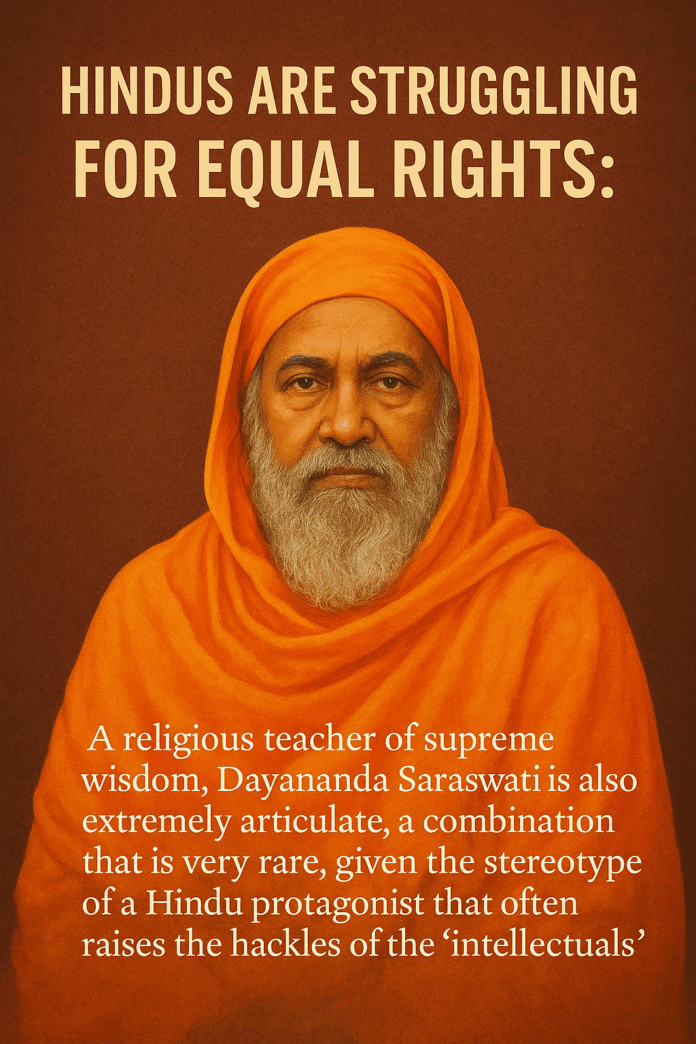
Hindus Are Struggling for Equal Rights

0

A religious teacher of supreme wisdom, Dayananda Saraswati is also extremely articulate, a combination that is very rare, given the stereotype of a Hindu protagonist that often raises the hackles of the ‘intellectuals’.

His superb command over the White man’s tongue is backed by phenomenal knowledge of not only the Vedas, Vedanta, Upanishads, Gita, but also the religious texts and practices of other faiths, not to speak of modern literature. In a way, he is the ideal foil for those at the other end of the ideological spectrum, viz.; Communists, atheists, JNU historians and lest I forget, ‘other miscellaneous secularists’. He is one who could be more than a match to them, word for word and in wits.

You have come out strongly against the Pope’s statements on the anti-forcible conversions laws. You have also been a campaigner against conversions, terming it as violence. Can you elaborate?

A.: Okay. What is violence? When you physically hurt me, it is violence. When you do anything that can instigate physical violence, that too is an act of violence. And if you hurt me emotionally, that again is violence. If you hurt me spiritually, that is the worst violence, rank violence. All these are there in conversion because it leads to physical violence. When you convert somebody, you have to criticise the person’s religion, his worship, his culture; all these hurt. Even when he changes, it hurts. How will he change? He has to disown his parents, and their wisdom and their culture, his ancestors, and his entire community; you are isolating him, uprooting him and all the uprooted people are emotionally unsettled.

For instance, Blacks in America are uprooted people. Even after generations, they are not emotionally settled. It will never help the persons who are uprooted from their culture. So it is great violence against culture, tradition etc.

Is the religious person, then, the core person?

A.: Yes, we find some people die for their religion because in their scripture it is told that if your religion is in danger then you will have to sacrifice your life so that you will also have a better place in paradise. The fellow begins to believe that, and he is ready to give up his life. This is indoctrination.

So for their religion’s sake, there are double standards. One who does not believe in their religion is anti-god, as if God has given only their religion for everyone to follow. If he does not follow that, he is an enemy of God, an infidel, and deserves to be killed. Though God anyway is going to destroy him, if you destroy him, God will be pleased that you have proved your faith. This is the double standard. The values are not common for all. For the followers, one set of values; for the non-followers, another set. Killing gets a sanction. That is why these are all dangerous religions. And I say all converting religions are dangerous. They have created problems. It is like somebody wanting freedom to destroy me. If I do not give this freedom, then I become a ‘fundamentalist’. But if I give them the freedom to destroy me, then I am a ‘liberal’, my religion a free religion, that’s it.

And to the Pope?

A.: Not only the Pope. The Pope said this because they have got away with it for 2,000 years in the name of ‘freedom of religion’. They have wiped out continents, cultures in various continents, religions in countries. Where are those religions and cultures that built those pyramids? Show me one fellow now as a sample. Greek and Roman monuments are there, but where are the religions? In Europe, they completely wiped out all the indigenous religions. In North America and South America, they have finished off all the native cultures. Even in Africa, it is almost finished.

Now in Asia they are planting their religion. They want to be successful; between these two people, they want to destroy all cultures in this world. Therefore, I say, enough is enough. I don’t want to ask them to give up their (the convert’s) religions now.

But their concepts, their beliefs are not acceptable to me. I give them the freedom to follow what they follow. But I want them to leave me free to follow what I believe! They cannot say evangelising is not against other religions. It is against other religions; conversions are against other religions. We don’t believe in conversion itself. We don’t accept that, we don’t do that.

Then how do you deal with this problem when it is so basic? What are the practical ways?

A.: The theologians have to change, but they will not because they have enough inbuilt programming. What we call indoctrination. There is no use even to make an attempt but we should keep talking about it to them. They just wait for a time when there is more freedom for them to do. So that time, conducive for conversion, should be kept away. The people have to be made aware and proud of their religion; that would take care of this problem in course of time. They should be able to say enough is enough.

There is the lure of money, incentives and other benefits that the naive fall for…

A.: It is not really the money that buys. What do they do? Small things, and then they try to tempt them. That gives the thumb space, they begin to enter the heart. Then they make the most unkindly cut. When the missionary tells that the fellow’s daily pooja is wrong, that his altar of prayer is not the altar, he has to alter that. That is the unkindest cut you can get. It is a stab in the heart, where this fellow, innocently, gives some space for the missionary to enter. That very place becomes a place for attack. He attacks at the heart of the person, his religious core. Therefore, the missionaries are the most violent people in the world. They have committed violence and nobody else has committed violence as they have done. They continue to do that but people do not realise this. They do seemingly good things in order to commit this violence.

What is the effect of missionary activity on national security?

A.: Look at the northeast. I wonder if I can go and talk there, in my own country. They ask if I am from India! This is what the missionaries have done. Those people are made to feel they are non-Indians, this is very unfortunate. It is a major problem for national integrity and not good for our tradition. In fact, Hindu religion has to be saved for the sake of humanity, because Christians don’t believe Muslims will go to heaven and Muslims don’t believe that Christians will go anywhere. They are fighting each other in trying to reach heaven or paradise. Both believe that the other is not going there, so they will fight forever.

The only person who says paradise is not up there, but here, is the Hindu. The Hindu is the only one who makes sense. He has a methodology to teach; it is not just a belief. There, it is only beliefs, many of which cannot be proved and several of which are wrong and foolish. See, a belief is above reason.

The inequalities that have cropped up in our society are used as a handle against Hinduism?

A.: Even they have their own inequalities. They have their own problems that are endless but that is not a sanction for us to have problems. We should try and solve them, but still, all these are our problems. Suppose, when two brothers are fighting over a property, a third fellow comes and says, since you two are fighting let me occupy the property – that cannot be allowed. You remain an encroacher. You can help us, but you cannot become a beneficiary of our fight.

Indian Christians and Indian Muslims are converted from Hinduism, without themselves knowing what they are getting into. But once converted, they are told that their brethren and forefathers are devil worshippers! This is what I say is dangerous. As Indians, they have a right to know their religions, their people, their culture and their forms. If they know, there will be no problems but they are purposely kept away. The clergy is responsible for that, Islamic and Christian clergy are responsible for that.

But Christianity lays much store by charity works …?

A.: It is because these missionaries are using some of these perverted methods for conversion work. And you also think that, this is the role of religion? The role of religion is to make you human, that’s all.

They should do humanitarian work, like the way we do. We have charities all over the world. Look at Salem or Coimbatore, how many hospitals are there? Almost all of them are run by Hindu charities. And what do they do? They don’t convert; they just run the charities. There is no priest or nun there, for there is no conversion programme and therefore the charities remain charities.

But to run charities for some other purpose is the most uncharitable thing to do. You see, they feed the cows before slaughter to fatten them. Similarly, they perform humanitarian acts with hidden motives for conversion. Love with ulterior motives is not love. If you really love people, just give it, forget about it, keep your sacred religion in your heart.

But if they want to know or even reconvert, will the Hindu ‘clergy’ allow that…

A.: In India, there is no clergy. Here all are Hindus until they call themselves differently, because when I allow every form of worship, then where is the problem? We deem you another Hindu, it is only you who are saying I am this and that. There is no reconversion. They come back like a prodigal son. We do not even need to baptise. We have to ask him to give up beef, that is all.

The US government appears to have a different view on the religious freedom here…?

A.: The US government had appointed a Commission on International Religious Freedom. This Commission gets information from all countries and submits a periodical report. According to their report, India is among the Countries of Particular Concern (CPC). They cite the anti-conversion Bills of Tamil Nadu and Gujarat, and some Gujarat incidents as the basis for this. I question this matrix of theirs.

What’s your logic?

A.: What is it that you call ‘religious freedom’? Is it freedom to evangelise and convert with impunity? If they can evangelise to destroy me, that is called religious freedom. But if I question their activities, it is infringement. Therefore, I am appealing to the Government of India to appoint a Commission on religious freedom, to issue guidelines and submit reports dispassionately.

But even the minorities in India often complain about lack of religious freedom?

A.: We should examine the privileges of minorities. Nowhere in the world do minorities enjoy such privileges. Christians run teacher-training colleges; they get government aid, and appointments are controlled by management alone. Meanwhile, the majority faces reverse discrimination. Temple money is in government hands. We fight for equal rights. Whatever privileges minorities have, we want them too.

But for that to happen we may have to become real minorities…?

A.: If I am in the majority, I cannot open my mouth for anything, even dental surgery. Minorities enjoy many privileges, including government support. That is why I say reverse discrimination exists in this country. It is blasphemy to say there is no religious freedom in India. The only place where there is religious freedom in the world is India.

[Swami Dayananda Saraswati shared his candid views on the raging conversion debate with Shri T. R. Jawahar, Editor, News Today, an evening daily published from Chennai. Some excerpts are published here. For the full text of the interview, log on to: http://www.newstodaynet.com/swami.htm]

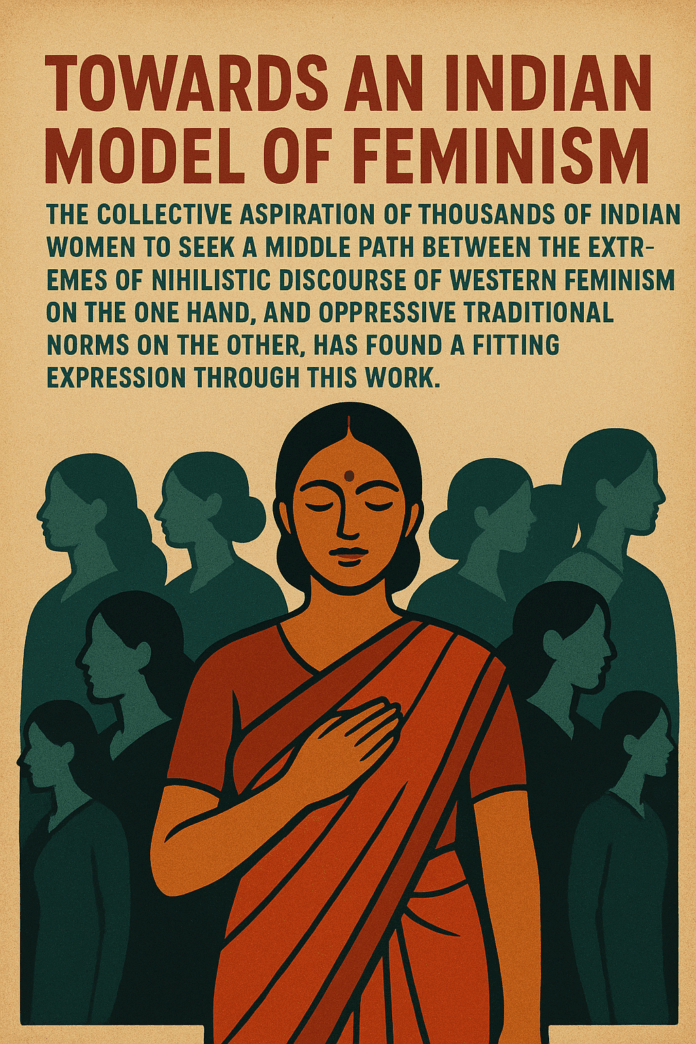
Towards an Indian Model of Feminism

0

The collective aspiration of thousands of Indian women to seek a middle path between the extremes of nihilistic discourse of western feminism on the one hand, and oppressive traditional norms on the other, has found a fitting expression through this work. The book is a collection of papers presented at a seminar on the same theme at the Indian Institute of Advanced Study, Shimla, 2002, a year dedicated to women.

While many Indian women are engaged in a real-life struggle to find a suitable expression of modernity and freedom without having to negate their cultural roots, they have not been aided till now by a well-defined and systematic exposition of Indian Feminism. This books hopes to fill the lacuna by attempting to evolve a theory of Indian Feminism.

  • Prof. Kapil Kapoor’s insightful opening essay titled “Hindu Women, Traditions and Modernity”
  • Prof. A. K. Singh’s lively thesis, “Constructing an Indian Theory of Feminism: Problems and Potentialities”
  • Prof. Arvind Sharma’s sparkling paper “How to Read the Manusmriti,” in the second-half of the book adds a real punch ; and finally
  • Prof. Chandrakala Padia’s paper “Feminism, Tradition and Modernity: An Essay in Relation to Manusmriti.”

Kapil Kapoor argues that Western Feminist discourse has become a tool of minority politics in India and points out that Indian Feminists have blindly tried to straitjacket the Indian reality into the western framework. This has led to the formation of a very peculiar situation in India today whereby feminists are obsessed with Hindu social norms and portray them as the chief obstacles to the liberation of the Indian woman while turning a blind eye to more disturbing practices prevalent among other communities:

“As in other areas of knowledge, in women studies also, we have tried to fit the Indian reality to a borrowed western framework. It is not that women in India have no problems – the issue is whether these can be rightly understood in an alien social framework without reference to our own history of social practice and ideas. In the process of applying every shifting framework, we unquestionably accept not only the constructs but also the assumptions that are always so definitely culture / history bound. The choice of the alien framework then constrains the discourse and the methodology; the analysts selectively choose and mine Indian social phenomena / practices and knowledge texts, specifically sociological texts (dharmasastra), mythology (purana) and epics (mahakavyas) to demonstrate the adequacy of the western theory and to rubbish Indian life and traditions.”

Prof. A. K. Singh explains the need for an Indian theory of Feminism in his paper:
“…the Indian situation and the Indian ways of looking at the world are different from others. The Indian society differs from others, particularly the western society in the sense that it is a service-oriented society, or as Professor Kapil Kapoor puts it as duty-oriented, not a right-oriented society. The duty-oriented society manages itself not by fighting for rights but by excelling in performing duties i.e. dharma (righteous way doing) for a given individual in given situations. This is one of the reasons that persuades me to suggest that instead of, NHRC (National Human Rights Commission), we should have instituted National Human Duties Commission. If fathers, sons, brothers and husbands perform their duties; and mothers, daughters, sisters and wives follow suit…”

A. K. Singh also surveys Indian literature in Hindi, Gujarati, Sanskrit and English, thus setting the tone for Section II of the book which delves deep into the image of women and feminist discourse as found in Indian literature, ancient and modern. Dr. Kavita Sharma’s paper “Exploring the Icons: Sita and Radha,” adds a poignant note to this section.

The next section on “Dharmasastras: Fetters or Freedom,” takes up the touchy debate on Hindu dharmasastras and particularly the Manusmriti. Their perceived lenience towards a rigidly patriarchal society is critically examined. The articles forcefully expose the shoddy reading of these texts by 19th century colonial historians, sociologists and Indologists. Prof. Arvind Sharma’s brilliant article, “How to Read the Manusmriti” dismantles many such artificial constructs of the text and provides a fresh perspective by describing five different ways of reading and interpreting the text in a well-defined context.

Chandrakala Padia’s own paper on the Manusmriti follows a similar yet straightforward tone. She argues that contemporary feminists often dismiss major Indian traditional texts in one categorical sweep and points out with evidence that there are many portions of these texts which are of great value even today and stresses the need for a balanced and objective view of these maligned texts. (This paper has been posted on the website of the International Forum for India’s Heritage for the benefit of inquisitive readers. The text is available online at http://www.geocities.com/ifihhome/articles/cp001.html). In trying to formulate a forward-looking model for Indian women, she gives expression to the ancient Indian vision of Ardhanariswar a and grihastha dharma:

“The freedom for women for which the feminists of today cry is taken to mean equality regarded as mere sameness. The same opportunities for work to women as for men – this is the battle-cry today. But let us pause for a while and consider whether such a view of equality is workable… Equality that is proper and workable is really equality of discriminating consideration… The ideal of freedom from undue domination by men is all right ; but it has to be supplemented with the ideal of freedom to cooperate with men variously, so as to make for social harmony without any loss of individual dignity.”

Indra Kaul’s paper on the Buddhist text Therigatha dealing with the lives of women in Buddhist monasteries is an interesting narrative delineating the liberating features of Buddhism with respect to women and how these monastic orders helped these women reorganise their lives and facilitated greater social freedom and fulfillment. Finally, the reader is introduced to contemporary issues in the discourse on feminism such as the representation of tribal women, ecofeminism etc.

Perhaps, a few critical remarks here, would not be out of place. While Indra Kaul provides space for a discussion of women in ancient Buddhist society, a parallel study of Hindu women who sought spiritual and social liberation while remaining rooted in their cultural and spiritual moorings is woefully missing in the book. On the other hand, Indra Kaul in her paper dismisses this proposition by an uncanny sweep, claiming that the Hindu worldview could not have provided such feminist models and uses this perception to make a contrast with the liberating Buddhist theology. Hindu society too has given birth to exemplary women who transcended prevailing social norms through deep devotion to their chosen spiritual ideals – Meerabai, Andal, Akkamahadevi in the remote past; Sarada Devi, Anandamayi Maa in the nineteenth century; and Mata Amritanandamayi Maa, a living saint and beacon light for women all over the world today – these are merely well known examples in the spiritual domain and scores of other unknown and unsung lives are yet to reach the Indian public.

Also, a study of the lives of exemplary Indian women in recent times would be a good addition to the next edition of this volume. Prof. Chandrakala Padia is envisaging a seminar on “Heroic Women of India,” precisely to throw more light on the lives of such women and generate educational material which can be used in schools and colleges. We eagerly look forward to the outcome of this seminar.

Title: Feminism, Tradition and Modernity
Editor: Chandrakala Padia
Publishers: Indian Institute of Advanced Study, Rashtrapati Nivas, Shimla
ISBN: 81-7986-023-X
Price: Rs. 600 (HB)

Place your orders with Prof. Chandrakala Padia.

Democracy as a Tool to Subvert Demography

0

If the number of articles and books that have appeared in recent times, analysing the impact of demography on nations and economies, are any indication, then demography is surely ticking like a time-bomb in the minds of many concerned sociologists. The Economist published a detailed story on the remarkable demographic difference between America and Europe titled “A tale of two bellies” (24.08.02). Reviewing the book Demography and Religion in India by Sriya Iyer, Dr. Nanditha Krishna wrote in the New Indian Express (18.05.03):

Any discussion of demography in India has invariably turned towards three determinants: education, economic development and religion. The higher fertility and growth rates of the Muslims, when compared with the declining fertility and growth rates of the Hindus, have raised the potential threat of Muslims outnumbering Hindus.

However, the debate is not new to us. Consider this revealing excerpt from an interview Swami Vivekananda gave to the Prabuddha Bharata in 1899:

“Certainly,” said the Swami, “they can and ought to be taken.” He sat gravely for a moment, thinking, and then resumed. “Besides,” he said, “we shall otherwise decrease in numbers. When the Mohammedans first came, we are said — I think on the authority of Ferishta, the oldest Mohammedan historian — to have been six hundred millions of Hindus. Now we are about two hundred millions. And then every man going out of the Hindu pale is not only a man less, but an enemy the more…”

More than a hundred years later, these prophetic words are ringing in the ears of many anxious Hindus today, who have begun to take note of the demographic challenge from proselytising religions. Moreover, it has often been observed that a rise in the population of members of proselytising religions gives rise to fissiparous tendencies, communal disturbances and separatist movements — a proof of the fact that these expansive religions have a clearly laid out political agenda.

Jammu and Kashmir, Arunachal Pradesh, Nagaland, Assam, West Bengal, Kerala, Bihar, Lakshadweep, Andaman & Nicobar Islands — what do all these have in common, one may ask. The steady fall in the numbers of ‘Indian Religionists’ and an equally steady (and in some cases spectacular) rise in the numbers of Muslims and Christians. As steady and spectacular as the decline in population of the Hindu minorities in Pakistan and Bangladesh.

The Centre for Policy Studies has published the results of a painstaking research and compilation undertaken by A. P. Joshi, M. D. Srinivas and J. K. Bajaj. This detailed study analyses the demographic changes in the subcontinent between the period 1881–1991 based mainly on the decennial censuses and also making use of the United Nations estimates while projecting the trends into the future. The book includes 38 detailed tables, 105 text tables, 29 maps and many references.

“What is new in these results, many of us already knew these trends?” some would probably say, without thinking for a moment about the grave implications of the changing demography of these states. “But we are only 3% of the population and we render much social service in the field of education and health care,” Christian leaders will chip in.

Indeed, the book already appears to have created a scare among Christian propagandists, going by the reaction of one such vocal proponent, John Dayal, national secretary of the “All India Catholic Union” and national convenor of the “United Christian Forum for Human Rights.” In a critical review titled, “Lies, Half Truths and Statistics,” John Dayal takes a cheap dig that the book has been typeset at “Ram’s Creative Chambers.” One can understand their desperate situation; refuting a scientific study such as this takes more than a clergyman’s skill at preaching the good news.

The book has had a relatively more ‘sober’ impact on other quarters — in a review in India Today (dt. 12.05.03), Swapan Dasgupta says, “The data is startling. In fact so startling that there is a chance this book, with its rich district-level data, will become a ready reckoner for the Hindu backlash against secularism” (sic).

A grasp of some essential concepts underlying India’s nationhood is necessary to comprehend this demographic study — the distinction between “Indian Religionists” and others, for instance. Especially when Shri L. K. Advani, having written a thoughtful foreword, expresses his reservations while releasing the book, regarding this definition. He expressed his doubts whether Islam and Christianity could be considered as foreign religions.

The authors have included Hindus, Buddhists, Jains, Sikhs, Jews and Parsis under the broad term, “Indian Religionists.” The idea seems to be to classify together followers of India-born religions viz., Hinduism, Buddhism, Jainism and Sikhism. To this list are added, followers of non-proselytising faiths such as Judaism and also tribal traditions. For a discerning eye, the distinction is sharp enough.

The two basic determinants of Indian demography, the authors contend, are the civilisational and cultural homogeneity of the Indian people and their share in the population of the world. Defining sanatana dharma as the binding factor behind this cultural homogeneity and introducing Islam and Christianity as the sources of heterogeneity, they explain:

The Indian subcontinent enjoys remarkable isolation from the rest of the world. The land frontier in the north is blocked by the high and wide wall of the Himalaya, which is impassable except at a few points in the northwest; the long seacoasts in the south are far away from any other major lands and have few natural harbours. The land enclosed within these impregnable frontiers is one of the richest in the world. It is therefore not surprising that Indians, living securely within their vast and fertile lands for millennia, without fear of external aggression or internal scarcity, developed into a homogenous civilisational area. This homogeneity was anchored in the sanatana dharma. Indians, living in their splendid and rich isolation, were at peace with themselves, with nature and the world; the sanatana dharma enshrines, at its heart, a sense of deep respect for all aspects of creation.

Unlike all those who came to India before them, the Islamic rulers, consciously and perhaps conscientiously, resisted acculturation into the timeless civilisational and religious milieu of India. This thus became the first source of heterogeneity in India, dividing the Indian population mainly into two distinct religious communities, Hindus and Muslims, as reflected in the 1881 census cited above. In time, this demographic heterogeneity led to the Partition of the country into Indian Union and two separate Islamic enclaves.

Throughout, “India” is used to refer to undivided India including Pakistan and Bangladesh. Data has also been compiled individually for Pakistan, Bangladesh and the Indian Union apart from the cumulative figures and analysis for “India.”

The religious composition of the Indian Union has been classified into three distinct zones (see map):

Region I, “Where Indian Religionists Dominate” — comprising almost all of the north-western, western, central and southern states viz., Punjab, Haryana, Himachal Pradesh, Madhya Pradesh, Orissa, Rajasthan, Gujarat, Maharashtra, Andhra Pradesh, Karnataka and Tamil Nadu. Even in these States, there is a considerable Muslim presence (12%) in every district; Aurangabad district (Maharashtra) and Hyderabad (Andhra Pradesh) being exceptional cases of well-defined pockets of high Muslim presence in this belt.

Region II, “Where Indian Religionists are under Pressure” — Uttar Pradesh, Bihar, West Bengal and Assam. Muslim presence is very high in this belt, Indian Religionists being a minority in many areas. Christian dominance is limited to two pockets in Ranchi-Raigarh-Sundargarh districts and the North Cachar Hills district of Assam.

Region III, “Where Indian Religionists are in a Minority” — these are presumably the border areas including Jammu & Kashmir, Goa, Kerala, Lakshadweep, Nicobar Islands and north-eastern states.

Calling the demographic alteration in the north-eastern states as “the most dramatic story of the twentieth century,” the study observes that entire populations in these states have been converted in quick spurts. Ironically, the significant spurt took place in the Independence decade of 1941–1951.

Interestingly, the census data from Pakistan show that during the pre-Partition period, the population of Indian Religionists was rising steadily from 15.9 percent in 1901 to 19.7 percent in 1941. However, Partition brought this trend to an abrupt end thanks to the large-scale genocide that ensued.

Unlike Pakistan, our ‘friendly neighbour,’ Bangladesh, shows a more consistent downward graph of Indian Religionists during the whole of the twentieth century. If one is to also take into account the recent and ongoing cleansing of Bangladeshi Hindus, this trend is very well confirmed and will continue to a stage where the presence of Indian Religionists will be reduced to rubble.

Though the work confines itself to statistics, an in-depth analysis of the socio-political and religious factors that cause such demographic alterations would form a fitting sequel. Commenting on one such aspect that gives rise to a difference in birth rate among Hindu and Muslim women, Dr. Nanditha Krishna writes:

The surprising revelation is that a Hindu woman spends, on average, 53 weeks at her parents’ home in connection with post-childbirth ‘purity and pollution’, which would undoubtedly cut down her fertility. On the other hand, Muslim women spend only 28 weeks. Further, Hinduism has no opinion for or against birth control and abortion, whereas several schools of Islam aver that birth control may be permitted only in restricted situations.

Moreover, there is the much-touted question of “religious freedom.” Religious freedom is meant only for destroying the non-Abrahamic religions; human rights are only for the Islamic terrorists and the missionaries. Thus, in democracies like India, the law and its loopholes are exploited to increase the numbers of the momins and the believers. Whereas, in military regimes like Pakistan or in pseudo-democracies like Bangladesh, the law is meant to keep the growth of Indian Religionists in check. Democracy, and the later roguish addition, secularism, have become tools to subvert the demography of Indian Religionists. The aim of this demographic siege is very clear, as the statistics show — to reduce Indian Religionists into a minority:

A decline of 11 percentage points in the share of the majority community in a compact geographical and civilisational region like India is an extraordinary occurrence to happen in the course of just about a century. At the peak of Mughal rule at the time of Akbar, after nearly four hundred years of Islamic domination, the proportion of Muslims in India was said to have reached no more than one-sixth of the population. As we shall see below, if the trend of decline seen during 1881–1991 continues, then the population of Indian Religionists in India is likely to fall below 50 percent early in the latter half of the twenty-first century.

One can only hope that the inscrutable destiny that has helped this nation survive a millennium of physical onslaught, will interfere in this nefarious design too. However, there is no excuse for us to turn a blind eye to this stark reality or else Swami Vivekananda’s grave warning might well turn out to be true:

There are three dangers before us: (1) All castes other than the Brahmana will combine and create a new religion like Buddhism of the ancient times; (2) will embrace a foreign religion; or (3) all religious ideas will completely disappear from India. In the first alternative, all efforts to stabilize this very ancient civilisation will be fruitless. This India will revert back to childhood, and forgetting all her past glory will be able to advance only a little on the path of progress after a long time. In the second alternative, the Indian civilization and the Aryan race will be destroyed very soon. For whoever goes out of the Hindu religion is not only lost to us, but also we have in him one more enemy. It is well known in history what great harm was done during the Muslim regime by the renegades who become enemies and destroyed their own hearth and home. In the third alternative, the cause of great danger lies in the fact that, with the destruction of the foundation of life of an individual or a nation, that individual or nation is also destroyed. The life of the Aryan race is founded on religion. If that is destroyed, the downfall of the Aryan race is inevitable.

The most immediate step is to work towards a national law against conversions; Tamil Nadu is certainly showing the way in putting an end to this menace. Secondly, a uniform civil code, which seems nowhere near implementation, will certainly help in striking a balance between the privilege-pampered minorities and the aggrieved majority. It is only when the uniform civil code is in place that the government can effectively implement family planning programmes among all communities. A theology-inspired birth rate is not a viable option in India.

The book will seriously impact debate on this subject in the years to come, and hopefully, influence our policy-makers and also shake Indian Religionists out of their complacency. Secularists and Communists who vainly dream of an India sans Indian Religionists should think twice; there will not be much space left for them either, if this guerrilla war of demographic domination is allowed to continue.

Sociologists in the country should come together to discuss the issue further and evolve effective policies to prevent any further deterioration. Just as bio-diversity is a rallying point among ecologists, ways to preserve the “theo-diversity” of India should become the focus of all demographic debates.

Politics by Other Means: An Analysis of Human Rights Watch Reports on India

0

All Pervasive Bias

After the Godhra incident of February 2002, Human Rights Watch (HRW) claimed, in a widely publicized report titled, “We Have No Orders to Save You: State Complicity and Communal Violence in Gujarat” (April 30, 2002), that the post-Godhra violence was planned even before the Godhra incident occurred and the attacks on Muslims in Gujarat were “state-sponsored.” HRW has authored many reports on communal violence and human rights in India such as the report on anti-Christian violence (1999) and two reports on the Mumbai riots (1992-93) in addition to its annual reports on human rights practices worldwide.

Gujarat Burns after Godhra

A closer examination of these reports reveals a systematic and all-pervasive bias. Their most glaring defect is the lack of concern for the rights and lives of the majority community in India – the Hindu community. Incidents of communal violence in which the Hindu majority and the Muslim or Christian minority[1] community were involved are portrayed as one-sided attacks by Hindus against “innocent minorities.” Human rights abuses against Hindus are either ignored or downplayed as compared to abuses suffered by minority groups.

In the 1995 report on the Mumbai riots, HRW sought to place the blame for the violent events exclusively on the Hindu community and completely ignored the role of Muslim communalism in the riots. This should be compared with a more objective report on the occurrences by the Sri Krishna Commission. There was not a single eyewitness account of attacks on Hindus in the report even though Hindus had also suffered many casualties!

Again, the 1999 report on attacks on Christians in India blamed Hindu nationalists for all the violence, totally ignoring news reports and individual testimonies which go against such generalizations. Even more disturbing, this report demonstrated hostility towards the Hindu religion itself. It also attributed the 1984 anti-Sikh riots to the right-wing Hindu groups, while it is common knowledge that the riots were instigated and led by many leaders of the Congress Party in retaliation to Indira Gandhi’s assassination by her Sikh bodyguards.[2]

HRW’s most extensive publication on India was its 2002 report on the Gujarat violence. The report claimed that the attacks on Muslims were all state-sponsored and planned well before the massacre of Hindus at Godhra. Virtually, all the blame for the violence is placed on the Sangh Parivar and the BJP state government. A detailed examination of the events shows that a spontaneous uprising of the populace in reaction to the Godhra massacre was the key element in the Gujarat violence, though Hindu extremists were also involved in the riots that continued for several months. There was not one iota of evidence in the report to back up its assertion of the state having planned the violence in advance. It also dramatically distorted the role of the police in the Gujarat violence.

Secularism Under Siege?

The 2000 HRW report on human rights developments in India begins with this bizarre claim: “The Hindu nationalist policies espoused by India’s governing Bharatiya Janata Party (BJP) and its affiliate organizations undermined the country’s historical commitment to secular democracy. Violence against Christian, Muslim, and Dalit, or ‘untouchable,’ populations was one result…”

It is hard to see what policies adopted by the BJP government at the Centre prior to the events in Gujarat and at the time of the report’s publication “undermined secular democracy.” In fact, Freedom House, an NGO that has annually rated political freedom in every country in the world since 1972, has indicated that since the BJP came to power, political freedom has actually improved. Both political rights and civil liberties fared better under the BJP-led NDA government than under the Congress government, which ruled from 1991-1996.

In addition, any of the party’s policies that could possibly “undermine the country’s historical commitment to secular democracy” could not have been implemented due to the fact that the BJP was leading a multi-party coalition, comprised of 23 parties that depend on Muslim votes and which are not supportive of Hindu nationalism. The BJP has in fact adopted pro-Muslim policies such as increasing government subsidy for the Haj pilgrimage to Mecca. Exit polls showed that between 7% and 16% of Muslims voted for the BJP in the February 1998 elections. Also, many policies of the BJP that have not been implemented, such as imposing a Uniform Civil Code and making changes to Article 30 in the Indian Constitution to end discrimination against Hindus, would actually strengthen secularism.[3]

Hindu-Muslim riots had actually decreased in the time period since the BJP came to power and the Gujarat riots started. As journalist K.P. Nayar notes, during this period, India had seen the lowest record of communal riots in all of the previous 10 years. Likewise, Tavleen Singh, writing in India Today a few months after the BJP first came to power at the Centre, notes, “Few people have noticed that there have been no communal riots in India since Vajpayee became prime minister. Remember the Congress record of one major communal riot every few months? Meerut, Maliana, Bhagalpur, Moradabad, Mumbai.”

Many BJP state governments have bright records with regards to containing communal violence. In Uttar Pradesh, four chief ministers performed as follows: under V.P. Singh, the monthly average of casualties (dead and wounded) in communal violence was 29, the monthly average of Muslims killed was eight; for N.D. Tiwari the figures were 28 and three; for Mulayam Singh Yadav they were 98 and 17; and for Kalyan Singh of the BJP they were five and one, respectively. Notwithstanding the fact that Mulayam Singh Yadav and V.P. Singh are widely considered to be amongst the most pro-Muslim politicians in India!

Most troubling in these reports, however, is the linking of violence against Dalits to the BJP and the Sangh Parivar. One can argue that groups such as the RSS and VHP are hostile towards Muslim and Christian minorities. But are these groups anti-Dalit? The core of Hindu nationalist ideology is “political unity among Hindus.” Caste divisions are seen as a threat to this unity. As The Economist remarked, “the bulk of the party’s [BJP] thinkers are reformers who seek a modern Hinduism purged of caste and sex discrimination…”

Nevertheless, the notion that the Sangh Parivar wants to prop up the caste system is spread throughout these reports, particularly the 1999 report on anti-Christian violence. In HRW’s report on caste violence titled, “Broken People: Caste Violence Against India’s Untouchables,” nothing is said about the role of the BJP or the Sangh Parivar in orchestrating violence against Dalits. Most of the cases of caste violence cited in the 2000 report on human rights developments in India take place in Bihar, a state not run by the BJP. Moreover, as the same report notes, the caste violence in Bihar was something in which both upper caste Hindu and lower caste Hindu militias were involved. In the 13th Lok Sabha, the BJP has far more Dalit MPs than any other party.

The 2002 report on human rights development in India states: “The government drew sharp criticism from numerous minority groups for selectively banning the Students Islamic Movement of India (SIMI) as part of its post-September 11 actions to counter terrorism while ignoring the ‘anti-national’ activities of right-wing Hindu groups. At least four people were killed when police opened fire on a protest in Lucknow on September 27 following the arrest of some SIMI activists.”

It is quite amazing, even by HRW standards, that it would criticize the banning of the infamous SIMI and define the ban on the Islamic terrorist group as “selective banning.” SIMI is a notorious “student” group, which has been linked to Islamic terrorist groups that have planned and carried out numerous terrorist acts and other crimes. HRW is absurdly insinuating that the government banned SIMI due to anti-Muslim bias and partisan politics. The government’s primary reason for banning SIMI is its links to Pakistan’s ISI which actively sponsors terrorism in India. Even non-BJP state governments in India have cracked down on SIMI considering its threat to national security. In the aftermath of the 1992-1993 Mumbai riots, the Congress government banned “right-wing Hindu groups” such as the VHP. When an organization is banned, a tribunal is required to determine if the ban is valid or not. The tribunal overturned the ban on the VHP. By contrast, the ban on SIMI was upheld by the tribunal on March 23, 2003, two-and-a-half years after the government declared the Students Islamic Movement of India unlawful. Justice R.C. Chopra of the Delhi High Court, who headed the Unlawful Activities (Prevention) Tribunal, said, “`there is sufficient cause for declaring SIMI unlawful’’ and as such the Government’s notification in this regard issued on September 26, 2003 “stands confirmed,” for its activities were “detrimental to peace, communal harmony, internal security and maintenance of secular fabric of the country.”

The Mumbai Riots

The report on the 1992-93 riots claims, “During the week following the events in Ayodhya, Muslims held public demonstrations in the streets of Bombay, targeted not against Hindus, but against the government, which had failed to prevent the destruction of the mosque.”

This is simply absurd and is an attempt to foist righteousness and innocence on Muslim rioters. As the Sri Krishna Report notes, from December 7, 1992 onwards, “large mobs of Muslims came on the streets and there was recourse taken to violence without doubt.” For example, in Nirmal Nagar jurisdiction, “a Ganesh idol in the Ganesh Mandir on Anant Kanekar Marg was found decapitated and moved out from its place of installation and eleven temples in different jurisdictions were damaged, demolished or set on fire.”

HRW repeatedly accuses the police of brutality against Muslims and places more blame on the police for alleged brutality against Muslims, than on the violent behaviour that caused the need for police involvement in the first place. In reading the report, one is inclined to view the police, rather than the mobs, as the aggressors.

Below are some selections from the Sri Krishna Report that document the type of violence inflicted on the police by Muslim mobs:

“This time the Muslim mobs appear to have come out with the intention of mounting violent attacks as noticed from their preparedness with weapons of offence. There were violent attacks on the policemen in Muslim dominated areas…

“Two Constables in Deonar jurisdiction were killed with choppers and swords by the rampaging Muslims. ..

“Jogeshwari area, which has been the hotbed of frequent communal riots, saw serious riots at the junction of Pascal Colony and Shankarwadi. A police officer carrying on his duty received a bullet injury in his head and died subsequently, though it cannot be said with certitude that it was a case of private firing. The police recovered large number of iron rods, sickles, choppers, knives and soda water bottles from different jurisdictions indicating that there was intention and preparations to carry on the communal riots (emphasis added).”

None of these incidents are included in the report. Indeed, the report seems to downplay the violence perpetrated by Muslims against police officers. For example, it states, “Many of these spontaneous gatherings, particularly in south and central Bombay, degenerated into violent attacks against police officers.” But as can be seen above, many of these were not mere “spontaneous gatherings” that “degenerated into violent attacks” but pre-planned attacks.

Most of the report, however, speaks of the rapes, murders, and attacks by the Shiv Sena on Muslims in January of 1993. However, almost nothing is said about attacks by Muslims against Hindus. The Sri Krishna Report notes that in the last week of December 1992 and first week of January 1993, particularly between January 1 and January 5, there was a series of stabbing incidents in which the majority of the victims were Hindus. The notorious Radhabai Chawl massacre, in which six Hindus (most of them handicapped) were burned alive, is not even mentioned. This massacre played a significant role in igniting the Hindu backlash. As Varsha Bhosle notes in another column on Rediff, an analysis of the Sri Krishna Report shows that prior to the Radhabai Chawl massacre, the majority of the victims in the early January violence were Hindus. After the Radhabai Chawl massacre, the trend was reversed.

HRW notes that “In January 1992, much of the violence was directed by members of the Shiv Sena who stopped cars, identified Muslim passengers, and attacked them.” Muslims, however, were doing very similar things, which HRW chooses to ignore. Mumbai resident Shrikant Talageri, who closely followed news reports in The Times of India, points out that, “On 7 January, mobs of Muslims in the Muslim areas named above fanned the streets and caught passers-by on the busy roads. Those suspected to be Hindus were made to remove their pants, and if they were found to be uncircumcised, they were stabbed to death. The police were under strict instructions from the state government not to shoot at Muslim mobs. The main area of this activity was in the Muslim heartland in south Mumbai.”

The communal breakdown of deaths, according to the Sri Krishna Report, was 575 Muslims, 275 Hindus, 45 unknown, and 5 others. While the majority of the victims were Muslims, this can hardly be classified as an anti-Muslim riot, since a significant number of dead were Hindus. Both communities are to blame for what happened. But from reading the HRW report, one would view the Mumbai riots as a one-sided pogrom by the Shiv Sena and the police against peaceful and defenceless Muslims.

In April 1996, another report on the Mumbai riots titled, “Communal Violence and the Denial of Justice” was released which repeats the things discussed in the first report, albeit in much more detail. As in the first report, exclusive blame for the violence is placed on the Hindu community and the Shiv Sena, Muslims are exonerated of all blame, and a biased analysis of encounters between Muslims and the police is presented. What is ironic about this report is that it was written as a response to Chief Minister Manohar Joshi’s decision to terminate the Sri Krishna inquiry. The purpose of this report is to encourage the continuation of the inquiry and the implementation of its recommendations.

Yet, despite the fact that the Sri Krishna Report notes that roughly one-third of those killed in the riots were Hindus, there is not a single mention in the HRW report of any attack against Hindus! In addition, every single one of HRW’s eighteen eyewitness accounts describes attacks on Muslims, and none describe attacks on Hindus. From reading HRW’s report, one would be surprised to find that any Hindus suffered from the violence. HRW even uses testimony from a Muslim man “who participated in a demonstration,” (not exactly the most objective of sources) claiming that Shiv Sena members attacked the demonstrators. Just imagine HRW using testimony from Hindu “demonstrators” or “activists.”

Report on Attacks on Christians in India

In 1999, HRW authored a report titled, “Politics by Other Means: Attacks on Christians in India,” which is perhaps the most biased among the reports discussed till now. It does not just display the typical lack of concern for the rights of Hindus, or blame “Hindu nationalists” for all of India’s ills, but includes bigotry towards the Hindu religion itself, distortions, and false statements that are directly contradicted by news reports and individual testimonies.

The report seems more like a work produced by fundamentalist Christian proselytisers than by an independent non-biased organization. Particularly troubling is that John Dayal, a notorious Christian demagogue who throughout the report is referred to as a “human rights activist” is extensively quoted and relied upon for information in the report. Dayal fabricated the story of the rape of nuns at Jhajjar and said in an online discussion with Rediff that there are no forced conversions in India despite numerous testimonies, police evidence, and above all the Niyogi Commission report on Christian missionary activity instituted by the Madhya Pradesh government in 1956. Dayal blamed Hindu groups for the church bomb blasts a full month after the confessions by Deendar Anjuman.

The report claims that attacks against Christians are part of a “concerted campaign of right-wing Hindu organizations, collectively known as the Sangh Parivar, to promote and exploit communal tensions to stay in power, a movement that is supported at the local level by militant groups who operate with impunity.”

Dr. B Raman of the South Asia Analysis Group explains that Hindu-Christian violence in India is mostly caused by the social tension created by aggressive missionary activity in the tribal belt. Conversion drives by Christian missionaries, foreign or Indian, are concentrated in the tribal belt. The people are very poor and many of them are animists with no organised religion. In return for material incentives such as cash, scholarships, etc, they are prepared to embrace Christianity even if they don’t like the faith or understand the implications of their actions.

Even though many of the tribals are animists, their social and cultural traditions are similar to those of the Hindus – like the responsibility of the son to look after the parents, perform their last rites when they die, find a husband for the sister etc. In the tribal areas, the old people are reluctant to convert. So, the missionaries focus on the youth. If in a family, the son is won over by the missionaries and embraces Christianity, he refuses to look after his parents or perform their last rites. They themselves do not want their last rites to be performed by their son because he has become a Christian. Nobody would marry the daughter in the house… the result: the activities of the missionaries have been playing havoc with local cultural and social traditions and creating social tensions and leading to the break-up of many families. Such tensions and anger result in occasional outbreaks of wrath against the missionaries.

According to HRW, any commission or inquiry that does not say that attacks against Christians were systematically planned attacks and carried out by the Sangh Parivar is suspect. For example, in the 2000 report on human rights developments in India, it is stated, “In May, the National Commission for Minorities (NCM), a government agency, issued a report stating that attacks against Christians were either accidental or the unrelated actions of petty criminals. Outraged Christian activists said the report showed that the government condoned attacks on Christians. Earlier reports by the NCM, issued before it was overhauled by the central government in January, had recommended prosecutions for such attacks and accused the government of wilful neglect at all levels.”

Simply because the report said that the attacks were “either accidental or the unrelated actions of petty criminals” does not mean the government condones the attacks. The notion that the NCM would be biased and would condone attacks against Christians is preposterous. The head of the NCM at the time was John Joseph, a Christian himself. His father was one of the leaders of the Pentecost church in India. Despite charging the NCM of condoning attacks on Christians in the report on communal violence in Gujarat, HRW cites the NCM’s strong criticism of the Gujarat government’s response to the communal violence. The NCM report noted that the attacks it examined were isolated incidents and could not be blamed on the Sangh Parivar. Joseph said that many Christian leaders who had criticized the report, especially Dayal, “want the attacks to continue so that they can be in the limelight,” and more easily obtain foreign funds. According to Joseph, Dayal was at the forefront of efforts to undermine Hindu-Christian dialogue. Joseph also notes that many Christian leaders want the NCM to portray all the incidents of attacks against Christians in the country as being the handiwork of the Sangh Parivar.

Chapter 5 of the report, titled, “Attacks Across the Country” includes a section on the infamous rapes of nuns in the Jhabua district of Madhya Pradesh. HRW manages to find a way to blame the VHP and the BJP for it, despite the fact that the Madhya Pradesh police found that that many of those involved were Christians.

The Madhya Pradesh government after investigations arrested the suspects and took the accused into custody. An equal number of Christians and non-Christians were arrested, and no one from the Sangh Parivar was implicated. Madhya Pradesh was run by the Congress party at the time, and it is unlikely the police would have covered up the Sangh Parivar’s role in the attack. Rather, there would be a vested interest in showing any Sangh Parivar involvement. It is more likely that Dayal is fabricating the story or not telling the complete truth.

The report is filled with half- truths, distortions, and missionary propaganda. One would expect that a human rights organization would be religiously neutral and not favour any religion. This unfortunately is not the case with HRW as it basically endorses proselytisation throughout the report. Note that the quotes above are strikingly similar to Father Dominic Emmanuel’s statement the that violence in the Dangs was the “handiwork of high caste Hindus who were afraid that the Church’s work among the poor would erode their status.”

Most importantly, no mention at all is made throughout the report about the Hindu reasons for opposing conversions. HRW makes it seem as if opposition to conversions is solely due to the fanaticism of the Sangh Parivar. The Hindu view on conversion is essential to understanding the strong opposition to proselytisation efforts and Hindu-Christian violence. As Arvind Sharma, Professor of Religion at McGill University notes, “most modem Hindus are opposed to the idea of conversion from one religion to another per se”. According to Sharma, this opposition is rooted in the neo-Hindu doctrine of the validity of all paths to the divine. If all paths are valid, then conversion from one religion to another does not make much sense. The Hindu view of religious freedom is not based on the freedom to proselytise, but the right to retain one’s religion and not be subject to proselytisation.

Several states in decades past not run by the BJP have passed laws banning conversion by force, fraud, or allurement. This is seen as a way of protecting religious freedom. The proselytiser takes the view that Christianity is the “only true religion” and “all other religions are false” and refuses to accept multiple paths to God, which is central to Hindu belief. That is why he seeks to convert and “harvest souls” for the Church. Such intolerance towards people of other faiths and the delegitimisation of the Hindu religion is what causes strong Hindu resistance to conversion. It is not just Hindu extremists in the VHP and the Bajrang Dal who are strongly opposed to conversion, but even Mahatma Gandhi himself was. Gandhi once stated, “If I had power and could legislate, I should certainly stop all proselytising.”

The notion of converting to escape the caste system is a ploy foisted by Christian proselytisers to cast their religious intolerance in secular and even humanitarian terms. Firstly, while it may be true that many Dalits convert to escape the caste system, Dalit Christians still suffer from extensive caste discrimination. For example, many parishes have separate chapels and graveyards for Dalit and non-Dalit Christians and prohibit Dalit Christians from becoming altar boys. Secondly, viewing caste oppression as the main reason for conversion ignores the fact that many conversions are carried about by force, fraud, and allurement as documented in the Niyogi Report and numerous others testimonies. The two quotes above illustrates one of the Hindu critiques of conversions pertaining to how economic benefits provided by missionaries, entice poor Hindus to convert. Thirdly, talking about “uplifting Dalits” obscures the real intent of proselytisers, which is harvesting the souls of the non-believers. If the main goal of proselytisers is to aid the underprivileged, why not help all those who are poor regardless of their religion and forget about conversions?

The fact that HRW does not believe that conversion and proselytisation should be criticized is a clear indication of its hostility toward the Hindu religion. From the perspective of HRW, even the mere criticism of conversion is off limits.     

Hindu-Christian Violence in Gujarat

Chapter 4 of the report describes the 1998-99 Hindu-Christian violence in Gujarat with particular focus on the Dangs region. HRW states that 1998 began “with an unprecedented hate campaign by Hindutva groups and culminated with ten days of non-stop violence against Christian tribals and the destruction of churches and Christian institutions in the south-eastern districts at the year’s end.” HRW makes copious mentions of the destruction of churches, Christian run schools, and Bibles. Also, the report mentions the anti-Christian propaganda spread by the Sangh Parivar, particularly the Hindu Jagran Manch and the VHP.

But Ghelubhai Nayak, a Gandhian social worker in the Dangs notes that Christian proselytisers have played a large role in promoting communal conflict in the Dangs, which is completely ignored by the HRW report. In testimony before the NCM, Nayak notes that “Christian missionaries in the area” are converting tribals with means that are “clearly questionable and even illegal.” He asserts, “They have been using a curious mix of blind faith and allurements to entice the innocent tribals into the Christian fold.” For example, a missionary infiltrated Sabarmati Ashram carrying a book, Gandhiji’s Favourite Bhajans, which was found to contain only Christian Psalms, and not a single Gandhian reference. In fact, when Nayak and his late brother rebuffed conversion overtures, the missionaries tried to forcibly evict them from their office in the Missionpada area of Ahwa.

Nayak notes that converted tribals under the influence of preachers desecrated Hindu idols at least fifteen times in the three years preceding the Dangs violence. Converted tribals have also abused Hindu idols as “devils” and urinated on them. According to Nayak, “The ire against Christians in the area has been rising for past few years and has reached a boil now because of the provocative activities of the Christians, under the influence of their preachers”.

Many instances have been recorded when those who refused to convert to Christianity were physically assaulted by converted tribals. HRW mentions the burning of Bibles at the I. P. Mission School in the Rajkot district. But what is not mentioned is that forced conversions were going on. The school distributed among its students, copies of Navo Karaar, the New Testament in Gujarati. On the last page was an oath (“I accept Jesus Christ as my saviour,” etc.) to be signed by each student. Not only does HRW neglect to mention that conversions by force, fraud, and allurement took place, but also dismisses the idea that such things occurred as anti-Christian propaganda.

None of the fact-finding missions found any evidence to support the accusation that Christians were converting tribals by force or trickery, accusations that were included in anti-Christian propaganda and distributed to the community at large. These are indeed fact-finding missions of a very strange sort!

In the report, HRW describes the start of the violence that took place in the Dangs in December of 1998: “The Hindu Jagran Manch (HJM), an offshoot of the Sangh Parivar consisting of people who belong to the Bajrang Dal, VHP and RSS, obtained permission to hold a rally on December 25 in Ahwa town in the Dangs district. Over 4,000 people participated in the rally, shouting anti-Christian slogans while the police stood by and watched. After the rally, the attacks began on Christian places of worship, schools run by missionaries, and shops owned by Christians and Muslims.”

Rediff, however, tells a very different story demonstrating that Christians, not Hindus instigated the attacks:

“When a little-known organisation called the Hindu Jagran Manch decided to stage a rally at Ahwa, headquarters of the Dangs district in south Gujarat, on December 25 to protest against the mass conversion of Hindus to Christianity, nobody foresaw much trouble. But according to the local police, at noon, some 100 tribal Christians pelted stones at the rally. Neo-Christians from surrounding villages joined in and started abusing the rallyists and throwing stones at them. Soon, the place became a battlefield with some 2,000 Christians ranged against 3,000 Hindus and stones flying all over. Finally, the police used their batons and tear-gas to disperse the warring groups. But by then several people were injured. And a spark had been lit.

Next, a group of tribal Christians turned their attention to a Hindu house, trying to break down the doors and windows. When they failed, they smashed a jeep parked outside. They then allegedly ransacked the shop of Pradeep Sambhaji Patil, district president of the Vishwa Hindu Parishad.

“The tribals were drunk and shouting anti-Hindu slogans,” alleges Sanjay D Vyavahare, whose house was attacked. “They were screaming, ‘Hindu baahar niklo, Hinduonko maar do [Hindus come out. Kill the Hindus] and abusing our gods. We were lucky the door didn’t open, otherwise they would have killed us.”Says Poonam Vyavahare, his sister-in-law, “We support neither the BJP nor the VHP, but still they attacked us. We have never experienced these things here. Our house was the only one they attacked.” The news spread like fire and soon Hindus started congregating and attacking Christian institutions.

[1] The term ‘minority’ itself, like the word ‘secularism,’ is a highly mischievous misnomer that has been exploited by the Muslims and Christians to enjoy undue privileges. There is as such no ethnic minority in India and aggressive religious minorities deserve no special privileges – Ed.

[2] Perhaps, this is the only instance of a “state-sponsored pogrom” in India since the party which was in power, particularly in Delhi, made use of the State machinery in shielding arsonists and instigating even the police to attack members of the Sikh community. The Sikh community was painted black all over India and looked upon with suspicion. – Ed.

[3] The BJP on assuming power, eschewed all those issues of concern to the Hindus which facilitated its electoral rise in the first place – Ramjanmabhoomi, Conversions, Uniform Civil Code, Article 30 etc. Some Hindu activist groups such as the Vishwa Hindu Parishad bitterly resent this sell-out by the BJP, “They have betrayed Ram in pursuit of Lakshmi (economic growth, lust of power etc.),” is a popular perception. In fact, the increase in Haj subsidy (in the face of disapproval from Muslims themselves!) and other apologetic measures to woo the Muslim community are seen as unfair and unjust, not only by Hindu activist groups but also by a large section of the Hindu community which feels increasingly discriminated against in the name of secularism, minority privileges and human rights – Ed.

Spontaneous Uprising or Planned Attacks?

The Gujarat government claimed that the attacks against Muslims in the Godhra aftermath were a spontaneous uprising of Hindu rage. HRW, by contrast, claims that the attacks were not a spontaneous uprising but were planned and “carefully orchestrated.” It is true that some attacks were well coordinated and carefully organized but this is only part of the story since much of the violence that occurred was the result of a spontaneous uprising at the outrage of Godhra.

For example, numerous news reports indicate that on February 28, the day after the Godhra carnage, there were Hindu mobs of 10,000 to 20,000 at different places on the same day at the same time. It is estimated that approximately two million people came onto the streets during the post-Godhra violence. It is inconceivable that these mobs consisted entirely of Sangh Parivar members or that the attacks were all planned by VHP or Bajrang Dal leaders.

Indeed as Prem Shankar Jha notes in Outlook, “None could anticipate the mob size or fury as none foresaw what TV would do to the communal powder keg in Gujarat. The images on TV of the Godhra carnage were a powerful force in igniting communal passion amongst the Hindus.” There was extensive participation of the educated middle class because many had seen the Godhra carnage on TV. The National Human Rights Commission and the Minorities Commission both of which are cited in HRW reports “accepted the Gujarat government’s contention that it did foresee trouble and took precautionary steps to check it, but was caught by surprise and overwhelmed by the mob fury erupting on February 28”.

In addition, Dalits took part in the violence on a large scale. As Lavakare notes: “In the post-Godhra violence in Gujarat, 8,000 armed tribals descended on Sanjeli town in the tribal heartland of Dahod district with bows, stones and gunshots, killing 15 fleeing Muslims and destroying 450 Muslim houses. The killers, be it noted, were tribals and not the urban elite moved by the Hindutva ideology; nor were they city goons armed with the Bajrang Dal trishul. In another post-Godhra episode, 7,000 armed Adivasis marched into Bodeli town in Chotte-Udepur tribal area of Vadodara district and 15,000 Hindus, mostly armed Thakurs of the Other Backward Classes, burnt 250 Muslim houses, causing large-scale Muslim migration.”

At the time Lavakare’s article was published, 140 deaths had been recorded in tribal areas. Furthermore, incidents of violence continued for weeks after the Godhra carnage, when there were no rampaging Hindu mobs of thousands of people and the army was deployed, indicating that much of the violence was due to strong communal hatred between the two communities. If all the violence that occurred was planned, there should have been no more violence at all after the first few days.Thus, it is problematic to say that everything that happened was planned. Elements of both planning by Hindu extremists and a spontaneous uprising of the populace at the outrage of Godhra were present in the Gujarat violence.

The Role of the Police

Caught in between: Were the police playing a partisan role in the riots as HRW claims?

HRW points to numerous instances of police participation and inaction during the communal violence. The report quotes many Muslims saying that the police was with the rioters. HRW states, “Eyewitness accounts cited throughout this report, as well as the history of police and political recruitment demonstrate the state’s partisan role.”

The section on police firings starts off with a quote in italics, stating, “They only shot at one side. Why? Why didn’t they shoot to stop the attackers?” HRW also notes, “According to a report in The Week, a weekly Indian news magazine, in the month following the Godhra massacre, 120 people had been killed in police shootings throughout the state, many of them Muslim.”

It is interesting to see that HRW does not give the communal breakdown of those killed in police firings, which was readily available at the time at the time of the report’s publication. For example, the head of the NCM at the time of the riots, John Joseph, noted in April 2002, “As on April 6, 126 persons were killed in police firing, of which 77 were Hindus”. Thus, HRW’s statement, “120 people had been killed in police shootings… many of them Muslims” is a deliberate attempt to mislead to the reader of the report.

The manner in which HRW presents the information on police firings hides the fact that the majority of those killed in police firings were Hindus, while calling attention to the fact that “many Muslims” were killed. It is not surprising to see HRW resort to such tactics. If it were to acknowledge that the majority of those killed in police firings were Hindus, this would seriously undermine it’s distorted and exaggerated account of the role of the police and lead the reader of the report to question its accuracy. Indeed, after reading HRW’s account of police actions, one would be shocked to find that any Hindus were killed in police firings, let alone a majority.

In addition to the police firings, the Gujarat police arrested 3,900 persons, two-thirds Hindus, in the first 48 hours of the violence. “By April 5, 9,500 persons had been arrested of whom two-thirds were Hindus. In one instance, while tribals were attacking Muslims, “Police intervention meant another 2,500 were spared a savage death.”

Statistics on police firings and arrests and situations where the police saved thousands of lives are extremely important in assessing the role of the police in the attacks. None of this, however, is mentioned in the HRW report. Such statistics demonstrate that “we have no orders to save you” could not have been the response of the police in every instance since many Muslims were saved, thousands of Hindus were arrested, and many Hindus were killed in police firings. Nor is it true that the police officers consistently “only shot at one side.”

Is this to say that the police did everything it could to stop the violence, as the Gujarat government claims it did? No. There were many cases where the police was partisan, participated in the attacks, or stood by and let Muslims be butchered. In addition, there were many instances in which politicians and cabinet ministers discouraged efforts to control the violence.

However, a more balanced view of the role of the police than the one presented by HRW is needed. In sharp contrast to the HRW report, Prem Shankar Jha, the National Human Rights Commission, and the NCM take the view that to an extent the Gujarat government took certain precautionary measures, but was overwhelmed by the mob fury that erupted on February 28. Jha notes that despite the size of the mobs, “The Gujarat police did try to restore law and order”. In Jha’s view, the problem was not so much how the administration behaved, but how the political leaders behaved. The BJP leadership tried to force the release of VHP and Bajrang Dal leaders who were arrested for their involvement in the violence and transferred police officers who did not comply.

In addition, state inaction also harmed Hindus. In the chapter on “Retaliatory Attacks on Hindus, ” one Hindu victim is quoted as saying, “We called the police thousands of times but they told us, “Sir is out.” In another case, when asked about police response during the attacks, a victim told:

After 5:30 p.m., the brigadier came in. The Rapid Action Force and the military said, “We got no message to come here. We have been close by for seven hours but got no message that there was any problem here.” The police said, “We are on our way.” They cut off our phones from the outside. When the police arrived they threw tear gas inside here.

HRW tries to use police partisanship to show state sponsorship of the attacks, but not one instance is cited in which the police leadership is giving orders to officers to participate in attacks on Muslims. Much has to do with events on the local level and the attitudes of individual low-level police officers. It is likely that the Godhra massacre influenced the communal mood at the moment. Much of the partisanship, inaction, and participation of the police in the riots probably were related to the anti-Muslim bias of individual police officers and local officials rather than a state-sponsored campaign to exterminate Muslims.In the overall analysis, there was considerable police inaction and some participation in the violence. If the Chief Minister was truly concerned about preventing communal carnage, greater steps could have been taken. But considering the fact that the police saved a lot of lives, many Hindus were killed in the police firings, and thousands were arrested, HRW’s descriptions of the role of the police aren’t just inaccurate, but inflammatory. From reading the report, one gets the impression that the police were orchestrating state-sponsored genocide against Muslims and not doing anything at all to help control the violence.

State Sponsored Attacks?

The Much Maligned Chief Minister: Narendra Modi retains his dharmic image in spite of the media’s unprecedented smear campaign against him.

Narendra Modi With Shankaracharya

As noted above, HRW claims the attacks against Muslims were “state-sponsored.” If the attacks were state-sponsored, then by the very definition of “state-sponsored”, this would mean that the attacks on Muslims were orchestrated and planned by the state hierarchy and carried out by the entire state machinery. The very fact that many Hindus were killed in police firings, 2,500 Muslims were saved at one point, and 3,900 arrests were made in the first 48 hours means the attacks cannot be defined as state sponsored. While police officers were implicated in attacks, no proof has been provided that orders were given by the state government or police hierarchy to carry out attacks on Muslims. Indeed, as HRW notes, Modi even gave “shoot to kill” orders on March 1.

In understanding the violence in Gujarat, one must examine what happened on the local level. K.P.S. Gill, the former director of the Punjab police who was sent by the Centre to advise the Gujarat government noted: “What happened in Gulmarg society and Naroda Patia is inexcusable because it was a failure at the local level.” Likewise, in the communally sensitive town of Dhokla, a local BJP leader helped bring community leaders together in order to prevent riots from starting.

If the attacks were state sponsored and the entire state machinery was involved, it is almost certain that the death toll would be higher. The official death toll of the riots is roughly 900 and the unofficial is 2000. The great majority, but not all of these deaths were Muslim. Large-scale riots are not new to Gujarat. Sanjeev Srivastava, a reporter for the BBC, puts the toll for the 1969 Gujarat riots at 2,500 while Ashutosh Varshney of the University of Michigan puts the toll at 630. Many more Muslims would have been killed if the entire state machinery were involved in the 2002 riots.

Also, if the attacks were state sponsored, it is unlikely that Hindus would have suffered as much as they did. About 10,000 – 40,000 Hindus were in refugee camps after the violence and hundreds were killed. It would have been almost impossible for Muslims to harm Hindus to the extent they did, if the entire state machinery was involved in orchestrating attacks against them.

However, while the attacks could not be called “state-sponsored” there was clearly some state complicity. Local officials, the police, and perhaps even some state officials were involved in the attacks against Muslims.

Planned Before Godhra?

As noted above, HRW asserts that the attacks against Muslims were planned before Godhra. It is of utmost necessity to have substantial evidence before one makes such a serious accusation. Yet, not one iota of evidence is produced in the report to back up this assertion. Most of the violent, large-scale mob attacks started occurring on February 28, the day after the Godhra carnage.

As the HRW report notes, very little violence occurred on February 27. If the attacks were planned in advance, it is more likely the anti-Muslim retaliation would have commenced on February 27, immediately after the Godhra carnage, than on February 28. It seems that the attacks that were planned by the VHP and Bajrang Dal were probably planned on February 27 after the Godhra carnage or on the morning of February 28. It is also inconceivable, how mob-violence involving hundreds of thousands of people could have been planned before the Godhra massacre without anyone knowing. Also, as noted above, much of the violence that occurred was the result of a spontaneous response to the Godhra massacre. Nor is there a political reason for planning such attacks. It is true that BJP and the Sangh Parivar have been strengthened in Gujarat as a result of the communal violence. They were successful in playing on the fears of Hindus and projecting themselves as the defenders of Hindus. However, it is difficult to see how committing atrocities against Muslims for no apparent reason or without a major provocation such as Godhra could have possibly benefited the BJP and the Sangh Parivar.

But it is not surprising that HRW alleges that the attacks against Muslims were planned before Godhra. By alleging that the attacks were planned before Godhra, HRW seeks to indicate that the Godhra killings, one of the worst massacres of Hindus since partition, had little to do with the carnage that followed. This is consistent with HRW’s pattern of reporting on communal violence in India.

With regards to the Godhra attack, HRW asserts:

“There are significantly divergent accounts about the events leading to the dispute that resulted in the Godhra killings. Human Rights Watch was not able to independently verify the accuracy of these varying accounts, but it was widely reported that a scuffle began between Muslim vendors and Hindu activists shortly after the train arrived at the station. The activists, who had been chanting Hindu nationalist slogans, were said to have refused to pay a vendor until he said “Jai Shri Ram” or “Praise Lord Ram”.” As the train then tried to pull out of the station, the emergency brake was pulled and a Muslim mob attacked the train and set it on fire.

Initially Gujarat Chief Minister Narendra Modi claimed that the killings were an “organized terrorist attack.” Federal government sources speculated that they were “pre-meditated”, or the work of Pakistan’s Inter-Services Intelligence (ISI). However, senior police officials in Gujarat have now concluded that the killings were “not pre-planned” but rather the result of “a sudden, provocative incident.” In addition, a report from the Railway Protection Force (RPF) has concluded that the killings resulted from a spontaneous altercation between VHP activists and merchants on the railway that escalated out of control, rather than a planned conspiracy.

If there are “divergent accounts” and HRW was not able to “ independently verify the accuracy of these varying accounts” why is only the version of the altercation between the VHP activists and Muslim vendors mentioned? While it may have been “widely reported” that the attack resulted from a scuffle between the VHP and Muslim vendors, a report by Justice D. S. Tewatia, a man whose findings are cited in an earlier HRW report, finds that the Godhra killings were pre-planned and sponsored by Pakistan.

While some “senior police officials” concluded that the attack was not pre-planned, Additional Director General (law and order) of Gujarat police, J. Mahapatra stated that they were a pre-planned conspiracy. In addition, while much is said about BJP members who were involved in anti-Muslim violence, HRW does not mention that local Congress Muslim leaders were arrested for their role in the Godhra massacre.

Reporting of Attacks on Muslims Versus Reporting of Attacks on Hindus

HRW even admits that 10,000 of the 98,000 in refugee camps were Hindus, while a British report that was extremely critical of the Gujarat government, claims that 100,000 Muslims and 40,000 Hindus were made homeless by the riots. Justice G. T. Nanavati, who is heading the commission investigating the Gujarat riots, rejected the notion that the riots were one-sided. “On the evidence that we have recorded so far, it would not be fair to say that only Muslims were targeted. Initially though Hindus may have been the perpetrators of violence because they were angry, later members of both communities were engaged in the violence, he stated.”

Balbir Punj, writing in The Pioneer, claims that 200 of the 800 killed were Hindus, while Prafull Goradia states that the Hindu death toll is one third. The proportion of Hindus killed might be a bit lower than Punj and Goradia suggest. But it is undoubtedly clear that Hindus greatly suffered in the Gujarat riots, though from reading the HRW report, one would think that the only dead were Muslims, and the only displaced were Muslims. Only three pages of the 75-page report describe attacks on Hindus.

The chapter on attacks on Hindus does not start off describing attacks on Hindus, but rather is all about the Sangh Parivar. HRW describes how residents were “wearing religion on their sleeve” and displaying Hindu religious symbols in order to protect themselves from Hindu mobs and how Muslim houses were burnt while Hindu homes were left unscathed. This is all good information that one needs to know. But shouldn’t a chapter on attacks on Hindus describe Hindu suffering at the hands of Muslims?

The chapter on attacks on Hindus is titled “Retaliatory Attacks on Hindus.” But the chapter on attacks on Muslims is titled “Overview of the Attacks Against Muslims.” By using the word “retaliatory” to describe the attacks on Hindus, HRW indicates that in all cases Muslims were responding to violence started by Hindus or that the attacks on Hindus occurred only after the first few days of the violence. While the overwhelming majority of attacks in the first days of the violence were initiated by Hindus, many of the attacks were initiated by Muslims. For example, HRW states, “Mahajan No Vando was the site of a retaliatory attack by Muslims on March 1.” The report, however, includes testimony, which indicates that it was Muslims who initiated the attack. Thus, Mahajan No Vando was not a “retaliatory attack,” but a Muslim initiated attack.

In addition, the deaths of Muslims are described in the most graphic ways. For example, the first page of the report describes the massacre of Muslims at Gulmarg Society:

They pulled him out and hit him with a sword across the forehead, then across the stomach, then on his legs… They then took him on the road, poured kerosene on him and burned him…first cut them and then burned them. Other girls were raped, cut, and burned.

In chapter 3 of the report, titled, “Massacres in Ahmedabad,” HRW presents the testimony of a witness to the Naroda Patia massacre:

“Others simply did not have the words to describe the attack: You won’t be able to bear it if we tell you. They are scared, they won’t speak, people have been asking for days what happened. What difference has it made? We don’t want to go back there. Our lives are in danger there [Naroda Patia]…. We won’t go back to Patia; we will go anywhere else. We even left without our shoes, all our hard-earned savings are gone.” One female resident said, “Some girls even threw themselves into the fire, so as not to get raped.

In sharp contrast to the reporting of attacks on Muslims that include graphic descriptions of murder, the grief of survivors, and testimonies of mass killings, attacks on Hindus are reported as if they were isolated incidents of stabbing, looting, and burning. While in the sections on attacks on Muslims one reads of entire families being killed in the most graphic language, the section on attacks on Hindus describes “instances of stone-throwing” and notes that in one particular instance “twenty-five people were injured in the attacks and at least five homes were completely destroyed.” All this gives the impression that attacks on Hindus were relatively low-scale and not systematic. The stories by victims, in Prem Darwaja Vagheri, however, show that Hindus were also subject to large-scale destruction.

About 550-odd residents of the Prem Darwaja Vagheri Vas, Dariyapur, had no choice but to leave behind their belongings and take shelter in a nearby temple, following the violence of March 21. These Dalit families claim that they had been attacked by the people belonging to the minority community, who damaged their houses, property and drove them out of the area.

HRW mentions that Hindu mobs were shouting, “Go to Pakistan. If you want to stay here become Hindu.” In the same manner, in Vagheri Vas on the walls of the locality slogans such as ‘‘Mini Pakistan,’’ ‘‘Miya Vad, Karachi,’’ “Don’t come back or you’ll pay a heavy price,’’ and ‘‘Hindus not allowed’’ were seen.

The HRW report contains many graphic descriptions about how Muslims were burned alive and their bodies slashed by swords. Professor Dr. Suvarna Raval, writing in a Marathi daily, documents the violence Muslims inflicted upon Dalits. Mobs consisting of thousands of Muslims burned Dalits alive and cut them to pieces with swords. It is interesting, that the HRW writes a report on caste violence (“Broken People: Caste Violence Against India’s Untouchables”), but says nothing about the suffering of Dalits at the hands of Muslims during the Gujarat violence.

We hear many stories from HRW of places where Muslim residences and shops are torched and Hindu ones left unscathed. Likewise, in one locality, a Muslim hotel manager, together with fanatic Muslim youths from the same locality set the houses in the locality on fire, first taking care to remove all inhabitants of Muslim houses to a safe place.

HRW reports about Hindu mobs chanting “Jai Sri Ram,” while they were attacking Muslims. Similarly, a man named Yusuf Ajmeri led a 1,000 strong mob with swords and guptis in their hands into a Hindu locality shouting, “Kill Hindus, Allah is with us”.

Context of the Communal Violence

Chapter 6 of the report examines the “the context of the violence in Gujarat.” Exclusive focus is placed on the Sangh Parivar and the fact that Gujarat has a BJP government. While radical Hindu groups like the VHP and the Bajrang Dal have to share the blame for communal violence and religious polarization in the state, there is much to the context of communal violence, which HRW ignores. In understanding the context of communal violence in India, it is of utmost importance to examine the role of minority communalism. In her book, The Politics of Communalism, Zenab Banu, a Gujarati Muslim scholar, lists the Hindu-Muslim riots that have occurred from 1713 to 1977. The overwhelming majority of these, especially the ones after 1950, were started by Muslims.

In all of India’s most recent major communal conflicts, Delhi 1984, Mumbai 1992-93, Gujarat 1998-99, and Gujarat 2002, minority groups played a significant role in initiating the conflict. HRW accuses the Sangh Parivar of spreading hate propaganda against minority groups. Such hate propaganda, however, is not the monopoly of Hindus. Muslim extremists and Christian proselytisers also spread such hate propaganda, which HRW chooses to ignore.

In addition, Gujarat has been a hotbed of communal tension long before the BJP came to power in 1998. In order to examine the context of these riots, one must examine the history of communal violence in Gujarat. Gujarat had by far the highest number of deaths per million in urban areas due to communal violence from 1950 to 1995.

According to Tavleen Singh, “ communal riots were a regular, yearly event” in the 40 years when the Congress ruled the state. Godhra, in particular, witnessed communal riots in 1947, 1952, 1959, 1961, 1965, 1967, 1972, 1974, 1980, 1983, 1989 and 1990.

Varshney notes that Ahmedbad has had “endemic violence.” He reports that, “The 1969 carnage in Ahmedabad was the nation’s single worst Hindu-Muslim riot between 1950 and 1995. About 630 people were killed in five days of mayhem and chaos, and many more injured and made homeless”. As noted above, Srivastava claims that 2,500 died in the 1969 Ahmedabad riots. As Bharat Wariavwalla writing in The Tribune of Chandigarh notes, “The Hindu-Muslim divide in Gujarat is deeper than perhaps anywhere else in the country. It cuts across party lines. That the Congress is secular and the BJP is sectarian simply doesn’t hold true in Gujarat, perhaps nowhere else either”.

For example, when a Congress MLA from Vadodara started the Khichadi Kitchen for Muslims affected in the riots, he was criticized by members of his party. Likewise, “it’s the Congress members who violently demonstrated, besides the BJP and VHP members, against Medha Patkar’s visit to the Sabarmati Ashram to help and console the grieving Muslims”.

The role of politicians in supporting communalism to obtain political power is a key reason for communal conflict in India. This phenomenon was evident long before the BJP became a major political player and the communal divide has been exploited by politicians of all stripes. For example, in the 1984 elections Rajiv Gandhi played to Hindu chauvinism more effectively than the BJP ever did through his virulent anti-Sikh campaign. The Congress ended up winning more than 400 seats in that election. In a similar manner, Modi and the BJP leadership have been attempting to capitalize on the communal violence in order to consolidate the Hindu vote, since the BJP has lost power in most states. As noted above, the mere presence of a BJP government at the state level or at the Centre does not mean that a state or the nation will be more prone to communal violence. In addition, many of the causes of communal violence relate to civil society. Varshney argues that cities with strong civic institutions such as trade unions and professional organizations are less prone to communal violence.

 Relief Camps and Rehabilitation

The HRW report describes in grim detail the conditions of those who lived in relief camps after the riots and the failure of the government in providing relief to the riots victims. Much of this is probably warranted. Horrific conditions did exist in relief camps and the government could still do more to help the victims. However, significant progress was made in rehabilitating riot victims in the months following the riots, which HRW makesno mention of.

For example, S.M.F. Bukhari, a Muslim, who was appointed special officer of relief by the state noted in late July of 2002 that of the 133,000 refugees who had taken shelter in the 110 camps across the state, 12,229 were still living in the camps, indicating that a significant number had been rehabilitated in the months after the riots. [lxxi] He stated that at the time kin of 773 of the 925 reported victims had been fully compensated and that 680 million rupees had been spent on compensating victims. Bukhari also stated, “We could achieve 100 per cent success in rural areas where we involved the local leaders and made them convince the refugees to return home. The state machinery behaved as a catalyst.”

Ethnic Cleansing? Genocide?

It has been often stated that what happened in Gujarat was “ethnic cleansing” or “genocide.” However, upon closer examination, these terms do not accurately describe the violence that occurred in Gujarat. Genocide is defined as “the systematic and planned extermination of an entire national, racial, political, or ethnic group.” There was no plan to exterminate Gujarat’s Muslim population. There are roughly five million Muslims in Gujarat. The official death toll was approximately 900, and the unofficial was 2000. Most but not all of those killed were Muslims. As horrific as the violence was, not even in one’s wildest imagination can it be said that there was an effort to exterminate Gujarat’s Muslim population.

“Ethnic cleansing” is defined as “the systematic elimination of an ethnic group or groups from a region or society, as by deportation, forced emigration, or genocide.” It is clearly evident that there was no plan to eliminate Muslims from the state of Gujarat and force them to flee elsewhere. As noted above, significant progress in the rehabilitation of riots victims has been made.

Other Statements from the Report

In the beginning of the report, HRW states: “The groups most directly responsible for violence against Muslims in Gujarat include the Vishwa Hindu Parishad, the Bajrang Dal, the ruling BJP, and the umbrella organization Rashtriya Swayamsevak Sangh (National Volunteer Corps, RSS), all of whom collectively form the Sangh Parivar (or “family” of Hindu nationalist groups). These organizations, although different in many respects, have all promoted the argument that because Hindus constitute the majority of Indians, India should be a Hindu state.”

With regards to the BJP, this statement is false. For example, one of the statements in the party pledge taken by a member when he joins the party is “I subscribe to the concept of a Secular State and Nation not based on religion.” Deputy Prime Minister L.K. Advani recently asserted in the Lok Sabha that India could never be converted into a Hindu state.

In the beginning of the report, it is stated, that the rioters, “were guided by computer printouts listing the addresses of Muslim families and their properties, information obtained from the Ahmedabad municipal corporation among other sources.” The Ahmedabad Municipal Corporation is run by the Congress Party, not the BJP. This raises interesting questions about the communal violence in Gujarat. For example, is it possible that the Congress may also have been involved in promoting violence during the Gujarat riots?

In chapter 4, titled “Overview of the Attacks Against Muslims” it is stated, “ According to the preliminary report of SAHMAT, a Delhi-based nongovernmental organization, its fact-finding team found graffiti left behind on the charred walls of a burnt madrassa in Sundaramnagar, Ahmedabad boasted of police support.”

Yeh andar ki bat hai, Police hamarey saath hai

(This is inside information, the police are with us).

Writing on the wall cannot be considered conclusive evidence. While in some cases the police looked the other way as Hindu mobs went on the rampage, it was taking action against the mobs in many instances too, as noted above.

In chapter 6, it is stated that past communal violence in Gujarat has led to the “increasing ghettoisation of the state’s Muslim community.” The Economist however, notes that in Ahmedabad, both “Hindus and Muslims have been quitting each other’s neighbourhoods since the mid-1980s”.

In this chapter, HRW also states that, “The current climate [in Gujarat] also cannot be divorced from heightened conflict in Kashmir, India’s deteriorating relations with Pakistan.” This is simply preposterous and is further evidence of HRW’s political agenda. One fails to see what events in Gujarat have to do with deteriorating relations with Pakistan. No evidence is provided to support this assertion. Relations with Pakistan are in the shape they are because of Pakistan sponsored terrorism in Jammu and Kashmir, which has killed 20,000-50,000 and an attempt to wipe out India’s political leadership on December 13, 2001. In fact, this quote seems to be placing the blame for tensions with Pakistan on “Hindu nationalists” and the Indian government, despite Pakistan’s continuing support for anti-India terrorism.

 Conclusion

It is not merely the lack of context in HRW reports, but the outright distortions contained in them, that are actually worrying. Blaming “Hindu nationalists” for church blasts carried out by Islamic terrorists, violence against Dalits and wanting to maintain the caste system, the 1984 riots, and insinuating their involvement in the Jhabua rapes are evidence of a concerted effort by HRW to advance a political agenda – an agenda of the Indian left, fundamentalist Christian proselytisers, and others. This political agenda includes demonizing the BJP government and the Sangh Parivar; ignoring minority communalism; ignoring human rights abuses against Hindus; and a barely concealed hostility towards Hinduism itself.

[1) The term ‘minority’ itself, like the word ‘secularism,’ is a highly mischievous misnomer that has been exploited by the Muslims and Christians to enjoy undue privileges. There is as such no ethnic minority in India and aggressive religious minorities deserve no special privileges – Ed.

2) Perhaps, this is the only instance of a “state-sponsored pogrom” in India since the party which has in power, particularly in Delhi, made use of the State machinery in shielding arsonists and instigating even the police to attack members of the Sikh community. The Sikh community was painted black all over India and looked upon with suspicion. – Ed.

3) The BJP on assuming power, eschewed all those issues of concern to the Hindus which facilitated its electoral rise in the first place – Ramjanmabhoomi, Conversions, Uniform Civil Code, Article 30 etc. Some Hindu activist groups such as the Vishwa Hindu Parishad bitterly resent this sell-out by the BJP, “They have betrayed Ram in pursuit of Lakshmi (economic growth, lust of power etc.),” is a popular perception. In fact, the increase in Haj subsidy (in the face of disapproval from Muslims themselves!) and other apologetic measures to woo the Muslim community are seen as unfair and unjust, not only by Hindu activist groups but also by a large section of the Hindu community which feels increasingly discriminated against in the name of secularism, minority privileges and human rights – Ed.]

– Arvin Bahl

(This is a slightly abridged version of a thorough critique which was published online by the South Asia Analysis Group (SAAG, www.saag.org). The writer is an undergraduate from Princeton University. He can be reached at: abahl@princeton.edu.)

Saga of Patriotism – Revolutionaries in India’s Freedom Struggle

0

“History is what everybody has agreed upon”

This book by Sadhu Prof. V. Rangarajan and Shri R. Vivekanandan is a fitting answer to the pseudo-liberal, left-leaning historians who often exaggerate the role of the communists in India’s freedom struggle.

It gives us glimpses of the life of great patriots, whose names have probably not figured in any of our history textbooks. It brings to light the immense contributions made by seemingly lesser-known revolutionaries like VOC Pillai, Madan Lal Dhingra, Bismil, Udham Singh, etc.

The account on each patriot is like a string of Rudraksha beads, so precious in content. And yet sometimes the string seems to be missing—some of the essays lack continuity and coherence. It is, of course, accepted that the authors never probably wanted to write full life accounts and just wanted to highlight the impact of their sacrifices.

This book will no doubt inspire the younger generation and sensitize them to lesser-known historical realities which official textbooks do not reveal, such as the failure of the Non-Cooperation Movement and the grand efforts of the Indian National Army.

Hopefully, this will serve as a springboard for them to question the lies and distortions fed to them from school. A more elaborate account of the lives of these patriots would be a fitting sequel to this book. The authors could also make efforts to introduce this kind of book into the curriculum of our schools.

Jai Hind!
Prashant R. Nair,
Amrita Vishwa Vidyapeetham, Coimbatore
E-mail: r_prashant@amrita.edu

Authors: Sadhu Prof. V. Rangarajan & R. Vivekanandan
Publisher: Sister Nivedita Academy, “Shri Bharati Mandir”,
Srinivasanagar, Kithaganur Road, Krishnarajapuram, BANGALORE – 560 036
Tel / Fax: 91 – 80 – 25610935
Email: sadhurangarajan@vsnl.com, sadhu@md4.vsnl.net.in

Journey of Jeevatma

This is a simple, concise, and lucid exposition of the foundations of Indian spirituality, with particular reference to the Bhagavad Gita and the four paths: Action (Karma Yoga), Devotion (Bhakti Yoga), Knowledge (Jnana Yoga), Meditation & Realisation (Raja Yoga).

Part 1 of the book on ‘Consciousness’ is a logical inquiry into the nature of the cosmos and different states of consciousness. Part 2 traces the journey of the individual soul to perfection through the various paths mentioned above. The author boldly draws his own conclusions based on his original analysis, sometimes even deviating from traditional knowledge and conclusions about metaphysical problems. For instance, he makes a subtle distinction between liberation (mukti) and salvation (moksha).

The introduction to the book begins with a moving autobiographical note about the author. His innate philosophical bent of mind gave him necessary strength to stoically withstand the sudden death of his only son due to heart failure and the demise of his daughter three years later due to fire burns on Deepavali day. His meeting with Swami Sivananda Saraswati, founder of Divine Life Society at Hrishikesh, marked a turning point in his life. His vairagya was strengthened after the mantra deeksha offered by Swami Sivananda. He resigned from the managing committee of the Ramakrishna Mission Vidyapeeth in 1992 and took to intense spiritual sadhana between 1997-2000, consisting of 500 days of silence and 40 days of solitude. This book is the crystallized form of his thoughts and insights gained during this period of introspection.

The book is very timely, considering the resurgence of the obsolete debate on the foundational similarities of science and spirituality in the Hindu context, following Meera Nanda’s pseudo-intellectual campaign in The Hindu (“Calling India’s Freethinkers,” May 22, 2004). ‘Freethinkers’ like her should take a little time off, like the sincere author of this book, and engage in sadhana and introspection to understand the depths of Hindu philosophical systems, instead of merely raising the bogey of Hindutva.

This book can also serve as an introductory course for all students of Indian philosophical thought. An interesting foreword by Prof. P. V. Arunachalam Society adds color to the book.

Eshwar, Business Publications Inc., 229/A, Second Floor, Krantiveer Rajguru Marg, Girgaon, Mumbai – 400 004
Tel: 380 8817, 3808819; Fax: 387 2625
Email: bpipl@vsnl.com
ISBN: 81-7693-137-3
Price: Rs. 95/-

Evam – Forum on Indian Representations

Evam is a cultural journal published by the Samvad India Foundation, Delhi, with support from the U.S.-based Infinity Foundation, and Prof. Makarand Paranjape of Jawaharlal Nehru University as its editor. Its content is of a high order and as such it deserves the support of all those who wish for India’s intellectual life to come up again.

The 3rd volume of Evam (over 300 pages, with black-and-white as well as color illustrations) has recently come out. The journal is published biannually in a very convenient and slick book format.

The 3rd volume includes many stimulating essays such as “The Inner Revolution and the Global Renaissance: Re-integration of Buddhism and Vedism (Hinduism) in Indic Religious Studies” by Prof. Robert A. F. Thurman; “Loss, Recovery and Renewal of Texts in Indian Traditions” by Prof. Kapil Kapoor; “‘Religion’ and ‘Religious Freedom’: Towards an Indic Understanding” by Prof. Arvind Sharma; “The U-Turn Theory: An Introduction” by Rajiv Malhotra, among others.

Michel Danino
International Forum for India’s Heritage
micheld@sify.com

Samvad India Foundation
N-16/B Saket, New Delhi – 110017
Email: evam@samvadindia.com
www.samvadindia.com
ISSN 0972-6160

The Wages of Impunity — Power, Justice and Human Rights

The author is a human rights lawyer, known to have identified himself with many Leftist, militant, and revolutionary struggles. While in real life, he tried to use legal instruments to defend the leftist militia, in this book, he argues vociferously in favour of human rights and advocates a strict no-compromise stand on the issue! Thus, every page of the book exposes his double standards.

The author projects the state as an oppressive, terrorist instrument. He claims that the Terrorist and Disruptive Activities (Prevention) Act, now called POTA (Prevention of Terrorism Act), is more repressive than the infamous Rowlatt Act. He wants issues giving rise to political turbulence (read PWG and Naxalism) to be addressed, instead of crushed by “law-and-order methods”.

Launching a tirade against “anti-secular” parties, he advocates that these parties should not be allowed even to participate in the politics of the country after the Supreme Court judgment in S.R. Bommai’s case (AIR 1994 SC 1918), declaring secularism as a basic feature of the Constitution. While arguing for tolerance vis-a-vis militant outfits in politics, the author himself tends to be intolerant towards political parties! Going by his logic, fundamentalist parties like the Muslim League (which has sent an MP to the Parliament for the first time in India in the recently concluded elections) should be debarred also.

He speaks as a political activist when he portrays the democratically elected Government of Gujarat as “Narendra Modi’s Hindutva laboratory”. He should be tried for contempt of Court as he attacks even the Supreme Court and blames it for the rise of “theocratic politics” through its decision of “equating Hinduism to Hindutva and giving legitimacy to the bigotry of Bal Thackeray.” One can only pray that the wages of the author’s impunity will not be as inhuman as his book.

Author: K.G. Kannabiran
Publisher: Orient Longman Pvt. Ltd.

Note: Publishers who wish to announce their book or get them reviewed in THR should send a copy to the Mumbai office.

The Conqueror and the Conquered

0

The story of humanity is not a happy tale. Nor can we assume that it will have a happy ending. No animal species has been so cruel and destructive to itself as Homo sapiens. The age-old maxim goes, “Homo homini lupus”– “Man is a wolf to man.” With rare exceptions or brief lulls, war, conquest, plunder and bloodshed, ruthless exploitation has been crimson constants in the shifting equations of “human” history.

Of course, this behaviour has its roots in animal nature: territorial conquest and expansion, defending one’s kin, preying upon other species. Still, there are species and species: the tiger’s nature is not that of the deer. But even the tiger – or the wolf, for that matter – does not destroy its fellow creatures. Only man does. The beast is not “bestial,” only man is. The difference is the mind, our blessed or cursed instrument, which has multiplied our possibilities animal or human, sordid or sublime, divine or devilish.

Conquering Creeds

But if the human mind could be purified or controlled, perhaps things would change? Such has always been the hope of the pacifist and the idealist. And what better way than religion? Religion, which claims to make man better, nobler, purer. Yet looking at history from a Western standpoint, it appears that the opposite has taken place: man’s rapacity reached its height when it put on the cloak of religion. The torments of Europe’s Pagans that began with Constantine the Great ended with their extinction a few centuries later. Even afterwards, the common people had to live in the shadow of fear and slaughter, with the Crusades, witch hunts, the Inquisition and wars of religion spreading their dark wings. The Renaissance sowed seeds that were going to free minds, but also an expansionist fervour that spelt doom for people across the seas. Wherever they went, Columbus and his successors killed, enslaved and plundered in the name of Jesus – a century ago, the French writer Anatole France called it “the crimes of the whole military and commercial Christianity.”1 Europe’s advance was more recently described by an African commentator in these words: “White hordes … fortified in an aggressive spirit by an arrogant, messianic Christianity … motivated by the lure of enriching plunder, … sallied forth from their western European homelands to explore, assault, loot, occupy, rule and exploit the rest of the world.”2

Islam did not lag far behind. Much of what is called the “Islamic world” saw relentless destruction and massacres for the glory of Allah. So did India.

U.S. historian Will Durant summed up her case in these famous words:

The Mohammedan Conquest of India is probably the bloodiest story in history. It is a discouraging tale, for its evident moral is that civilization is a precarious thing, whose delicate complex of order and liberty, culture and peace may at any time be overthrown by barbarians invading from without or multiplying within.3

So long as conquests were in the name of their god, those two creeds, born of the same exclusive god, legitimized and titanized man’s unregenerate nature instead of seeking to transform it. Such is religion of the aggressive and conquering type, claiming the earth and humanity as its God-given fiefdom. It sets out to make man better but ends up strengthening his worse propensities, if in so doing it can grow in power and influence.

True, monotheistic religions also provided higher elements, a simple morality, a rudimentary ethical guide, some limited mystical experience and teaching. But much of these can be traced to earlier traditions, from Gnosticism, Mithraism, to Buddhism and older Indian influences. And in practice, as far as the “Other” was concerned, it was their worse and not their better side that had the upper hand: the Pagan, the heathen, the infidel saw very little of Jesus’ love or Allah’s mercy. What they saw was the death of hundreds of millions in Europe, the Americas, Africa, Asia (and in Asia particularly India), the brutal disappearance of hundreds of cultures, scriptures, art forms, and the ruins of countless lives, bleeding psyches, uprooted ethnic groups and torn nations. “With all your brags and boastings, where has Christianity succeeded without the sword?”4 asked Swami Vivekananda of missionaries. As unpleasant as the reality may be, we must face it. If we are told, for instance, that Christianity and Islam preach peace, love and brotherhood, we must ask why their histories are full of war, hatred and division. We must ask why in their obsessional quest for heaven, they strove so hard to turn this earth into a living hell. And we must keep asking until we get an honest answer.

It took Europe several centuries to fully emerge from the Dark Ages that followed the rise of Christianity, and many thinkers of the fibre of a Voltaire, who in 1765 addressed the Church thus:

You are right, gentlemen, do overrun the earth ; it belongs to the strong or the clever who grabs hold of it. You have made the most of the times of ignorance, superstition, insanity, you have divested us from our heritages, trampled on us, you have grown fat on the substance of the wretched – dread the coming of the day of reason.5

And indeed, with the advent of enlightenment and reason, many announced the demise of religion – by which they meant the irrational belief in a god enthroned in heaven and busy sending the greater part of humanity to eternal torture. Christianity, and to a lesser extent Islam, did lose much of their grip on the more advanced minds, and therefore much of their political power, and by the end of the nineteenth century were in a state of semi-slumber. Science, industry, commerce were the new gods. The good Lord was no longer needed, nor were his son and prophets. At last, order, prosperity, progress were going to reign in the world. That they never made it is another story, and with the increasing seething and boiling the earth has seen since World War II, the two slumbering giants have woken up again, as eager as ever to swallow the world.

Christianity could not recover much of the lost ground in a largely materialistic West,6 and has preferred to concentrate on the Third World, investing huge funds, deploying armies of missionaries, evolving sophisticated strategies and a defter language. Islam has expanded its horizons, thanks to colossal profits from the oil trade, a policy of rapid demographic growth, and a steady penetration into disadvantaged sections of Western societies. Today, despite all our claims to modernity, the two faiths pursue their openly hegemonic goals, usually – but not always – through subtler methods, claiming to spread peace and tolerance or brandishing “human rights,” and reasserting their exclusive ownership of truth and salvation,7 and therefore the essential falsity of other religions.

Non-Aggressive Religions and Cultures

But what of those other religions? What of the cultural traditions8 of Red Indians, Africans, Hindus or Buddhists, Shintoists or Mesoamericans, or the few others that managed to survive the onslaught, however diminished? They share at least one trait – a lack of aggressiveness, an unwillingness to use force, cunning or allurement in order to increase the flock.9 Many of them remained confined to a particular ethnic group or region; others, especially from India, did extend far and wide. Hinduism and Buddhism, for instance, spread from Syria to the Far East, and cast their influence on much of the Old World – but without ever unsheathing a sword.

That is not the only difference. It has long been a fashion to advocate the “unity of religions,” to assume that all of them speak of the same god, teach the same truths, and to stress commonalities rather than differences. All the while, Christianity or Islam loudly reject any idea of “equality of religions” (as the Vatican again did recently), but proponents of unity and equality have chosen to be deaf to such noises. This is a costly error, which will in no way help the survival of non-aggressive religions and cultures.

The latter have celebrated life and generally viewed humanity as one, with an equal divine potential, while the Semitic (or Abrahamic) faiths have divided it into the faithful and the infidels, the saved and the damned, and celebrated death, not the here and now. Christianity could not have existed without the myth of Jesus’ crucifixion: his teaching in itself would not have given rise to a separate religion – after all there were many prophets and teachers before him – it was his death that made all the difference. The Pope, in a speech delivered during his last visit to India, made this very point when he declared, “If the Church is to fulfil its providential destiny in Asia, then evangelization, as a joyful, patient and progressive preaching of Jesus Christ’s saving death and resurrection, must be given absolute priority.”10 As French writer Madame de Staël remarked two hundred years ago, “Pagans divinize life, Christians divinize death.”11 The revolutionary poet Rimbaud, addressing “the Great Mother of gods and men,” exclaimed in 1870, “Oh, how bitter the road has been since the other God yoked us to his cross !”12 So too, Islam would lose all foundation without its concept of heaven and hell and would be reduced to a primitive morality. Because the two creeds are death-centred, it is no surprise if in their actual application they have chiefly worked towards the stifling of life, of life’s diversity, and of man’s free spirit. Dogma and fear are their central pillars.

By contrast, India’s spiritual paths generally encouraged debate and free inquiry, accepted new schools of thought or yoga or worship, and except for a few extreme monastic tendencies, sought to express life’s divinity through a profusion of art forms. Above all, their central goal – union with the Divine – did not brook any easy shortcut: it had to be achieved through one’s own aspiration, labour and efforts from life to life, growth from experience, not through blind adherence to a faith dictated by someone else.

To be conscious of such essential differences is of special importance today, when aggressive creeds have raised the pitch in a desperate, perhaps final, conquering attempt, while many older cultures – from the Indian to various forms of “Paganism” – are asserting their right to peaceful existence, the plurality of forms and paths, and the universal value of their deeper contributions to mankind. And those deeper contributions, too, have suddenly come back to life. Our technological societies are busy mass-producing not just machines but more and more human wrecks, vacuous, rootless and aimless, and the call for a meaning in this race to nowhere has opened the field wide to renewed inquiry. Much of it may be misguided, muddled or clumsy, but the depth and intensity of the aspiration are undeniable and have led to the revival of traditions long thought to be gone forever. From the Druids and Europe’s ancient Pagan gods, from Red Indians or the Mayans, we learn anew to look upon the all-pervasive divinity of life, the sacredness of our mother earth, and our responsibility as humans. From India the West eagerly imbibes yoga, meditation of various kinds, reincarnation and a larger dimension of man.

Battle for Survival

This growing stream, peaceful and fed by individuals, not groups or institutions, is however outpaced by the feverish campaigns of Christian or Islamic groups, with institutional and often governmental support, and disproportionate resources in terms of finance and media. It is a grossly unequal battle – and in fact one side has not even realized that a battle is on.

Let us just take a look at India, a favourite hunting ground for those in the business of saving souls (often a lucrative one, judging from the preachers’ lifestyles). Christian and Islamic missionaries lecture Hindus on the virtues of tolerance and ahimsa – by which they mean that Hindus must tolerate aggression without a whimper. Bible or Koranic colleges are sprouting, with alluring facilities and sometimes fat cash rewards offered to students who commit themselves to proselytism ; government-aided Christian schools start the day with prayers to our “Father in Heaven,” offer “free tuitions” with heavy biblical content, and warmly encourage students to attend mass ; Hindu girls are often prohibited from wearing a bindi. Countless Christian magazines call for the “evangelization of India,” the building of “one church a week,” and exhort the faithful to work hard at it. Processions are more and more frequent, loudspeakers louder and louder. Christian activists barge into peaceful Hindu satsangs shouting “Halleluiah !”,13 knowing that local authorities will be reluctant to intervene for fear of being called “unsecular” or “anti-minority.” Many lower-class Hindus have experienced the harassment of frequent visits to their homes by representatives of dozens of Christian denominations, with unsolicited preaching and glowing promises of material benefits upon conversion.14 All these activities reflect a concerted campaign of aggression, generously financed from overseas. Most of India’s tribes have already suffered deep inroads, and are fast on the way to total alienation, division, and many of the other bitter fruits of conversion; after centuries of generally peaceful existence, they are taught the virtues of separateness and unrest, often also of secession.15 Lower castes are other favourite targets, “oppressed” victims which Christianity and Islam claim to “liberate” in the name of “human rights” – although if they do convert, the caste discrimination and economic deprivation they were suffering from continues unchanged; the very expression of “Christian Dalits” is proof enough of the hollowness of the “liberation” theory.”16

Similar scenarios targeting non-Christian or non-Islamic populations are visible in neighbouring countries such as Sri Lanka or Nepal, and in much of the Third World. Christian pamphlets and websites publish in great detail the regions they concentrate on, the reasons why they think conversions are easier to obtain there, district-wise statistics of non-Christians and Christians, how many of the latter are prepared to work for conversion, and so forth. To give just one example among hundreds, one such website17 recently proclaimed, “Unreached peoples are being identified, researched, profiled, and adopted as targets of focused, fervent prayer and outreach with an urgency that is unprecedented.”18 It then dilates on North India, because,

This part of the world is of enormous importance. The needs and the opportunities are staggering…. The time is right. North India is poised to receive an outpouring of His grace and His glory….19 North India is strategically important in completing the unfinished task of world evangelization.20

And coming to Varanasi, we get a sudden whiff of the nineteenth century: “Many consider this city the very seat of Satan.”21 Impressive statistics follow on the number of churches, baptisms, “intercessors” etc., concluding that “Research information on this part of India is available as never before.”22

Islam adds a military dimension to the missionary one, with militants from Kashmir to Bosnia and Chechnya fighting for Islamic rule and asking for reestablishment of a Khalifat, in Central Asia to begin with.23

The two giants are now wide awake and active, while “secular” nations either turn a blind eye or deny that there is any danger.

A Triple Task

That is what makes a concerted action by all non-aggressive traditions and cultures of the world so imperative. They represent the saner, wider, deeper side of man, and they bear a responsibility towards the present generations living in an increasing alienation from all human values. Their task is triple.

First, they must reject collective amnesia and study the history of religions – the conquering ones and the conquered. As the Belgian thinker François Perin wrote a few years ago,

Europe’s ancient civilization, chiefly developed on the shores of the Mediterranean, was not submerged by a religion of love, but indeed forcibly destroyed by a fanatical Church…. It is easy to understand why the history of Christianity is so uncommon at school ; the spread of such knowledge would have a disastrous effect on what is left of faith today. 24

Awareness of the misery inflicted for centuries over most of the world by Christianity or Islam (or both, as in India) is crucial. Forgetting the past only serves the aggressor, not the victim. And since we hear so much of apologies and reparations for past wrongs, I, for one, have never understood why Independent India has never had the courage to ask at least for an apology from the Vatican and Portugal for the horrors inflicted during the Goa Inquisition. “Goa is sadly famous for its inquisition,” wrote Voltaire as far back as 1773, while it was still in effect. “The Portuguese monks deluded us into believing that the [Indian] people worshipped the devil, but they are the ones who served him.”25 Though much evidence remains locked in the Vatican’s archives, we still have enough26 to put the horrors inflicted on Indians in the name of Jesus beyond doubt.

Secondly, non-aggressive cultures must avoid the snare of “unity of religions” – an impossible proposition as long as any of them claims exclusive property of the truth and a mission to overrun the earth. Unity of religions and cultures is only possible between fraternal and mutually respectful faiths. If Christianity and Islam explicitly reject such a unity, why waste time and mental clarity in vainly trying to force it upon them? Also, how can any interreligious dialogue be of any use if one side posits that its God-given mission is to gobble up the other? Those are awkward facts that Hindus in particular have been most reluctant to face, and we often see them going out of their way to praise Christianity and Islam, while remaining deeply ignorant of their dogmatic nature. It is strange to find the lamb too often eager to defend the wolf’s gospel.

As Sri Aurobindo said, “[Hinduism] has been synthetic, acquisitive, inclusive. . . . It is in the first place a non-dogmatic inclusive religion and would have taken even Islam and Christianity into itself, if they had tolerated the process.”27 But they did not. The I-will-unite-with-you-even-if-you-refuse-to-unite-with-me attitude has only led to confusion and will continue to do so until Christianity and Islam explicitly and truly renounce all desire to conquer followers from other faiths. Until then, the latter should be anxious to nurture their own withering tree rather than being unduly concerned with the tree next door.

This leads me to the third and most important point. Non-aggressive cultures and traditions must work to share, rediscover and revivify their common heritage – a considerable one. They must learn to formulate it anew, in the language of our age, not in that of bygone times. In so doing, they must not be afraid of shedding elements that, however picturesque, have lost all usefulness. Any tradition that refuses to adapt itself to changing world conditions is doomed to extinction. This means keeping the central spirit, but abandoning forms that have outlived their relevance. It means remembering that the spirit ever evolves. As Sri Aurobindo said of Hinduism,

The spirit and ideals of India had come to be confined in a mould, which, however beautiful, was too narrow and slender to bear the mighty burden of our future…. We must not cabin the expanding and aggressive spirit of India in temporary forms which are the creation of the last few hundred years. That would be a vain and disastrous endeavour.28

The soul of Hinduism languishes in an unfit body. Break the mould that the soul may live.29

Human Rights

In a word, the world’s ancient cultures must strengthen their naturally fraternal bonds and join forces, realizing that in union there is strength. This World Congress is a hopeful sign in this direction, but it must be followed by others and by an effective collective working. A concerted action alone can fight back and expose the falsity of proselytism.

Allow me to give just one example, which I believe to be central to what has brought us here together. In the famous Universal Declaration of Human Rights of 1948, Article 18 on “freedom of thought, conscience and religion” also stressed “freedom to change [one’s] religion or belief.” This formulation was the result of sustained pressure from numerous Christian groups.30 But the same Declaration states under Article 5: “No one shall be subjected to torture or to cruel, inhuman or degrading treatment….” Yet proselytizing groups, Christian or Muslim, base much of their propaganda on the fear of eternal hell, from which they alone can offer salvation. A look at their thousands of pamphlets and slogans should be enough to convince anyone. Now, suppose I am a Red Indian, an African or a Toda tribal, a Hindu or a Jain, and someone comes and threatens me with eternal hell unless I swear by his creed. Is this not patently a case of “cruel treatment”? Because the torture is mental rather than physical, does that make it more acceptable?

I remember a British friend of mine, an anthropologist researching the lore of a Nilgiris tribe a decade ago. One day he visited a village hospital to comfort a sick tribal. A troop of Christians from a particular denomination entered noisily, and kindly informed all the patients in the ward that unless they accepted Christ, they would soon die and go to hell forever. Is this Jesus’ love, or mental torture? Were the patients’ human rights respected or violated? I could narrate many other such cases, as could many of you here I am sure.

If therefore we are so keen on Human Rights, I fail to see why Article 18 on freedom of religion cannot be amended to include freedom from religious cruelty, harassment, allurement or other unfair pressure exerted to secure conversion. Let us call it the “Freedom from Religious Cruelty Amendment.” Tolerant cultures must get their act together and start campaigning to remove such injustices, assert their right to peaceful existence, and convey the message that tolerance does not include tolerance of intolerance, and freedom to propagate one’s religion does not include freedom to harass, lure or slander. It also must be made clear that any religion holding the dogma of eternal hell for non-believers goes against the Declaration of Human Rights in spirit and letter, and pressure must be applied upon them to annul this dogma from their system of belief.

Ironically, the formulation of Article 18 on religious freedom was influenced by followers of a creed that always invoked “divine right” to trample on human rights. As Helen Ellerbe put it, “The Church, throughout much of its history, has demonstrated a disregard for human freedom, dignity, and self-determination. It has attempted to control, contain and confine spirituality, the relationship between an individual and God. As a result, Christianity has helped to create a society in which people are alienated not only from each other, but also from the divine.”31 The same or worse can be said of Islam. If today those two faiths pretend to be so concerned with human rights, it is only to have liberty to resume their briefly interrupted conquests with renewed vigour. The pretence must be exposed. Nor is it hard to do so.

Non-aggressive traditions suffered much, they must remember why. Their spirit is now reviving, and they must understand why. They must learn to stand on their own strength, a reborn strength. As always in human history, fanatical elements are winning short-term victories. And as always, the Spirit and its genuine instruments will outlive their conquerors. In the words of Sri Aurobindo:
The mighty perish in their might;
The slain survive the slayer.32

Notes and References

1. Anatole France, Sur la pierre blanche (“On the White Stone,” Paris: Calmann-Lévy, 1928, p. 163 ; written in 1905).

2. Chinweizu, The West and the Rest of Us: White Predators, Black Slavers and the African Elite (Vintage, 1975), p. 3, quoted in Noam Chomsky, The Culture of Terrorism (Boston: South End Press, 1988), p. 3.

3. Will Durant, The Story of Civilization, part I, Our Oriental Heritage (New York: Simon and Schuster, 1954), p. 459.

4. In a lecture on “Hindus and Christians” reported in The Detroit Free Press of 21 February 1894. (Complete Works, 1951, vol. 8, p. 212).

5. Voltaire, Dictionnaire philosophique (“Philosophical Dictionary,” Paris: GF-Flammarion, 1964), p. 22.

6. “Christianity has now almost been vanquished,” the Archbishop of Westminster (Cardinal Cormac Murphy-O’Connor) recently declared (quoted in The Times and reproduced in The New Indian Express of 7 September 2001). He refers to England, and his statement could be extended to much of Europe and America, where church attendance has long been dwindling and even priests are increasingly harder to recruit. Christian missionaries, with typical duplicity, have found Westerners too tough to preach to, and much prefer the gentler Hindus. In the West they cannot fight materialism or confront Christianity’s record, but they will still bring the light and salvation to benighted Hindus in the grip of the Devil!

7. Let us note that at the Second Vatican Council, the Roman Catholic Church took the view that it was not strictly impossible for a sincere non-Christian to be saved through his own religion. However this view has remained wholly theoretical, and in practice Catholic priests and preachers continue with the old line that “Jesus is the only Savior.” Other Christian (and in particular Protestant) denominations do not even envisage making such a theoretical concession.

8. When we deal with pre-Christian cultural traditions, I tend to prefer the word “culture” to that of “religion” because of it wider scope and greater depth. Hinduism, for instance, is certainly more than a “religion” as understood in the West ; it is, in the words of Sri Aurobindo, a “spiritual culture.”

9. Buddhism and Jainism did campaign actively for conversion, but always peacefully and strictly on the basis of their teachings ; moreover their demarcation line with Hinduism was far more flexible than we are told, as they had so much in common and kept exchanging generously with the parent tree.

10. Retranslated from the French version of the Pope’s speech of 6 November 1999 (given at New Delhi to Indian representatives of Christianity) circulated by the Holy See, p. EA-T/2 & 3 (emphasis added).

11. Quoted by Satprem in La Légende de L’avenir (“The Legend of the Future,” Paris: Éditions Robert Laffont, 2000), p. 110.

12. Arthur Rimbaud, “Soleil et Chair,” Poésies (Paris: GF-Flammarion, 1989), p. 73.

13. A recent example was reported from the region where I live (the Nilgiris) by M. Pramod Kumar in his letter to the Editor, The New Indian Express, Coimbatore edition, 8 September 2001.

14. For public consumption in the West and to avoid legal problems in India, Christian groups will always assert that they “do not accept any forced conversion or conversion by fraudulent means” (to quote from one of their innumerable Internet sites). In practice, however, just the opposite takes place, with not only cash rewards but promises of new houses, easy admissions to Christian-controlled schools, free treatment at Christian-controlled hospitals, etc. It is another matter that those promises are rarely kept, except for the first: many converts do get a new house, but little else.

15. As is painfully clear in India’s Northeastern States, where secessionist movements have long been supported by missionary activity. I could also mention how a Don Bosco priest (a South Indian) one day almost proudly confided to me that he was preaching to tribes of Maharashtra that they had “no future within the Indian Union,” and their only hope was “to take up guns.” Ostensibly, of course, Don Bosco is an “educational” organization. How much more such “education” is India going to need before she breaks up into a hundred warring fragments?
More than forty years ago, the famous Niyogi Committee Report provided a massive documented study of such practices, which should be prescribed reading for all those interested in the subject of religious freedom (originally published in 1956 and republished as Vindicated by Time-The Niyogi Committee Report on Christian Missionary Activities, Voice of India, New Delhi, 1998).

16. The continued caste discrimination converts suffer from is well known and has often been documented. See for instance Zariuna Bhatty’s”Social Stratification Among Muslims in India” and J. Tharamangalam’s “Caste Among Christians in India,” both in Caste – Its Twentieth Century Avatar, ed. M. N. Srinivas (New Delhi: Penguin Books, 1996).

17. http://www.ad2000.org.

18. http://www.ad2000.org/utercall.htm. (Though the website remains, with detailed statistics, targets etc., this page is no longer available; I have an original printout, complete with colour photographs and tables, dating late 1999.)

19. Ibid.

20. http://www.ad2000.org/utermost.htm (same remark as above).

21. http://www.ad2000.org/uters4.htm (same remark as above).

22. http://www.ad2000.org/utermost.htm (same remark as above).

23. This call is not made just by Central Asian militants but also by Islamic leaders comfortably settled in the West. As an example, Sheikh Omar Bakri Mohammed, well-known London-based head of the Al-Muhajirun network (also called Maddad, Hezbet-Tahrir …), openly advocates the reestablishment of Khalifat, helps train militants fighting from Chechnya to Kashmir, and tells his dream of one day raising “the green flag atop Downing Street.”

24. François Perin, Franc-Parler (“Flankly Speaking,” Ottignies, Belgium: Quorum, 1996), p. 64.

25. Voltaire, Fragments historiques sur l’Inde (“Fragments of India’s History,” first published Geneva: 1773), in Œuvres Complètes (Paris: Hachette, 1893), vol. 29, p. 407.

26. See for instance Priolkar, The Goa Inquisition (Bombay: 1961, republished New Delhi: Voice of India, 1991)

27. The Foundations of Indian Culture (Pondicherry: Sri Aurobindo Ashram, 1972), vol. 14, p. 76 & 90.

28. Sri Aurobindo, India’s Rebirth (Mysore: Mira Aditi, 3rd ed., 2000), p. 61.

29. Ibid., p. 82.

30. See Sita Ram Goel, History of Hindu-Christian Encounters (New Delhi: Voice of India, 2nd ed., 1996), chapter 15, “The Hoax of Human Rights.” Interestingly, about the same time, such groups in India pressured India’s Constituent Assembly to insert the famous clause in Article 25 on “Freedom of conscience and free profession, practice and propagation of religion.” See chapter 16 in History of Hindu-Christian Encounters.

31. The Dark Side of Christian History (Morningstar and Lark), p. 1 quoted in Yuva Bharati (Chennai: June 2000 issue), p. 14-15.

32. Sri Aurobindo, Collected Poems (Pondicherry: Sri Aurobindo Ashram, 1972), vol. 5, p. 569.

[Paper presented at the World Congress for the Preservation of Religious Diversity held in New Delhi on November 15-17, 2001. The text of this paper is also available online at http://www.aimforseva.org/conqueror.htm)]

American Hinduism

0

Dr. David Frawley (Vamadeva Shastri) discovered Hinduism in his quest for the truth at a spiritual level. He left behind the Catholic Church and formally embraced Vedic Dharma. His personal discovery, spanning over many long years, included a study of the deeper fundamentals of Hinduism and its allied branches — Yoga, Vedanta, Tantra, Ayurveda and Vedic Astrology.

He has written ten books and many articles on the communal debate in India and ancient Indian history which have inspired many Indians and Westerners to re-evaluate the negative perceptions of India and Hinduism projected by the biased media and academia. These selected extracts are from his autobiographical account, “How I became a Hindu – My Discovery of Vedic Dharma.” He is an inspiring role model for Westerners and Hindu Americans.

He is presently the Director of the American Institute of Vedic Studies (www.vedanet.com) and can be reached at Vedicinst@aol.com

Hindu Dharma came to me over a long period of time, in many forms, through many people, as well as through a deeper consciousness. From leaving the Catholic Church to officially becoming a Hindu took a number of years. It was never a question of leaving one religion and looking for another one better, but of a quest for truth at a spiritual level. This at first made all outer religious formalities irrelevant but later showed me the importance of culture and community in sustaining one’s spiritual path.

Disturbed by media or textbook images of Hinduism or bewildered by its multifaceted nature, people ask me: “Can one access the deeper teachings of Hinduism, like Yoga and Vedanta, without having to go through the outer aspects of the religion as caste, ritual or temple worship? Does one need to formally become a Hindu to benefit from its spiritual teachings?”

One must cast off prevalent misconceptions about Hindu Dharma before being able to answer these questions. Hindu Dharma does not dwell in a mere formal social identity, but in following one’s own dharma. Its rituals reflect nature and are not artificial. Its deities symbolize different aspects of our higher Self and the cosmic mind. While one doesn’t have to officially become a Hindu before being able to use its teachings, one cannot access the deeper aspects of Hinduism without becoming something like a Hindu in one’s life and mentality.

One might also ask, “What would an American or a Westerner have to lose by becoming a Hindu?” You would have to give up exclusive beliefs that say that there is only one true God, prophet, saviour or scripture. You would have to become reconciled to your Pagan ancestors and respect their way of life. You would have to accept pluralism in religion. You would have to bring spirituality into your daily life through some form of prayer, chanting, study, contemplation or meditation.

But you wouldn’t have to stop thinking, or cease to be open to the truth. You wouldn’t need to restrict yourself to any creed or dogma. Above all, you wouldn’t have to give yourself away in the process. You would need only to strive to understand yourself at a deeper and universal level.

Hinduism never seemed to be something foreign or alien to me, or inappropriate to my circumstances, living in the West. It is the very religion of nature and consciousness in the broadest sense, which makes it relevant to everyone.

For me, true religion and spirituality comes from nature. It arises from the ground. The soul in nature lives beneath the earth, in the soil, dwelling in the roots of plants and sustaining the vegetable kingdom. The fire at the centre of the Earth that upholds geological processes on the planet is a form of the Divine fire that dwells within our hearts.

The most important insights that have come to me usually occur while walking in nature, particularly hiking in the high mountains. In the wilderness, nature can enter into our consciousness and cleanse our minds of human-centred compulsions. I think that liberation is like wandering off into nature, climbing up a high mountain, and not coming back to the lowlands of human society.

Hinduism is a religion of the Earth. It honours the Earth as the Divine Mother and encourages us to honour her and help her develop her creative potentials. The deities of Hinduism permeate the world of nature. For example, Shiva is the God of the mountains, while Parvati is the mountain Goddess. Shiva dwells in high and steep rocky crags and cliff faces. Parvati rules over mountain streams, waterfalls, and mountain meadows with their many flowers.

Hiking in the mountain country, one can find natural Shiva lingas. Beneath high rocky peaks that take the form of a linga, a basin naturally forms as a mountain lake that becomes the yoni. In this way, Shiva and Parvati manifest everywhere in nature. They don’t belong to a single country or book only. It is not necessary to live in India to be a Hindu. In fact, one must live in harmony with the land where one is located, to be a true Hindu.

I see Hinduism as a religion eminently suited for all lands and for all people because it requires that we connect with the land and its creatures — that we align our individual self with the soul of all beings around us. Hinduism finds holy places everywhere, wherever there is a river, a mountain, a large rock, or big tree, wherever there is some unusual natural phenomenon, be it a spring, a cave, or a geyser.

In this way, I can speak of American Hinduism and call myself an American and a Hindu — an American connected with the land and a Hindu connected with the spirit and soul of that land. Hinduism has helped me discover the forces of nature in which I live, their past and their future, their unique formations and their connections with the greater universe and the cosmic mind.

A real American Hinduism would not be a Hinduism scaled down to the needs of American commercialism, turned into a new fad or hype of Hollywood or Wall Street. It isn’t merely yoga postures for football players or for movie stars. It is an experience of one’s Self and true nature not only in the context of the American landscape but also as connected with the Earth, universe and the supreme consciousness.

Hinduism honours the Divine Self in all beings and helps us develop our individual potentials organically and in harmony with all of life. That is why it can never accept any final dogma or prescribe any stereotyped creed or practice for everyone. Its goal is to help us realize ourselves, through learning about the universe we live in that is a reflection of our deeper soul.

As time continues, this Hindu sense of the cosmic Self and world Soul will dawn on more and more people, regardless of their location or culture. It is simply the unfoldment of life itself and its deeper spirit. This will gradually transform humanity and bring us back into the fold of the universal religion beyond names and institutions. We will once more become caring citizens of the conscious universe instead of human-centred exploiters of the natural world as we are today.

David Frawley

Rediscovering America

0

On 12th October 1986, the USA organised a festival to celebrate Columbus’s discovery of the New World. The Statue of Liberty, the guardian of the New York harbour, was symbolically married to the 170-feet high statue of Columbus in Barcelona. Mr. Edward Koch, the Mayor of New York, acted as the proud father of the bride, Miss Liberty.

But one wonders if this could also be a day of jubilation for the native Indian Americans who in so far as they survived general extermination were made into hewers of wood and drawers of water in their own homes. Five hundred years ago, on this day, they fell under an evil star and a process began in which they lost their hearths and homes, their land, their liberties, their language and culture, their Gods and religion and their wonted way of life. Their funeral became the newcomers’ festivity. I could not help recalling a book which I read recently: The Inconstant Savage by H. C. Porter, published by Duckworth in 1979.

Columbus landed on the American soil on 12th October. Within three days of his landing, he noted that the natives had “quick intelligence” and would make “good servants.” But his adventure was not all for gold and political domination. He was also a faithful soldier of the Church and on the fifth day, on the 16th, he also noted of the natives that “no creed is known to them, and I believe that they would be speedily converted to Christianity.” His biographical accounts tell us that wherever he went, it was his custom to set up a cross as “an emblem of Christ Jesus our Lord, and to the honour of Christendom.”

The struggle was unequal. The newcomers had arms, horses, wheeled carriages and dogs; the natives had only their bare bodies – though as Gonzalo Fernandez Oviedo, a naturalist, observed the bones of their foreheads were “four times thicker” and so many swords were “broken on their heads with little harm done.” Soon many of them were organised into Encomienda, a form of economic organisation by which the natives were made into slaves on land which in legal fiction still belonged to them.

Culturally, there was the notorious “Requerimienta”, which required the natives to embrace the Faith and to submit to the authority of the Pope and the rulers of Castile (Pope Alexander’s Bull of May 1493), which if they failed to do, empowered the Spaniards to seize their lands and goods and to enslave their persons.

The colonization and its methods did not go undebated. But with rare exceptions, the ethics and theology were all on the side of the colonizers. One Juan Gines de Sepulvada, a theoretician and theologian, argued that wars against the American Indians were “very just”, that the Indians were bound to submit to the Spaniards “as the foolish to the wise.” It was also argued that the Indians were “idolators”, an important point to make because it meant that it was quite in order and even righteous to make them slaves. Luke was also quoted: Go out to the highways and hedges, and compel people to come in, that my house may be filled – a favourite biblical text for forced conversions and for the suppression of heretics ever since St. Augustine used it in support of this purpose.

A hundred years elapse and the same drama is enacted in the North; the main characters in the drama are the British, the French and the unfortunate Red Indians. Again, God’s hand is seen in the selection of the locale and the actors. Edward Hayes, Captain and owner of a ship, ‘Golden Hind’, that sailed to St. John’s Newfoundland, assures us that God had appointed the limits of the Spaniards “not to exceed North of Florida” and that He “had reserved the countries to be by us converted unto the faith at His appointed time.”

Today’s intellectual fashion emphasizes economic and political motivation, but to the first colonizers religious motive was highly important. Robert Johnson, a future Deputy Director of the Virginia Company, urged in 1609 that the first concern of the Virginia settlement should be “to advance and spread the Kingdom of God, and the knowledge of his truth, among so many millions of men and women, savage and blind, that never yet saw the true light.”

William Crashew, an ordained Calvinist minister, made a similar exhortation in his Virginia Company sermon. He said that while the settlers made their twenty percent, they should not be forgetful “of converting ten thousand souls to God.” He added: “Remember the end of this voyage is the destruction of the Devil’s Kingdom, and propagation of the gospel.”

All this was possible because as Edward Hayes (mentioned above) had already found out in 1583 that the natives were “destitute of edge-tools and weapons, whereby they shall be unable to defend themselves or to offend us.” Missionary zeal, finding no check, became more righteous and ran riot. The results were disastrous for the cultures and religions of the people of the two Americas. Hinduism Today (Nov.-Dec., 1986 Issue) provides a telling example in Hawaiian people who “numbered nearly 500,000 a century ago, are now less than 50,000 – their culture gone, their language spoken by a mere 500 people and their Gods worshipped by a dying handful of kahuna priests.”

<<Insert Aztec Priest b&w.tif>>

This is all about the past of these unfortunate people but what about their future? There are signs that they may rise again, phoenix-like, from their ashes. Their “medicine men” are beginning to speak. They are discovering that their old religion was deep, that it did not believe that man was conceived in sin but held there is only one Great Spirit and one Great Mystery which is seen all around – Is this the sarvam khalvidam brahma (verily, the whole world is Brahma) of the Hindus? Their religion believed in the great balance in nature and the great law of harmony (the ritam of the Vedas).

While the Missionaries sang the familiar missionary song, “Lost in the dark the heathen doth languish,” the old racial type is coming to the fore. In the North, the old stock is pretty exterminated, but in many other countries of the Central and Southern Americas, people are “growing dark,” a new racial reassertion is taking place at the biological level. Will it also lead to cultural and religious reassertion? Will the people go back to their roots and rediscover themselves? Racial reassertion will have no great significance without cultural reassertion. The latter alone will make a contribution to the world’s spiritual store.

Remember that America was discovered during Europe’s search for India. Is it all chance, or does it have some deeper meaning on another plane? Are the two peoples of the two antipodal lands interlinked in some invisible way? Indians should learn to take a deeper interest in American Indians. Is not the Great Spirit of the American Indians the same as the Brahma of the Hindus, the purusham mahantam of the Upanishads? America is waiting to be rediscovered in a characteristically Hindu way, not the Christian way.

(This article originally appeared in The Telegraph, Kolkata, dt. November 29, 1991 and is included in Ram Swarup’s famous book, Hindu View of Christianity and Islam.)

Daddy, Am I a Hindu?

0

(These selected excerpts are from the well-known book by the same name (Bharatiya Vidya Bhavan, second ed. 1989). The author, Viswanathan, presents many fundamentals of Hinduism through a lively, imagined dialogue between a 14-year old Indian American and his father. The book, though written at a time when a global renaissance in Hinduism still seemed a distant dream and the Hindu mind lacked clarity on issues concerning Semitic faiths, exudes great confidence about the Hindu identity.

Many Indian Americans today continue to search for satisfactory answers to these questions. Such questioning deserves to be encouraged and we hope Hindu parents will derive inspiration from this dialogue and provide accurate answers to the younger generation. – Ed.)

SON: OK. What am I, a Hindu?

DADDY: Of course, you are. We follow Hinduism, so we are called Hindus, like the people who follow Christianity are called Christians…

SON: Daddy, before I proceed further, I want to warn you, I am a teenager born in U.S.A., so some of my questions may sound aggressive. I hope you won’t get offended.

DADDY: Son, you can ask me any question you want. Just think of yourself as a district attorney, interrogating me on the witness stand. Trust me, none of your questions will offend me. I will answer all your questions as directly as possible.

SON: Honestly, can Hinduism stand grilling questions?

DADDY: Hinduism has no problem facing any type of questions… Believe it or not, Hinduism recharges itself with modern science… psychology, parapsychology, modern astronomy, the new physics and genetics enrich Hinduism.

Father: The Eleventh Commandment: Thou shalt not think.

SON: Daddy, what attracts you to Hinduism?

DADDY: Utmost freedom of thought… that is what attracts me to Hinduism. Where else can you see Krishna, Buddha (who questions the authority of the Vedas), Adi Sankara (who revolutionized the thinking in Hinduism), Charvaka (who originated a materialistic philosophy)… If Sankara and Buddha would have born in some other faith, they would have been burnt alive…

Look at what happened to Socrates and William Tyndale (who wrote the first English version of the Bible). Both of them were executed for their Free Thinking. Look what happened to Sufi saints when they proclaimed they are God, in tune with the mantra Aham Brahmasmi (I am Brahman). They were beheaded.

So in Hinduism, you can argue on any subject and you don’t have to accept anything until you are fully convinced about the truth behind it. Again, Hinduism has no monopoly on ideas… Ideas are unwritten laws of the universe… They are open to all who are in the relentless pursuit of truth.

SON: What makes Hinduism really great?

DADDY: Hinduism is a great banyan tree. On its sakas (limbs) one can see the religious principles of all the great religions of the world… in Hinduism one can find a religion, tailor-made for each of us, whatever be our way of thinking, or way of living.

Hinduism recognizes the fact that people are on different levels. Matters do not apply or appeal to all persons in the same manner… That is the reason why, Hinduism which is filled with hundreds of ideas will appeal to everyone.

SON: What makes Hinduism really great?

SON: Do the laws of Hinduism change from time to time?

DADDY: It used to be like that. The great Rishis who guided Hinduism from one age to another made all changes as per the need of the time.

SON: So, does Hinduism allow the introduction of new laws?

DADDY: It allows not only the introduction of new laws but also the production of new scriptures. Right now Hindu society has grown very big and unfortunately, most Hindus only know the mythological stories and a few lines from the Bhagavad Gita.

SON: Do Hindus believe in the words ‘sin’ and ‘sinner’?

DADDY: Except in mythology, in no other Hindu scriptures are there any references to sin. Hinduism very scientifically deals with sin, explaining the law of Karma, of cause and effect.

All the parables in mythology explain how to deal with sins in a very positive manner. When the child puts his hand in fire, he gets burnt. His action here is due to ignorance of the power of fire, the child did not commit a sin… Hinduism looks at all actions in the manner of the example quoted above.

We all sin or do bad Karmas due to ignorance. Ignorance is the root cause of all evils. Knowledge eradicates ignorance. That is the way the idea of sin is explained in Hinduism. Christianity has stressed sin and fear of God and Hell. Hinduism, as I said before, stands against the doctrine of sin… So, to the Hindu who believes in the truth, ‘Salvation is for all’ the words ‘sin’ and ‘sinner’ do not mean much at all.

SON: Does Hinduism believe in the existence of the ‘Devil’?

DADDY: According to Hinduism, a devil is an Illusion or Maya… Hinduism recognizes the Satanic force as the effect of Maya (Illusion) and Maya is caused by Ignorance… Hinduism does not regard the devil as the personification of a dangerous being, but only as a negative force standing against the spiritual upliftment of man.

SON: Daddy, what is wrong with Hinduism today?

DADDY: There is nothing wrong with Hinduism at all. Some people misunderstand the essence of Hinduism and that creates problems and misery among people…

Karma and Fate are the two most misused words among the Hindus…

Doing wrong actions and then bringing in scriptures to support them is another mistake some do.

Some among the younger generation of Hindus look at Hinduism as a taboo only to be touched when they hit 60. They perceive Hinduism as being full of dogmas without even reading one line from the Vedas and the Upanishads.

Some mix up mythology, Vedic and Upanishadic teachings. That creates unnecessary arguments about scriptures. Arguing on mythological stories is the most stupid act of all.

SON: Daddy, whenever people talk about Hinduism, they bring up ‘holy cow’, ‘untouchables’, ‘many gods’ etc. and they conclude that Hinduism is a stupid religion. Are they right?

DADDY: They are right in much the same way as concluding that New York means “Harlem and Time Square.” Those ugly, downtrodden places are parts of New York city, but we all know that they do not represent the real New York. Broadway, Museums, art galleries and thousands of multicoloured citizens make New York.

The Advaita philosophy, Bhagavad Gita, Raja Yoga, Pranayama, Mantras etc. are the pillars of Hinduism. Anyone who does NOT want to discuss them is only searching for dirt and they are getting dirt, barrels and barrels of it.

Most critics look at Hinduism with a preconceived notion and a coloured vision. By doing so, they are actually degrading themselves…