
| Continued from the previous issue… The question of Jammu and Kashmir’s status must be extricated from the religious-political mindset and restored to its rightful place – in facts of history: First, the Jammu and Kashmir imbroglio must be correctly answered in terms of the legality, completeness and irrevocability of the accession of J&K to India. Second, it must be understood that the accession of J&K to India has been fully and firmly ratified by the wishes of the people of Jammu and Kashmir, enshrined now in the very Constitution of the State of Jammu and Kashmir. Third, a clear vision for the development of Jammu and Kashmir as an integral part of the Republic of India must be developed. (Key elements of these three critical factors will be discussed in the present series of articles). Thus, it is in the backdrop of the ‘secular’ Constitution of India that Jammu and Kashmir’s status and development as an integral part of India must be addressed. Toward this objective, it is necessary to – Ø Meticulously free the path towards Consolidation of Integration First of Jammu and Kashmir in India (CIFJKINDIA) from religious and political nuances. (Like it is with other states in India, the people of Jammu and Kashmir may practice different faiths. Also, its State Government must be periodically elected.) Ø Address Article 370 of the Constitution of India, which has been and remains a stumbling block for the Consolidation of Integration of J&K in India. [A State in the Indian Union can be governed only in accordance with the country’s constitution; amendments to the constitution can of course be made in accordance to constitutional provisions. Article 370 must be addressed to bring on par J&K’s statehood with that of other states. Each state may have its own laws appropriate to the region, but wild variations in State-Centre relationships are not desirable. Article 370 contravenes this requirement violently, and must therefore be dealt with.] Ø To discuss the Consolidation of Integration of ‘Pakistan occupied’ and ‘China occupied’ parts of J&K (PoJK and CoJK) in Jammu and Kashmir, and of J&K in India. [Given the ground reality in the Gilgit-Baltistan region, this is a compelling goal, for the security and integrity of India, and also to enable the people of the region to reclaim their human rights – right to peace and prosperity]. The Jammu and Kashmir discomfiture is predominantly due to lack of awareness about exhaustive facts pertaining to the following questions: (i) Was the Accession of J&K to India ‘just’? (ii) Did the UN Resolutions indict India, and what is their relevance today? (iii) What about the ‘Wishes of the People’? Pakistan harps on these questions by its misinformation campaign, only in order to divert attention from the real ‘most critical’ factors, which are: A.) Supreme National Will To resolve the issue for the best advantage of the people, specially of those who belong to the State of J&K, inclusive of Hindus, Muslims, Buddhists, Sikhs etc., and including those who live in the Gilgit-Baltistan region. B.) Abrogation of Article 370 This is the ‘root’ cause that has maintained a different status for J&K. It prevents many Indian laws to operate in J&K, thereby creating an atmosphere conducive to breed secessionism and terrorism. C.) Demographic Rationalization and Prospective Reconfiguration Trifurcation, Quadrification, creation of Panun-Kashmir etc. of J&K. Diversionary tactics employed by Pakistan sidetracks India’s contemplation on these factors. Worse, political interests in India have overtaken national priorities. What has allowed this to happen is a lack of national will. A disastrous offshoot of this is the continuation of the anomalous ‘Temporary’ Article 370 to contaminate the country’s Constitution for over fifty years! Finally, confusion about constitutional provisions (or lack of them) under Article 370 for reconfiguration of Jammu and Kashmir, and a multitude of proposals inconsistent with each other, further aggravate difficulties. In the present series of articles, the diversionary factors invented by Pakistan’s misinformation campaign (of which the Indian media has become an unsuspecting ally) will be dealt with, and the above-mentioned three critical factors will be expanded upon. However, before that, the relevance of the Jammu and Kashmir imbroglio to Hindu renaissance must be demonstrated. The discussion can be carried out essentially within the framework of ‘secularism’, but this requires a clear understanding of ‘Dharma’ and ‘Religion’. ‘Religion’ and ‘Dharma’ are not synonyms; in fact they are antonyms! Common understanding is that ‘Religion’ imposes adherence to a particular tradition, faith in a particular God, adoption of a particular path to ‘moksha’, ‘nirvana’, ‘and salvation’. In sharp contrast to this, ‘Dharma’ has been defined differently by Krishna himself (Mahabharata, Karna Parva 69.59): The word ‘dharma’ stems from the root ‘dhru’ which means ‘to hold’ and it is by ‘dharma’ that the society (social order, civilization) is held together. Thus it is in essence true that ‘dharma’ is that system which holds the social order. Imposition of any one religion threatens peace, produces war. Pursuit of ‘Dharma’ does just the opposite: it produces a scheme that would hold different, plural, conflicting perspectives to be embraced together in constructive, synthetic harmony, since ‘Dharma’ is what holds the social order together. The meaning of the terms ‘Dharma’, ‘Religion’ and ‘Secularism’ must certainly be clarified to prevent their political abuse. A Hindu, Christian and a Muslim may practice different religions, but their common ‘Dharma’ toward sustenance of the social fabric they belong to in India must be the same. Reforms in the practice of each religion may be needed, and must be carried out based on the above broad based definition of Dharma. ‘Dharma’ concerns itself with an evolutionary sense of righteousness; ‘Religion’ (any religion) is dictated by theology and sacred books in whose terms alone – however anachronistic and obsolete – can a code of conduct be framed. Rigid adherence to ‘Religion’ has been, and will remain, the root cause of conflicts, bloodshed and wars. Hindu Renaissance would be unsuccessful unless it clearly defines the opposite elements in ‘Dharma’ and ‘Religion’. Operational definitions: The definitions – ‘Dharma’ as ‘that system which holds the social order’; and ‘Religion’ as ‘a system of personal faith’ – would allow each to practice his personal religion and worship his own God. However, in each aspect of social behaviour, a common discipline must be observed by every citizen of the society (such as following the same ‘traffic rules’). Sensitive terms like ‘Religion’, ‘Dharma’ and ‘Secularism’ must be properly defined within the Constitution so that Government cannot interfere with personal freedom. The very ambiguity in the meanings of these terms would otherwise permit the majority to run over the minority, or impose the tyranny of the minority on the majority via the politics of appeasement. The Constitution of India must provide for equal opportunity and justice to each citizen irrespective of sex and ancestry. It must guarantee that each citizen has the right to his personal faith. The Constitution must however require that every citizen adhere to a societal system of norms that would hold peoples of diverse religions in a harmonious framework. None would then feel threatened by the other’s religion, and each person would trust every other. Indian Muslims on ‘Article 370’, and on ‘Jammu & Kashmir’: ‘Article 370’ applies to the State of Jammu and Kashmir alone but impacts the integrity and security of the entire country. Article 370 has allowed secessionism and terrorism to grow in Jammu and Kashmir, affecting Hindus and Muslims both. Article 370 has prevented the consolidation of integration of Jammu and Kashmir in India. It has nothing to do with Allah or with Rama. Article 370 offers absolutely nothing to a Muslim in Hyderabad or Kolkata, but clubbing it with the ‘Ram temple’ has united Muslim voters in both Hyderabad and Kolkata against its abrogation, and only because they may be united in their stand on ‘Rama temple’. This is tragic, for otherwise the stand taken by Indian Muslims on Jammu and Kashmir is no different from that of Hindus. Indian Muslims’ stand on Jammu and Kashmir: (a) Not a single Indian Muslim leader of any consequence has ever supported the secessionist activity in Kashmir. Militant outfits in J&K hold this against the Indian Muslim community. Indian Muslims in the Valley were not spared by the militants. Most were compelled to leave the Valley. Some were killed including the VC of Kashmir University, Prof. Mushirul Haq, a brilliant son of the Indian Muslim community. Indian Muslims, by and large, have shown no support whatsoever to the secessionist movement in Kashmir, and have openly opposed it time and again. (b) The National Convention of Indian Muslims on J&K, held in Delhi on 21st September 2003, adopted the following consensus statement [9,10]: “… we, the Indian Muslims, regard the people of Jammu and Kashmir as an inseparable and valuable component of the larger Indian Community…. the destiny of Jammu and Kashmir is indivisible from that of India. … We note with satisfaction that an increasing section of the Kashmiri intelligentsia rejects the option of independence in view of the geo-political situation of the territory and the emergent threat to the sovereignty of small States… We totally reject the ill-conceived presentation of terrorism, which destroys innocent lives, as ‘jihad’. We condemn the infiltration of terrorists across the LoC and the support it gets from the various agencies in Pakistan.” (c) A characteristic viewpoint expressed by a Kashmiri Muslim is worth noting: “It is well known that Pakistan has no love for Kashmiris as their so called co-religionists… Kashmir is no pocket borough of Pakistan and Kashmiris no pawns on Pakistan’s political chessboard. They are a proud, ancient and most cultured community in the sub-continent; be they Hindus or Muslims. It has been the shortsightedness on the part of our leadership that we did not wrest PoK from Pakistan soon after that country invaded the valley in 1947. Muslims in India are Abdul Hamids, Brig Usmans, Idris Latifs or Abdul Kalams or my father-in-law, a Second World War veteran, a freedom fighter and a pious Muslim who was assassinated in cold blood by an ISI-hired Afghan mercenary in July 1992 while offering afternoon prayers. Indian Muslims and Kashmiris in particular do not require to be authenticated by Pakistan. It is therefore, time that the present leadership in Pakistan woke up to the realities and considered accommodation instead of confrontation.” VIII. Pressing Questions! It is sometimes argued that Muslims can never co-exist with any other community as they are stuck with the finality of the distinction between a ‘believer’ and a ‘non-believer’. Reforms sought by some Islamic scholars are however underway. Pessimism on such reforms amongst Hindus is on account of historical events. Gandhi’s support to the Khilafat movement is often cited as the basis for this pessimism. However, should Hindus neglect prospective reforms amongst Muslim scholars? By such indifference, would they not catalyse the amalgamation of Indian Muslims against the Hindus? The biggest question is: can the Hindus then still expect the Muslim-majority State of Jammu and Kashmir to be retained as an integral part of India? Why should Hindus always suspect that reforms amongst Muslims were not effective in the past, and hence cannot take place in the future? Aren’t reforms in the twenty-first century world of mass communication more promising than ever before? Why must they fail when some Islamic scholars are themselves openly advocating them? Can such reforms be encouraged if they are treated with contempt and suspicion? As an alternative, can one wish away one out of every five Indians across the country? Hindu renaissance must seek its destiny on the principles of ‘Dharma’ and ‘Secularism’, undeterred by the confusion about the former and misuse of the latter. An important and involved element in this exercise will be to extricate the Jammu and Kashmir issue out of its muddle and consolidate the integration of the State in India. Many view Jammu & Kashmir as an ambiguous residue of an incomplete partition of the pre-1947 British India, precipitated by a Hindu Maharaja against the wishes of his Muslim citizens. This misconstruction has triggered religious and/or political nuances engineered by Pakistan’s muck propaganda, generating doubt in the unsuspecting Indian mind. The Indian media and intelligentsia have remained only passive, letting politics overtake national priorities. This has left the gates open for jihadi assault into India through Kashmir. India must combat this effectively, and this is possible only if Indians squarely examine the records of history and dissociate the issue from all religious and political ramifications. These issues will be addressed in the forthcoming articles in this series. [The author is the Coordinator of the Jammu and Kashmir Project, Bharat Awareness Forum, Atlanta, USA and Convener, CIFJKINDIA (http://www.cifjkindia.org )] References: Arvind Lavakare, “The definition of ‘secular’”, See http://www.rediff.com/news/2002/may/14arvind.htm Non-Muslims and the Sharia, Islam and Democracy. See http://www.ntpi.org/html/nonmuslims.html Pervez Hoodbhoy, “Exorcising Terror – American Style.” See http://www.ntpi.org/html/exorcisingterror.html See http://www.subcontinent.com/sapra/terrorism/terrorism20001227a.html B. Raman, “Pakistan-Sponsored Terrorism In J & K,” South Asia Analysis Group. See http://saag.org/papers2/paper192.htm Mrs. Hamida Maqbool Shah, “Leave India Alone: Pakistan And Terrorism In Kashmir,” The Truth About Kashmir, See http://www.armyinkashmir.org/articles/lindia.html The Korea Herald. http://www.koreaherald.co.kr/SITE/data/html_dir/2003/11/07/200311070034.asp The Indian Express, http://www.indiaexpress.com/news/regional/delhi/20030921-3.html The Hindustan Times, http://www.hindustantimes.com/news/181_486790,0008.htm Forthcoming Articles of the present series: THR-JK3: “Jammu and Kashmir’s Accession to India: Legal, Complete, and Irrevocable” THR-JK4: “UN Resolutions on Jammu and Kashmir: Plebiscite and Will of the People” THR-JK5: “Root Cause and its solution: Article 370 of the Constitution of India” THR-JK6: “The Consolidation of Integration of PoJK and CoJK in J&K, and of J&K in India” THR-JK7: “Kashmir – 6th Century BC to 3rd Century AD – The Persian encounter (531 BC – 322 BC), The Mouryas (320 BC – 180 BC ), The Greeks (160 BC), The Kushans (ad 15 – 225), the Nagas (3rd century)” THR-JK8: “Major Events in Jammu and Kashmir – 3rd Century AD to 7th Century AD: India under the Guptas (240 – 600), The Hun assault (467), and Samrat Harshavardhan (606 – 647)” THR-JK9: “Rulers of Kashmir – 7th Century AD to 16th Century AD: The Karkotas (600 – 855), The Utpalas (855 – 1003), and the Loharas (1003 – 1320), The first Muslim rulers of Kashmir (1339 – 1586)” THR-JK10: “Kashmir under the Mughuls (1586 – 1751), Afghans (1751 – 1819), Sikhs (1819 – 1839) and under the Dogras (1846 – Oct. 26th, 1947)” THR-JK11: “The Kashmiri Hindus – their plights and rights” THR-JK12: “Resolution of the Jammu and Kashmir problem toward global fight against terrorism” THR-JK13: “Geopolitical context of Chinese occupation of Jammu and Kashmir (Ladakh)” THR-JK14: “Development of fully integrated Jammu and Kashmir: jewel in Bharat-Mata’s crown” – Pranawa C. Deshmukh |
J & K’s Relevance to Hindu Renaissance & ‘Secularism’ Politics in India (Part II)
America’s Inhuman Rights Record
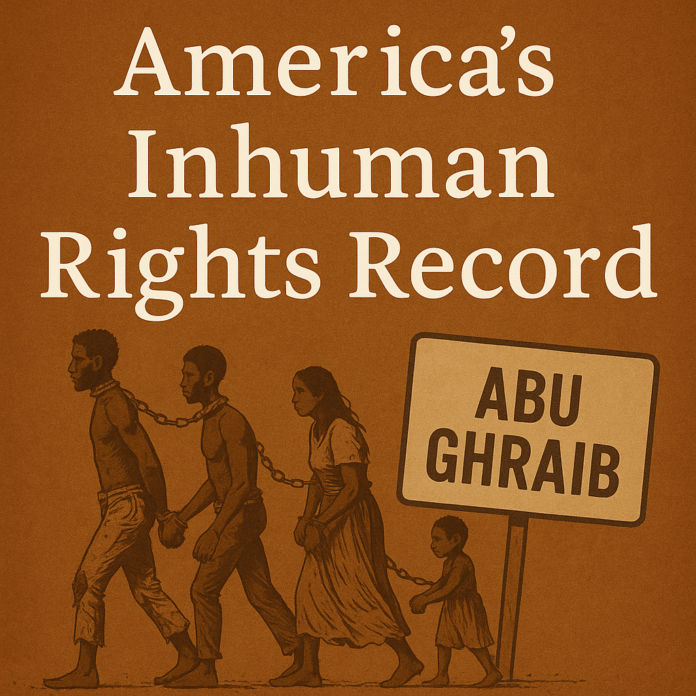
After the recent revelation of the horrors and humiliation inflicted by US soldiers on Iraqi detainees at the Abu Ghraib prison near Baghdad, the American nation has lost whatever pretension it may have had for presenting to the world its state department’s annual human rights report that includes everyone else but the US.
And if the US, the arrogant nation that it is, persists in compiling that report, every thinking media outlet must henceforth dump it into the waste paper basket.
The fact of the matter is that the Abu Ghraib episode is not the first of the miserable US track record on human rights. Below is a chronological summary of that record:
The US constitution, ratified in June 1788, had no solace whatsoever for the Blacks. Although African slaves were first brought to Virginia in 1619 as indentured servants who could earn their freedom, by the 1660s Africans were being brought to America in shackles for a lifetime of involuntary servitude. The ten constitutional amendments proposed in December 1791 and collectively called the Bill of Rights also showed no concern for Blacks and Black slaves. The much-lauded Bill of Rights was supposedly meant to ensure the fundamental freedoms and rights of the citizens of the US. Indeed, even 30 years after the advent of the Bill of Rights, the Union was admitting states that openly permitted slavery, and where a planter in the South meant that he was the owner of at least 20 slaves. Thus, in 1819, half of the 26 states in the Union were slave states. It was only after the ratification of the 15th amendment in December 1865 that slavery was constitutionally abolished—77 years after the constitution came into being.
Martin Luther King – Champion of the Blacks: Assassinated for demanding equal rights
Since the early 1600s, lands that belonged to the native Indian settlers were relentlessly taken away from them by European settlers and then by those who were called Americans. This was effected through outright purchase or through the superiority of cannon and cavalry over bows and arrows. By a law in 1887, 54 million acres of land were redistributed to the Northern American tribes like the Cherokee, but the land use rights remained with the government, with the money raised from the land being put in a trust for redistribution to the individual landowners. It now transpires that the natives filed a lawsuit in 1996 claiming that they are collectively owed $80 billion for farming, timber, and oil rights. The strength of this claim? The remark of the US district judge, Royce Lamberth, describing the case as “the golden standard for mismanagement by the federal government for more than a century.”
On May 8, 1945, all that remained of Germany’s Third Reich surrendered to the Allied forces of World War II, and Japan was on its knees. Yet, US President Harry S Truman ordered the use of its atom bomb if Japan did not surrender within a week ending August 3, 1945. On August 6, accordingly, Hiroshima was bombed; two days later, it was Nagasaki’s turn to suffer the holocaust. Though three years of intensive research in laboratories across the US and a test at Alamogordo, New Mexico, on July 16 had been done, the scientists, the military, and the politicians of the US had not cared to assess the awesome destructiveness of the atom bomb. And those Americans, remember, are the ancestors of those of today who write the annual human rights report on the world.
More than one million Black soldiers fought for the US in World War II, but those who came from the South could not vote. Blacks who registered faced the likelihood of beatings, loss of job, loss of credit, and eviction from the land. Lynchings continued to occur even a year after the war, and there were laws in place that enforced segregation of the races in streetcars, trains, hotels, restaurants, hospitals, recreational facilities, and employment. Ironically, the first documentary use of the expression “human rights” is to be found in the United Nations Charter adopted at San Francisco on June 25, 1945 and promptly ratified by the US Senate by a vote of 89 to 2.
After World War II, the US government became so paranoid over rooting out Communism within the country that the House Committee on Un-American Activities investigated the motion-picture industry to see whether Communist sentiments were being reflected in popular films. When some writers refused to testify, they were cited for contempt and sent to prison. The most militant anti-Communist was Senator Joseph McCarthy, a Republican. With the help of press and television coverage, he indulged in savage attacks on suspected Communists and didn’t hesitate to offer scapegoats to heighten fears aroused by the Truman administration’s own anti-Communist effort.
McCarthy has many followers in India amongst the left-liberal intelligentsia and media who intimidate Hindus with secular terrorism as their weapon.
Segregation of Black and White students in schools continued till 1954 when the Supreme Court debarred the practice. Till 1956, segregation in buses of Black and White continued till another Supreme Court verdict prohibited it. Till 1957, the US Constitution did not guarantee the right to vote, and it was only the Civil Rights Act of that year which authorised federal intervention in cases where Blacks were denied the chance to vote. Yet loopholes remained, warranting the Civil Rights Act of 1960, which provided stiffer penalties for interfering with voting but still stopped short of authorising federal officials to register Blacks.
It was only in 1964 that the landmark Civil Rights Bill was enacted, outlawing discrimination in all accommodations. It was as late as 1965 that the Voting Rights Act came, authorising the federal government to appoint examiners to register voters where local officials made Black registration impossible. And in 1968, Congress passed legislation banning discrimination in housing. By contrast, each and every Indian citizen of 21 years and more was, irrespective of caste, creed, community, colour, education, and income, entitled to vote in every state and national election held from 1952—two years after the commencement of the Indian Constitution—to 1968.
The anti-Communist zeal led in 1964 to the prolonged war in Vietnam that cost 58,000 American lives, and the needless invasion of Cambodia in 1970. In both instances, there were revelations of American units engaging in atrocities.
The Watergate scandal of 1972 showed that a President of the US could violate human rights to the extent of tapping his rival party’s crucial deliberations in a hotel.
The Equal Rights Amendment to the US Constitution was passed by Congress in 1972, barring denial of a right on account of sex. Even after several years, ratification from the necessary number of states was not obtained. Women secured the right to abortion only by a Supreme Court verdict of 1973—the right, though, was restricted to early months of pregnancy.
Space constraints demand a jump to 9/11 and the bombing of Afghanistan with its big collateral damage. Within two months of that historic date came the US Patriot Act, which allowed the police at any time, and for any reason, to enter and search any resident’s house, files, and bank accounts without even notifying them. According to legal experts, the new law effectively nullified at least six amendments of the Bill of Rights addendum to the US Constitution. As a result, America became a police state, pure and simple. And President Bush wants to extend the life of that law.
9/11 also meant the ghastly scenario at Guantanamo Bay, near Cuba. Imagine 680 inmates held there in solitary confinement for more than 24 months. No lawyer was allowed to represent an imprisoned suspect at trial unless the lawyer was a US citizen vetted and approved by the US Defense Department; imagine the construction of an execution chamber at the site. It’s been a new low in human rights—even for the USA.
No presiding Uncle Sam has described any of the above as “a national shame”—not even after Abu Ghraib.
There’s no need at all for its state department to give lessons on democracy and social justice to Free India, which has had a pluralist, liberal, and humane constitutional mechanism (barring the aberration of the 1975 Emergency) that is unmatched in the rest of the world.
We have our failings, yes, but we don’t need sermons from those who have the blood of slaves on their hands.
— Arvind Lavakare
The Hoax of Human Rights
(In the demise of Shri Sita Ram Goel, Hindu society lost a bold and towering figure whose collaboration with Shri Ram Swarup gave birth to a stimulating era of debate and introspection on many socio-religious and political problems plaguing the Hindu community. In memory of these two distinguished personalities, we begin a new column with this issue titled “The Voice of India Column” devoted exclusively to selected extracts from some of the important works of these pioneers published under the banner of “Voice of India”, New Delhi. Our sincere thanks to Shri Pradeep Goel for making this possible.)
The next encounter between Hinduism and Christianity took place in the Constituent Assembly, which started framing independent India’s Constitution in 1947 and completed the work by the end of 1949. The dialogue centred around what the Christian participants proclaimed as their fundamental human right, namely, to propagate their religion.
The Christians were quite clear in their mind as well as pronouncements that the “right to propagate” religion entitled them to: 1) receive massive financial help from foreign sources; 2) maintain and multiply churches and missions; 3) train and mobilize an ever-expanding army of missionaries, native and foreign; 4) enlarge the mission infrastructure of seminaries, social service institutions, and mass media; and 5) convert an increasing number of Hindus to Christianity by every means, including fraud and material inducements. They had been holding meetings and passing resolutions on all these points even before the Constituent Assembly was mentioned in the negotiations between the Congress leaders and the British Cabinet Mission.
The Hindu participants, on the other hand, did not grasp the full meaning of the “right to propagate religion.” They did understand that the word “propagate” was only a substitute for the word “convert,” and tried to hedge in the provision with various restrictions. But they did not realize or think it important that “propagation of religion” had employed, and would employ, a formidable organisational weapon forged almost entirely with the help of foreign money and controlled completely by foreign establishments, including intelligence networks. Therefore, the points they raised in the course of the dialogue did not go to the heart of the matter.
What helped the Christian lobbyists a good deal was the talk about fundamental human rights, which filled the atmosphere at the time the Constitution was being framed. The San Francisco Conference had completed the framework of a United Nations Charter. A declaration of fundamental human rights was being proposed and discussed. The Christian missions were backed by powerful people and establishments in the West. They, therefore, exercised considerable influence in the United Nations and were able to ensure that this declaration included their right to wield organisational weapons in the countries of Asia and Africa for the conversion of non-Christians. The politicians who mattered in India were either unaware of the Christian game or did not understand the implications of the “fundamental right to propagate religion.” They yielded easily when the Christian lobby pressed for inclusion of the word “propagate” in the clause, which in its earlier version had allowed only freedom to profess and practise religion.
The controllers of Christian missions in Europe and America had foreseen quite early in the course of the Second World War that the enslaved countries of Asia and Africa were heading towards freedom. The future of Christian missions in these countries was fraught with danger. The missions were an integral part of Western imperialism. Leading native freedom fighters did not look at them with favour. It was, therefore, felt that the future of these missions had to be rethought and replanned. They had to be presented in a new perspective in the post-war world.
In the past, propagation of Christianity and conversion of heathens with the help of organisational weapons, forged and financed by the West, had been propped up as a “divinely ordained” privilege. That was not going to work in the new world order which was emerging fast. Propagation of Christianity was, therefore, to be presented as a fundamental human right. Christian missions were to become champions of religious liberty and minority rights. As early as 1941, church organisations in Britain and the USA had set up Commissions for projecting a post-war world order from the Christian point of view. The Commissions “foresaw” great opportunities for “world evangelization” in the “just and durable peace” that was to be ensured in the wake of victory over the Axis Powers. More important, the Federal Council of the Churches of Christ in America and the Foreign Missions Conference of North America had set up a joint Committee on Religious Liberty with which the International Missionary Council was cooperating unofficially. The Committee completed its work at the end of 1944, and its findings were presented to the world at large in a 604-page book published by the International Missionary Council from New York in January 1945.
Coming to India under British rule, the book said, “The major difficulty is in lack of social liberty, rather than in deficiency of civil liberty legally formulated. It is extremely hard for members of most Indian groups to transfer their allegiance to Christianity or to any religion unless it be to the majority group of Hindus—or in some area, of Moslems—among whom they dwell. Persecutions and disabilities are severe, especially in regard to employment and the use of land. They rest upon the fact that transfer of religious allegiance brings a loss of entire status in society, including family position, economic relationship in village or caste guild and opportunities of marriage in the natural grouping. Not only do these hindrances tend seriously to limit accession to Christianity, even from the ‘depressed classes’ who have little to lose and everything to gain, but they also serve to cut off Christians as a distinct body of persons largely dependent upon their own meagre group for economic and social opportunity.”
The problem faced by Christian missions in some princely states of India was also noted. “Restrictions in certain Native States,” it was pointed out, “are ominous, since they suggest what the full combination of political rule with religious community interest may hold for wide portions of India in the future. Despite considerable British persuasion and influence to the contrary, certain Indian states prohibit the preaching of Christianity and the entry of missionaries within their borders. Some states forbid the erection of church buildings, some prohibit schools, and one is tolerant of a single denomination. Patna recently put severe difficulties in the way of change from Hinduism to any other faith, using the piquant title ‘Freedom of Religion Act.’”
Looking to the future, the book stated, “Rule by Indians is already well along in transition and is certain to be consummated, whether by gradual or by revolutionary change from the present mixed system in which British authority has long fostered the concept and the practice of self-government… The Congress Party has committed itself to religious freedom and the protection of minorities. But the restraints of British neutrality and British protection of minorities are irksome to the strenuous elements, and they may be swept away in the name of ‘Indian unity’ or even of ‘Hinduism restored’. All that has been associated in fact or in the emotions of Indians, with foreign rule and its cultural connotations will be a target for attack.
Finally, it came to the main culprit—Hinduism. “It is necessary,” it said, “to consider further the basic nature of Hinduism, the system which controls the lives of a multitude half as numerous as all the peoples of Europe. It is a totalitarian social and economic and cultural complex knit together with powerful religious sanctions. Every act of life, from birth till death, is directed by it. Race, caste, guild or occupational grouping, tribe or clan, family, gods, temple and pilgrimage, literature and legend, folklore and local superstitions, ethical and social prescriptions, community in all senses of the term: they are one pervasive, controlling force—Hinduism. How can one renounce it? If not impossible, the thought is unnatural, impious. Withdrawal is an outlawing of self from all established institutions and from normal human fellowship. Such is the background for the Hindu view of conversion.”
The World Council of Churches and the International Missionary Council exhorted church organisations all over the world to “intercede” for the success of the San Francisco Conference. The National Christian Council of India received a cable from New York stating that the American churches were planning special intercession on April 22 for the success of the San Francisco Conference and suggesting like action in “your constituency.” The National Christian Council Review commented, “Momentous issues will face the delegates of the San Francisco Conference of the United Nations as they assemble on April 25… A supreme responsibility rests at this time on the Universal Church.”
What this “intercession” meant became clear when the U.S. monthly, Christianity and Crisis, published in its June issue a report about Christian influence at San Francisco. “The concern,” it said, “which Church leaders have shown during the past decade for the development of a law-governed world has borne fruit… The State Department included in its group of advisers or consultants, representatives of certain Church organisations, Federal Council, Church Peace Union, Catholic Welfare, and others. These representatives had worked consistently and steadily to back the American delegates in giving what Mr. Dulles has called a ‘soul’ to the Charter. They had backed the recommendations for a commission on Human Rights and had urged the recognition of such in preamble and definition of the Assembly’s work.”
18 May – Churches’ concern over the situation in Iraq and the Israel/Palestine conflict, the role of religion in conflict, and working relations between the World Council of Churches (WCC) and the United Nations Organization were the focus of a first meeting between the UN secretary-general Kofi Annan and the WCC general secretary Rev. Dr Samuel Kobia. Annan welcomed Kobia’s initiative to invite the Council’s member churches to mark the International Day of Peace with prayer services.
It seems, however, that lobbying for “religious liberty” through government delegations was not enough. Pressure from outside had to be maintained. It was with this aim that the World Council of Churches and the International Missionary Council set up a Commission on International Affairs, which held its first meeting in Cambridge, England, in August 1946. One of its aims was to make sure that “the Church should and will play an important part in promoting the work of the United Nations.” According to a spokesman of the Church, “It is imperative that Christians develop an intelligent understanding of what the United Nations Organisation is, what its duties are, and the manner in which these duties are to be discharged.” He added, “The American Church helped influence the shaping of the Charter. Upon invitation of the Department of State, they had their consultants at San Francisco Conference. Plans are now being perfected whereby Churches may have ‘observers’ present at the public meetings of the major organs of the United Nations, including the General Assembly.
Rest is history. The Universal Declaration of Human Rights adopted and proclaimed by the General Assembly of the United Nations in October 1948 included Article 18, which read: “Everyone has the right to freedom of thought, conscience and religion: this right includes freedom to change his religion or belief, and freedom, either alone or in community with others and in public or private to manifest his religion or belief in teaching, practice, worship and observance.” The renewed assaults to be mounted by Christian missions in post-war Asia and Africa had been camouflaged in clever language.
Extracted from Sita Ram Goel’s History of Hindu-Christian Encounters (AD 304 to 1996), Voice of India, New Delhi.
An Evening with the Hindu Human Rights Group – UK
‘Human Rights’ has always been a useful stick to browbeat opponents in the global political arena. How honest and balanced are the self-proclaimed human rights ‘watchdogs’? Organizations like Amnesty International give wide coverage to rights violations of many ethnic groups and communities but maintain a strange silence when it comes to Hindus. Whether it be the deliberate killings of Hindus in Kashmir or the planned depredations in Bangladesh or the subtle discrimination and manipulations in countries like Malaysia or Fiji, these organizations at best present a muted response.
Therefore, thinking Hindus have developed a sort of cynicism and general distrust towards them. Recently, when many well-known news portals across the world quoted “the Hindu Human Rights group, based in the UK,” I was pleasantly surprised. BBC even offered a link to the ‘Hindu Human Rights’ website (http://www.hinduhumanrights.org). A quick look at it tugged at my heart – after years of anguish, is global Hindu Renaissance heralding a new beginning here too? I thought I should meet them up.
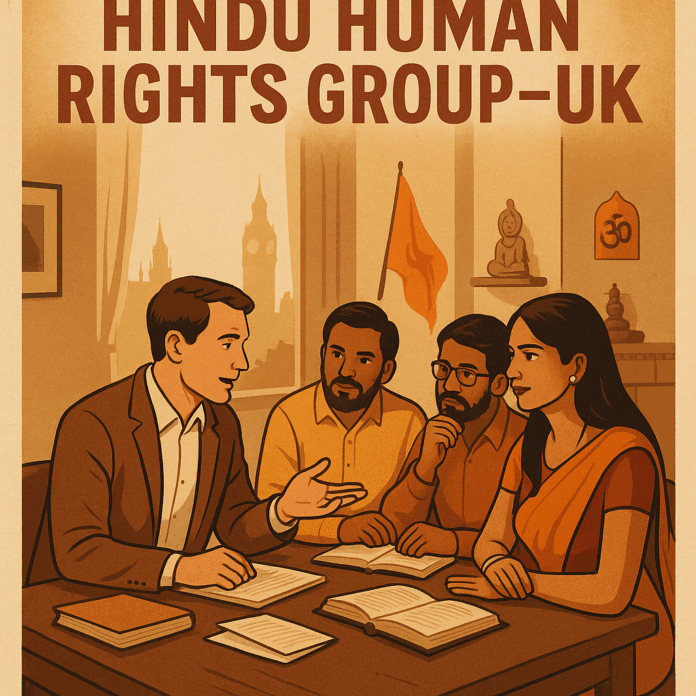
On a quiet English Sunday, I arrived at one of their meeting places at London. I was welcomed in. There was quiet activity, some members discussing seriously, while others pored over books. Some were planning to leave but stayed back to speak to me. A hush set in as I introduced myself, with some apprehension, perhaps shared by many Hindus towards English language journalists today. But as the meeting progressed, our conversation shifted to a smooth track.
What follows is the gist of the interview with Anil, Nitin, Raju, and Sheila – founding members of the Hindu Human Rights group (HHR), UK. Sheila Maharaj is HHR’s spokesperson.
Sheila Maharaj, spokesperson of HHR
Prabhu Rajagopal: Can you tell us something about the origins of your group?
HHR-UK: (after a short pause) It was a long process. Growing up in mixed communities in London made many of us acutely aware of and question our identity. Over the years, we were painfully exposed to the numerous problems facing Hindus. So many times, it was frustrating for us, as Hindus, to see why we alone put up such a spineless response to the different challenges and provocations. But deep within, we knew, that in spite of all this apparent weakness, Hinduism could not be all that shallow.
That this great religion survives today and still provides anchor to millions worldwide, when all its contemporaries have been confined to museums, and is as vibrant as it was over millennia, would not be possible without an underlying strength. The wonderful magazine Hinduism Today affirmed what we felt. Books by brilliant authors like David Frawley and Sita Ram Goel stirred us. There was this great churning going on and some of us decided that we had had enough of complaining; that it was time to act, to do something, to put into practise what Sri Krishna taught, that ‘we had to go for it now.’
PR: When was this and how did you all meet?
HHR-UK: Things began roughly in around 2001… (with a ring of deep sincerity) When the mind and heart are true to what you want, people turn out. That’s how we all met.
PR: Why this unconventional name?
HHR-UK: All around the world, there are pressure groups lobbying for the rights of particular communities. They have people in the media, academia and the political parties. So much so that some of them even get away with blatant acts and plain blackmail and still, there are people who want to cuddle up to them and ‘respect their sensibilities.’ In this atmosphere, Hindus seem like orphans. Their rights ‘don’t concern nobody’ and they die most often unsung and unwept. No groups, no lobbies represent them effectively, leave alone speak for them. Aren’t Hindus human beings? Also, are they not entitled to Human Rights? That question brought us to this title. But actually titles are nothing, we are essentially a group of concerned people and ‘Hindu Human Rights’ is one of our activities.
PR: Please tell us about some of your activities
HHR-UK: Our activities are mainly aimed at promoting a better understanding of Hinduism and Hindu issues especially rights abuses and circumstances leading to them, both among Hindus and the world at large. We have so far sought to do this through different activities, like promoting awareness through incisive books, organizing talks open to the general public and also at Universities, setting up channels for spreading of ideas like websites etc.
We take efforts to present an unbiased perspective of Hinduism and reach out to similarly marginalized groups like the neo-pagans in Europe and the natives in Africa and America. We have also, till date, organized a number of protests, like the ones against Taliban in July 2001 (at 10 Downing Street); against biased articles during the post-Godhra period in The Independent newspaper; and against the abuse of Hindu minorities in Bangladesh in the aftermath of elections there, in 2003. Recently, we launched a petition against the casting in Shakti, one of Ismail Merchant’s forthcoming films, given that Hindus revere Shakti and considering the lead star’s image. This gained wide coverage in about a dozen newspapers and news portals around the globe, including the Washington Post and the BBC; we were interviewed on BBC Radio 4 in this regard. We believe such coverage is helpful because at least people would awaken to the fact that Hindus do have views on different issues and that the world cannot just continue taking them for granted without any consultation or dialogue.
PR: What in your opinion are the challenges before the Hindus today in the UK?
HHR-UK: There are both internal and external challenges. One important external issue is the need for Hindus to be classified as Hindus and not in such confusing terms as ‘Asians’. You know that a few years ago there were race riots in the North of UK. What many do not know however is that Hindus were attacked as much as the whites; but the local newspapers ran campaigns for freeing those very ‘Asians’ who’d butchered Hindus.
Then there is the problem of periodic attacks on Hindu temples, dating from the Ayodhya days. Added to this is the portrayal of Hinduism in the print and electronic media, which creates an intellectual atmosphere for the abuse of Hindus – ‘they deserve it’ kind of attitude. Unsympathetic, disparaging and outlandish comments often bordering on mockery are made upon Hindu Gods and Goddesses and Hindu rituals.
There is also a disturbing trend in so many popular soap operas, which show Hindu families as dysfunctional and Hindu women as being loose. This makes us suspect if there is an attempt to influence Hindus in a certain way, because, in reality, Hindus in the UK have been known to have the strongest family values. And then we have the problem of missionary propaganda and conversion of Hindus to other faiths. Hindus can be easy prey because they do not often know much of their own tradition and all that they see and hear only adds to negativity regarding Hinduism. Internally, a serious problem is the unreasonable dominance of regional and sectarian bodies over religious and social life of Hindus. The consequent lack of cohesion aggravates all the problems and hinders any collective response.
PR: What do you think is the cause for this media bias?
HHR-UK: This bias in world media occurs because the English language journalists and media in India itself are so prejudiced towards Hinduism. When we protest to The Guardian or The Independent or BBC about biased reports, they taunt us that they’ve got the stories from “Hindu columnists from India.”
PR: A quick aside – I’m curious to know how, as second generation Hindus in the UK, you connect to India.
HHR-UK: Yes, we feel connected to India, we feel connected emotionally and spiritually; India is our Holy Land. India is the spiritual mother ship of Hindus everywhere in the world. But, we are sometimes disgusted with the Indian State. All the sham that happens in the name of secularism and crass politics upsets us. We feel connected because of our Hindu identity.
PR: Returning back, why do you think there is no representation from genuine Hindus against this bias?
HHR-UK: This, we believe, is because Hindus are the most uneducated about Hinduism and regarding issues facing them. Ninety percent of Hindus don’t quite understand Hinduism well. Many of them are the most brainwashed – anyone pro-Hindu is perceived to be a fundamentalist and a fascist (with some amusement, whatever those words might mean!). And Hindus seem to have a taboo against going into anything that won’t benefit them immediately. This is why either non-Hindus or Hindu namesakes fill the academic chairs on Hinduism and related studies in so many universities. The same is true with the mass media too.
PR: Is there something coming, do you see a change in this direction? Are there more groups like yours in the UK or in the world?
HHR-UK: At the moment, there are few other groups like ours. The Global Human Rights Defence Group formed recently in Holland is in our opinion, a laudable venture. The consciousness has arisen, but nobody has given a comprehensive vision yet.
PR: Are you optimistic about the future? What vision do you propose?
HHR-UK: Indeed the future is bright. We need to be and ought to be positive. Hinduism is a global religion and Hindus just need to understand that today they are spread over the entire world; Hinduism is not just a ‘way of life’ but ‘THE Natural Way of Life’. There is something fundamentally wrong with the modern world, so much of strife and chaos and so much running after nobody knows where. Therefore the big vision before Hindus is to expand – on one hand, take to their religion more strongly than ever before and on the other, play a part in making the world a better place.
So much has been spoken about Hindu Gods and Goddesses and our myriad philosophies. But there is something more intrinsic to Hindus, which has never been given coverage – family values, morality, emphasis on a balanced life and respect for nature. These are actually the practical manifestations of Hindu ideas. Today societal chaos stares the world, and we may be on the brink of an ecological disaster. Hindu ideas can go a long way in assuaging these crises. In future, we propose to put this vision to action. Hindus need to come out of a sort of trauma into which they have shut themselves.
– Prabhu Rajagopal
How Khem Singh Starved to Death
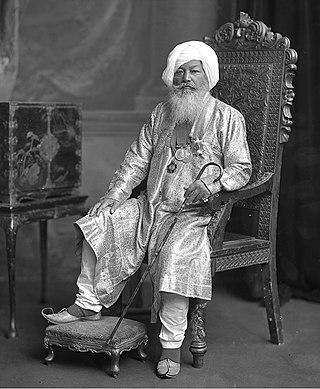
This man, who did not speak English well, was brutalized in a jail in Fresno, California, and the jailers watched him starve to death, with no compunctions. They gave him no medical attention or even food for two months while he starved.So 72-year-old Khem Singh died in prison of slow starvation partly because his religious beliefs were violated: a strict vegetarian, he was given meat to eat. Which meant he ate nothing at all.
A few years ago, a young Indian man named Navroze Mody was beaten to death by eleven white racists shouting ‘Dot-head!’ as he was walking to catch a train in Hoboken, New Jersey. His crime? He was Indian.
A couple of years back, an Indian father of three, Charanjit Singh Aujla, was shot to death by plainclothes sheriff’s deputies in Jackson, Mississippi. They claimed that he, a person with no prior criminal record, had pulled a gun on them as he thought they were trying to rob the liquor store that he managed. His crime? He was Indian.
None of the people in the civil rights cottage industry in India, such as the ever-vigilant Human Rights Watch, or Amnesty International, or Teesta Setalvad, or Shabana Azmi, or SAHMAT or Communalism Combat raised a little finger in the defense of Navroze Mody or Charanjit Singh Aujla.
Nor did the great protectors of minority rights such as FOIL (Forum for Indian Leftists) mavens Vijay Prashad and Biju Mathew. I suppose you can’t blame the US Indian Marxist cohort: they prefer more glamorous issues, like the Guinean Amadou Diallo being shot by New York City police. No time for Indians, plenty of time for African Muslims.
What was the original sin of Mody and Aujla? They did not follow Semitic faiths. If Aujla had been, say, Mohammed Akram Aujla, FOIL, ActionAid, Human Rights Watch, and other lords of poverty would have been all over his case, and would have gone to the US Supreme Court shouting from the rooftops about the human rights of minorities.
If he had been Christopher Ignacius Aujla, the US Council on International Religious Freedom and John Dayal and Jaichand somebody (that’s his real name, I get mail from him) would have sued the US government for ill treatment of a minority. On second thoughts, scratch that. All these worthies, who are in cahoots, would have hushed up the incident, just as the church hid decades worth of paedophilia. In any case, the CIRF’s purpose is not to worry about religious freedom, it is to make money for clever religious entrepreneurs.
An even more appalling incident took place in February. A crippled, elderly, Sikh priest was brutally and deliberately murdered by agents of the US government. Yes, I say this, because at the very least, it is criminal negligence, and more likely culpable homicide on the part of prison authorities.
This man, who did not speak English well, was brutalized in a jail in Fresno, California, and the jailers watched him starve to death, with no compunctions. They gave him no medical attention or even food for two months while he starved.
So 72-year-old Khem Singh died in prison of slow starvation partly because his religious beliefs were violated: a strict vegetarian, he was given meat to eat. Which meant he ate nothing at all.
It was an egregious violation of his human rights as well as his religious rights, in the land that prides itself on the rights of its residents.
I am reminded of Kala Pani, about the brutal prison camp in the Andamans, where the British imperialists broke brave men: a gulag, a Devil’s Island.
Remember this was a frail old man, a man of God, who was only 110 pounds to begin with, and not quite able to deal with the culture of this land, thrown in jail on what were probably trumped up charges, which shocked and deeply depressed him. Perhaps he just wanted to die, because of all this. And he was terrorised and injured by a prison guard who slammed a cell door on his hand, so he never even left his cell to eat. Casual racism, bigotry and brutality. This is the America of chain gangs, Jim Crow, Bull Connor, and Mississippi Burning.
The details are absolutely shocking; the LA Times has reported this in full, but Indian newsmen are busy with more important news, such as cricket in Pakistan.
The Singh case reminds me of two incidents. One, the Achille Lauro hijacking, where Palestinian terrorists shot a wheelchair-bound Jewish man, Larry Klinghoffer, and threw him overboard. The second, when a missionary, Graham Staines, was killed in India.
In the Klinghoffer case, there was universal condemnation of the fact that a terrorist had murdered a defenseless old man. In the Staines case, much was made of the fact that he was a preacher.
Khem Singh was both a defenseless old man and a preacher. The case is also far more egregious, because it was not random individuals who were responsible. It was duly appointed law enforcement officers of the California correctional system who were the violators of human and religious rights. This is a serious blot on the American legal system and its moral standing, and I wish the Indian government would take up the legal issue.
However, we know full well that the Indian government will not do this, and so it is up to individual Indians, especially NRIs, to take it up. I hope the Indian Diaspora will pursue the legal issues, for this is a test case for the rights of non-white, non-Christians in the US in the post 9/11 scenario, and the limits to government-sanctioned cruelty. It might get to the US Supreme Court eventually. Alternatively, Bush II or Kerry I may build concentration camps for some US residents, like they did for Japanese Americans during World War II.
A few friends of mine have been galvanised by the Singh case, and are in the process of collecting data about similar cases of human and religious rights violations in a few countries such as the US, EU nations, China, Australia, and so forth. If you have specific and verifiable details, including reliable media reports, about such cases, feel free to send them to my email id below.
As expected, FOIL and other Marxist Indians are quite blasé about this murder. All the ‘secular progressives’ afflicted by ‘South Asianitis’ have also been astonishingly quiet about it. These are the hypocrites who screamed loudly when the white missionary was killed (see my earlier rediff column, “Death of a Missionary”). But since this priest was merely a Sikh, he doesn’t count.
Prison Authorities Ignored Our Repeated Alerts: Inmates
India Post Reports on Khem Singh case
Tuesday April 6 2004 11:56 IST
WASHINGTON: An elderly Sikh inmate, who was a former priest at a local Gurdwara, died of starvation in a California state prison, where he also faced brutal abuse by security guards, a media report alleged.
“On February 16, the 72-year-old Khem Singh passed away at Corcoran state prison. Crippled and bound to a wheelchair, he died of lung and heart failure brought on as a result of starvation, India Post, an ethnic weekly published from multiple centres in the US said.
“Fellow inmates repeatedly alerted the authorities about his condition but allegedly no action was taken,” the report said alleging that it was the first case of a starvation death in a California state prison.
The matter, said the weekly, is under investigation and, “Hopefully, upon the intervention of state senator Gloria Romero, chairperson of the oversight committee who visited Corcoran to review medical and other related documents and spoke to the inmates, those responsible for nay wrongdoing will be brought to justice.”
An inmate wrote about Singh’s condition to Romero for her intervention but it arrived a few days late. The inmate also accused a prison guard of brutalising the frail old man.
Khem Singh was the head granthi at the Modesto gurudwara. But was relieved of his post, said India Post. He continued to provide religious education to Sikh children in the area.
He was accused of “inappropriate behaviour” with a child and was sentenced to 27 years in prison in June 2001. Khem Singh, then almost 70 years old, maintained he was innocent and had been “framed,” the weekly said.
Baljit Kaur, Khem Singh’s wife, accused the prison authorities of brutalising her husband.
(PTI)
Because Hindus, Sikhs, Buddhists, Parsis and Jains are children of some lesser god. Only the Semitic types (in the Indian context, these are Christians, Muslims and Marxists) are human, only they have human rights, only they have the right to worship. Yes, it’s true, it’s written in their books, by God (and Marx). Personally. Didn’t you know?
What Nehruvian Stalinists have institutionalised in India is nothing but apartheid. Just as in South Africa the numerically larger black population was brutalized and exploited by a small white population, the fascist Marxists of India, in cahoots with Christian and Muslim collaborators, engage in systematic and endemic discrimination and oppression of Indic religionists. And the latter are led to believe they deserve it, too.
This is one of the greatest perversions that has been visited upon India in the recent past. Subramanian Swamy, whom I am not a great admirer of, nevertheless wrote an intriguing piece in the Chennai newspaper called The Hindu of March 18th, explaining why the ‘secularism’ of Jawaharlal Nehru is a travesty because it is totally discriminatory against the native culture of the land. Just like apartheid.
Like the empty nihilism of the Dravida Kazhagam, this Nehruvian ‘secularism’ is a monstrosity, as it creates a spiritual vacuum which will be filled with something, perhaps a religious abomination: people are worshipping E V Ramaswamy Naicker, Jayalalithaa, C N Annadurai, M G Ramachandran, et al. ‘Secularism’ is creating a backlash where all Semitic types are now viewed with suspicion, deservedly or not.
The effects of this grand apartheid can be seen all over the place: the victims of Muslim aggression in Maraad, Kerala, are forgotten. Nobody publishes the stories of the widowed women or their fatherless children. The reports that I read suggest that the cover-up, led by a Muslim League minister in the Congress government, has been quite successful in thwarting an official CBI enquiry into the massacre. Everybody is losing interest; after all it is only inferior beings, Hindus, who were killed. Nameless, faceless creatures.
But Bilkis Bano from Gujarat, also a victim, now that’s a different matter. She’s a Muslim, so she has a name, she is interviewed in the media, she has batteries of lawyers and gets many column inches in the papers. Or take the Best Bakery case. This will be tried over and over again.
This asymmetry is utterly shameful, and inappropriate in a society that aspires to be just. It is clear that some Indians are more equal than others.
Where are the court cases about Maraad? There are none.
What about the court cases about the Godhra massacre? Once again, everyone is losing interest. After all, the victims were just Hindus. The Muslims have their poster boy, the fellow whose image, allegedly begging for his life, was flashed around the world.
But there were no images of grieving relatives of the 59 Hindus burned alive, nor of their charred bodies: ah, we mustn’t show Hindu victims, because Hindus by definition can only be victimizers. Soon there will be a film that ‘proves’ that Hindu pilgrim women and children set fire to the train from inside and committed suicide to make the Muslims of Godhra look bad just because they had gathered in a two thousand strong mob at 7 am, armed with Molotov cocktails.
The USCIRF and their JNU friend, Kamal Mitra Chenoy, have a stick to beat India with for, oh, the next fifty years. Everyone is happy, all’s well with the world. Business as usual, apartheid rules.
But I beg you to shed a tear for a little Sikh man named Khem Singh, 72 years old, crippled, starving to death in a strange and brutal place. Imagine now, God forbid, something like this happening to a loved one of yours.
I cannot help thinking of my father first coming to America, smaller than I remembered him, unsure of himself, clutching his briefcase when I met him at the airport in Boston, intimidated by the strange surroundings, even though he was a professor of English and American literature.
Khem Singh too was someone’s father, someone’s husband, some mother’s son.
I once wrote about Jallianwallah Bagh. 1,650 bullets, 1,579 casualties. The savagery of the white man and of the imperial West. Khem Singh’s case is in its small way, another Jallianwallah Bagh.
The marchers at Martin Luther King’s last public meeting, in Memphis in 1968, bore signs that said, simply, “I am a man.” Khem Singh was a man. He had rights too.
Khem Singh didn’t deserve to die like this. No, not in the land of the free and the home of the brave.
(This article is available online at Rediff: http://in.rediff.com/news/2004/mar/22rajeev.htm Other columns by Rajeev Srinivasan referred to in this article are also available at: www.rediff.com/news/srinivas.htm. Reproduced with the kind permission of the author.)
Identities in a Multicultural World
In a world where people are on the move from country to country, identity becomes a very complex issue. Just fifty years ago, it would have been unthinkable for people to be born in a small village in Europe and live in a large and fast changing metropolis like Bangalore, Bharat or vice versa. In the present era this is commonplace, facilitated by easier and faster means of communication, travel, as well as global job opportunities. So, the issue of identity is a crisis for all those who live away from the countries of their origin and the offsprings of the uprooted have identity issues too, which varies by ethnic groups.
It is well known that when moving, we take not only a few bags of things with us but also many habits; in fact this is how humans cross-fertilize cultures. Identities are tied to these habits that seem to form rather early in our lives and become ingrained; in one form or another these stay with us – all through the complicated journey of our existence on Earth. That must be the reason why Mom’s food is the best tasting! Another significant add-on to this learning in early years is our religious ideas and the concept of Bhagavan (God). These are the core values forming our identities and when threatened, cause great disturbances to both the individual and to the world at large. In fact, two most sustaining habits from our beginnings seem to be food and God!
In the USA, I have seen each religious identity become less tolerant, moving towards fundamentalism, as opposed to India where each group moves towards less staunchness and more acceptance. I attribute this to a feeling of threat that comes from being in the presence of a strongly converting religion here in the West. Hindu Dharma, on the other hand, has attempted to accommodate all traditions and thus is less threatening.
A Hindu-American living in North America, at first thinks that blending in a land of immigrants should be easy, especially one that also claims to be secular. Very soon though, one finds this to be not at all the case. Secularism to most Hindus means to be able to practice the religion of one’s choice – often the one we were born into.
We have no single Hindu authority controlling our religious life nor are we told to accept anything unless it makes sense to us. In other words, we are used to great freedom in the area of our relationship with our Maker, which is not the case with the people of aggressive traditions. A world of religious fatwas, excommunications and a host of other restrictions shock us. At the same time, it creates a sense of awe towards the Hindu Tradition, which is so very open. Some of us feel very privileged to be born into such a system, where restrictions are social, not religious!
We are just not used to constant interference into our spiritual lives, nor are we used to seeing people denigrating other religions in the most uncivilized way. This is something Hindus rarely do and have very little tolerance for. Hearing highly ignorant, hurting and downright impolite comments about Hindu Dharma has made our Hindu identity become stronger, especially for those of us living abroad.
I have often wondered how our adopted country, the USA, will handle the future of a multicultural nation? Will we assimilate the non-European, non-white, legal immigrants and their USA born children, belonging to various traditions, wisely, into the larger mainstream? The present majority is Euro-centric in nature and the question of white superiority remains in the minds of some, though less obviously than before.
On this process of assimilation depends the future of USA. Without creating a sense of security for the ethnic minorities, USA could become a battleground like the Middle East and other parts where differences have not been harmonized well. Naturally, my mind thinks about Bharat, the other country and society I know equally well. The way India has kept her even more diverse people together, even during times of unbelievable stress, seems marvellous. Here, we must learn from this example or suffer eventually.
My observations over the past thirty-seven years, is that in the USA, this attempt at harmonizing will be more challenging. Whereas in India, the Vedic Sanatan Hindu Dharma is itself an accommodating tradition whereas the religion of the majority in the USA belongs to the aggressive type – making conflict resolution far more difficult. Now, the conflict with Islam is on the rise, making it even more complex.
Samuel P. Huntington in his book, The Clash of Civilizations writes about conflicts of the two religions of expansion:
“The causes of this ongoing patterns of conflict lie not in transitory phenomena such as twelfth-century Christian passion or twentieth-century Muslim fundamentalism. They flow from the nature of the two religions and the civilizations based on them.”
Further, he says,
“From its origins, Islam expanded by conquest and when the opportunity existed Christianity did also. The parallel concepts of ‘jihad’ and ‘crusade’ not only resemble each other but also distinguish these two faiths from other major world religions. Islam and Christianity, along with Judaism, also have teleological views of history in contrast to the cyclical or static views prevalent in other civilizations.”
Faced and threatened by such unaccommodating religious systems, plus the usual adjustment problems, the first generation immigrant faces a different society. Religious aggression evokes fear and anger which leads to insecurity and a strong desire to defend and protect one’s own religion. These repeated assaults by evangelical groups within the USA and by missionaries in Bharat (one of the reasons for insurgencies in many areas) have done much to offend the Hindu psyche. Hence, the tradition of accommodation among the Hindus is weakening both outside and inside Bharat.
There is, however, a very positive effect too – an increasing desire amongst the young and the old to learn about their traditions. This is particularly good for Hindu Dharma as we are a teaching tradition with a great regard for debate on ontological (nature of being) issues.
Even so, the Hindus everywhere are faced with a great dilemma. First and foremost, we have been brought up to respect other faiths and see them as equal in importance to the respective communities. We respect other traditions and ours is not a proselytising religion.
We also tend to confuse Dharma with Religion, which is incorrect. Only the faiths born on Bharat Bhumi (namely Hinduism, Sikhism, Jainism and Buddhism) are Dharma based; the others have no word equivalent to Dharma. So we must correct our understanding through a deeper study and then refer to the traditions of the world appropriately. The confusion about the terminology stems from ignorance of Hindus about their own traditions.
This, the greatest learning tradition in human history, was forced to stop the teaching for nearly eight hundred years! How else would those who wanted control of lands and riches belonging to others achieve their motives of domination? Fortunately, this spiritual tradition has been well maintained by those who understood its value, through immense sacrifice, and is now re-emerging to ennoble the human mind.
India was, till recently, usually mentioned here only for bride burnings, holy cows and the caste system. Mid-nineties saw people of Indian origins flooding the Information Technology revolution in the Silicon Valley first, and then other parts of the world. This and the new booming economy of Bharat have changed this attitude somewhat. However, the neglect of India and its great contributions to the world, as well as to the North American life continue. Voices ridiculing Hindu Dharma are now coming out of even prestigious institutions like Harvard and the University of Chicago.
The promotion of the ‘South Asian’ brand is part of this move by the conservatives who fear the Hindus most, as they are losing their ‘flock’ to the simple and benefiting Arsha Vidya (of the seers and sages) of Yoga, Meditation, classical dance and music.
The fact that India greatly influenced almost all major nations of the world – without colonizing them – bothers many a Westerner to no end. Any keen observer of the Western world, who also is well versed in the Hindu Tradition, can see that these influences are obviously recapturing people’s imaginations again. Regrettably, the attitude of plunder and possess, which has prevailed in these societies, rather than learn and share continues to exist. However, ordinary folk are willing to explore anything and everything, and in time, noble ideas will come to hold their own.
One obstacle to be overcome is that Hindu Dharma is seen as having ethnic connections to India alone, so those who follow its teachings tend to distance themselves from it outwardly. Little is known about the influence of India all over what is referred to as South Asia today – but that was a vibrant world, perhaps much nicer to live in, before the advent of the religions of war!
The Hindu identity is unique because the Dharma is based on a non-commercial spirituality, having concepts of Karma to make an individual responsible, not fatalistic. The foundations of Hindu Samskriti are strong and designed to perpetuate unity and harmony within societies. Hindu identity is a privilege that stabilizes us through the worst of times and we must claim it. South Asian we may be, for those that do not want to give us credit for our immense contributions since ancient times.
In bringing up children outside India, the best thing to do is to give them a strong foundation in the Hindu value system, a sense of family, and the wisdom to handle situations by having a prasada buddhi, that stays balanced no matter what life brings. The achievements of the Bharatiya Diaspora owe much to these ingrained qualities that have stayed with immigrants and so far with the children.
I pray that it will hold for many generations to come and also impact the adopted land and its other citizens positively. Bringing up children in the present day USA is not easy as most families are not structured for stability – a much needed attribute for healthy humanity! Our children are bright because of a value system that teaches but accommodates. Bharat is stable, giving sanctuary to displaced and persecuted people from all over, because of a Hindu identity, not simply South Asian. In Bharat, a jaagriti has begun and our spiritual heritage will help all humankind as it always has been doing.
Critical Paradigms of the Conversion Debate
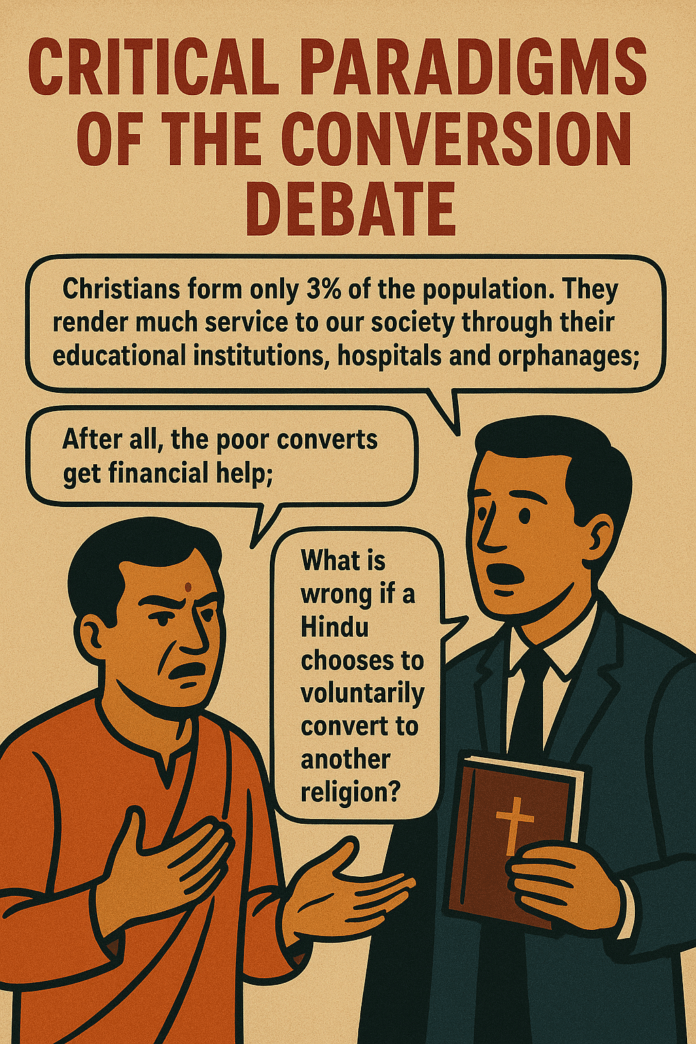
Hindus get stumped by Christian arguments during the conversion debate.
“Christians form only 3% of the population. They render much service to our society through their educational institutions, hospitals and orphanages;” “After all, the poor converts get financial help;” “What is wrong if a Hindu chooses to voluntarily convert to another religion?”; “The Christian minority in India is a peaceful, non-violent community;” “Christians are bringing in Foreign Direct Investment through their charitable activities (sic);” “Conversions occur only because of caste discrimination in Hinduism.” And so on…
Such misinformation serves to stifle opposition, for a confused Hindu is a neutralised Hindu. A confused person has no will to act, or has no clarity of thought that is essential for decisive action. For this reason alone, our society has failed to generate a “critical mass” of public opinion that can force the administration into taking serious note of the raging debates on issues of utmost importance. Otherwise, the secular machine is more than happy to remain indifferent to the plight of a voiceless “majority in moral minority,” as one French writer described us.
Seen from the Hindu perspective, these critical paradigms can be paraphrased into four key issues: unfair and outrageous conversion methods used by evangelists leading to social strife; foreign funding, disproportionate wealth of the missionaries and land-grab; Christian clout in the educational sector; state control of Hindu temples and misuse of temple revenue & attached property.
The solutions to these problems are also not difficult to locate. They have already been proposed and some have also been partially implemented in controlled pockets. What is needed today is a coordinated nationwide effort, which will provide a united voice to the Hindu community in resolving these conflicts.
The Myth of Free and Fair Conversions
The anti-forcible conversion laws passed recently by the Tamil Nadu and Gujarat governments in India seek to crack down on conversions by force and fraudulent means. Does it mean that there are conversions by free and fair means also? Can a Hindu be converted without the lure of financial aid or the fear of social exclusion? Can a Christian propagandist convince us about the superiority of his religion in a philosophical debate? For those who have an inkling of Christian theology or practice, the answer is an obvious ‘no’.
The claim of Christian evangelists that all conversions occur through a change of heart in the convert deserves to be nailed once and for all. All conversions, and particularly mass conversions, are achieved through force and fraudulent means. Hence, it is not difficult to understand the rationale behind the blackmail by Christian lobbies against these anti-conversion laws.
An empirical study recording the experience of thousands of Christian converts is very much needed. Let the truth be revealed from the horse’s mouth. The family strife, social stigma, cultural uprootment, spiritual suicide, and financial dynamics involved in every conversion should be exposed thoroughly.
Financial Scrutiny of Christian Missions a Must
Is it a state-secret that much of the evangelical activity in India is dependent on foreign money? Squeeze the foreign funding and let’s see if the Christians can succeed in changing the heart of a single convert in India; let us demand a bit of fair play in the business of saving souls. On the other hand, Hindu organisations, which participate in the shuddhi and paravartan movements in India, must seek greater participation from their NRI friends.
Public awareness on the foreign funding of Christian missions in India needs to be increased. Let this question be raised again and again in the Indian Parliament and State Assemblies and in every public forum. Foreign money is also the root cause of Christian land-grab in the southern Indian states of Karnataka, Tamil Nadu, and Andhra Pradesh. The demographic siege in the north-eastern states is also not without foreign support.
Dubious Role of the Media
The false stereotypes discussed above are largely a deliberate projection, which we have internalised without critical analysis. Hindus must learn to challenge every such stereotype that is doled out to them by Christian or secular propagandists, and particularly by the mainstream English press. Every report and every editorial is suspect; media credibility is at an all-time low today.
Consider recent events which the media turned into headlines for weeks together: the chain mail circulated on the internet about karsevaks molesting a Muslim girl on the Godhra train was simply faked; Dalit lynching in Jhajjar turned out to be a case of police torture. Recently, there were these “Special Correspondents” claiming that the Ayodhya excavations showed no evidence of a temple, even before the Archaeological Survey of India released its report!
Letters and articles from the Hindu perspective are not given any space; events showing the progressive side of Hinduism are not covered; criticism of Abrahamic faiths and minority fundamentalism is suppressed – the list is endless but the conclusion is unanimous: read your news with a pinch of salt. Obviously, these are “pre-paid” columns and “post-paid” headlines. While the press holds everyone accountable to its mighty pen, to whom is it accountable in turn? Virtually none.
[II] The Practical Side
Temples as Centres of Community-Welfare
If there is one issue that Hindus need to rally around today, it is the question of government control of temple revenue. Transparency in devolution of temple funds is woefully lacking. A temple is one institution that receives charity from a majority of Hindus. Where is this money going? Why should secular governments be using this communal money for their survival? Temple revenue deserves to be utilised for the welfare of the Hindu community.
Setting up of educational and cultural institutions attached to temples, renovation of ancient temples, and revival of their cultural significance in the Hindu consciousness are focus points. Tamil Nadu temples have successfully implemented annadaanam programmes and religious lessons; let this be replicated in other states too.
Need for Private Hindu Educational Institutions
A time must come, hopefully in the near future, when parents need not look up to convent schools as inevitable alternatives for primary and secondary education. The early years of the child are the most crucial in inculcating cultural and spiritual values. Educating our children in convents is literally converting them to the Euro-Christian worldview. This minority of English-educated Indians who emerge from the convents are manufacturing and controlling the opinion of the Indian nation today.
The recent historic judgement of the Indian Supreme Court on minority institutions and the right of the majority to establish educational institutions comes as a great relief. Let us not lose any more time in establishing quality educational institutions that will cater to our cultural aspirations, or else we will be losing many more generations to the stranglehold of Christian oligarchy in the educational sector.
The Role of Spiritual Leaders and Ashrams
There are a thousand philosophical and epistemological differences among Hindus of various sampradayas, but a difference of opinion on issues of critical importance such as conversions is not a feature of a robust society.
This weakness of Hindu society becomes particularly conspicuous when we observe the functioning of ashrams and spiritual leaders and their inter-relationship. It was in the not-too-distant past that an attempt was made to evolve a consensus among many heads of ashrams to sign a memorandum seeking a ban on conversions. Needless to say, some of the pontiffs refused to sign the declaration, taking refuge in many flimsy excuses. The conversion issue is politicised, some claimed, and hence did not want to get involved in it. Others said they did not recognise any ‘horizontal’ conversion between religious faiths and encouraged only the ‘vertical’ conversion from worldliness to spirituality!
It is indeed sad to note that the tendency to remain politically correct and the colonised mindset sans self-confidence is more widespread among some of these ashrams than among the common masses. The reasons for this are not difficult to find and have been discussed in detail elsewhere. However, one central point has to be made and hammered into the consciousness of these ashrams by every conscious devotee – these ashrams and spiritual leaders have a responsibility to address the problems of the Hindu society. Their very existence is dependent on the support and respect they receive from the Hindu community and, in turn, Hindus look up to them for solutions to such problems. To let us down in pursuit of their pet agendas is a betrayal of the faith reposed in them.
The Need for a New Smriti
Another failure in our cap is the inability to evolve a new Smriti, in spite of the fact that our shastras permit us to override earlier texts to suit the needs of the changing times. The unfinished attempts of pioneers like Swami Vivekananda and Swami Dayananda to create a new Smriti should be taken to their logical conclusion. Let all our revered acharyas demonstrate some unity now by coming together to compile a universal social text that is acceptable to every Hindu and provides necessary guidelines to address all the above issues.
Such a Smriti, which comes with the sanction and authority of our spiritual leaders, can be more potent and effective than all the laws and constitutional amendments put together.
What Can the Average Hindu Do?
Educate your friends and make them see the debate in proper light. Gift them books on appropriate occasions – books that deal with the deeper foundations of Hinduism or on any of the above issues.
Revive the Hindu tradition of charity. Identify organisations that are involved in grassroots work or dissemination of positive ideas and donate to them regularly. Avoid donating to disguised fronts of pseudo-secular institutions.
Counter the disinformation campaign. Make your voice heard.
Voice Across the World
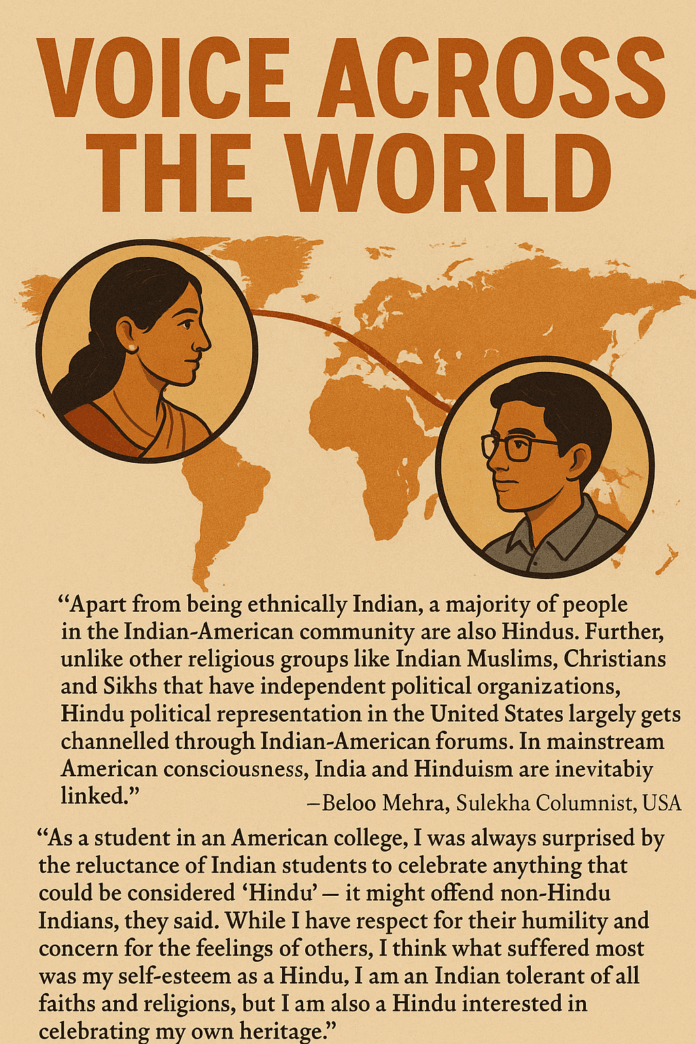
“Apart from being ethnically Indian, a majority of people in the Indian-American community are also Hindus. Further, unlike other religious groups like Indian Muslims, Christians and Sikhs that have independent political organizations, Hindu political representation in the United States largely gets channelled through Indian-American forums. In mainstream American consciousness, India and Hinduism are inevitably linked.”
- Beloo Mehra, Sulekha Columnist, USA
“As a student in an American college, I was always surprised by the reluctance of Indian students to celebrate anything that could be considered ‘Hindu’ – it might offend non-Hindu Indians, they said. While I have respect for their humility and concern for the feelings of others, I think what suffered most was my self-esteem as a Hindu. I am an Indian tolerant of all faiths and religions, but I am also a Hindu interested in celebrating my own heritage.”
- Agastya Kohli, Seattle, WA
“Yes, we live outside of India, the home of Sanatana Dharma, but we remember that Sanatana Dharma and India live within us.”
- Rahul, New Jersey
“I recently went to a function presented by a Christian organization called the Charismatic group. There were around 20,000 people gathered in a huge hall. Eighty percent were young people. The only elderly people there were brought by the youth. What they had was something that was not just religious. It was fun as well. They had a great ‘pull factor.’ Because it was fun, the kids could relate. We Hindus need to use a similar formula to attract the youth. We have to create activities that are fun and interesting.”
- Muthukumaran, 29, Publicity Coordinator, Hindu Centre of Singapore, in an interview with Hinduism Today
“In a global community long synonymous with achievement, these mind-benders (people of Indian origin) have used the heady combination of East and West to blast into new frontiers. Bright and confident, they promise to redesign the world… In countries big and small and in professions new and old, overseas-born Indians are excelling beyond the ordinary and redefining the Indian identity.”
- India Today
“Shouldn’t Indians make this critical choice of classification and framework rather than being dictated to by foreign think tanks and academics? In this regard, China controls its brand management, while India is simply being led… SAJA (South Asian Journalists Association) illustrates how some institutions with the ‘South Asian’ nomenclature are compromising India’s interests. SAJA consistently placates Pakistan. Its 5 percent Pakistani members leverage the collective power of SAJA to neutralize the 95 percent Indian members. Hence, it cannot write critically of Pakistan, leave alone assert a pro-India stance on Kashmir and other issues. But Pakistanis have a separate Pakistani Journalists Association in parallel, and, are also proud leaders of Pan-Islamic movements on campuses. They, clearly, do not suffer from cultural or identity shame. The Pakistani government is a silent but active force in these situations.”
- Rajiv Malhotra, Infinity Foundation, USA
“The ‘secular progressives’ (in India) realize that NRIs, and in particular NRI engineers, especially those who made money in the high tech boom of the 1990s, are not so likely to swallow their propaganda… I do recognize the very real problems a lot of NRIs have, of cultural confusion and displacement, but in the eyes of the JNU-ites, NRIs form a cohesive and frightening force. These NRIs have seen the world and done well in fully competitive circles, do not have inferiority complexes, and do not need to suck up to some white academic like Doniger for crumbs like travel grants, which the ‘sepoys’ of Indology in India crave. In other words, the NRI engineers are shouting from the rooftops, ‘The Emperor has no clothes!’ This is, of course, distressing to those who have been supplying non-existent clothes to the Emperor and profiting mightily therefrom. These NRI engineers have also come to realize that there is something precious in India that is under grave threat from the Sino-Islamic axis and Christian fundamentalists.”
- Past
“Mark me, then and then alone you are a Hindu when every man who bears the name, from any country, speaking our language, becomes at once the nearest and the dearest to you.”
- Swami Vivekananda
“…let us look to become Hindus, in a true sense, for the first time. For it is a question whether so grand a word ought to be borne by us unless we have first earned and approved our right to it. Ought not the name of our country and our faith to be to us as a sort of order of merit, a guerdon of loyal love, the token of accepted toil?”
– Sister Nivedita
Godhra – The Missing Rage
The English language media has had a bias against the so-called ‘Hindutva’ elements for several decades, but since Godhra, the bias has started bordering on hate. This bias is a complex phenomenon, encompassing an intrinsically inefficient and ignorant intelligentsia, ridiculously naive perceptions of profit strategies in the media industry, inadequate articulation on the part of the Sangh Parivar, cultural effects of globalisation, and the age-old habits of grandstanding everything western.
Perceived bigotry is being opposed by zealots in the name of secularism, and ‘journalistic terrorism’ unleashed by the English language media is being fed grist by a select band of ‘five star’ activists for whom spiting the majority community has become a ticket to a luxurious life. For this media, the enemy is the man who still believes in saying his prayers in the morning. The enemy is the woman who still refuses to wear a pair of jeans and insists on putting a bindi on her forehead. The enemy is the man who teaches his child to touch the feet of elders. The enemy is the woman who keeps her hair in a single plait.
At least for the media industry, the returns of the current strategies are likely to be nominal in the immediate term and negative in the long term. This book analyses the role of the multitude of factors that have converted bias into a virtual hate campaign.
A Heart Poured Out: A Story of Swami Ashokananda
By Sister Gargi
SISTER GARGI (MARIE LOUISE BURKE) is well-known in Ramakrishna-Vivekananda circles as the award-winning author of the six-volume classic Swami Vivekananda in the West: New Discoveries — a pioneering and comprehensive study of Swami Vivekananda’s sojourn in the West and the attitudes of contemporary Western society towards Indic religions.
A Heart Poured Out is an engaging biography that brings the reader on a powerful journey into the life story of Swami Ashokananda (1893-1969), a monk of the Ramakrishna Order who developed the Vedanta movement in northern California. In 1948, Sister Gargi, then Marie Louise Burke, met Swami Ashokananda and became his disciple. It is through her vivid insider’s account that we learn about the relationship of this extraordinary teacher to his students in their day-to-day spiritual training.
Those who have had occasion to read Swami Ashokananda’s editorials from the Prabuddha Bharata of the 1920s will know him to be an original thinker and a pioneering exponent of Hindu renaissance. At a time when the whole nation had begun to accept Gandhiji’s extreme economic and political theories, Swami Ashokananda displayed extraordinary courage and conviction through his penetrating critique of Gandhian policies in the Prabuddha Bharata, which created a stir in the intellectual climate in the country. Sister Gargi’s account of the debate that ensued between them makes delightful reading.
Hindu Americans would do well to learn from the Swami’s struggles in America in the 1930s, when Indic religions were considered suspicious and evaluated through the framework of Judeo-Christian belief systems.
Publishers: KALPA TREE PRESS, 65 East 96th Street, Suite 12D, NEW YORK, NY 10128
Price: $26.00
ISBN: 0-9706368-I-4 Cloth, 372 pages, 50 Illustrations, Index
LCCN: 2002113577
ISBN: 0-9706368-1-4
Roar of the Ganges
Mark Barian
Eshwar, Business Publications Inc., 229/A, Second Floor, Krantiveer Rajguru Marg, Girgaon, Mumbai – 400 004
Tel: 380 8817, 380 8819; Fax: 387 2625
Email: bpipl@vsnl.com
ISBN: 81-86982-00-0 | Price: Rs. 250/-
What power on earth can transform a young, successful American computer engineer, earning a six-digit salary, into a penniless monk? What charm can draw him out from a beautiful Santa Barbara home overlooking the Pacific Ocean into the ashrams of Hrishikesh?
This is the fascinating story of the transformation of Mark Barian into Swami Tadatmananda and his discovery of Hinduism, interspersed with lively discussions with many sadhus and seekers and their character sketches. A must-read for all Hindu Americans — this book could serve as supplementary reading material on Hinduism and deserves to replace the poorly written textbooks of biased Indologists which are currently in use in US and Indian academia.
S. K. Modi
Publishers: OCEAN BOOKS PVT. LTD., 4/19, Asaf Ali Road, NEW DELHI – 110 002
Tel: 23289555 | Email: ocean@indianabooks.com | www.indianabooks.com
Price: Rs. 195/- | ISBN: 81-88322-45-8
Dr. Koenraad Elst’s India Tour

Renowned Indologist Dr. Koenraad Elst visited Chennai, Coimbatore, Kochi, and Bangalore during his India tour in January and delivered public lectures to generate awareness on important issues. At Chennai, he gave a lecture at the C. P. Ramaswamy Aiyar Foundation on “Decolonizing the Hindu Mind.” On January 15, he spoke at Kochi on “Ayodhya: Facts and Controversies,” organized by the Bharatheeya Vichara Kendram. On January 18, he spoke on “India’s Image in the West” at the Avinashilingam University, a lecture presided over by H. H. Swamini Vimalananda, Acharya, Chinmaya Mission.
On January 19, Dr. Koenraad Elst addressed the students of the Amrita Vishwa Vidyapeetham, Ettimadai, on “Indian Culture and Heritage,” with his talk presided over by Br. Abhayamrita Chaitanya, correspondent of Amrita Institutions. He later spoke to the students of the Avinashilingam Deemed University on “India’s Image in the West,” with Vice-Chancellor Dr. Kulandai Vel presiding over the function. On January 20, he also spoke at the Indian Institute of Science, Bangalore, on “De-Colonizing Indian Minds.” Dr. Koenraad Elst also interacted with mediapersons on several occasions.
He remarked that the economic growth in India has boosted the image of India and Hinduism in the world and that the BJP deserves thanks, at least for this achievement. He cautioned the public against the “greed” of some scholars who claim that all modern scientific discoveries and knowledge could be found in the Vedas or other ancient Indian texts, as such unsubstantiated claims damage even genuine research into science in ancient India. Such claims become weapons in the hands of Marxist and other political groups.
However, he added that “in future, we are going to have one universal civilisation in which the most valuable elements of every culture will have a place. Most of these will be traceable to India.” He also pointed out that the popular perception that India was mainly a land of religion and spirituality devoid of material and scientific progress deserves correction, as there is much evidence to show that India had achieved great progress in all material fields of life too in the past.
Scientific Study of the Effect of Vedic Rituals
In April 2004, a gigantic Vedic Yajna called Saagnichitya Sarvaprushta Sarvasthoama Apthoaryaama Yaagam is due to be performed in Kerala with the joint collaboration of three organisations — the Vedic Yajna Prathisthaan, Mulakunnathukavu, and Om Shanti Dham, Bangalore — with the cooperation of Sroutha Shastra Parishad, Thrissur.
The organisers say that the main objectives of the event are “to scientifically evaluate the effects of Vedic rituals on nature, human beings, animals, and plants with the help of eminent scientists and modern, sophisticated equipment.”
The lush green paddy fields adjoining the Sree Narayana temple in Mulakunnathukavu, Kerala, have been selected as the venue for the yajna. Rehearsals have already started to ensure that the rituals and chanting are done in a thorough manner. A notable feature of the event is the sincere effort to involve people from all sections of society in various activities and functions of the yajna — “to bring the Veda to the common people and the common people to the Veda.”
A team of eminent scientists will be constituted to conceive, plan, and execute scientific studies of the yajna’s effect on nature, human beings, animals, and plants. Studies of the effect on the environment will include analysis of atmospheric temperature, pressure, humidity, rainfall, and study of electromagnetic fields and nuclear radiation. Studies on human beings will include measurement of brain waves and cardiological analyses. Studies on animals will include, among other factors, behavioural patterns.
Conference Announcement
International Conference on “India’s Intellectual Traditions in Contemporary Global Context”
The World Association for Vedic Studies, Inc. (WAVES), is organising its Fifth International Conference on “India’s Intellectual Traditions in Contemporary Global Context” between July 9–11, 2004, at the University of Maryland Shady Grove Campus, Washington, DC, USA.
The Conference aims at bringing together persons having scholarly interest in diverse areas of Indian Studies. These will include scholars, academics, authors, writers, journalists, media-persons, artists, and of course the common man interested in the past, present, and future of Indian/Vedic Studies. Papers on any aspect of Indian studies can be sent for presentation. These will include topics on Archaeology & Anthropology, History & Social Sciences, Language, Literature & Linguistics, Science & Technology, Vedas, Upanishads, Smritis, Puranas, Epics — Ramayana & Mahabharata, Gita, Contemporary Works and Issues, Dharma-Shastras, Ethics & Rituals, Agriculture, Plant Science & Ecology, Inter-Religious Dialogue, Health, Yoga & Martial arts, Business, Economics & Administration, etc.
Abstracts, running about 200 words each, can be sent to Professor Bhu Dev Sharma, President, WAVES (Clark Atlanta University, Atlanta, USA), 2495 D Briarcliff Road, Atlanta, GA 30329, USA.
Ph: 404-248-9494 (H), 404-880-6912 (O) | Fax: 404-880-6909
Email: sharmawaves@yahoo.co.in, bsharma@cau.edu