
| The Statement & Resolutions Passed by The Hindu Dharma Acharya Sabha Held at Chennai on November 29, 30 & December 1, 2003 Reproduced below is the full text of the statement and resolutions released by the Hindu Dharma Acharya Sabha. Probably, it is the first time in the history of modern Hinduism that nearly 70 Dharma Acharyas of many ancient and important Hindu sampradayas assembled together to take stock of the problems and the future of Hindu society. The venerable acharyas deliberated on some of the most pressing problems Hindus are facing today. Hence, these resolutions and all the prospective activities of the Dharma Acharya Sabha are worthy of our support by all possible means. — Editor Statement & Resolutions The Acharya Sabha, comprising the Heads of various Sampradayas within the single composite whole known from time immemorial as Sanatana Dharma, deliberated comprehensively for three days on November 29, 30, and December 1, 2003 on several issues of concern and importance for the Hindu Society. This Acharya Sabha crystallizes the collective Hindu consciousness and speaks now and shall speak in future, in a single Hindu voice. The substance of the deliberations is mentioned below in a brief statement and is followed by the Resolutions passed. STATEMENT Whereas, Sanatana Dharma is a living continuity over several thousand years, catering to the spiritual, religious, and cultural needs of diverse people of Bharata Varsha and embodies an inclusive, all-integrating philosophy synonymous with the national ethos of this ancient country and civilization; Whereas, the inclusive nature of Sanatana Dharma, which is also called Hinduism, seeks to accommodate several concepts in human efforts to understand the relation between Divinity, Human being, and the Universe, has been in the past, and is now too, misunderstood as lack of unity; Whereas, within the Hindu fold, followers of Sanatana Dharma enjoy full freedom in terms of altar and modes of worship; Whereas, Sanatana Dharma accepts the same freedom for followers of other religions of the world; Whereas, Sanatana Dharma has never in the past sought, nor seeks now, to subvert, conquer, or denigrate other religious persuasions and faiths; Whereas, this approach is being taken advantage of by the organized, aggressive religious traditions with origins from outside Bharat to such an extent that there has arisen a clear and present danger to Sanatana Dharma; Whereas, such aggressive religions which exist in the country derive all types of support and sustenance from abroad, including from governments; THE ACHARYA SABHA PASSES THE FOLLOWING RESOLUTIONS AND CALLS FOR THEIR IMPLEMENTATION BY APPROPRIATE MEANS: RESOLUTIONS 1. Nomenclature: Henceforth, the Sabha be known under the title “The Hindu Dharma Acharya Sabha.” 2. Religious Freedom: It is resolved: To proclaim that religious freedom means freedom to follow one’s own religion or faith and peaceful practices accordingly; That religious freedom does not mean disruption of peace and harmony within a family or society at any level in the name of religion; That freedom of religion may include freedom to expound the tenets and beliefs of a religion but does not include the right to denigrate any other religion or to mislead an individual or a community or to use subtle or blatant, implicit or explicit, aggressive means to bring people, singly or in groups, into one’s own religious fold. 3. Religious Conversion: It is resolved: To reject the theory put forward that people are not converted but convert themselves out of spiritual and religious conviction; To call religious conversion by denigrating the religion of the targeted person as violence committed against the person’s soul, family, community, culture, and religion; To tell the world that conversion is not a movement to enhance the spirituality of a people but is an organized campaign to surround, attack, and significantly reduce the number of followers of Sanatana Dharma; To call upon the State governments to follow the footsteps of Tamil Nadu and Gujarat and legislate to place a ban on such religious conversions by force, fraud, or allurements, overt and covert, and implement the legislation vigorously; To appeal to the leadership of proselytising religions in the country to review and change their theological disposition towards Sanatana Dharma (Hinduism) to promote harmony and avoid any conflict, violence, and disruption in Indian society. 4. Welfare of Temples, Control and Use of Funds and Property of Temples: Whereas, the temples of Hindus are not only places of religious worship but centers of cultural concerns and activities; Whereas, consolidated statewide legislations to cover and control places of worship, their properties, and financial income and management apply only to Hindu temples under the ostensibly public purpose of improvement of facilities to devotees and better management; Whereas, no such legislation is applied to places of worship of other religions in the country, notwithstanding whether they suffer from unaccountability, malfeasance, and mismanagement; Whereas, the income accruing to temples from Hindu devotees is being merged into general government funds and loses its sacred identity; Whereas, such temple incomes are not being utilized primarily for the welfare of the temples and Hindu devotees; Whereas, such incomes are being utilized indirectly through the Budget mechanism for other than the cause of Hindu temples and Hindu Dharma; IT IS THEREFORE RESOLVED: To call upon the State and Central Governments: To undertake only where there is a genuine requirement, temple-specific legislation, ensuring in the process that the temple property and income are managed by genuinely autonomous bodies associating only Hindus of good repute and genuine commitment in the management; To apply similar legislation to the institutions of other religions also, as may be appropriate or necessary; To declare, ordain, and commend to eventually remove all controls on Hindu temples, religious and charitable institutions, consistent with the principle that the Secular State shall not interfere in the religious affairs of any religion; To encourage and help the people engaged in the retrieval of ancient temples, in rebuilding destroyed temples, and preserving ancient and sacred sites of Hindu heritage. 5. Common Civil Code: Whereas, the constitution of the country has made a commitment and has given a promise to the people of the country to provide a common civil law for all the citizens of the country; Whereas, the criminal law and related statutes are applicable uniformly to all citizens of the country; Whereas, there is no ethnic minority in India; IT IS RESOLVED: To call upon the Government of India and all political parties to rapidly move towards implementing the Constitutional commitment without being swayed by fear or favour, in respect of the non-Hindu religions in the country, dropping the false pretext of minority safeguard; To extend the privileges and rights enjoyed by other religions in the country to the Hindus also. 6. Ban on Cow-Slaughter: Whereas, the State and Central governments in the country have been and are overtly sensitive to the claims and demands of Christians and Muslims in the country, on the grounds of their religious sentiments; Whereas, the governments do not take due note of and respect the religious sentiments of Hindus despite their being in vast majority in the country; Whereas, the Constitution of the country makes a specific promise to ban the slaughter of cows; IT IS RESOLVED: To call upon all Governments in the country to honestly implement this Constitutional commitment of ban on cow-slaughter and to take steps necessary for the proper upkeep of the cow that is sacred to the Hindus. 7. Upliftment of Hindu Society: Whereas, the social and economic conditions of people in rural and remote areas of the country are such that fair opportunity is still not available to all of them for self-development and realization of their potential; Whereas, several Hindu organizations and religious institutions are doing very valuable social service in the fields of education, public health, etc., in the areas within their reach; Whereas, it is necessary to explore the scope for complementarities in such Seva activities and effect synergy in them; IT IS RESOLVED: That on behalf of the Hindu Dharma Acharya Sabha, appropriate mechanisms shall be established to realize the benefits of such coordination, complementarities, and synergy. 8. Operational Mandate: Whereas, the Hindu Dharma Acharya Sabha shall function as the body of high guidance and shall meet periodically at the national or regional levels for: a) taking stock periodically of the situation and concerns of Hindus in the country and elsewhere; and b) pursuing the efforts to implement the foregoing resolutions and decisions taken from time to time; Whereas, a permanent Secretariat is proposed to be set at Delhi to: a) work out an action plan and implement it appropriately with the good offices of participating institutions; b) function as a coordinating unit and clearing house of mutually useful information; c) operate a central database available for the use of constituents of the Hindu Acharya Dharma Sabha and Dharma Samstha Pramukh Sabha engaged in economic and social upliftment of the Hindu populace; and d) liaise and coordinate with the government machinery; IT IS RESOLVED THAT: Such a coordinating secretarial unit shall be established at Delhi; A flexible and comprehensive mandate is given to the Convener of the Hindu Dharma Acharya Sabha for: a) guiding the Secretariat; b) drawing up plans of action; c) supervising their implementation; d) liaising with the members of the Hindu Dharma Acharya Sabha membership and of the Dharma Samstha Pramukh Sabha, individually and severally; e) operating as a quick-acting interface with governments and other bodies in the outside world and interacting with them in the furtherance of the interests and welfare of Hindus in general, and in implementing the resolutions and decisions of the Hindu Dharma Acharya Sabha in particular. |
The Hindu Dharma Acharya Sabha: The Unified Voice of Hindus

The Hindu-American: An Emerging Identity
My parents came to Chicago from Calcutta in the 1960’s. They associated with Bengalis and their closest friends have remained Bengali — it is with the Bengalis of Chicago that we have celebrated and to this day celebrate Thanksgiving, New Year, Durga Puja, Kali Puja, and Saraswati Puja. What binds them together is not just the language but also the shared memories of the home they left behind — a fragmented India, where Bengal was distinctive from the rest of the country. They saw themselves as Bengalis, not as Indians.
The India they left behind is drastically different from the India I found this summer when I spent a few months there. This is an India where Bengalis speak Hindi as much as they speak Bengali, while many in my parent’s generation can’t follow a Bollywood movie without subtitles. This is an India where my cousins listen to bhangra and Hindi soundtracks more than they listen to Rabindra sangeet. This is an India where the anthem being sung is the national anthem, not that of individual states. This is an India where Indians are finally seeing themselves as Indian.
So, the new immigrants who are coming from India are identifying themselves not as members from a particular region, but as members of an increasingly unified nation. They are more apt to celebrate Diwali than Kali Puja when both celebrations fall on the same weekend. They are more likely to talk to their friends in Hindi than in Bengali. They are more likely to join NetSAP than the local Bengali association.
This shift is similar to the changes in identity prevalent among the second generation, the so-called ABCD’s, American Born Confused Desis, like myself. While I learned to speak Bengali before English, and while I bonded with the children of my parent’s Bengali friends, what drew us together wasn’t our ethnicity: it was our shared experience of being brown folk in a white world, of weekend get-togethers with other immigrant families and eating Indian food, of being dragged to pujas celebrated in local high schools rented out for the weekend. It was our shared experience of being perceived as the dorky nerds in school, of teachers and parents expecting us to excel in math and science and to be at the top of our class, of teachers and parents expecting us to be engineers or doctors, of being asked whether we spoke Indian. In short, what bound us together wasn’t being Bengali-American or even necessarily Indian-American; it was the experience of being foreigners born in this country, a shared experience of alienation.
I first heard the term South Asia when I came to Tufts. I was told that the differences between Pakistanis, Indians, and Bangladeshis were negligible — in short, since other Americans couldn’t distinguish between us, why should we? Eventually, I was told that we should think of ourselves as Asian-American — we shared common experiences and came from the same general continent after all. The underlying premise behind each of these movements was the idea that what formed a group identity was based largely on how others perceived us and what would bring political clout and social coherence.
This is a fundamentally flawed approach. Of course, it is valuable and necessary to have communities of Indian-Americans, South-Asian-Americans, and Asian-Americans. But communities and group affiliations are different from what constitutes political and social identity. Identity cannot be based on political expedience or social convenience — it cannot be based on circumstances of birth or geographical origin or even race/ethnicity. Even culture is not enough, though it is a closer approximation of what matters — it is our values, our worldview, our beliefs about ourselves and the world we live in, it is the way we think, the way we conduct ourselves, the philosophy behind our actions. Of course, this is very much based on culture and ethnicity, but it goes beyond these parameters to something larger.
Bengali-Americans, Asian-Americans, South-Asian-Americans function well as communities but cannot suffice as identities. They will shed and morph over time as migration patterns and political and social realties shift. The same way the Bengali identity has given way to an Indian identity, the current South Asian vogue will give way to something else in the coming years. These identities are inherently unstable, based on external circumstances, not innate characteristics of personality that are necessary to constitute any real or permanent identity.
For example, while I may go for months without uttering a word of Bengali or even without speaking to another Indian, not a day would pass by without my praying to Krishna or reciting the Gayatri mantra. While I would be as amenable to marrying a Punjabi as I would a Rajasthani or a Bengali, I would find it very difficult to marry a man who didn’t believe in reincarnation or karma or dharma. While I might be equally happy at a South Indian temple or a Chinmaya Mission or an ISKCON center, all three share fundamental characteristics of the faith dear to me. While I may not take my children to the local Durga puja celebrated by Bengalis in the future, I would tell them the stories I know from the Ramayana and the Mahabharatha.
Well, first of all, to think religion and politics aren’t mixed to begin with is a naïve and dangerous presumption. Politics does not happen in a vacuum; all actors, especially political actors, are motivated by convictions based on ideology and morality, which come from social norms as well as religious beliefs. The debate over slavery was inextricably intertwined with Christianity; the universal recognition of human rights is based on a consensus of religious viewpoints on basic values; the partition that tore through the subcontinent was a bitter battle over the soul of a nation as characterized by religion. The more conscious we are of how religion affects our identity and viewpoints, the more we can try to be open-minded and fair. If we deny the religious component of our identity, we just become blinded to what is going on in our subconscious and our own prejudices — we no longer know ourselves. Religion does not exist in a separate component within our being; it pervades and permeates our personal life and also our public life, our career, our social interactions and our conduct as citizens.
Before debating the merits of adopting a Hindu-American identity, we have to understand what it means to be a Hindu-American; how is it distinctive from being any other type of American or indeed any other type of Hindu? I’ve touched a bit on how Hindu-Americans are different from the groupings of people as Indian-Americans or Asian-Americans. It’s an identity that looks at the individual rather than broad categories of ethnicity or race; it’s an identity that is chosen rather than assigned
But how are American Hindus different from other Hindus, principally Hindus from India? It is admittedly difficult to separate the two; India is Hinduism’s birthplace and the traditional homeland for a religion that has done little proselytizing beyond its borders. However, we must understand that the faith and philosophy of Hinduism is distinctive from the social customs and rituals that have come to plague it through the years. Just as Christianity is not about the Crusades or slavery or sexual abuse perpetuated by priests, similarly, Hinduism is not fundamentally about dowry, or the current caste system, or the subordination of women in the name of religion.
These are social practices caused more by the history of Indian society than by the philosophy of the religion. What does it mean to be a Hindu? Not so long ago, people identified themselves as followers of Shiva or Vishnu or the Vedanta philosophy, not as Hindus. When we began to call ourselves Hindu, it came from an acknowledgment that despite the diversity of the faith, a diversity of beliefs and practices that we cherish, there is an underlying unity — an acceptance that though there is one truth, we call it by different names, that we are all taking different paths to the same God, the same destiny, an acceptance of the truths of the Vedas that we may never have even read.
Though we in America may never understand a word of Sanskrit or though we may celebrate pujas on the weekend for convenience rather than on the actual day it is supposed to be held, though our vision of Hinduism may be colored more by the popularization of yoga and meditation than by the teachings of the Puranas, we still subscribe to the same beliefs that allowed Shaivas and Vaishnavas to bridge the gaps between themselves and forge a common identity as Hindus. These beliefs are strong enough to bridge the geographical distance that separates American Hindus from Hindus of other nations.
It is this unity that matters the most, this unity that we need to recognize and acknowledge. Whether we pray to Kali or Krishna, Rama or Ramakrishna, whether we revere the words of Swami Vivekananda or Sri Aurobindo, there is a unity of belief underlying it all. However, we must understand that American Hindus are also distinctive from other Hindus around the world. These distinctions are based on the society in which we are living. Think of people like Deepak Chopra, who has repackaged Ayurvedic science for a western audience, or Krishna Das, who fuses traditional bhajans with western music. Think of the hundreds of yoga teachers who have combined traditional hatha yoga with aerobics or pilates or even martial arts. Think of Hindu weddings as they happen in America today, three days’ worth of ceremonies compressed into an hour or two with English translation for those non-Sanskrit speakers like me.
I am not as Indian as my parents or others of their generation are. I date and probably would not consent to an arranged marriage; I drink at social gatherings; I do not speak Bengali as frequently or as well as I should. But does that make me less Hindu? I pray, meditate and practise yoga; I read books on the Gita and other scriptures; I believe in the philosophy they hold dear. I value the same things they do – family, caring for others, and honor – but I express these values differently. I practice the religion differently. I am Hindu, not in the Indian way but in a new American way. When I think of a Hindu-American, I think of myself.
I have reinterpreted my religion to adapt to the society and lifestyle I have adopted as my own. Some would call this deviating from the authentic religion. I disagree. I think it is healthy to reinvent and reinterpret and reform any philosophy or religion. That is how people and societies and religions survive and evolve. It is this process of adaptation and assimilation that has preserved Hinduism for so long. It is the reforms that preserve the essence of the faith while accommodating social changes and modernization that have added to the richness and wisdom of the religion.
As American Hindus, we have the opportunity to contribute to that process. It is something we should not shy away from – it is a responsibility we should accept and honor. Why? First, because it is necessary for the survival of the religion. Religions that are stagnant and refuse to change with the times, to adapt to the society in which they are living, die away. Christianity has been so successful in its appeal to people around the world for so many centuries precisely because it has been more flexible than others in accepting the tide of the times.
Why should we care about whether Hinduism survives as a religion? This reminds me of an article I read a while ago in National Geographic. There are languages that are dying by the thousands every year. Sure, in some ways it is effective and efficient to have fewer languages to ease communication between groups. But, one problem is that as these languages die out, vocabulary and culture associated with these languages also vanish. For instance, words that identify the medicinal properties of herbs and plants. Without this vocabulary, we lose the knowledge of potential cures for cancer and other illnesses.
Religions contain invaluable knowledge. Whether one is a Hindu or not, there is an interest in preserving as many traditions of the religions of the world as possible — preserving not as in maintaining their status quo but in encouraging the growth and evolution of such traditions and faiths while staying true to their roots. Diversity in and of itself is a public good.
The Hindu Students Council (HSC), a student body that has nearly 70 chapters in US universities – a positive example of the emerging Hindu-American identity.
Additionally, a Hindu American identity can be more encompassing than ones based on geographic boundaries. We may reach out beyond the differences of race and ethnicity towards other Hindus of Caribbean, African, or European descent and find commonalities that bring us together. Exposure to and awareness of the variety and diversity of practicing Hinduism in different societies and cultures would enrich our own practices and understanding of the religion.
More specifically, as Hindus ourselves, we have a particular interest in formulating and articulating a Hindu-American identity. I believe that the “confused” in ABCD (American Born Confused Desi) comes from being confused about what it means to be a desi in America. Of course, there are things that we share in common with all Indians, but the lasting impact of being born as an Indian-American comes from the rift between the values our parents teach us and the values we find ourselves surrounded by in the U.S. Some of these differences are based on social norms and cultures, some on religion. In order to better understand these differences and our own coherence, we need to examine our religious identity, and in particular, what we accept from our heritage and what we reject.
Doing that in a group or community format is preferable to each of us doing it individually, because many heads are better than one, and having the support of others going through similar experiences gives us comfort and guidance. And in the end, we are not islands isolated from one another — we are all members of communities, of a sub-community as Hindus and a larger community of Americans and global citizens. And in order to contribute to the important dialogue between civilizations and faiths, we must begin with the discussions and dialogues within our own faith and religion.
How do we do this? The best and most important way is through education. The only way we can get to think of ourselves as Hindu is to understand first what it means to be Hindu. We need to learn more about our religion. I’ve read so little of our scriptures, and all of it has been in poorly translated English. My knowledge is fragmented: bits and pieces of the Puranas, selected verses of the Gita. But imagine the possibilities if we could all get together and put together our own fragments of knowledge  we’d be so many steps closer to a coherent understanding of the fundamentals of the religion. There are so many resources out there, and they’re best used if shared and as the products of collaboration.
Interaction and dialogue are also key. Conferences and forums encouraging widespread community participation and input are invaluable. Forums based on being Hindu rather than being of a certain ethnicity or nationality are important. Also, open-ended discussions on topical issues such as what our views as American Hindus are on social issues such as women’s rights or interfaith marriages would be useful.
Darwinism is not just for living beings. Survival of the fittest applies to religions, societies, and civilizations. To succeed not just as individuals, Americans, or Indian-Americans, but as Hindu-Americans, we need to understand better both sides of the hyphen — what does it mean to be Hindu and what does it mean to be American? As really the first significant generation of American Hindus, we have the unique opportunity to frame, formulate, and generate the dialogue and debate needed to give birth to an identity that will hopefully stand the test of time and generations.
These are just my thoughts. This is just one voice in what I hope is a massive dialogue and discussion about what unites and distinguishes us as Hindus living in America.
(Aditi Banerjee is a student at Yale Law School. Her interests include international law & foreign policy and issues related to Hinduism and the Indian Diaspora. This is the text of a paper presented at a seminar on “Hindu Ideological Empowerment and Derivative Activism” held at Chicago on 1-2 November 2003).
– Aditi Banerjee
The Feminine Mystic: Mata Amritanandamayi

In the last issue we saw how Hindu society is headed towards a serious social crisis unless quick and efficient action is initiated. A study of Pandit Pandurang Shastri Athavale’s (Dadaji) life offered many positive leads in this direction. However, appropriate action is hampered today by the difficult predicament nurtured by liberal Hindus. The liberalism which a large number of Hindus imbibe is mostly western in its approach due to the influence of colonial residues in Indian education. Also, I have been pointing out that western liberalism developed in response to rigid views held and propagated by the Semitic religious traditions. Hence, liberal thinkers in the west were compelled to completely reject religion, which had become palpably static.
In the past 50 years, Hindu liberals have tried a similar approach in India and failed. Predictably, the methods have not been successful and a sense of frustration is beginning to obfuscate their vision. On the other hand many liberal Hindus do not want to touch their own traditions even with a barge pole, because of the psychological baggage they carry against religion and spirituality.
One of the major critiques discussed earlier, against engrafting the methods proposed by western liberals to Hindu society, is about the stark difference between the worldview propounded by Hindu dharma and the Semitic religions. Through the life and work of Dada we saw how the separation of Sruti from Smriti provides Hinduism a scope for great dynamism and adaptability to change. Hindu dharma seems to be an ocean of wisdom as it were and each saint who delves deep into it seems to come out with unique pearls to enrich our experience. The life of the saint we present in this article provides us with a different and refreshingly new, if not radical, perspective on the issue of Hindu social reform.
Double Disqualifier
The life of this remarkable saint breaks all those stereotypes which uncharitable critics have sought to bind Hinduism with. A girl child born to illiterate, so-to-say ‘low caste’ parents, in a remote fishing village of the southern Indian state of Kerala has risen to be recognized worldwide today as a living teacher of the Hindu way of life. Her followers find in her a living spark of the principle of universal motherhood and unselfish love.
After Sri Sarada Devi¹, she is the only woman in the recent spiritual history of Hinduism (and yes, actually of any religion in the world included) to head a monastic order. From the child Sudhamani of Vallikkavu to Mata Amritanandamayi directing a spiritual mission from Amritapuri, her life is one long commentary on how spiritual visionaries like her have been silently revolutionising our social norms.
Out of the ‘dialogic process’
We are dealing with the life of a living saint, and so in sifting through the different accounts and extracting the core, we may bear in mind what Max Muller called ‘the dialogic process’. In brief, it is to understand that legends naturally grow around factual events, when they are transmitted by word of mouth.
Sudhamani was a precocious child, but had to be withdrawn from school owing to her mother’s illness. The poor girl had to literally serve her large family of seven sisters and brothers, tending to the different chores from dawn to midnight. But what separated her from others of her age was her deep bhakti, enhanced by the religious piety and lore of the family, and her concern and love for the suffering people around.
For a moment, let us go back a little in time to take note of the astounding change wrought upon the Keralite Hindu society by the great saint Sri Narayana Guru: it was through his life and work that in a land, which was once so ridden by caste animosities, Hindu spiritual lore could penetrate the ‘lowest’ strata and eventually serve to influence a Sudhamani there.
The child Sudhamani carried around a photo of Bhagavan Sri Krishna to whom she prayed, sang songs full of deep love and cried her heart out. She spent the spare time she got after her day long hard work, immersed in waves of devotional longing. As she grew up into a girl, she was established in the mood of supreme love of the divine and this led to the manifestation of Krishna Bhava². She would have lost herself completely in the divine, unseen by anyone, but for what she experienced and which she later related:
“In the early days, I used to dance in bliss and move about alone, persisting in Krishna Bhava, but no one knew. One day I strongly felt the urge to be absorbed in the Supreme Being without returning. Then I heard a voice from within saying, ‘Thousands and thousands of people in the world are steeped in misery. I have much for you to do, you who are one with Me.’”
Thereafter she appeared to people in her exalted spiritual moods, but this brought her hostility from rationalist youth of neighbouring villages who misunderstood her as a charlatan.
Meanwhile, Sudhamani continued to have further spiritual experiences and one day she had a vision of the blissful Divine Mother herself. She was so enraptured by this vision that she forgot all about her household duties, which were already affected by her constant ecstasies. Now she cared for nothing else but the uninterrupted vision and mystic union with the Divine Mother. But her family could not appreciate what spiritual summits she was scaling. Enraged at her lapses from work and at all the crowds gathering at the house, they refused to allow her to remain in the house.
Nature became her home and for some time, she endured great hardships. Until one day, she reached the culmination of her spiritual practices: the Divine Mother Herself appeared before her once more and conveyed to her, her mission henceforth:
‘It is to give solace to suffering humanity that you have come into this world and not merely for enjoying Divine Bliss. Therefore, worship Me by showing mankind the way back to Me.’
She tells of this momentous event of her life in her mystical poem, ‘Ananda Veedhi’:
…Thenceforth, Seeing nothing as apart from my own Self,
a single unity, and merging in the Divine Mother,
I renounced all sense of enjoyment
Mother told me to ask the people to fulfil their human birth.
Therefore, I proclaim to the whole world the sublime truth that She uttered,
“Oh Man, merge in your Self!”…
Rain of Nectar
As the 19th century Hindu mystic and spiritual luminary Sri Ramakrishna had observed, ‘When the lotus blooms, bees come of their own accord to gather honey’ and slowly a small group of people gathered around her to seek her guidance and motherly succour through the vicissitudes of spiritual practice. Gradually, before her genuineness, the resistance from family and rationalist groups frittered away. Upon the insistence of the disciples Sudhamani assumed just another form of her own name: Amritanandamayi (Amrita or nectar is synonymous in Sanskrit with the word Sudha) and she began to be revered as ‘Mata’ or Mother. She is affectionately called ‘Amma’ (which literally means ‘Mother’ in many Indian languages) by her devotees.
Hindu sainthood is implicitly linked to the revival of dharma – rediscovering the Truth pointed out by the Sruti and applying these experiences to rejuvenate the Smriti – this is actually the essence of the Hindu idea of ‘social reform’. There is here again, a very important point lost to liberal Hindus. Influenced by the west, they perceive all spirituality to be otherworldly. This is true for the Semitic faiths, which are distinctly otherworldly, where the present life is to be led in privation and piety to be allowed entry into a heavenly after-life. But Hindu spirituality, by insisting upon spiritual realization in this life and the importance of the human birth for this, is intensely connected to the welfare of human society and its destiny. All great modern teachers of Hinduism have emphasised this practicality and realism. Swami Vivekananda said at Ramesvaram in 1897:
He who wants to serve the father must serve the children first. He who wants to serve Shiva must serve His children — must serve all creatures in this world first. It is said in the shastra that those who serve the servants of God are His greatest servants
These ideas, in fact, constitute the foundation of modern Hinduism and Vedantic thought. Following in their illustrious line, Mata Amritanandamayi too illustrates our thesis and preaches such spirituality. Through her own realization, she reached the conclusion that the God whom we seek is best reflected in the human being and service of mankind itself becomes a path to perfecting ourselves.
She stated this beautifully in her speech at the second Parliament of the World’s Religions, held in Chicago, from 28th August to 4th September 1993:
‘To show compassion towards suffering humanity is our obligation to God. Our spiritual quest should begin with selfless service to the world. People will be disappointed if they sit in meditation, expecting a third eye to open after closing the other two. This is not going to happen. We cannot close our eyes to the world in the name of spirituality and expect to evolve. To behold unity while viewing the world through open eyes is Spiritual Realisation’
She asks people to put to practice the immanence of God which Hindu philosophy preaches. She herself sets an example through her almost indefatigable dedication to service, sleeping just over a few hours a day. Asked once if she had any desire left, she replied saying that she wants to attain the life of an incense stick: she literally lives this desire by the day.
Charitable Works
Her Math has launched large number of charitable and humanitarian activities in keeping with these ideas. These are either involved in direct aid or in indirect support such as educational facilities designed to empower the underprivileged. The most ambitious of these is Amrita Institute of Medical Sciences (AIMS), which offers state-of-the-art medical treatment including open-heart surgery, neurosurgery and organ transplants, free of charge to the needy. AIMS has grown over the years into a hospital with facilities for hundreds and has treated around 20,000 patients free of cost.
The Math has built over 25,000 houses for the poor in a dozen Indian states and proposes to build another lakh in the next decade. It rebuilt three earthquake-hit villages in Gujarat. Other direct aid schemes include orphanages and homes for the aged, hospices for the terminally ill, community aid centres, programmes for village reconstruction and integral development of tribal people and a recently launched free legal cell for the poor.
Concurrently, a network of educational facilities is being set up all over India. So far, it includes numerous elementary, secondary, vocational and graduate schools, ranging from remote tribal tutelage to advanced business and technical qualification. Higher educational institutions managed by the Mata Amritananda Mayi Math — including Amrita Institute of Technology and Science, the Amrita Institute of Management and the AIMS medical college — have been conferred with deemed university status under the name “Amrita Vishwa Vidyapeetham” and is the only institution in India to achieve this status in a very short span of time.
On the other hand, she teaches that the greatest service to mankind can be the awakening of its own divine potential and has undertaken to spread spiritual values as a Guru and accepts disciples, both lay and monastic. In fact, under her direct supervision and guidance, her main Ashram at Amritapuri has evolved into a lively spiritual centre with novices, brahmacharins (celibates to be initiated into monasticism after due training) and Sannyasins (monks).
To others, she bestows this spiritual awakening in her own inimitable way — her famous hugs, through which she transmits her love and spirituality. She has also established sixteen ingenious ‘Brahmasthanam’ temples in which devotees also get an opportunity to take part in the worship. The image in the temple is four-faced and carved out of a single stone, representing Siva Kutumbam (Siva’s family) and signifying unity in diversity.
Her Unique spiritual message
But there is something refreshingly more to her message which has path-breaking implications to the very idea of social reform. She brilliantly outlined these in the speech, ‘Awaken the Universal Motherhood’ delivered upon receiving the 2002 Gandhi-King award for non-violence (at the Global Peace Initiative of Women Religious and Spiritual Leaders, held under the auspices of the United Nations in Geneva, Switzerland in October, 2002):
- The balance of the male and female principles is essential for social progress
- Unselfish love, compassion, dedication and patience are qualities associated with enlightened motherhood and intrinsic to women
- Society’s ills — oppression, crime, etc — are due to excessive dominance of exclusively male qualities like aggression
- Men should cultivate the feminine principle internally
- Women should balance masculine qualities like strength
- Women must break artificial patriarchal restrictions
God is beyond gender but more female than male because the masculine is contained within the feminine; cultivation of the qualities of divine motherhood is the key to spiritual progress itself.
She said:
‘Anyone – woman or man – who has the courage to overcome the limitations of the mind can attain the state of universal motherhood. The principle of motherhood is as vast and powerful as the universe. With the power of motherhood within her, a woman can influence the entire world. The love of awakened motherhood is a love and compassion felt not only towards one’s own children, but towards all people, animals and plants, rocks and rivers – a love extended to all of nature, all beings. Indeed, to a woman in whom the state of true motherhood has awakened, all creatures are her children. This love, this motherhood, is Divine Love – and that is God.’
‘In the process of striving to regain their rightful position in society, women should never lose their essential nature. This tendency can be seen in many countries, and will never help women to achieve true freedom. It is impossible to attain real freedom by imitating men. If women themselves turn their backs on the feminine principle, this will culminate in the utter failure of women and society. Then the problems of the world will not be resolved, but only aggravated. If women reject their feminine qualities and try to become like men, cultivating only masculine qualities, the imbalance in the world will only become greater. This is not the need of the age. The real need is for women to contribute all they can to society by developing universal motherhood, rather than only their masculine qualities.’
These ideas may not sound new; indeed it is no coincidence that many of those who pioneered modern Hindu resurgence were from the land of Bengal, the traditional seat of Shakti worship. Most of great Hindu saints and teachers of the past thousand years who made an impact on the society have emphasised the importance of Shakti: ‘Maya’ in Shankara’s Advaita is identified with Shakti; Ramanuja’s great contribution was the recognition of the importance of Sri or Lakshmi’s grace in spiritual redemption. Thus we find that the ideas of worship of God as mother and the reverence for women subtly pervade the Hindu worldview.
However, to the common Hindu masses that encounter her ideas, they are indeed radical. The essence of Hindu spirituality is to get close to God or Truth, which involves cultivation of divine virtues like unselfish love, purity, compassion etc. These are motherly qualities, intrinsic to the feminine nature, but found in both men and women. Again if the idea of God itself is more feminine than masculine, then spirituality means cultivation of the sublime values associated with the feminine nature.
In addition to the humanitarian and charitable projects which we mentioned above, Mata Amritanandamayi has inspired a set of activities particularly aimed at promotion of these ideas and also for emancipation of women. She has adopted the revolutionary practice of appointing women as priests in her Brahmasthanam temples and she consecrates them herself.
She has launched schemes for providing pension to widows and destitute women and shelters for homeless women. Everywhere she goes, she urges women to awaken to their innate potential.
Volunteers learn through nearly backbreaking works of service to emulate the love of a mother, which does not make her tired in looking after her child. And her trademark hug also seems to dawn out of her own identification with this motherly love, because of which she was able to revolutionise the concept of darshan — a hug instead of mere personal audience — and also be able to muster the sheer physical stamina to hug thousands of people for hours at a stretch.
The Impact
In a short span of 30 or so years of her ministry, Mata Amritanandamayi has truly made a deep positive impact on Hindu society. The scale and number of awards and international recognitions she has been accorded show how her success has been appreciated by people across the world.
In 1993, she was invited to the second World Parliament of Religions in Chicago (marking a centenary of the epoch-making first Parliament of religions which the redoubtable Swami Vivekananda took by storm, introducing Hinduism to the west), where she was elected as one of the three Presidents representing the Hindu faith.
Later that year, the respected ‘Hinduism Today’ magazine named her ‘Hindu of the Year’ and presented her with their annual Hindu Renaissance Award. In October 1995, she was invited to the United Nations on the occasion of its 50th Anniversary Celebration, in New York as a special guest speaker for the UN conference on “Visions for the 21st Century.”
In August 2000, Amma addressed the UN on ‘The Role of Religion in Conflict Transformation’ at the millennium world peace summit. In October 2002, she was a keynote speaker at the ‘Global Peace Initiative of Women Religious and Spiritual Leaders’ at the United Nations, in Geneva where for the first time in history, as many as 500 women leaders from religion, business and government from all parts of the world gathered to claim a more active role in building peace.
On October 7 2002, she was presented with the prestigious Gandhi-King award for non-violence at the United Nations General Assembly Hall (Palais des Nations) in Geneva in recognition of her lifelong work in spreading the message of love and peace throughout the world, and uplifting the poor and needy through the vast network of charitable institutions she has established (awarded previously to such eminent persons as Kofi Annan, Secretary-General of the United Nations and Nelson Mandela, former President of South Africa).
Last year, she was one among 50 women whom the ‘Ms Magazine’ (a landmark institution in both women’s rights and American journalism) recognized as having made significant impact on society.
But no award can ever assess the profound psychological impress her rise has made possible. For one, the fact that a woman (that too from a so-called ‘lower caste’) has been universally recognised as a spiritual teacher itself is an affirmation of the definite potential for change in the Hindu society.
The material for transformation is already present in seed from in Hinduism’s own traditions — they just need to be brought out and broadcasted. When the orthodox Brahmin priests of the Rameswaram temple honoured her exceptionally during her recent visit, golden chapters were being added to the ongoing story of Hindu reform.
Again her role as a Satguru holds the promise to undo the currently widespread and decadent portrayal of women as mere objects of pleasure. Her story is an ongoing saga and the movement she has inspired is a growing one, with exciting prospects.
As her teachings and service activities based on her interpretation of Vedantic thought spread, so do the cultivation of universal motherly virtues and the recognition and respect for the innate motherhood of women.
Ultimately, this is a two-pronged weapon for social transformation. Most of the problems of the Hindu society like caste oppression and strife and suppression of women stem from an excessive manifestation of the aggressive masculine qualities. A dose of feminine love will restore the balance.
Further, oppression of people and exploitation of nature is aggravated because of the unfortunate spread of the mentality of objectification: treating others as objects to satisfy ones’ concerns. As people learn to see the person of mother in women, they also learn to gradually de-objectify and see the person in others as well as the surrounding nature.
Implications for Social Reform
Through Mata Amritanandamayi we discover a special and new perspective on social reform. Perhaps, Western liberalism was not a reaction against religion, but against the excessive patriarchy of Semitic theology. Western liberals promoted virtues like equality, compassion, freedom, which vaguely hint at feminine virtues as opposed to order, fear and obedience preached by Semitic religions.
In hindsight, perhaps, they did not reject God, but the excessively masculine idea of an overbearing God who demanded surrender and punished errors with merciless wrath. In addition, the feminist movements seemed to only further defeat the purpose of liberalism by persuading even women to overtly court masculine values.
The life and teachings of Mata Amritanandamayi have resurrected the understanding and application of the idea of Shakti and the benign face of feminine nature. Liberal Hindus have today an opportunity of harnessing another powerful thought current from their own tradition to better understand the Hindu society and propose an effective line for Hindu social reform.
- Sri Sarada Devi was the ‘Sangha Mata’ of the Ramakrishna Math and Mission until her Maha-Samadhi.
- Dissolution of the lower ego and individuality in the consciousness of Sri Krishna and complete spiritual union with Him.
— Prabhu Rajagopal
The Spiritual Context of Human Rights
This time I want to share a very unique experience that I had recently, which relates to the issue of human rights. All over USA, Institutes for Healing Racism have sprung up in the past few years. The one in our town of Grand Rapids, Michigan, invited me to attend two full days of a workshop on the subject. Generally, schools, corporations and other organizations send their employees so they are better equipped to handle the increasing diversity in the population of the USA. Arguably, India may be the only country more diverse than this nation on planet earth as of now!
It is very interesting to study how India has dealt with its diversity as compared to what we are doing in the USA now. Whereas, in Bhaarat, diversity was accepted in a Spiritual context, as a natural phenomenon – part of Bhagavaan’s creation, in the West, it has not been so. The United States now feels the heavy burden of its history of discrimination during the past couple of centuries. First, the fact that the Native American was killed in large numbers and many treaties were broken to usurp the land which, for thousands of years has been home for these groups. The natives had even helped the Europeans to survive, in early years. Ownership of land was not a well-entrenched idea in much of the indigenous cultures of the world in pre–Christian/Islamic days. In fact the study of the manner in which the western part of the present day USA was conquered reveals the extreme suffering of the Native population, which continues to this day. There is complete segregation among these people, living on reservations, and the main stream.
Another pressing issue is the fact of slavery of the black people who were bought, sold, beaten and literally treated in the most inhuman way for a very long time. These blacks are ten to fifteen percent of the total population and have contributed heavily to the construction of the new country i.e. in its European avataara. So, while the Natives got totally marginalized to the point of being called the invisible minority today, the blacks were plucked from their native lands, against their wishes and then treated cruelly within the new land.
Then, there is the question of the Mexicans. Unlike North America, South and Central America saw the Spanish conquistador vanquish the land from the original owners. It seems the white Spaniard males took many native women, producing a race called ‘Mexican,’ who were then discriminated against and continue to be so to this day! How a white father can reject his own child, because he /she may be less white, is mind-boggling!
All children of European and non-European mixture were unacceptable to the White Europeans. Even today, in deciding who is a minority, those rules apply – if there is any non-white blood then they are considered a minority. Amazingly, they were accepted among the non-white communities with far less objections. The more one knows about the human race the less Humane it seems.
Discrimination on the basis of colour seems to be a particularly European and even more strongly a Northern European problem. It seems that after the colonies i.e. USA, gained freedom from the British, every group of immigrants coming in, namely, the Irish, the Italian, Japanese, Indian and Chinese, faced some form of discrimination. The strange thing is that the whites themselves brought each of these groups in, to work in the tobacco fields or cotton fields or to lay the railroad and generally to build a country with good infrastructure. The superior white race was not able to do the hard and dangerous work that was necessary to build the country that we have today.
As I have learnt more and more, I am stunned at our (as a human race) continuing ability to be cruel. All along we have been told and even now are told by many, that the people of Africa, India, as well as many of the Islands that the Europeans took over, are basically lazy people and fell to bad times because of this trait. Nothing could be farther from the truth! Even today in this so-called enlightened age very few realize this fact. I think in India, there is even less awareness of such facts among the general population than here in the USA. It is always the immigrant, usually also a minority, that worked hard to make a Nation along with the majority. The two day-workshop which involved some thirty persons of mixed backgrounds talked of all this and also emphasized the facts through three movies, one of which was so painful that I had to leave for a while to get hold of myself. We were also asked to do some exercises to look into our own biases and to experience the truth via answers to certain questions. In one exercise, all of us lined up holding hands and then were asked to take one step forward each time our answer was a “yes”. At the conclusion, the whites were way ahead; I was ahead of the black but well behind the whites and by myself.
This was a way to have the white community realize how privileged they have been, continue to be and how the other non-whites are still struggling to catch up. One fact of great importance to naturalized citizens, completely unknown to me, was that there is a precedent of stripping people of citizenship. A person of Japanese origin who tried to get US citizenship was denied even though he was white or whiter than many of the Europeans. The Supreme Court declared that only White and Caucasians could be given citizenship. Then a person of Indian origin, Shree Bhagat Singh Thind, who rightly claimed his Caucasian-ness was given citizenship that was later rescinded. He had a wife and two children but committed suicide after loosing citizenship.
In this two-day workshop I learnt how the Supreme Court of this land systematically and over and over again ruled in favour of the White Europeans, particularly those from Northern Europe. Very disillusioning, as I myself am a naturalized citizen of the USA and have generally tried to be proud of and fair towards my adopted country.
As an Indian-American-Hindu, I have been thinking about how all this fits into my own thinking. Is there a contribution to be made by us Hindus? Our own society has been blamed for treating certain sections badly too. After much study, I find it very difficult to find the truth of why and when abuses began in a particular society. However, one thing does stand out from the pages of history after a great deal of reading between the lines. Europe was not a peaceful land ever and the cold northern areas had very harsh living conditions with constant shortage of food to contend with. The deserts of the Middle East too offered harsh and uncompromising conditions. In contrast, Bhaaratvarsha and much of Asia were (are) lush – with abundant crops and flowing rivers. This geographical difference it self created a great disparity between regions of the world. This combined with the Spiritual Vedic culture made for a land which all who came into contact with it. Perhaps, the abundance of Mother Nature allowed our people to be compassionate and use their energy to explore deeply, the meaning of life.
India was the fabled land of wealth and wisdom and the “have-nots” wanted all she had to offer. Alas, they knew only to plunder — no immigration policies were in place like we have in the modern world. Using aggressive religions as a cloak, these people gave themselves the license to kill mercilessly and plunder in every way imaginable. Arabs, Turks, Central Asians followed by seemingly benign but far craftier people of Europe, ground rich Asia to abject poverty. If we read carefully it is obvious that the world that existed before the two warring religions almost came to an end. Certain parts like China, and Russia responded with calling themselves atheists and opted for communism. India, ever a survivor and compassionate, gave refuge to the persecuted people from all over, but in the process became very, very poor – both in monetary terms and in education of her people.
The loss of education has been a greater loss to us – a culture that sees Knowledge as the supreme lakshya (goal) of a human being. As of now, Asia, India (especially) and China are still trying to undo those years of ravage. The West and much of the Arab lands became rich by unscrupulous plunder legitimised by a brand of religion that seems to go against the true teaching of its own prophets.
The West has begun to feel the guilt that comes naturally to human beings. Humans are Spiritual beings and have an innate sense of fairness. With our freewill we can transgress, but not eliminate our sense of connectedness and justice. In the workshop for Healing Racism, this pain was obvious. The plundered are hurt but so do those that plunder. The pain also continues for the future generations – long after the ancestors are gone! As an Asian and a Hindu, I see several insights in this experience of pain.
The play of the Law of Karma is obvious to those that understand the workings of the Karmic cycles – the only way to make some sense of all that goes on inside and outside the mind of the homo sapiens. The mixture of races living all over the world is largely a work of the European Colonizers. It has to be a play of Karma that the world should become diverse by the actions of those that hated anyone different in colour, religion or culture. The good deeds and the bad deeds both do get visited on the children and cause havoc with their mental states (consider, for instance, the amount of Prozac prescribed in the USA).
My Hindu mind wants to forgive all concerned, even though not only the Evangelists but also Harvard professors are still denigrating the Hindus here, may be more vehemently now, as traditional hold of their religions are collapsing. I am also fully convinced that only the thinking of Sanaatana Dharma can give any relief. They fear that Hindu Dharma can swallow all other religions; they do not understand that it does not swallow at all rather it gives everything and every tradition a place to live in harmony with a myriad differences within a healthy, harmonized whole.
– Renu Malhotra
Imagining a Second Mosque at Ayodhya

The Great Somersault
On 10th and 16th June 2003, Irfan Habib told the press that “nothing has been found in the excavations” at Ayodhya (The Hindu and The Asian Age, 11th June; Times of India, 17th June) and that the whole exercise had been an utter waste of time and energy. It was flashed all over the world through the mass media. However, the likes of Irfan Habib, who opposed the fresh excavations ordered by the Allahabad High Court, shifted their stand and did a somersault ever since the ASI report titled Ayodhya 2002-2003 was made public on 25th August 2003.
The report brought to light hundreds of objects and remains of various buildings immediately below the disputed structure, so much so that the foundation walls of the Disputed Structure or the Babri Mosque have been found directly overlying the walls of a temple of the North Indian Style, called “Nagar Style,” implying thereby that the so-called Babri Mosque was built after destroying a pre-existing temple at this site and directly over the ruins of the temple.
The ASI Report is in two volumes. The first volume has the text running in 308 pages, fully illustrated with dozens of charts, tables, and line drawings of plans and sections of the excavated remains. The second contains 237 photographs of structural remains and movable antiquities. In the light of this revelation, these scholars accepted the discovery of material remains unearthed at Ramjanmabhumi, though reluctantly, and with riders as may be seen from a write-up of Irfan Habib circulated in the form of Xeroxed copies.
Since the findings have gone against the Masjid protagonists, the likes of Irfan Habib have started a malicious campaign against the ASI Report by imagining a mosque of the Sultanate Period which had never existed at the Janmabhumi. The only mosque-like structure “meant for angels to descend on” that existed at the site was the so-called Babri Mosque of the 16th century. Moreover, very cleverly, Habib avoided naming the Sultan who may have built this “imagined mosque.” After all, the Sultans ruled for more than 300 years and they were so many of them. Is this history or cat-and-bull story?
In any case, the speculative theories aired by Irfan Habib are not supported and substantiated by any source of history — literature, tradition, epigraphy, numismatics, manuscripts, farmans, sanads, nishans, Muslim and Hindu alike. For instance, even the granddaughter of Aurangzeb, who wrote the famous book Safiha-i-chahal–nasaih Bahadur Shahi in the late 17th century, has not mentioned it at all; she talks only of the so-called Babri Mosque. In fact, we will be happy if any scholar in India or abroad can give us proof of the existence of a mosque of the Sultanate Period at Ramjanmabhumi; it is a very serious matter, and opinions of motivated historians cannot be taken as proof.
Animal Bones and Ritual Sacrifice
The first point raised by Irfan Habib concerns the presence of animal bones in different excavated levels. Though zoologists have not yet identified the animal species to which they belonged, Irfan Habib takes them as sheep and goat. He then says, “Animals are surely not eaten and their bones deposited in a temple,” in order to prove that there could never be a temple at the Ramajanmabhumi site.
First, animal sacrifice is a common feature in most of the temples — the Bimala Devi shrine in the Jagannath Temple, Puri; the Kali Temple of Kolkata; the Kamakhya Temple of Guwahati; the Masuria Temple of Allahabad; and practically all the temples of Uttaranchal. These are only a few examples of temples where goat and sheep have been regularly sacrificed and their meat eaten by the devotees for hundreds of years. Therefore, if the bones of sheep and goats are found in the debris of the temples at Ramajanmabhumi, what is surprising in it?
It may be noted that not a single animal bone has been found from within the temples; even the Circular Shrine has not yielded a single piece of animal bone. Where is then the question of “deposited in a temple”? It is sheer twisting of archaeological evidence, intentionally and with a purpose, sinister as it is. On the contrary, is there any evidence of animal sacrifice in mosques? Do the Muslims eat animal flesh in mosques and then deposit the bones in mosques? Does the presence of goat and sheep bones in the debris of a temple, or even within a temple, automatically mean that it was a mosque and not a temple? The answers to all these questions will be just “No.”
Lime Mortar in India: Sultanate or Pre-Sultanate?
Second point: Habib says, “four floors have been discovered; all of them have lime-mortar bonding, a sure sign of Sultanate and post-Sultanate construction,” and that “the presence of lime-mortar in the floor and attached walls” would show “floor 4, the lowest floor, belongs to Sultanate period.”
This statement apparently means that lime-mortar (a) used as bonding material, (b) used in flooring, and (c) used as plaster on walls, came to India with the Sultans of Delhi who came from Ghazni in Afghanistan and who established their regular rule in Mehrauli area in 1206 A.D. In other words, the Hindus did not know the technique of producing lime from kankar and its use with the admixture of coarse materials like sand in their constructions; and the Muslims, when they came to Delhi, taught them the use of lime for preparing mortar for joining bricks and stones and plastering walls. It only betrays Habib’s utter ignorance of the history of science and technology of ancient India.
The massive use of lime-mortar is attested in the Harappan cities of the third millennium B.C. Later on, it is found used in the 3rd century B.C. at Bhir Mound, Taxila, Pakistan. In the 2nd century B.C., i.e., at least 1500 years before the coming of Delhi Sultans, the builders of the famous dome of the Buddhist Stupa at Sanchi had made use of it. The dome has thick lime plaster, found by Sir John Marshall, and can still be seen in situ. Percy Brown has quoted the archaeological evidence of the use of lime mortar at Besanagar (Vidisha) as recorded by Alexander Cunningham: “portions of the foundations consisted of bricks cemented together by a well-made grade of lime mortar… bricks were grooved to hold the lime mortar.”
Lime mortar was also used during the Kushana Period (1st – 3rd century A.D.) for example, at Mathura, as recorded by its excavator, Sri M. C. Joshi, former Director General, Archaeological Survey of India. At Sirkap, bajari-lime mortar was used, as recorded by excavators including Sir John Marshall. At Kaushambi, the lime mortar had a high percentage of lime, as the chemical analysis has undoubtedly shown. It is common knowledge that lime-mortar was extensively used in bonding bricks, in plastering walls, and in finishing floors during the Gupta Period (400–600 A.D.) at Nalanda, Aphsad, and many other places in Bihar.
From the 7th to 10th century, Nalanda used lime-mortar in the ratio of 3:2 (lime + sand). Jars with dried-up mortar and a cell used as a cistern to make the mortar have been found at Nalanda. At Karvan, District Vadodara, Gujarat, two kinds of lime mortar were used in Gupta buildings, one with higher content of lime and the other lower. At Bhitari, District Gazipur, Uttar Pradesh, the lime and sand ratio in the mortar was 6:1. The red colour of the mortar and plaster comes from the use of ferruginous kankar in making the lime. Lime-mortar and surkhi with lime were used at Bangarh also during the Gupta period.
It was used extensively in the 8th – 9th century in temple construction at Nara Nath in Kashmir, and Purana Qila, Delhi. It was also used extensively in the 10th century temple of Lingraj at Bhubaneswar, the Kanchipuram temple of the same period, and the Arthuna Temple of Rajasthan. At Sarnath, it was used during the rule of the Gahadaval dynasty (11th –12th century A.D.) in temples. Samples of lime-mortar from Kaushambi and Bhitari have been examined by Dr. B. B. Lal, Prakash and Rawat, Sanaullah, and others, and published by A. Ghosh, H. C. Bhardwaj, and others.
Therefore, more than a thousand years before the Sultans of Delhi, the Hindus had used lime-mortar (chunam) on a large scale in their constructions. Lime-mortar, both rough and fine—the former used for bonding bricks and stones, and the latter for plastering walls and floors—was used for the last 5000 years in India from the north to the south and from east to west. Is it, therefore, correct to say that the Sultans of Delhi introduced lime-mortar in India?
‘Muslim’ Glazed Ware in India: Sultanate or Pre-Sultanate?
The third objection raised by Habib is “the finding of medieval (‘Muslim’) glazed ware beneath all the floors levels, including the floors attributed to the temples by the Archaeological Survey of India in its Report.”
The fact of the matter is that glazed ware was first produced in India during the Harappan times at Harappa and Mohenjodaro in the third millennium B.C. Glazed ware of greenish blue colour was used in India during the Kushana period, 1st – 3 rd centuries A.D., at Mathura. At Shahji-ki-Dheri, Buddhist structures used glazed tile and a Buddhist shrine near Dal Lake in Srinagar had a courtyard paved with tiles of different colours.
Hieun T’sang had noted the use of coloured tiles in the roof at many places in northern India. The pre-Sultanate glazed pottery is found in Gaur and Pandua in Bengal. The blue, turquoise blue and polychrome glazed wares, i.e., potteries used in everyday life, including those which have in addition incised pictures of lotus petals, birds, etc. on them, were used throughout the Western Coast of India in the wake of the so-called ‘Arab Trade’, from the 8th century A.D. ¾ at least 300 to 400 years before the coming of the Delhi Sultans.
Glazed wares, it is common knowledge, were produced in Iran during the pre-Islamic period, under the Sassanian rule and hence called ‘Sassanian Glazed Ware’ ¾ the Muslims adopted it when they came to Iran. In any case, the so-called Muslim Glazed Wares are found at the hinterland sites also, where they had reached through the Northern Trade Routes, the Uttarapath. In my own excavations conducted at Sanjan, an early Parsi site near Mumbai, dated to 9th –10th centuries, I found them in profusion and in vast variety, and published them in Puratattva No. 32 (2002-2003), and History Today, Volume 3 (2002). Does the presence of these wares in later periods prove that the Sultans of Delhi introduced these wares in India?
It is, therefore, clear that the presence of the so-called Medieval Glazed wares at the Ramajanmabhumi site will neither shift the dates of the temples from the 10th century to the 13th century nor will it prove the non-existence of the temples at the site during the pre-16th century period.
It must also be noted that there is nothing like ‘Muslim Glazed Ware’ and ‘Hindu Glazed Ware’ — glazing found on burnt earthen pots and pans was primarily a technique which was adopted by many people in India and West Asia from very early times as noted above. What is, however, sometimes called ‘Medieval’ or ‘Muslim’ Glazed Ware is the one which was produced in Iraq, Iran, Syria, etc. in West Asia from the 8th – 9th centuries, at sites like Basra in Iraq, and Siraf and Nishapur in Iran but taken to many parts of the world by the Arab traders. This ware is also called ‘South Mesopotamian Islamic Turquoise Grey Ware’, sometimes even ‘Hib’ Ware and ‘Sassanian-Islamic Blue Glazed Pottery’ by scholars like R. E. Mason and A. Rougeulle. Ian Glover has also written long articles on these ‘Muslim’ Glazed Wares. A. V. Sedov has written a whole book on this subject. The so-called ‘Muslim Glazed Ware’ has also been found at Mantai in Sri Lanka, which has been mentioned by J. Carswell and M. Prickett in Ancient Ceylon, No. 5, 1984. They have found it at 25 sites in India also.
Therefore, it is not at all correct to say that the ‘Muslim’ Glazed Ware came to India with the Sultanate. It had a long history in India as in many other countries in the east, up to China and Japan, belonging to the pre-Sultanate times.
Imagining a Sultanate Period Mosque at Rama Janmabhumi
The fourth point relates to the discovery of a “Massive Structure” of a temple “below the Disputed Structure”, mentioned in the Report. In this context, Habib observes that this wall must have belonged to a ‘mosque’, a pre-Mughal mosque, of the Sultanate period. Thus, in order to counter the evidence of the existence of two temple-complexes at the site, one belonging to the 10th century A.D. and the other belonging to the 12th century A.D., as proved by the ASI Report, Habib has concocted the theory of ‘Two Mosques’, one built after the other ¾ first during the Delhi Sultanate period to which the ‘Massive Wall’, according to him, belonged, and the second in the early 16th century, 1528-29 A.D. by Babur. Although, in the absence of any solid evidence in his favour, he took recourse to utter falsehood to the extent of charging the Archaeological Survey of India of even removing, destroying and manipulating the evidence, such as ‘ignoring’ Mihrab’ in the Qanati Mosque, creating pillar-bases where there were none and calling the Islamic Tomb a Hindu Shrine. We wish all these charges were true!
The Falsehood of Qanati Mosque:
He observes, “It is obvious from the presence of lime-mortar and attached walls that floor 4, the lowest floor, belongs to Sultanate period (i.e., 1206–1526 A.D.). A mihrab having been found in an attached wall (ignored in the Report), it is certain, that it belongs to a pre-Mughal open (qanati) mosque or idgah.”
In other words, there is a wall attached to the ‘massive wall’ of the 12th century temple which is being projected by Habib as Qanati mosque. What a great discovery indeed! Just a simple ‘attached wall’, to the main wall, meaning a secondary wall, being interpreted as Qanati mosque. And for this purpose he even goes to the extent of imagining the existence of a mihrab in this wall, which simply does not exist; the charge of ‘ignoring’ it in the Report is absolutely baseless and false. Four Muslim archaeologists took part in the excavations as well as in the preparation of the ASI report. There was neither a Qanati mosque here nor mihrab in any wall, ‘attached’ or ‘independent’. This is supported neither by the ASI Report nor the actual remains of the structures at the site on which the Report is based. It is not supported by even the Muslim traditional accounts, written or oral, contemporary or later. Who built the Qanati mosque? When exactly was it built? What are its details? A Qanati mosque should have several mihrabs in odd numbers, one alone, if it was at all there, will not do. Habib has no answers for any of these questions. It is in fact just a fabricated story and nothing else.
Negationism of Marxist Historians: Questioning the very Existence of Pillar-Bases
Irfan Habib wants us to believe that there were no ‘pillar-bases’ at the excavated site, the ‘pillar-bases’ were only ‘plugged up hollows’ for making a floor. This is his fifth howler.
The ASI Report makes mention of 50 pillar-bases found in the excavations. Prof. B. B. Lal had found six of them in 1970s. Hence, these are not new discoveries but their number has increased since the area covered under the excavations has increased. These ‘bases’ belong to two different periods, four to the earlier (10th century) and forty-six to the later (12th century). For the earlier period, radiocarbon dates have also been quoted in the Report. In fact, there are as many as ten C-14 dates from various levels.
Habib asks why there are so few of the pillar-bases of the 10th century A.D. Those who have even the elementary knowledge of archaeological excavations will understand the fact (unfortunately, Habib does not, since he has never excavated a single site in his life) that unless the structures and floors of the later period are removed bodily, one can not find the structures and floors of the earlier periods buried under them. Therefore, archaeologists adopted a simple strategy: leave the maximum amount of the evidence of the later period, i.e., of the upper levels, and go down only in available areas to find out the clues of earlier structures and floors. This was exactly what the excavators did at Ayodhya. They left behind forty-six pillar-bases intact, and can still be seen in situ by every one. Then, in the limited area available to them, they had dug below the level of the above forty-six bases. In this limited excavated area, they naturally found only four pillar-bases which belonged to the 10th century. What is surprising in it? Had they removed the forty-six bases and then gone down the floors associated with them, they would have certainly found many more of them.
Also, it appears that the question of lime-mortar is haunting Habib so much that in his write-up he has raised it repeatedly at various places. He also poses a funny question whose answer is, however, inbuilt: “They (46 pillar-bases) contain not only mud bonding but also lime-mortar and thus follow Muslim methods of construction. Are we, then, to suppose, following the ASI’s inferences, that the great temple was built under Muslim rulers, the Delhi Sultans and the Sharqi rulers of Jaunpur?”
As noted above, lime mortar was used for both the purposes in the Harappan Period (3000 B.C.), Mauryan Period (300 B.C.), Sunga Period (200 B.C.), Kushana Period (1st century A.D.), Gupta Period (5th century A.D.) and Pre-Sultanate Period (8th -12th century). It is, therefore, evident that there is absolutely no truth in the observation of Irfan Habib.
More on Pillar-Bases:
Irfan Habib goes on to say that “the 50 pillar bases are the only argument left for a temple, even if 46 of these have to be dated to the Sultanate times”. Is it so? What about the carved structural pieces depicting motifs associated with temples in India? Are the photographs of these pieces not there in the ASI Report? Also, do they not match with those temple pieces which were discovered earlier (June 1992), on display in the local U. P. State Museum at Ayodhya, December 1992 and January 1993 kept in lock-and-key at Ayodhya by the Commissioner, Faizabad? Habib obviously does not take the trouble to look into the older reports and publications before making such non-scholarly remarks.
The Discovery of an Amalaka:
Secondly, let us make it absolutely clear, that the “50 pillar-bases” were not the only evidence cited in the Report for the existence of two temples at the site. The excavators have also recorded the discovery of an amalaka at the site which is exclusively used in the shikharas (spires) of north Indian temples. Do we take it that the amalakas were used in secular Hindu buildings also? Irfan Habib, who is crying foul, has wilfully suppressed this evidence simply because it is inconvenient to him.
The Divine Couple:
Then, the discovery of a highly damaged icon of a ‘Divine Couple’, published in the ASI Report, presumably of Uma-Maheshvara, has also been suppressed by Habib. Are we to suppose that this icon was worshipped in a mosque and not in a Hindu temple?
Sacred Motifs on Carved Stones:

The discovery of makara or crocodile image, used variously as a vahana of Ganga, as the symbol of water fecundity, as the mouth of pranala in a temple, has also been suppressed by him. Do we take this sculptural piece in black stone as the one used by Delhi Sultans and Sharqi rulers of Jaunpur in one of their mosques? The makara formed the pranala or water chute in a shrine with a deity on which milk and water are poured in abhisheka ritual; it is hollow from inside so that the liquid is taken out of the shrine.
There are many other sacred motifs found carved on stone pieces, quoted and illustrated by the excavators in their Report in favour of a temple. For example, a meandering creeper called vallari, lotus (kamala or padma), lozenges with flowers (mani ratna), divine beings called yakshas, and several others. Stylistically, all these examples of works of art were found earlier also at the site and widely published.
There has never been any literary or traditional account in favour of the existence of two mosques at the site of Ramajanmabhumi, and there is also no archaeological evidence of the ‘imagined mosque’ of the Sultanate Period either — no fragment of any Persian or Arabic inscription, no remains of Qiblah, no remains of minarets, no remains of domes, no remains of mihrab, no remains of piers, in fact no remains of any architectural member of a mosque.
Our answer to his contention that “…these are neither ‘pillar bases’ nor ‘structural bases’” is that this kind of negationism does not apply to archaeologically excavated remains since they still exist at the site and can be verified again and again; their photographs published in the Report can also been seen. Archaeology, unlike history writing, is a rigorous scientific discipline, archaeological remains are verifiable material remains.
A 10th Century Circular Structure: Hindu Shrine or Muslim Tomb?
And finally the tail end of the write-up of Irfan Habib: “I end with another absurdity” ¾ presumably of the ASI Report, “Much is made out of the ‘Circular Shrine’ (pp. 70-71) with fanciful drawings (Figs. 24 and 24A). Comparisons with other circular Hindu shrines are made (Fig. 18) though not, of course, with any circular domed buildings! When a careful reader looks at the Plan of the Circular Shrine on Fig. 17, thankfully drawn to scale, its total diameter (inclusive of the thick wall) is found to be just 180 cms or less than 6 feet! Moreover, the wall does not even make quarter of a circle, so that even this smallest of “Circular shrines” is just a piece of the ASI’s own imagination.”
Is this academics? The facts are as follows. There is, on the southern side of the site, a circular structure of burnt bricks (sizes: 28 x 21 x 5.5cm. and 22 x 18 x 5.5 cm.) laid in several courses, as many as thirteen of them found in situ. From inside, it is square. The outer diameter is less than 6 ft. The inside square space is around 4.4 ft. in length and breadth. The entrance to this structure is from the east. For this purpose a rectangular projection was made. The doorsill was laid with a calcrete stone slab. On the north side, there is water chute or pranala for the removal of water from inside the shrine.
The excavators feel that it was a small shrine. Abhisheka of the deity was done with water and milk because of the water-chute (pranala) on the north, which can clearly be seen in Plate LX, No. 60 of Vol. II of the Report. With the Muslim agenda in hand, Irfan Habib declares this shrine as a ‘tomb’. The question is whose tomb? Then, could such a small structure of around 4.3 ft. from inside contain the dead body of a man laid in extended position? Where is the dead-body? And on top of all this, is there any example in northern India, of the Sultanate and the Mughal periods, i.e., the entire Muslim period, in which a tomb is built of burnt bricks and whose roundedness starts from the ground level itself? How will a dome then be raised over this structure? Where are the piers? Let me categorically state that it could never be a tomb.
Communal Compulsions of a Communist Historian
The question is, why is Irfan Habib trying so hard against all evidence to identify the circular Hindu shrine as a Muslim ‘tomb’? Obviously, Habib wants to prove that the Babri Mosque was built on plane ground and not on the debris of a temple. This is the Muslim stand in the present-day litigation. Now, how can this be proved archaeologically?
Therefore, first he made a theory, the theory that the ‘Massive Wall’ along with its attached wall represents not a temple but a mosque. Then he dated it to the Sultanate Period. Since there are absolutely no remains of a regular mosque of this period at the site, no dome, no kiblah, etc. he had no other option but to call it a Qanati mosque in which one needs only a wall with, of course, mihrabs, not one but three or five or seven or even more of them. So, this is the Communal Compulsion of Communist Irfan Habib. In trying to prove his pre-conceived notions, he is falsifying history and archaeology of many kinds ¾ Muslim architecture in India, ‘Muslim’ Glazed Ware in India, lime-mortar and plaster used in Indian art and architecture, presence of animal bones in temple debris and the presence of 50 pillar-bases at Ramajanmabhumi.
This is the inside story of imagining two mosques at Ramjanmabhumi, one belonging to the Sultanate Period (Habib has not dated this mosque precisely anywhere in his write-up, he only talks of the Sultanate Period, which covers a period of at least 300 years (1206-1526 A.D.) on his own admission but imposed on a 12th century “massive structure” of a temple, and the other of the Mughal Period of 16th century. However, for the last 400 years the world knew only of the 16th century so-called Babri Mosque at Ramajanmabhumi, but now Habib has taken out of his hat a Sultanate Period mosque which, however, never existed. Irfan Habib’s present write-up has thus completely discredited his own scholarship.
The Right Approach
Archaeology is a multi-disciplinary science. Its sources are the explored and excavated remains of material items which are verifiable by one and all. It employs several scientific methods of dating, including the well-known radiocarbon method. The data recording method is three-dimensional, hence accurate. It also employs art-historical method to date accurately sculptures and structures. It is, therefore, surprising as to why Marxist and Communal historians are making a big hue and cry over the ASI Report (2002-2003) on Ayodhya. After all, the site was subjected to excavations even previously. It was dug by Prof. A. K. Narain in 1970; by Prof. B. B. Lal from 1975 through 1980, by PWD in June 1992, by S. P. Gupta and K. M. Srivastava in July-August 1992. These were physically examined by 40 scholars from all over the country who assembled at Ayodhya in October 1992 to attend a three-day conference. Even on 6th December 1992, a lot of material of antiquarian value came to light. In January 1993 also, an amalaka was found buried in a pit by the labour engaged in erecting a barricade in the presence of high-ranking officers of the Civil and Police Administration.
Much of these material items unearthed at Ramajanmabhumi have been published variously in several volumes of Indian Archaeology ¾ A Review, a Govt. of India (ASI) annual publication besides the highly-illustrated book in Hindi, entitled Ayodhya ka Itihas aivam Puratattva by T. P. Verma and S. P. Gupta. (Refer to the Gurupurnima edition of The Hindu Renaissance for photographs of artefacts found during the earlier excavations.)
The archaeological, art, architectural and epigraphical remains are housed in the Department of History, Culture and Archaeology, Banaras Hindu University, Archaeological Survey of India, Purana Qila, New Delhi, Ramayana Research Institute and Museum, Ayodhya, and the New Police Building, Ayodhya, under the charge of the Commissioner, Faizabad.
The archaeological, art, architectural and epigraphical remains are housed in the Department of History, Culture and Archaeology, Banaras Hindu University, Archaeological Survey of India, Purana Qila, New Delhi, Ramayana Research Institute and Museum, Ayodhya, and the New Police Building, Ayodhya, under the charge of the Commissioner, Faizabad.
If we, therefore, look at the findings mentioned in the ASI Report 2002-2003, it will become quite clear that except for a few new discoveries such as the Circular Shiva Temple and a few sacred motifs on stone pieces such as the makara, nothing is really new.
Conclusion
If so, then what is the value of this ASI Report? The ASI Report has the supreme value in corroborating the archaeological and historical findings of the earlier regular excavations and casual diggings mentioned above. For example, the fragmentary Nagari inscription of the Report corroborates the inscriptions found earlier. The amalakas found earlier are exactly of the same type as has been found in the present excavations. The lotus symbol is also found depicted in identical style. The vallari or meandering creeper is also exactly the same as was found earlier.
Thus, as noted above, the supreme value of the ASI Report 2002-2003 lies not so much in digging out new things as in corroborating the old findings made by several scholars in the past. It has, therefore, stamped the final seal of approval of the so far held views that at Ramajanmabhumi there did exist a temple of the 12th century A.D., which was destroyed in order to build the disputed structure of the so-called ‘Babri Mosque’ directly on the ruins of the temple.
– S. P. Gupta
Director, Indian Archaelogical Society, New Delhi
Applications of the Principles of Yoga in Learning Systems
| Swami Vijnanananda Saraswati It has always been a deep concern for those in love with the Hindu Traditions and Scriptures, that there has been a slow and systematic erosion of the institutions and environments that had facilitated its sustenance. This love, for some, emerged out of a simple affection or a deep-seated regard while for others emanated from a deep sense of understanding and insight of the wisdom that prevailed in this part of the world since time immemorial. India, being as rich as it was—what we have always read, understood, and imagined—was always a prey for the petty aspirants all across the globe. That is exactly the reason why there have been continuing attacks on India since early days, and even now, only their forms have changed. While making a historical study of the causes and the fall-outs of these events, we could identify elements—individuals or communities—who led the onslaught. However, still, just as the student of science makes certain presumptions based on the environment around and conclusively derives the analysis, similarly, seeing the way the social dynamics has been working [more comprehensively—with detailed reports since the days of Vivekananda, till now], I feel that positive and negative have always co-existed in the society. Just as, within the individual, there is a continuous process of birth-growth-death of organic elements within, and if the individual is not strong enough, he will not be able to stand the continuing assault of the extraneous infections and germs that keep attacking our body and the body will fall prey to it; similarly, the society has to be internally strong enough to be able to stand the external enemy. Somewhere down the line, we tend to put the blame on others—who, as I feel, have merely been instruments in the hands of nature for this state of ours, since the real enemy was always within. The Vedas have always stood for Collective Knowledge—as we say that the Vedas are Apaurusheya—they are not authored, but the cosmic knowledge that has manifested in the mind field of the Seers. This process of collective participation has not been seen elsewhere. Yet, we must acknowledge that while the greatest of the sages were striving to take the human cognitive level to higher echelons, surely there were enough charlatans who somewhere were taking advantage of being from the category of twice-born. That is exactly the reason why there have been imbalances in the society. However, we culturally had not been so discriminative as we were made out to be at a later point of time—by the pundits who took advantage of having parroted a few letters. The best example of this lack of discrimination was the total acceptance of Sage Valmiki (who wasn’t a Brahmin by birth) and that the society was so open that they accepted growth wholeheartedly and never tied people to a set frame—as in the case of Ratnakara the dacoit. Similarly, at a relatively later stage, we have been basking under the glory of institutions like Takshashila and Nalanda, which eventually got destroyed for various reasons. Yet, the fact remains that we failed to create many more such institutions when the need arose. Where is the basic problem? Probably, we have not only failed in creating vibrant institutions, we have also miserably faltered in creating a living relationship with the life of the common man—where he couldn’t relate to the need of these traditional concepts on a day-to-day, rather, a moment-to-moment basis. This is where people like Swami Vivekananda, and the contemporary saints and spiritual leaders played a vital role in revitalizing the whole system. What was common with all of them was the fact that they all felt the need to add the element of a modern scientific approach, of making things more tangible and allowing people to have a broader and probably at times, more skeptical approach so as to prove things in more logical and cognizable terms than the vague concepts like experiential sciences and the lack of measurability. This also brought a larger segment of people within the fold. I have personally known people like Swami Satyananda [of Munger fame] or read of Swami Rama, who allowed experiments on them in their Yogic states so that people understand and comprehend the necessity to practice these in daily life and reap their benefits. And finally, it is this approach that is seeing a revival of all these sciences and studies, despite the apathy of the establishment in the land where these precious jewels have existed. Ironically, with most of the ved pathshalas that are running in our countries, our students are only learning how to make the correct pronunciations and intonations, which is good, but rarely do we find anybody doing a deeper research and playing a role to contextualize these Vedic insights in the modern-day scenario—probably a vision of some upstart, somewhere in the West! Action Plan I feel that there is a need for more and well-networked [integrated] autonomous educational institutions to come up which will encourage interdisciplinary studies and research. Just as there are institutions that are doing deeper studies on the impact of yogic processes in daily life—medical, psychological, and their applications; or there are institutions that are creating good quality Ayurvedic students—still the saddest part is that there is very little interdisciplinary study and research. Why can’t a student pursuing a degree in medicine be upgraded on Ayurveda and the techniques thereof, or a student of Ayurveda be upgraded in modern diagnostic techniques to confirm his traditional analytical skills? Similarly, why can’t a student of physics be exposed to the Vedantic philosophy or any other aspect that he feels interested in, and a lot more multidimensional search will manifest? In a way, probably—it is a shift in the paradigm that is the need of the hour when concerning the revival of traditional sciences. This alone can help us take the traditional concepts and knowledge to a higher plane. [We at Swachetana Foundation are doing exactly this. Despite lack of funds, it is true that our operative scale is small, yet we are striving hard. We have managed to have surgeons who have given up surgery and dedicated themselves to more academic study of Ayurveda, trying out processes from Ayurvedic concepts for detoxification programs, using other tertiary techniques followed in the West as supportive processes for yogic and Ayurvedic processes. Similarly, when it comes to blending traditional yogic techniques with learning procedures, we have succeeded where years of psychiatric help have failed.] Second, there is a genuine need to take things on a level of mass participation. This is where we have a concept of organizing youth festivals in colleges and universities, where we’d be encouraging the students to have seminars and paper reading sessions on applying these traditional knowledge schemes in their field of studies. Simple or complex, these papers will create an interest and tendency to get into the framework of researchers. Even if we manage to inspire 0.1% of the participants from these grass-root levels to do serious work, there will be a nice reap of fresh minds happening slowly. That is what is needed—to take the knowledge to the people and make people feel responsible towards maintaining the sanctity of ancient wisdom. It’s a slow process, but it will happen one day. However, I feel the need to caution that this process should happen at the widest possible network in India and not allow research work outside. Only then the initial lead can be maintained. That is where the Vedic ethos—in terms of individual search and collective learning—will be blended with the spirit of Yoga, which is none other than Harmony—within and all around us. The only thing is that we need to open our hearts and stop all infighting to grow as one whole rather than segregated beings and sects—that has been the root of all our disasters. About the author: Swami Vijnanananda Saraswati has been conducting Vedantic study circles, yoga retreats, and workshops for private groups and corporate sponsors. He can be e-mailed at vijnanswami@gmail.com. |
– Swami Vijnanananda Saraswati
Directions for Vedic Sciences Research
(a deliberation for future researchers)
– Dr. B V Venkatakrishna Sastry, Dr. Suren Dwivedi
‘Veda’ s are sacred documents of Hindu traditions, addressing holistic human welfare. In academic and Hindu religious studies, ‘Veda’, stands for a large collection of Vedic Sanskrit language documents. Historically these are dated prior to 3000 BCE. Vedas are considered to be the source of Hinduism. Vedas provide deliberations on human welfare in two perspectives. (a) The first one is a model, where Spirituality is explicitly guiding life styles for welfare issues. Example: Vedanta darshana, mimamsashastras. (b) In the second model, Spirituality is embedded in professional services guiding enterprise for welfare. Example: Upa-Vedas, Vedañga’s. Research in vedic sciences has to cover both these dimensions. In the present period, researchers go with two models of understanding Science. This is based on how the following issues are addressed: What makes a discipline to be called a ‘science’? What constitutes the criterion of a ‘scientific methodology /study’? This article explores the two models of understanding science and scientific methodology in the present period and how this resonates with the understanding of vedic sciences. The outcome of select current researches in vedic sciences, as an interdisciplinary and independent study are analyzed. Based on this, the directions for future research in the vedic sciences for potential global human welfare are suggested.
1. Introduction to Veda, Vedic Sciences, Vedic Research Models
1.1 What is Veda? Vedic Sciences? Extent of Vedic Documents
‘Veda’s are sacred documents of Hindu traditions, addressing holistic human welfare. In academic and Hindu religious studies, ‘Veda’ stands for a large collection of documents in Vedic Sanskrit language. Historically these are dated prior to 3000 BCE. Vedas are considered to be the source of Hinduism.
The Vedic sciences are mainly the following disciplines, listed under the headings of upa-Veda, vedañga, shastra-vidya vijñana: Ayur-Veda, Dhanur-Veda, Vastu Veda, Gandharva Veda, Vyākaraṇa, Astrology (Jyotish), Kalpa (Ritual performance techniques), Nirukta, Chandas, Shiksha, Yoga, Tantra.
There are several sub-disciplines under each one of these titles. The documents of these disciplines are as diverse and distributed as Vedas are in the current period.
The oral tradition of Vedic chanting has been declared an intangible heritage of humanity by UNESCO. The vedic sciences are studied under the scope of alternate medicines, ethnic medicine, classical languages, endangered languages, religion-science dialogues, Para-psychology, kinesiology, ancient sciences and the like.
The current extent of ‘vedic documents’ is less than two percent of the materials which were available in India to the research scholars around the period 500 to 200 BCE, the time of Buddha to Sanskrit grammarian Patanjali. A great part of the diversity in the oral traditions and ritual practices have been lost in the course of time. The rule books do provide positive indication for existence and application of the text in the earlier period. The rule books also provide guidance for restoration of the voice component, constructions and application of text.
The current sources of vedic documents are thinly distributed in several formats in India and abroad. The formats are like: oral teaching in the teacher–taught home school traditions (Guru-shishya parampara), handwritten books in palm leaf/parchments/paper media in several regional language scripts, printed books, digital media tapes/CDs/VCDs, the practicing traditions and rituals in temples and holy places. The upa-Veda, vedañga, darshana shastra traditions have the regional language supplementations for mainstream traditions along with the above formats. These have a practical dimension, coupled with a rider of secrecy and sanctity. The shastra tradition is shrouded in technical Sanskrit language.
The practical methodological tools of yoga and tantra are a part of living traditions. These are scattered in different family traditions, institutionalized religious traditions. These need to be compiled across documents of several centuries of Asian religious traditions across ritualistic practices. There are several unpublished manuscripts which are held in private libraries and governmental institutions, which are yet to see the light of the day.
1.2 Three Models of Vedic Research: Historic, Spiritual, Scientific
Three models of Vedic research streams are currently identified based on how the Vedas are looked at. These are – Historic model, Spiritual model and Scientific model. Each stream contributes to the understanding of Veda from different perspectives.
Historic model looks at Veda as an anthropological, linguistic document of a certain period associated with a land and community. This model of research is strongly advocated by western scholars and orientalist’s. The focus of research here is exploring the historicity of the land, culture, practices, faiths, traditions, languages associated with Vedas.
Spiritual model looks at Veda as divine revelation from a higher level of consciousness intended for holistic welfare (Dharma, Vishwa kalyana), free from all association with a land, community and period. This model of research is strongly advocated by traditional scholars and religious teams. The focus of research here is exploring the spirituality present in Vedas and application for global human welfare.
Scientific model looks at Veda as source of inspiration and model providing a perspective of integrated mind-matter-energy-consciousness equations, which may become useful in dealing with the understanding of Life phenomenon. This model of research is strongly advocated by yoga, ‘Ayur-Veda, Tantra, mysticism’ traditions. The focus of research here is exploring the material, mind, energy and consciousness transformations that can take place with the implementations of suggestions made in Vedas for global human welfare.
2. Approach of Vedic Traditions for the Goal of Human Welfare
2.1 Vedic Welfare Model – Purushartha
Vedas provide deliberations on human welfare in two perspectives.
(a) The first one is a model, where Spirituality is explicitly guiding life styles and acts for welfare issues. Example: Vedanta darshana, mimamsa shastras.
(b) In the second model, Spirituality is embedded in professional services guiding enterprise and acts for welfare. Example: Upa-Vedas, Vedañga’s. This approach is also called para-apara vidya model, bhuktimukti model of welfare.
There are four upa-Veda’s and six vedañga’s. Four upaVeda’s are: AyurVeda, DhanurVeda, Vastu Veda , Gandharva Veda. Six vedañga’s are shiksha, vyakara.a, kalpa, nirukta, chandas, jyoti.ha. Each of these disciplines have more areas for specialization.
Dharma shastra’s and smriti’s are vedic social sciences. These have provided directives for Hindu communities for centuries in these two models, where Spirituality and Worldly enterprise is integrally twined for guiding holistic welfare. This is a dynamic model. The historic observance of these formats has resulted in social and professional identities of professions / communities / guilds / life styles in India. The factored identity by religiosity, parentage, guild membership and profession for livelihood are integrated 4 for welfare.
2.2 Vedic sciences and integrated approach to human welfare Ayur-Veda is the vedic science dealing with health related issues.
Dhanur-Veda covers laws of Physical matter -energy transformations guided by mind power, with an application in weapons of defense and security.
Vastu- Veda is the discipline dealing with material sciences and applications related to housing, construction, road building, transportation, vehicles and the like.
Gandharva Veda deals with technology of aesthetic entertainment, fine arts, humanities and the like.
Six Vedañga’s cover the areas of use of languages, influence of time-cosmic space events on rituals and technicalities of administering rituals.
Yoga and Tantra are two special disciplines 5 which permeate the upa-Veda’s and vedañga’s by providing the right guidance and appropriate model accommodating mind-consciousness dimensions of phenomenon as important elements of these studies.
There are four shastras that are connected with these deliberations: Dharma shastra, Artha shastra, kama shastra, mok.ha shastra. These cater to the safe, smooth and secure conduct of individuals in the civilized society, ensuring worldly and spiritual welfare.
All these disciplines have interconnection and interdependence. All these disciplines follow the vedic guidance for integrated welfare. The four UpaVeda’s and shastra’s represent the shift of focus 6 in Vedic traditions from Individual towards family and society. These address the basic needs of all beings for health, Security, Housing and transport, entertainment at the level of Body and Mind.
3. Modern Sciences and Vedic sciences – Diverse formats for common goal of human welfare
3.1 Science (Matter-Phenomena model) and vedic sciences (Mind-Matter-Consciousness model)
The word science comes from the Latin word, scientia, which means knowledge; thus the phrase ‘scientia potentia est:’ -knowledge is power. Until the “Age of Enlightenment,” the word science (or its Latin cognate) meant any systematic or exact, recorded knowledge. Science therefore had the same sort of very broad meaning that philosophy had at that time. Veda in its primary sense means ‘True knowledge’ which is the path to power. ‘Seeking Truthful Knowledge’ (satya-dharma drishṭi, darshana, jijñasa) is the common ground for all forms of sciences (modern or vedic) and philosophies.
Sciences are sometimes termed pure science to differentiate it from applied sciences and the application of research to human needs. The movement founded in the US by Ernest Holmes (1887–1960) on the theme of Religious sciences is an interesting point to note here.
In the current period, the scientific investigation in the matter– phenomena model has advanced to a greater extent compared to the previous centuries. The present science researchers have powerful tools which help them to investigate the deepest level of matter and touch the borders where matter ceases to be identifiable as matter. Every event that can be observed in the cosmos at all levels seems to be explainable within the realm of matter-energy-phenomenon and the rules related to it. The challenges are in explaining the mind and consciousness phenomenon. This team feels that there is no need for inviting any postulation of an agent of action having a mind and consciousness (God).
On the other hand there is a large body of knowledge and deliberation which claims to explain every event that can be observed in the cosmos at all levels with a different model, postulating the factor of mind and consciousness along with matter.
Each of these schools have loyal supporters, historic traditions and powerful arguments. Vedic sciences have their unique theory about the relation between mind-matter-consciousness, which is distinctly different from the views of material sciences.
Despite popular impressions of science, it is not the goal of science to answer all questions. The goal of the sciences is to answer only those that pertain to perceived reality. Rather, science tests some aspect of the world and provides a reasonable theory to explain it. Science is not a source of subjective value judgments, though it can certainly speak to matters of ethics and public policy by pointing to the likely consequences of actions. What one projects from the currently most reasonable scientific hypothesis onto other realms of interest is not a scientific issue; the scientific method offers no assistance for those who wish to do so.
3.2 Scientific methodology- Diverse formats of language, terminology,
model and methodology.
Learning science requires learning its language, which often differs from colloquial language. For example, the terminology of the physical sciences is rich in mathematical jargon, and that of biological studies is rich in Latin names. The language used to communicate science is rich in words pertaining to concepts, phenomena, and processes, which are not a part of popular use of communicative language.
Similarly in vedic sciences, there is a technical format of Sanskrit language with specific conventions. This technical vocabulary is discipline specific and precise in its connotation. The communication from the same \words in literary language differs from the word used in the technical religious context. Overlooking this linguistic standard leads to an error in research methodology. These language conventions and technicalities change from discipline to discipline.
The terms “hypothesis”, “model”, “theory” and, “law” have a different use in science to colloquial speech. Scientists use the term model to mean a description of something, specifically one which can be used to make predictions which can be tested by experiment or observation. A hypothesis is a contention that has not (yet) been well supported nor ruled out by experiment. A physical law or a law of nature is a scientific generalization based on empirical observations.
Most non-scientists are unaware that what scientists call “theories” are what most people call “facts”. The general public uses the word theory to refer to ideas that have no firm proof or support; in contrast, scientists usually use this word to refer only to ideas that have repeatedly withstood test. Thus, when scientists refer to the theories of biological evolution, electromagnetism, and relativity, they are referring to ideas that have survived considerable experimental testing. But there are exceptions, such as string theory, which seems to be a promising model but as yet has no empirical evidence to give it precedence over competing models. Especially fruitful theories that have withstood the test of time are considered to be ‘proven’ in the scientific sense i.e. that it is true and factual but of course can still be falsified. This includes many theories, such as universally accepted once, such as heliocentric theory and controversial ones such as evolution, which are backed by many observations and experimental data. Theories are always open to revision if new evidence is provided or directly contradicts predictions or other evidence. As scientists do not claim absolute knowledge, even the most basic and fundamental theories may turn out to be incorrect if new data and observations contradict older ones.
Some thinkers see mathematicians as scientists, regarding physical experiments as inessential or that mathematical proofs are equivalent to experiments. Others do not see mathematics as a science, since it does not require experimental test of its theories and hypotheses. In either case, the fact that mathematics is such a useful tool in describing the universe is a central issue in the philosophy of mathematics.
Most scientists maintain that scientific investigation must adhere to the scientific method, a process for evaluating empirical knowledge under the working assumption of methodological materialism, which explains observable events in nature as a result of natural causes, rejecting supernatural notions. Less formally, the word science often describes any systematic field of study or the knowledge gained from it. Particular specialized studies that make use of empirical methods are often referred
to as sciences as well.
3.3 What guides and validates research in vedic traditions and current
sciences?
Economics enterprise dominating the revelation and spirituality?
The philosophy of science seeks to understand the nature and justification of scientific knowledge, and its ethical implications. It has proven difficult to provide a definitive account of the scientific method that can decisively serve to distinguish science from non-science. Thus there are legitimate arguments about exactly where the borders are. There is nonetheless a set of core precepts that have broad consensus among published philosophers of science and within the scientific community at large.
Science is reason-based analysis of sensation upon our awareness. As such, the scientific method cannot deduce anything about the realm of reality that is beyond what is observable by existing or theoretical means and finite nature of changes which are measurable. When a manifestation of our reality previously considered supernatural is understood in the terms of causes and consequences, it acquires a scientific explanation. For example, God may choose to be hidden from this reality, hence making discussion over God’s existence non-scientific.
Vedic sciences have adopted the model where the mind-matter-consciousness continuum is accepted as a ‘hypothesis’. This stand brings in a different methodology in postulating the explanations for the phenomenon and experimentation for investigation. The shift from ‘material-machine model explanation’ to ‘human-divine model explanation’ is seen here. This shift has a major impact on the research goals, language, methodology and visions.
Resting on reason and logic, such as the principle of Occam’s Razor, which states a principle of parsimony, scientific theories are formulated and the most promising theory is selected after analyzing the collected evidence.
What is the importance of this shift? It is important to have the clarity on the meaning of what is ‘research’ and how it is validated. The common understanding of terms of communication, documents, deliberations and dialogue should be accurate and free from ambiguity. This helps in reducing the subjectivity and evaluates the results in a better organized manner and logical precision. This supports in knowledge advancement and reduces differences in understanding. This facilitates to build coherent and logical arguments, theory development/refutation/reviews.
4. Research Work done so far and directions for future research
4.1 Potential areas for further research
With the theme of ‘integrated human welfare’, the potential areas of research in the current period would be identified as needs of humanity in the areas of health, communications, protection, productivity and peace (-Sanskrit words respectively are: svasthya, samvada, raksha, vritti, shanti).
The researches conducted in the ‘materials-machines’ based model currently in use has provided wonderful benefits in all these areas in specific countries and communities. This welfare has come at the cost of greater imbalances in the areas of technology access, reach, administration and delivery. The best medical care is not necessarily the most cost effective. The research methodologies followed in these investigations have brought in many ethical and economic issues. The net result has been deliverance of partial welfare through pursuit of research models and methodologies operating with a finite focus, at an enormous cost.
On the other side, there has been a time tested tradition of vedic sciences which suggests research using a different model and methodology, which points to the deliverance of integrated welfare at a low-cost. But this tradition is seen with great suspicion by the first team. Thus it is imperative that there be a dialogue of these two traditions in an environment of open mind set and mutual respect to yield a common set of goals and common language, terms and methodology of research, addressing welfare.
In the current position, the historical model and spiritual model understandings of vedic sciences are not on common page; Nay, they are speaking contradictions on each other. The true spirit of scientific research has suffered a set back in this process.
4. 2 Selection from researches done / on going in vedic sciences
There have been several streams of research going on in relation to Vedas and vedic sciences.
In the historical model, the pointed focus is on (a) the proto IE language studies (b) comparative religion and philosophy of proto vedic period (c) tracing the global imprints of vedic society.
In the spiritual model, the pointed focus is (a) to restore the excellence of traditional learning and effective methods to translate and present the Master’s wisdom to the current period (b) use of technology for the preservation of traditions in text and voice modes (OCR / Voice records / Data bases/ scanned images data bases) (c) Microfilming and other models of document preservation.
In the scientific model, the pointed focus has been to (a) identify the inspirational thoughts, solutions, materials and models for certain welfare benefits indicated in the source document and (b) verify with the current scientific thoughts, terminology, and experiments with the objective of reaping the benefit. For example: Ayur-Veda texts speak of a plant Shardunika Madhunashini as a natural herb which can cure diabetes. The modern scientists identify this by the botanical name gymnema sylvestre. Taking a clue that this herb has some active ingredient which can bring in the healing/curative benefit for diabetes disease, the medical teams investigate the properties of the herb and extract the active ingredient that causes the healing chemical changes.
Many publications in the field of health related to Ayur-Veda, music healing, prayer healing and the like have been documented in several instances. And these have been observed with a skeptic view by the modern scientists!
4.3 Projected benefits of these researches
The benefit of all this research is multifold. A proper appreciation of the historic past helps to assess the current understanding of the religious teachings and goals. In the era of globalization, where human identities are intricately linked to national and religious identities, a proper understanding of religion, religious history, tenets of religions are critical for the state administrators and international leaders to handle religious fanaticism and fundamentalism.
A proper understanding of how religion, religious philosophies and languages have survived through generations provides a time tested human societal model and expected standards for knowledge documentation, training and transmission. This can be of great help in shaping the community educational strategies.
An interfaith – inter/intra religious appreciation of the human welfare and spirituality in the practice of prayers, community worship, rituals and rites of passage helps in spreading an atmosphere of religious tolerance and appreciation. This is of great value in promoting and maintaining the peace at all levels – family, community, state and Nations.
The dialogue of religions and sciences can help to understand the clarity of borders between faith and facts. This will help in avoidance of hyped explanations of religious tenets and agnostic model of sciences. In vedic sciences, this would amount to promoting ‘Dharma’ and not necessarily heralding any particular theology of ‘God/s’.
The statements in religious documents and philosophical deliberations can pose challenges that science may pick for a serious investigation. This will help in planning a harmonious journey of religion and sciences in understanding the ‘Truth’ for human welfare.
The advancement in the digital technologies have outpaced the knowledge documentation, training and validation models that were / are followed in the human-chain model of Teacher–taught (Guru-shishya parampara) with an eye contact in a proximately supervised mode. The progressive simulation of human teaching model in the machine– interactive / virtual reality models / AI is a challenge that can bring immense benefits in communication sciences.
Vedic sciences project several healing models, out of which, use of non-chemical natural processes are an interesting area. Religious teams have always held that there are efficacious sounds / sacred chants / visuals / rituals which can bring about quick healing. An investigation of this theoretical statement brings out newer relations between human speech making process, human states of consciousness and bio-chemical healing processes.
4.4 Directions for further research
The decadence of Vedic science tradition started at the time line of Hindu society, where (a) upa-Veda/Vedanga traditions ignored and distanced themselves from spiritual dimension of Veda and (b) lost sight of the continuing need of research in contemporary times for welfare of society. This status needs to be changed by initializing the dialogue between Vedas, Vedic sciences and modern sciences with the objective of integrated welfare indicated above. The future directions of research can follow the three models indicated earlier. Some suggestions in this regard are placed below:
The potential areas for further research in Vedas can be marked in three models of pursuit: Historical, Spiritual and Scientific. These represent the intellectual/intentional, intuitional and inspirational propensities in research. Each model contributes to a different flavor of understanding Vedic sciences contributions for human welfare.
In the historical model pursuit, the researchers may seek advancement in these areas:
a) Archaeological direction: The archaeological exploration of the land of Vedas seeking evidence for the society which lived vedic life. This helps to understand the history and ancient civilizations. The evidences that emerge in this line of search brings in the element of hard evidence, which is highly appreciated in bridging the gap that separates religious faith and history of religions.
The fact stands that work in this area is insignificant compared to the importance it demands. The archaeological explorations about the historicity of Ramayana and Mahabharata have yielded substantial and irrefutable evidences which corroborate parts of the traditional texts and understanding. It is also a fact that the available evidences have been preferentially interpreted to fit a-priori theories and hypothesis, which conflict the continuity of traditional understanding and documented history elsewhere. There is a need to bring in more evidence and work for reconciliation in the understanding of the evidences.
The teams which intend to pursue this historical models of research need to mop up support with the following end goals: (a) Institutional teaming support for archaeological exploration of vedic land and culture. This may demand international cooperation and bigger team players, involving bigger finances. (b) A study of the existing hard evidence from the traditional vedic-insider perspective. (c) Objective assessment of the evidence.
b) Classical languages of the past: Many of the writings about the past history, life style of Vedic traditions relies on linguistic evidence. There are very serious differences in the theories and methodologies of the traditionalists and the modern scholars in understanding the classical languages connected with vedic history, be it Sanskrit, Prakrit’s or Tamils. The investigation into the classical languages of vedic land in the period intervening Panini (500 BCE circa) to Ramayana (at least three thousand years prior to Panini) needs to be investigated more seriously.
A right understanding of the classical languages and grammars of this period will help to resolve many conflicting issues in the interpretation of Vedas, the Proto-language concepts, directions of movement of the vedic civilizations and the like. This will also help to clarify the issues related to the religious calendar (pañchanga) used for the determination of religious events.
In its current state, the difference between the modern linguistic model of interpretation and traditional models of literary and technical interpretation of source documents is at so much of divergence, that no scientific model of analysis can be reasonably placed forward. The suggested line of research can help in clearing this situation of confusion and pave way for a favorable dialogue.
c) Building up of resource centers for study of Vedic sciences and cultures: There is a need to make available the treasure of vedic sciences to the global community with a better outreach. The power of digital technologies need to be used here to build digital libraries of vedic sciences.
These have a technology challenge in the areas of non-roman script technologies, multilingualism, multi-modality, large scale database handling of mixed data formats. The technology teams need to give attention in these areas.
In the Spiritual model pursuit, the researchers may seek advancement in the following areas:
a) Preservation of the traditions in text, voice and ritual formats along with the pedagogy.
b) Translation of technical classical language terminologies into concept units in current period languages and preferably into visual medium communications, to the extent possible.
c) A review of the approach of other traditions in the pursuit of Truth and human welfare in different parts of the world in different periods. This helps to get a ground reality picture beyond the theological frame of understanding.
d) Make efforts to restore the relevance of the ‘Dharma’ Spirituality model as the control/reference over the economics; place the ethics and enlightenment values before the economic values.
e) Understand the writings about mutual traditions in other disciplines and see why or what of the inaccuracies of representations; and work for setting right the same. As far as Vedic traditions are concerned, the post-colonial period writings – of primary and secondary nature in the duration of 1700 onwards – need a thorough review.
In the Scientific model, the researchers may seek advancement in areas exploring the relation of mind-matter-energy-consciousness paradigm in explaining phenomena. One of the suggested interdisciplinary scientific investigations of Vedic traditions for research is as follows:
There are five specific beliefs from Hinduism Vedic tradition, which emerge from the Rig-Veda Purusha Sukta, explaining the mind-matter-energy-consciousness relation paradigm. These are suggested to be taken for investigation in view of their significance for human welfare:
- Matter is a transformed state of mind.
- Matter and mind originate from a common source which is non-matter and non-mind.
- Mind has the potency to get transformed into physical matter and various forms of energy.
- Mind may be used intentionally to influence matter and energy transformations, in proximity or at a distance.
- This potency of mind to influence matter and energy can be enhanced by specially processed matter.
These religious beliefs have guided two thousand years or more of ‘spiritual capital’ in Asian traditions of Hinduism health care/welfare systems (AyurVeda, Yoga, Vedanta – physical, mental, and spiritual health respectively), understanding of material and energy sciences (Tantra, Yantra, Vastu – physical matter and energy interactions and transformations), and socio-economic cultures (Artha Shastra, Kama Shastra, DhanurVeda – economics, social sciences, and war sciences respectively).
The expected contributions through this study are the following:
a) Design experiments that help to investigate whether mind, matter, and energy-related transformations are (i) uni-directional or reversible, and (ii) scientifically controllable or otherwise.
b) Shortlisting of issues and concepts of significance for further interdisciplinary investigation for useful tapping of mind energy.
c) Compilation of a dictionary explaining religious technical terms in modern scientific terminology.
This understanding will usher in new ways of scientific understanding which would look at:
- Physical matter as a continuum of mind.
- Diverse forms of energy as a continuum of mind energy.
- Ways and means of tapping mind-power for welfare.
Variant forms of this premise have been investigated (and are under active current investigation) in the past several years in several leading research institutions (including the US), working in areas of health and energy. The research is covered under the titles of kinesiology, bioelectricity, healing power of prayers, alternative medicine, non-chemical healing, bio-feedback, telepathy, meditation, para-psychology, ancient flying machines, anti-gravity materials, UFOs, gods from space, and the like.
An extended dimension of this is the postulates relating to the power of mind and the life force called prāṇa. The premise in Vedic sciences is that the power of mind can be used to amplify and control the life energy prāṇa for healing benefits. This is a powerful technique of internal healing and a non-chemical, natural healing model. This part of Vedic sciences needs to be systematically explored. In the present period, yoga-related research is partly covering this study.
Conclusion: The pride of a great heritage does not have to stop at a two-compartment model of compromised faith and scientific temperament. Modern technologies have to address human welfare beyond consumerism to the integrated spiritual model of ‘Dharmic welfare’; and this is the intention of Vedic sciences. This is amply reflected in the shanti mantras of the Vedas. The directions for Vedic science researchers for all times are summarized in the following statement:
‘Vedanta vijnana sunishchitaarthah, sanyasa yogat yatayah shuddha satvah, te brahma loke to paraanta kale, paraamrutaat parimuchyanti sarve’ (Maha Narayana Upanishad)
The true seekers validate their understanding in multiple streams: in the spiritual dimension through Vedanta; in material fields through vijñana; and in the experiential field through sannyasa-yoga, which refines their intellect to the purest of essence. Only such seekers realize the Supreme Reality spoken of in the Vedas over a period of time.
References
- Bridgman PW, “On Scientific Method,” Reflections of a Physicist, 1955
- “Ignorance reveals itself through arrogance.” JP Siepmann quote, 1997
- http://teacher.nsrl.rochester.edu/phy_labs/AppendixE/AppendixE.html
- The American Heritage Dictionary of the English Language, Third Edition, 1996
- Siepmann JP, “The Laws of Space and Observation,” Journal of Theoretics, April/May 1999, Vol.1-No.1
- Online Dictionary Wikipedia – entries
- The four main Vedas are Rig-Veda, Yajurveda, Sama Veda, and Atharva Veda. The category-wise classification within each of these is Sa.hita, Brahma.a, Ara.yaka, Upani.hat. A number of sacred documents also go by the name of Upani.hat or Veda. Eg. Ayur-veda, Yogopani.had. The documents of Ramaya.a, Mahabharata, Pura.a’s, Tantra, and Yoga are also referred sometimes as Veda/Upani.hat in view of their sacredness.
- Three technical Sanskrit words are to be understood here to appreciate what is meant by the ‘Vedic sciences’:
(i) Vijñana (generally translated as science/technology in popular usage). This is to be understood as ‘special focused knowledge in any specific discipline’.
(ii) Upa-Veda: This means Applied Vedic Knowledge. This may also be called the technology/application of Veda.
(iii) Veda.ga’s are the auxiliary disciplines for understanding the technical language of Veda and Upa-Veda.
Shastra means the methodology of enquiry, investigation. Each Upa-Veda/Vedañga has its appropriate shastra methodology. Vidya is another term used to indicate a specific discipline of science.
- Source: http://www.unesco.org/bpi/eng/unescopress/2000/00-60e.shtml FIRST MEETING OF THE JURY NAMED TO SELECT MASTERPIECES OF THE ORAL AND INTANGIBLE HERITAGE: Paris, June 15 {No.2000-60} In a meeting of jury members on November 7, 2003 at Paris, UNESCO Director General Koichiro Matsuura declared the chanting of Vedas in India an outstanding form of cultural expressions.
- The technical words in this connection are: var.a-ashrama- v.utti –jati-kula.
- The traditional standard for reckoning the excellence in the pursuit of Vedas is given in the statement:
‘Vedanta-vijnana – sunishchitaarthaah, sanyasa yogaat yatayah shuddha satvah’. [Maha-narayanopanisad 4.12]
The true and vigilant investigators of Vedas assess their understanding of Veda on a combined threefold platform of logic of revelation (Vedanta Darshana), objective investigation (Vijnana), and following it up with the experiential yoga. - The four shastras provide interpretation models appropriate for life styles:
- Artha Shastra – for societal administration and resource management, social, civil and criminal justice, executive model.
- Kama Shastra – for individual/family desire management, public health in terms of values, ethics, and code of conduct.
- Dharma Shastra – for guiding the religion/spiritual issues in society
- Moksha Shastra – for individualized spiritual guidance and salvation
- Definition of science: NOUN: (a) The observation, identification, description, experimental investigation, and theoretical explanation of phenomena.
(b) Such activities restricted to a class of natural phenomena.
(c) Such activities applied to an object of inquiry or study.
(d) Methodological activity, discipline, or study: “I’ve got packing a suitcase down to a science.”
(e) An activity that appears to require study and method: the science of purchasing.
(f) Knowledge, especially that gained through experience.
(g) Science Christian Science.
(http://education.yahoo.com/reference/dictionary/entry/sciencesci?ence)
(b) Etymology: Middle English, knowledge, learning, from Old French, from Latin scientia, from sci ns, scient- present participle of sc re, to know; see skei- in Indo-European roots. Science (from scientia, Latin for “knowledge”) refers to the systematic acquisition of new knowledge about nature and the body of already existing knowledge so gained. The scientific method is based on careful observation and the testing of theories by experiment.
(c) Science (from Latin scientia – knowledge) refers to the system of acquiring knowledge – based on empiricism, experimentation, and methodological naturalism. The term science also refers to the organized body of knowledge humans have gained by such research.
8. The Sanskrit verb root is ‘vid’ jñane’ – vid = knowledge, process of knowing.
9. The Sanskrit technical words indicated in the parenthesis come from the following reference: Satyadharma d.u.h.i is a word in Isa Upani.had; jijñasa is a technical word used in Brahma-sutras 1-1. Darshana is a technical word as in Yoga-Darshana, Atma-Darshana, Vedanta-Darshana, Deva-Darshana.
10. After publishing his major work, The Science of the Mind (1926), Holmes established the Institute of Religious Science and Philosophy (1927). In 1949, Religious Science was established as a denomination; it soon split into two groups. It teaches that the individual mind and the Universal Mind are one and that the universe is the material manifestation of the Universal Mind. Like New Thought, it teaches that evil stems from ignorance of humanity’s true higher identity and that prayer can bring about healing not only of spiritual but of physical ailments.
11. These are the principles of the indriya-atindriya model – senses, mind, and transcendental factors brought in the matter of explaining events and designing experiments to bring desired changes; the new model of relation between mind-matter-consciousness-energy factors.
12. This is the essence of the Vedic shanti mantra – ‘pur.amada. pur.amida., pur.at pur.amudachyate; pur.asya pur.amadaya, pur.amevavashi; shyate’.
13. “Pluralitas non est ponenda sine necessitate” or “plurality should not be posited without necessity.” The words are those of the medieval English philosopher and Franciscan monk William of Ockham (ca. 1285-1349).
14. Rigveda X-129 Purusha Sukta, Arthur A. Macdonell, A Vedic Reader for Students (ISBN: 81-86142-681, Pub Year: 1995)
15. There are several other powers that are associated with this technique as described in the yoga and Tantra treatises. They can be explored once the basic premise is scientifically established.
Tireless Campaigner for India’s Scientific Heritage
COIMBATORE, August 18:
Where would you find a person who has delivered more than 4,000 lectures, in the span of a few years, to students, teachers, and the general public exhorting them to learn more about India’s contribution to science and technology from the ancient to modern times? Not in the Guinness Book of World Records, but certainly in India. Meet Dr. N. Gopalakrishnan, scientist at the Council for Scientific and Industrial Research (CSIR) and a tireless campaigner for Indian heritage. He awakens a great thirst for this knowledge with his fascinating exposition of ancient Indian scientific discoveries, theorems and mathematical problems, astronomical knowledge, and technological feats.
He established the Indian Institute of Scientific Heritage (IISH), which has been popularising Indian science through lectures, seminars, group discussions, quizzes, essay competitions, and the publication of hundreds of books and cassettes. The topics covered include Indian mathematics, astronomy, metallurgy, health sciences, agriculture, study of the Indian approach to nature, environment, and management based on the principles mentioned in Indian texts such as the Bhagavad Gita, a scientific analysis of Indian social systems, Vedic literature, Indian values in education, and Indian spiritual heritage.
While on a lecture tour in Coimbatore, he inaugurated the Science Association of Shree Dharma Sastha Matriculation Higher Secondary School on August 18. He asked the students to orient the Science Association towards Indian heritage and study the life and works of Indian scientists, ancient and modern, who have made seminal contributions in various fields and yet remain unknown to Indian students. In the afternoon, he also inaugurated the Students Union of the Avinashilingam Deemed University (for girls).
In the evening, speaking to the students of the Chinmaya International Residential School at Siruvani, he pointed out that a peculiar situation exists in India – Indians suffer from an inferiority complex, disown their own heritage, and feel ashamed of anything that is truly Indian in character! Prior to India’s Independence from British rule, he said the colonisers were trying hard to destroy this heritage. But more unfortunately, in the post-independence era, Indians themselves have been continuing this destruction, albeit with more vigour and efficiency!
Narrating the overwhelming response he received recently from the students of the Indian Institute of Technology-Madras (IIT-M), where he was invited to deliver an “extra-mural lecture” and interacted with the students for nearly three hours – giving them Sanskrit equivalents of many well-known scientific theorems and discoveries – he said the younger generation is very much interested in discovering this suppressed dimension.
THR wishes him good luck and hopes that he will double the number of his lectures to 8,000, awaken many more young Indians, and thus help in accelerating the decolonisation of the Hindu mind.
Buried Temples in India: The Case of Sidhpur
Nalini Rao
The unearthing of buried objects of art and architecture is an important aspect of archaeology and art history which has not received adequate importance in India. Accounts of historians and oral traditions account for the burial of hundreds of Hindu temples, including the sacred temple complex of Rudramahalaya in Sidhpur in Gujarat.
Sidhpur, 64 miles north of Ahmedabad, near Patan, is said to have contained the old Rudramahalaya complex built by Sidhraj Jayasimha in the 12th C. A.D. The temple, destroyed partly by Ulugh Khan in 1297-98 and partly by Ahmed Shah in 1415, contained innumerable relief sculptures and ramifications of an elaborate temple, parts of which have been exposed by the Archaeological Survey of India.
The paper describes and analyzes the images in their architectural context in order to understand the use, function, and social significance of the religious images and of the institution during the contemporary period. It will describe the form and meaning of the images in the garbhagriha of the Siva complex, the importance of the royal images in its sacred area, those below the surrounding wall, and those under the Qibla in the Islamic Masjid erected above the temple. It will look into the iconoclastic reasons for their destruction, removal, and burial by an opposing value system.
For such a study, it is important to look at the literary sources in the opposing system, the Hindu oral traditions that kept alive the sanctity and devotion to the temple site, related Hindu sites where ancient temple complexes have been excavated, and ultimately the reasons for its unearthing by the Survey.
It is necessary to narrate the process of the exposition of the temple finds in relation to the disputes between the ASI and the authorities, and how the richness of artistic finds and valuable ancient Hindu artworks have been the victims of the Trustees of the Masjid.
The judgment of the Archaeological Survey of India to discover India’s buried cultural treasures in Sidhpur led to impressive findings here, which are masterpieces in world art. But the process was suffused with arguments in the court and tensed with popular risings. However, it is important to realize that in the field of history and art, adherence to study ancient material culture is obligatory, as these are historical documents and history is sacred and too valuable to be ignored.
In order to reveal artistic finds that tell the story of its society and culture, it is very important that the story be told without fear so that artistic appreciation and understanding of its deeper meaning and content can lead to a sense of cultural identity and pride. Art is the story of the values, dreams, and struggles of man, which can inspire generations towards a higher fulfillment in life.
Youth Show the Way to Universal Brotherhood (A Report on the Global Dharma Conference 2003)
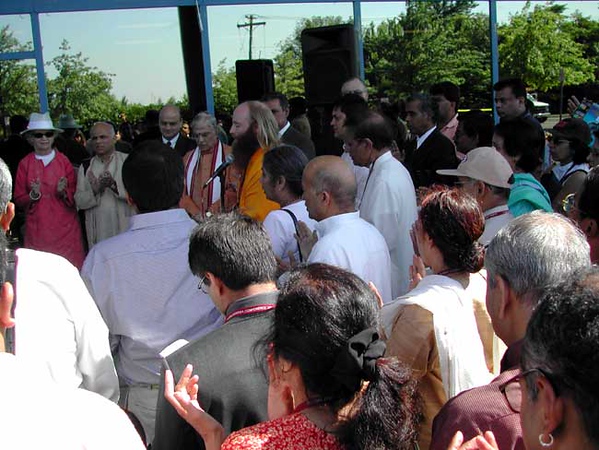
The Global Dharma Conference held in Edison, New Jersey, from July 25-27, 2003, was a unique religious conference. In fact, it was not a religious convention… it was all about our duties and values towards humanity.
A Rare Congregation
This momentous event—conceived, organized, and conducted by second-generation Indian youths, born and brought up in the USA (university students and budding professionals, mostly in the 18-30 age group)—was unique not only because of the kind of dignitaries and illustrious guest speakers it attracted, but also because of the multi-faceted aspects of ‘dharma’ it unfolded. The conference featured workshops, discussions, presentations, exhibitions, cultural and spiritual activities, including an international concert. Besides North American countries, there were youths from at least a dozen other countries, including Africa and Australia. It was one of those ‘wish-everybody-I-know-was-there’ kind of events. Almost all the (few thousand) delegates who attended the conference were simply overwhelmed by the sheer youthful energy and vibrancy that engulfed Raritan Expo Center and the nearby Sheraton Hotel, the venue of the parallel sessions.
A Galaxy of Speakers
The array of speakers was spectacular: H. H. Swami Dayananda Saraswati; Shri David Frawley, the American Vedantic scholar; Dr. Deepak Chopra; Dr. Mahesh Mehta; New Jersey Governor James McGreevey; Indian statesman Dr. Murali Manohar Joshi; Dr. Koenraad Elst, the Belgian historian; Dr. Subhash Kak; Dr. Kiran Bedi, the celebrated prison reformer; Andy Fraenkel of the multi-cultural stories network; Reuben Thuku, the East African philosopher; Mr. Bawa Jain, U.N. Secretary General of the World Peace Summit; Dr. George Sudarshan, Nobel Prize nominee; Rabbi Joseph Novick; Jonas Trinkunas, et al. In short, all non-proselytising faiths actively participated, including ‘Native American’ (Cherokee) and a European body representing 20 ancient religions. The Dalai Lama conveyed his blessings, and the Indian Prime Minister sent his best wishes for this grand get-together.
Day 1
The opening day gave an overview of what was to follow. Governor McGreevey acted as the ‘host’, delivering not the usual ‘one-size-fits-all’ political spiel, but a thought-provoking, eloquent speech on ‘Dharma’ and humanistic values. Dr. Deepak Chopra once again proved to be a marketing genius with his concoction of Eastern philosophy and modern science. He ended his speech with one of Tagore’s poems tuned to pop music, and the youths loved it! The inaugural day was followed by a night concert of Garba, Bhangra, and a performance by rap star ‘Apache Indian’.
Day 2
The second day was divided into four segments of multiple workshops emphasizing Dharma’s relevance to the individual, the family, society, and the world. At any given time block, the delegates had the choice of five concurrently running sessions. The topics were so varied, interesting, and informative that it was frustrating to miss one. Topics ranged from consciousness and quantum theory to rights vs. responsibility; worldwide commonality of ancient faiths; stress and conflict management; Vedic sciences; genetics; crime & punishment; Dharma & modern management, etc. Every session was overbooked!
Harmony Through Music
The international music concert on Day 2 was simply memorable. Titled “Harmony Through Music”, it had four distinct subtexts:
- “Dharma,” presented by a troupe from India and the famous ‘Shanti-Shanti’ American sisters.
- “Karma,” by a Houston-based theatre group.
- “Artha,” by Joseph Firecrow.
- “Moksha,” by Dr. Shanker and Gingger, double violinists with Ustaad Zakir Hussain and a local drummer, who brought the house down with their ecstatic rhythmic percussion.
Hollywood actress Goldie Hawn briefly appeared ‘live’ on the two giant screens to say ‘Hi’ via video conferencing.
Day 3
On the concluding day, the biggest surprise was the live address by the President of India, Dr. Abdul Kalam, again through video conferencing. This interactive session was a high point of the event and lasted 40 minutes.
Quotable Quotes
The essence of this conference was beautifully summed up by Dr. David Frawley and Swami Dayananda Saraswati. Dr. Frawley emphasized, “You don’t belong to any religion, but rather all religions belong to you.” Swami Dayananda said, “Dharma is nothing but a common-sense value structure for harmonious co-existence. We don’t need preachers (for that), we need teachers… there won’t be any need for ‘salvation’, ‘reconciliation’, or ‘peace’ if you don’t disturb people.” At the end, he asked people to repeat after him: “A ‘value’ is a ‘value’ when the value of ‘value’ is valuable to me.”
Youth Did It
The Dharma Conference was put together by many student and youth organizations, prominent among them being the Hindu Students’ Council. What was most remarkable was the way these youths, coming from different corners and avenues, worked together as one solid team. Nowhere was there any chaos, glitches, or emotional outbursts. This glorious conference was a tribute to their hard work and tenacity. The delegates are already asking: “When will we have it again?” This is enough compliment for Kanchan Banerjee, who was a prime force behind the whole show.
A Step Towards Vivekananda’s Noble Vision
Three years ago, when the U.N. convened a ‘World Peace Summit’ to resolve world conflicts through religious and spiritual guidance, it was, in a way, a manifestation of Swami Vivekananda’s vision of the world coming together in the spirit of ‘Universal Brotherhood’. The Global Dharma Conference is undoubtedly a step in that direction. One strong Hindu can change the thought-current of the whole world… Hindus should possess fearlessness, the first prerequisite of a spiritual life.